SUBSCRIBE TO OUR FREE NEWSLETTER
Daily news & progressive opinion—funded by the people, not the corporations—delivered straight to your inbox.
5
#000000
#FFFFFF
To donate by check, phone, or other method, see our More Ways to Give page.
Daily news & progressive opinion—funded by the people, not the corporations—delivered straight to your inbox.
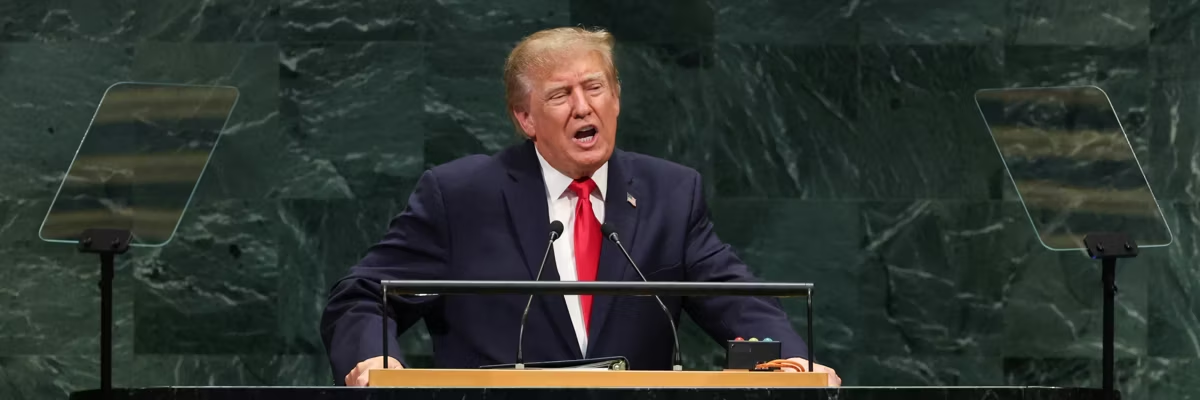
In directly challenging an international system that is arguably dead, his diatribe puts front and center the state of American decline on the global stage.
Hegemonic decline comes in many different forms. From the Roman empire to the Islamic caliphates of old, great powers of the world have repeatedly risen and collapsed under the weight of their excess. While the arc of human history and empire carry diverse experiences and paths, it is near the end of the imperial line that often sees some of humanity’s most volatile moments. Today, the United States represents the end of that line in a rapidly transforming world, with US President Donald Trump’s United Nations General Assembly speech embodying a challenge to the international system and the American decline accompanying and driving it.
To be sure, no one should be surprised by bombastic rhetoric at the UNGA’s annual gatherings. World leaders often use the international forum more as an opportunity to bolster their domestic image at home than for diplomacy and problem solving, as intended. This dynamic is understandable: As the adage goes, “All politics is local.”
Yet it is this exact cliché that makes Trump’s speech different.
The world understands the United States in this context: An empire at the height of its decline, hellbent on aggrandizement in a desperate attempt to grip what remains of its global primacy, even at the expense of the international system.
Approaching the UNGA podium on day one of the plenary session speeches by world leaders from countries like Brazil, Türkiye, and France, Trump understood his political position. The supposed leader of the free world, the American president is in his second and final term in the White House, which has reached a pinnacle moment that will define his legacy.
That moment and legacy are imperiled, if not already ruined. Trump’s sinking domestic approval rating, at its lowest across his two presidential terms, stems from a disastrous domestic and global economy hitting the working class and most vulnerable. His ongoing forever war with Iran and its allies in the Middle East with no end or direction drives those economic problems and the worsening polls.
As such, Trump finds himself underwater politically. His response has been clear: He is as stubborn as ever.
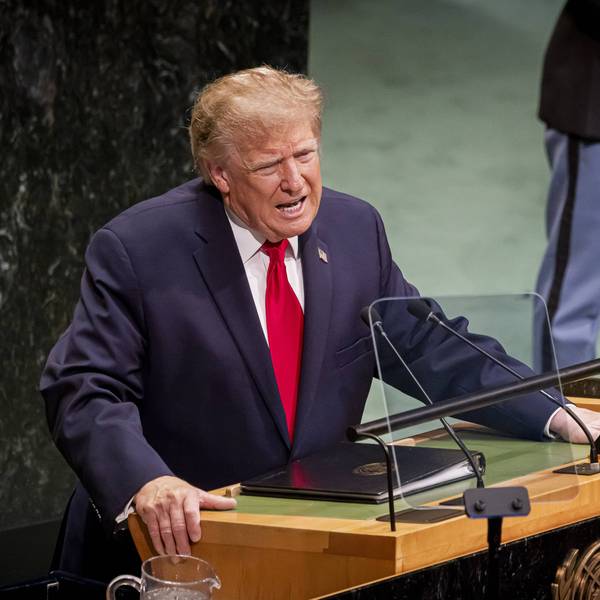
The president launched into a tirade at the UNGA. Opening with a statement that could understandably be confused for a stump speech on a campaign trail or rhetoric meant for the State of the Union, he boasted about his would-be accomplishments at home and abroad. Trump repeated his old lie that he has single-handedly ended multiple wars across the globe. He claimed to have saved the United States, kicking of a “Golden Age of America” while arguing that the country has never been stronger.
Yet it was his rhetoric on multiple American wars in 2026 that should speak. On Venezuela, Trump openly bragged about overthrowing a neighboring country to extract their natural resources—in this case, oil. He gloated about military strikes on alleged cartel boats in the Caribbean Sea, actions amounting to extrajudicial killings. He threatened military action against another neighbor—Cuba—in the near future.
If these boasts reflect a foreign policy disconnected from international law, then Trump’s comments on Iran mark an insult to humanity. In this regard, the American president openly used genocidal language to threaten the country he has taken the United States to war with for the last seven months, openly pondering: “Do I annihilate the Islamic Republic and do it quickly… Do I drive them into hell with no chance of survival and no hope of future greatness [f]or generations?”
To use such bombastic rhetoric at the UNGA—the heart of global diplomacy, even for all the UN’s warts—marks a new low for American leadership and foreign policy. In directly challenging an international system that is arguably dead, his diatribe puts front and center the state of American decline on the global stage.
These words represent the mindset of an American president who chose a war of aggression against a sovereign state without authorization from the US Congress, meaning American citizen approval, the UN Security Council, or any real international legal basis. These checks—largely cast aside in recent decades—exist with their own warts specifically because this war represents a strategic and humanitarian disaster, as have the wars of the past that informed the international legal system the world understands today.
Instead of leaning into concepts of diplomacy and humanity, playing a leading role in bringing nations together through diplomacy and in support of the principles of international law, the president of the United States has leaned deeper into imperial and interventionist desires, going so far as to hearken to a pre-World War II system of chaos in which the world operated on a simple rule: “To the winner goes the spoils.” Trump used this cliche when discussing American efforts to steal Venezuelan oil.
Instead of recognizing the pain that war, in no small part waged by US weapons and defended in the UNSC by American diplomats, Trump espoused the importance of it in perpetuity to fight some ill-defined “evil.” Instead of recognizing how the inertia of US foreign policy has become an illness for people at home and abroad alike that many akin to the true “evil,” he crowed on about war and violence as if they constitute abstract concepts and games, not real consequences for people around the globe.
The people of Minab, where American missiles hit a school full of children and teachers, killing over 150 civilians, would dispute the abstractness of American power and the giddy willingness to use it in such brutal fashion. Iranians writ large can and do contest the use of genocidal language against their country and civilization. The American people, tired of war amid major domestic problems at home, do not see strength in their president bragging about his would-be personal accomplishments abroad that reflect more of the same mistakes of the past.
People around the world did not see a man espousing American greatness at the UNGA. They witnessed a leader with immense power brag about his ability to cause unspeakable pain and suffering at will as his popularity at home collapses. This comes as the United States proves itself incapable of seriously using its position as a global power to enact real change for the better abroad. In fact, it uses that position in increasingly malign ways and has done so for years.
The world understands the United States in this context: An empire at the height of its decline, hellbent on aggrandizement in a desperate attempt to grip what remains of its global primacy, even at the expense of the international system.
From Ukraine to Gaza to Iran, the old world is regressing to a time before the international legal system was crafted in a way that proclaimed and systematized a simple term: “Never again.” While states will always act with raw power considerations and national interests in mind, the international system marked a valid and worthwhile attempt to temper humanity’s worst instincts. Trump and other leaders of the world, like Russia’s Vladimir Putin and Israel’s Benjamin Netanyahu, represent those worst instincts, explaining why they work to destroy ideals that ultimately improve the human experience—diplomacy, cooperation, development, and human rights.
The UNGA, despite Trump’s ramblings, can and should remind the world that these values matter, just as pure national interests can still be informed by such principles. Such an approach to foreign policy is not a contradiction as strength and humanism are not mutually exclusive. Instead, they must form the basis of how Washington and other capitals approach the world now and in the future.
Dear Common Dreams reader, It’s been nearly 30 years since I co-founded Common Dreams with my late wife, Lina Newhouser. We had the radical notion that journalism should serve the public good, not corporate profits. It was clear to us from the outset what it would take to build such a project. No paid advertisements. No corporate sponsors. No millionaire publisher telling us what to think or do. Many people said we wouldn't last a year, but we proved those doubters wrong. Together with a tremendous team of journalists and dedicated staff, we built an independent media outlet free from the constraints of profits and corporate control. Our mission has always been simple: To inform. To inspire. To ignite change for the common good. Building Common Dreams was not easy. Our survival was never guaranteed. When you take on the most powerful forces—Wall Street greed, fossil fuel industry destruction, Big Tech lobbyists, and uber-rich oligarchs who have spent billions upon billions rigging the economy and democracy in their favor—the only bulwark you have is supporters who believe in your work. But here’s the urgent message from me today. It's never been this bad out there. And it's never been this hard to keep us going. At the very moment Common Dreams is most needed, the threats we face are intensifying. We need your support now more than ever. We don't accept corporate advertising and never will. We don't have a paywall because we don't think people should be blocked from critical news based on their ability to pay. Everything we do is funded by the donations of readers like you. When everyone does the little they can afford, we are strong. But if that support retreats or dries up, so do we. Will you donate now to make sure Common Dreams not only survives but thrives? —Craig Brown, Co-founder |
Hegemonic decline comes in many different forms. From the Roman empire to the Islamic caliphates of old, great powers of the world have repeatedly risen and collapsed under the weight of their excess. While the arc of human history and empire carry diverse experiences and paths, it is near the end of the imperial line that often sees some of humanity’s most volatile moments. Today, the United States represents the end of that line in a rapidly transforming world, with US President Donald Trump’s United Nations General Assembly speech embodying a challenge to the international system and the American decline accompanying and driving it.
To be sure, no one should be surprised by bombastic rhetoric at the UNGA’s annual gatherings. World leaders often use the international forum more as an opportunity to bolster their domestic image at home than for diplomacy and problem solving, as intended. This dynamic is understandable: As the adage goes, “All politics is local.”
Yet it is this exact cliché that makes Trump’s speech different.
The world understands the United States in this context: An empire at the height of its decline, hellbent on aggrandizement in a desperate attempt to grip what remains of its global primacy, even at the expense of the international system.
Approaching the UNGA podium on day one of the plenary session speeches by world leaders from countries like Brazil, Türkiye, and France, Trump understood his political position. The supposed leader of the free world, the American president is in his second and final term in the White House, which has reached a pinnacle moment that will define his legacy.
That moment and legacy are imperiled, if not already ruined. Trump’s sinking domestic approval rating, at its lowest across his two presidential terms, stems from a disastrous domestic and global economy hitting the working class and most vulnerable. His ongoing forever war with Iran and its allies in the Middle East with no end or direction drives those economic problems and the worsening polls.
As such, Trump finds himself underwater politically. His response has been clear: He is as stubborn as ever.
The president launched into a tirade at the UNGA. Opening with a statement that could understandably be confused for a stump speech on a campaign trail or rhetoric meant for the State of the Union, he boasted about his would-be accomplishments at home and abroad. Trump repeated his old lie that he has single-handedly ended multiple wars across the globe. He claimed to have saved the United States, kicking of a “Golden Age of America” while arguing that the country has never been stronger.
Yet it was his rhetoric on multiple American wars in 2026 that should speak. On Venezuela, Trump openly bragged about overthrowing a neighboring country to extract their natural resources—in this case, oil. He gloated about military strikes on alleged cartel boats in the Caribbean Sea, actions amounting to extrajudicial killings. He threatened military action against another neighbor—Cuba—in the near future.
If these boasts reflect a foreign policy disconnected from international law, then Trump’s comments on Iran mark an insult to humanity. In this regard, the American president openly used genocidal language to threaten the country he has taken the United States to war with for the last seven months, openly pondering: “Do I annihilate the Islamic Republic and do it quickly… Do I drive them into hell with no chance of survival and no hope of future greatness [f]or generations?”
To use such bombastic rhetoric at the UNGA—the heart of global diplomacy, even for all the UN’s warts—marks a new low for American leadership and foreign policy. In directly challenging an international system that is arguably dead, his diatribe puts front and center the state of American decline on the global stage.
These words represent the mindset of an American president who chose a war of aggression against a sovereign state without authorization from the US Congress, meaning American citizen approval, the UN Security Council, or any real international legal basis. These checks—largely cast aside in recent decades—exist with their own warts specifically because this war represents a strategic and humanitarian disaster, as have the wars of the past that informed the international legal system the world understands today.
Instead of leaning into concepts of diplomacy and humanity, playing a leading role in bringing nations together through diplomacy and in support of the principles of international law, the president of the United States has leaned deeper into imperial and interventionist desires, going so far as to hearken to a pre-World War II system of chaos in which the world operated on a simple rule: “To the winner goes the spoils.” Trump used this cliche when discussing American efforts to steal Venezuelan oil.
Instead of recognizing the pain that war, in no small part waged by US weapons and defended in the UNSC by American diplomats, Trump espoused the importance of it in perpetuity to fight some ill-defined “evil.” Instead of recognizing how the inertia of US foreign policy has become an illness for people at home and abroad alike that many akin to the true “evil,” he crowed on about war and violence as if they constitute abstract concepts and games, not real consequences for people around the globe.
The people of Minab, where American missiles hit a school full of children and teachers, killing over 150 civilians, would dispute the abstractness of American power and the giddy willingness to use it in such brutal fashion. Iranians writ large can and do contest the use of genocidal language against their country and civilization. The American people, tired of war amid major domestic problems at home, do not see strength in their president bragging about his would-be personal accomplishments abroad that reflect more of the same mistakes of the past.
People around the world did not see a man espousing American greatness at the UNGA. They witnessed a leader with immense power brag about his ability to cause unspeakable pain and suffering at will as his popularity at home collapses. This comes as the United States proves itself incapable of seriously using its position as a global power to enact real change for the better abroad. In fact, it uses that position in increasingly malign ways and has done so for years.
The world understands the United States in this context: An empire at the height of its decline, hellbent on aggrandizement in a desperate attempt to grip what remains of its global primacy, even at the expense of the international system.
From Ukraine to Gaza to Iran, the old world is regressing to a time before the international legal system was crafted in a way that proclaimed and systematized a simple term: “Never again.” While states will always act with raw power considerations and national interests in mind, the international system marked a valid and worthwhile attempt to temper humanity’s worst instincts. Trump and other leaders of the world, like Russia’s Vladimir Putin and Israel’s Benjamin Netanyahu, represent those worst instincts, explaining why they work to destroy ideals that ultimately improve the human experience—diplomacy, cooperation, development, and human rights.
The UNGA, despite Trump’s ramblings, can and should remind the world that these values matter, just as pure national interests can still be informed by such principles. Such an approach to foreign policy is not a contradiction as strength and humanism are not mutually exclusive. Instead, they must form the basis of how Washington and other capitals approach the world now and in the future.
Hegemonic decline comes in many different forms. From the Roman empire to the Islamic caliphates of old, great powers of the world have repeatedly risen and collapsed under the weight of their excess. While the arc of human history and empire carry diverse experiences and paths, it is near the end of the imperial line that often sees some of humanity’s most volatile moments. Today, the United States represents the end of that line in a rapidly transforming world, with US President Donald Trump’s United Nations General Assembly speech embodying a challenge to the international system and the American decline accompanying and driving it.
To be sure, no one should be surprised by bombastic rhetoric at the UNGA’s annual gatherings. World leaders often use the international forum more as an opportunity to bolster their domestic image at home than for diplomacy and problem solving, as intended. This dynamic is understandable: As the adage goes, “All politics is local.”
Yet it is this exact cliché that makes Trump’s speech different.
The world understands the United States in this context: An empire at the height of its decline, hellbent on aggrandizement in a desperate attempt to grip what remains of its global primacy, even at the expense of the international system.
Approaching the UNGA podium on day one of the plenary session speeches by world leaders from countries like Brazil, Türkiye, and France, Trump understood his political position. The supposed leader of the free world, the American president is in his second and final term in the White House, which has reached a pinnacle moment that will define his legacy.
That moment and legacy are imperiled, if not already ruined. Trump’s sinking domestic approval rating, at its lowest across his two presidential terms, stems from a disastrous domestic and global economy hitting the working class and most vulnerable. His ongoing forever war with Iran and its allies in the Middle East with no end or direction drives those economic problems and the worsening polls.
As such, Trump finds himself underwater politically. His response has been clear: He is as stubborn as ever.
The president launched into a tirade at the UNGA. Opening with a statement that could understandably be confused for a stump speech on a campaign trail or rhetoric meant for the State of the Union, he boasted about his would-be accomplishments at home and abroad. Trump repeated his old lie that he has single-handedly ended multiple wars across the globe. He claimed to have saved the United States, kicking of a “Golden Age of America” while arguing that the country has never been stronger.
Yet it was his rhetoric on multiple American wars in 2026 that should speak. On Venezuela, Trump openly bragged about overthrowing a neighboring country to extract their natural resources—in this case, oil. He gloated about military strikes on alleged cartel boats in the Caribbean Sea, actions amounting to extrajudicial killings. He threatened military action against another neighbor—Cuba—in the near future.
If these boasts reflect a foreign policy disconnected from international law, then Trump’s comments on Iran mark an insult to humanity. In this regard, the American president openly used genocidal language to threaten the country he has taken the United States to war with for the last seven months, openly pondering: “Do I annihilate the Islamic Republic and do it quickly… Do I drive them into hell with no chance of survival and no hope of future greatness [f]or generations?”
To use such bombastic rhetoric at the UNGA—the heart of global diplomacy, even for all the UN’s warts—marks a new low for American leadership and foreign policy. In directly challenging an international system that is arguably dead, his diatribe puts front and center the state of American decline on the global stage.
These words represent the mindset of an American president who chose a war of aggression against a sovereign state without authorization from the US Congress, meaning American citizen approval, the UN Security Council, or any real international legal basis. These checks—largely cast aside in recent decades—exist with their own warts specifically because this war represents a strategic and humanitarian disaster, as have the wars of the past that informed the international legal system the world understands today.
Instead of leaning into concepts of diplomacy and humanity, playing a leading role in bringing nations together through diplomacy and in support of the principles of international law, the president of the United States has leaned deeper into imperial and interventionist desires, going so far as to hearken to a pre-World War II system of chaos in which the world operated on a simple rule: “To the winner goes the spoils.” Trump used this cliche when discussing American efforts to steal Venezuelan oil.
Instead of recognizing the pain that war, in no small part waged by US weapons and defended in the UNSC by American diplomats, Trump espoused the importance of it in perpetuity to fight some ill-defined “evil.” Instead of recognizing how the inertia of US foreign policy has become an illness for people at home and abroad alike that many akin to the true “evil,” he crowed on about war and violence as if they constitute abstract concepts and games, not real consequences for people around the globe.
The people of Minab, where American missiles hit a school full of children and teachers, killing over 150 civilians, would dispute the abstractness of American power and the giddy willingness to use it in such brutal fashion. Iranians writ large can and do contest the use of genocidal language against their country and civilization. The American people, tired of war amid major domestic problems at home, do not see strength in their president bragging about his would-be personal accomplishments abroad that reflect more of the same mistakes of the past.
People around the world did not see a man espousing American greatness at the UNGA. They witnessed a leader with immense power brag about his ability to cause unspeakable pain and suffering at will as his popularity at home collapses. This comes as the United States proves itself incapable of seriously using its position as a global power to enact real change for the better abroad. In fact, it uses that position in increasingly malign ways and has done so for years.
The world understands the United States in this context: An empire at the height of its decline, hellbent on aggrandizement in a desperate attempt to grip what remains of its global primacy, even at the expense of the international system.
From Ukraine to Gaza to Iran, the old world is regressing to a time before the international legal system was crafted in a way that proclaimed and systematized a simple term: “Never again.” While states will always act with raw power considerations and national interests in mind, the international system marked a valid and worthwhile attempt to temper humanity’s worst instincts. Trump and other leaders of the world, like Russia’s Vladimir Putin and Israel’s Benjamin Netanyahu, represent those worst instincts, explaining why they work to destroy ideals that ultimately improve the human experience—diplomacy, cooperation, development, and human rights.
The UNGA, despite Trump’s ramblings, can and should remind the world that these values matter, just as pure national interests can still be informed by such principles. Such an approach to foreign policy is not a contradiction as strength and humanism are not mutually exclusive. Instead, they must form the basis of how Washington and other capitals approach the world now and in the future.