5
#000000
#FFFFFF
To donate by check, phone, or other method, see our More Ways to Give page.
Daily news & progressive opinion—funded by the people, not the corporations—delivered straight to your inbox.
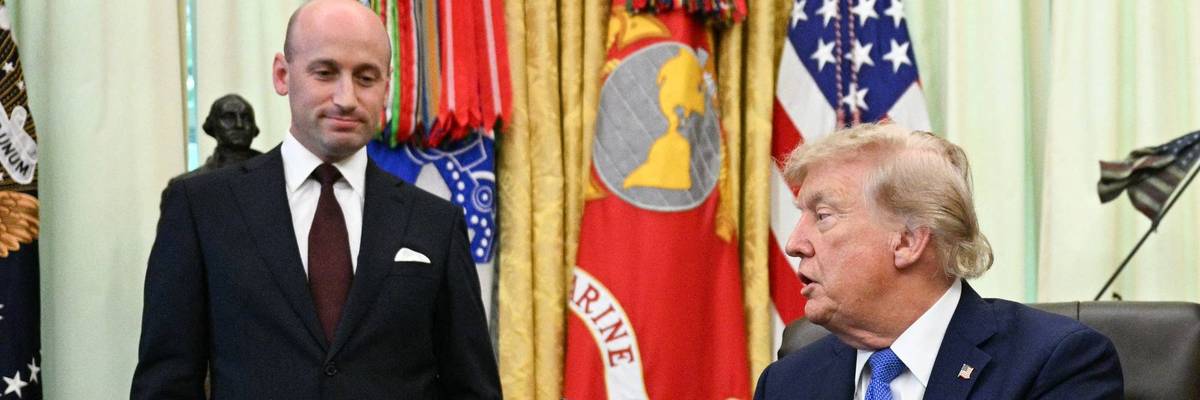
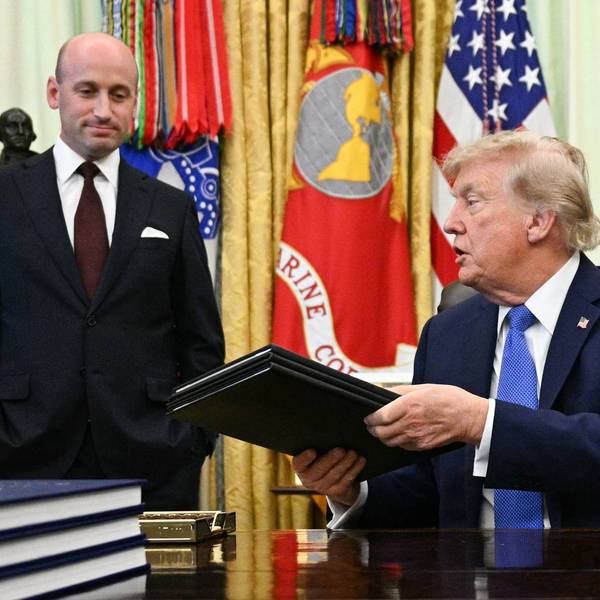
White House Deputy Chief of Staff Stephen Miller (L) smiles as US President Donald Trump holds signed executive orders in the Oval Office of the White House in Washington, DC, on August 6, 2026.
Although the origins of nativist thought in America continue to be instructive in the modern era, what is new is the degree to which those fears and anxieties have been stoked, amalgamated, exploited, and broadened to push what can only be called a neofascist agenda.
In 1955, the historian John Higham published his classic analysis of American nativism, Strangers in the Land. During the 19th and 20th centuries, nativist movements tapped into particular fears and ideas specific to the historical context, and Higham convincingly argued that there were three central roots—distinct from one another but, at times, overlapping—that fed “foreigner-hating” in the US.
Higham’s analysis still feels relevant, particularly as the United States continues to witness waves of nativism and, especially, as the central force behind the Trump administration’s immigration policy, Stephen Miller, has been promoted to the president’s chief of staff. (Miller’s foreigner hating has been carefully documented over the years, most notably in Jean Guerrero’s Hatemonger.) While Higham’s work is informative, the modern xenophobic milieu requires some updated, but complementary, explication. Historians explore both continuity and change, and these newer manifestations of foreigner hating capture both: recent anti-immigrant expressions harken back to Higham’s earlier patterns of American nativism and, simultaneously, have generated something relatively new, a least in the US.
Higham’s religiously based branch of nativism, often associated with the Know-Nothing Party—its slogan was “America for the Americans”—was initially directed at the Irish and German Catholics in the mid-1800s. Even after the demise of Know-Nothingism, however, religion and xenophobia again mixed and swept through the nation as large numbers of Catholics and Jews emigrated from Southern and Eastern Europe later in the 19th century.
Previous nativist movements and politicians’ exploitation of foreigner hating did not facilitate the development of a fascist movement that, ultimately, was able to control (and expand the power of) the executive branch of the government—as well as parts of the Congress—until now.
Anti-Catholic sentiment has not disappeared in the modern era—the lobbyist group US English’s WITAN memo that was leaked in the 1980s was rife with it—and polling suggests that antisemitism is again on the rise. Unsurprisingly, the nativism directed at Muslim immigrants and Muslim Americans since the terrorist attacks on September 11, 2001 has increased exponentially. Twenty-five years after 9/11, over 40% of Americans continue to hold negative opinions of Muslims in the US. At a recent campaign rally, for example, President Donald Trump stated that Abdul El-Sayed, the then-Democratic candidate for US Senate in Michigan, was a “jihadist lunatic that wants to destroy you.” (The previous month, Trump had used an antisemitic slur—the same one he used in 2025—at a rally in Kansas.)
Higham argued that economically based fears formed another root cause of nativism in the United States during the late-19th and early-20th centuries, notably fears related to depressions and the then-growing interest in “foreign” economic ideologies, such as socialism. The fiscal downturns in the 1870s and 1890s, for instance, provided a new justification for restricting programs for immigrants in some parts of the country, such as bilingual education in the public schools, while the fear of economic “radicalism” prompted an increased scrutiny of newcomers as they arrived on America’s shores, culminating with the first Red Scare in the aftermath of World War I.
Economically driven nativism, of course, is still with us today. Although not solely tied to immigrants, socialism is a boogeyman in US political discourse, with over half of Americans opposing the framework (the percent of those holding a favorable view has increased in recent years though). Financial crises continue to be a driver of nativism, so much so that the late sociologist Zygmunt Bauman argued that, as modern globalization disrupted fiscal stability, the anger many felt toward multinational corporations’ machinations—relocating factories to countries with minimal labor and environmental protections, etc.—was directed at immigrants because they were often the closest thing to a tangible “global force” on which people could focus their fury.
Perhaps most unsettling, Higham’s third source of nativism was rooted in the racial pseudoscience of the Progressive Era. This “science” spawned a hierarchy of ethnicities that unsurprisingly placed people of color on the bottom rungs and that also undergirded the Johnson-Reed Act of 1924, which greatly restricted immigration from Southern and Eastern Europe (from where, ironically, Stephen Miller’s ancestors emigrated). In the racialist thinking of the day, Italians, Russian Jews, and others were not only considered inferior to Northern and Western Europeans, but often were characterized as non-white.
Although eugenics and other forms of racist pseudoscience have been thoroughly debunked, many of the core beliefs and attitudes of that pattern of nativism have witnessed a resurgence in recent decades. White nationalists and “great replacement” conspiracy theorists’ numbers are growing, not only in the darkest corners of the internet, but also throughout mainstream culture and American politics. President Trump and Chief of Staff Miller both have promoted the replacement conspiracy—essentially an updated version of Madison Grant’s 1916 The Passing of the Great Race—and right-wing terrorists have used such ideologies and conspiracies as justifications for mass murder.
Although Higham’s origins of nativist thought in America continue to be instructive in the modern era, what is new, at least in the United States, is the degree to which those fears and anxieties have been stoked, amalgamated, exploited, and broadened by political actors to push what can only be called a neofascist agenda. After rejecting the label for years, Robert Paxton, one of the leading historians of fascism, concluded after the January 6, 2021, insurrection that Trumpism is, in fact, an American version of fascism. Trump’s inability to accept the 2020 election results and his encouragement of political violence to stop the certification makes one think of President Ronald Reagan’s opening remarks at his inauguration in 1981: “The orderly transfer of authority as called for in the Constitution routinely takes place... and few of us stop to think how unique we really are. In the eyes of many in the world, this... ceremony... is nothing less than a miracle.” As it turns out, Americans are not so unique.
Certainly, politicians have long tapped into a subset of Americans’ fears of immigrants, socialism, and the decline of the “white race” to advance their policies and careers, Joseph McCarthy, George Wallace, and Pat Buchanan being some of the most prominent. Yet, the previous nativist movements and politicians’ exploitation of foreigner hating did not facilitate the development of a fascist movement that, ultimately, was able to control (and expand the power of) the executive branch of the government—as well as parts of the Congress—until now.
The fundamental fascist aim of “internal cleansing” has been in full swing during the second Trump administration, with nativism and other forms of prejudice playing a central role in that purge. The administration’s fueling of xenophobia ensured that those who have recent roots in other parts of the world feel unwelcome, as well as those who have the “wrong” skin tone, gender, political views, sexual orientation, religion, or mother tongue. The result has been a dramatic narrowing of those who count as “real” Americans. These “disappearing citizens”—as scholars Christopher Robbins and Eric Ferris have called those who have been pushed aside by the current regime—had their say on November 3, 2026, and resoundingly repudiated the administration’s fascist agenda, along with the nativism, corruption, and cruelty upon which it was built.
This country and this world are at a monumental crossroads. US voters have an opportunity to beat back the forces of fascism and confront the billionaires who are rigging the economy, our media system, and our democracy, making it increasingly impossible for ordinary people to get by. We’re not just talking about the election. We’re talking about what must be done once these fascist elements are vanquished from power. We need a bolder set of solutions than what either major party has so far been willing to offer and a working-class movement ready to fight like hell for it. Trump didn't emerge from nowhere. The conditions that fueled MAGA authoritarianism were created by decades of radical neoliberal economic policies and a corrupt political system dominated by corporate interests. They slashed taxes on the super-rich, promising that the benefits would trickle down. They said giveaways to the corporate titans would make life more affordable for the rest of us. It was all bullshit. And when a bitter, betrayed populace searches for someone to blame, right-wing demagogues have little trouble finding scapegoats. People know when they're being lied to, but you won't hear any of this from the corporate media. Only independent journalism—powered and funded by people who believe in building a better world—can deliver truly trustworthy daily news. If you share our vision, please contribute whatever you can to sustain our work. |
In 1955, the historian John Higham published his classic analysis of American nativism, Strangers in the Land. During the 19th and 20th centuries, nativist movements tapped into particular fears and ideas specific to the historical context, and Higham convincingly argued that there were three central roots—distinct from one another but, at times, overlapping—that fed “foreigner-hating” in the US.
Higham’s analysis still feels relevant, particularly as the United States continues to witness waves of nativism and, especially, as the central force behind the Trump administration’s immigration policy, Stephen Miller, has been promoted to the president’s chief of staff. (Miller’s foreigner hating has been carefully documented over the years, most notably in Jean Guerrero’s Hatemonger.) While Higham’s work is informative, the modern xenophobic milieu requires some updated, but complementary, explication. Historians explore both continuity and change, and these newer manifestations of foreigner hating capture both: recent anti-immigrant expressions harken back to Higham’s earlier patterns of American nativism and, simultaneously, have generated something relatively new, a least in the US.
Higham’s religiously based branch of nativism, often associated with the Know-Nothing Party—its slogan was “America for the Americans”—was initially directed at the Irish and German Catholics in the mid-1800s. Even after the demise of Know-Nothingism, however, religion and xenophobia again mixed and swept through the nation as large numbers of Catholics and Jews emigrated from Southern and Eastern Europe later in the 19th century.
Previous nativist movements and politicians’ exploitation of foreigner hating did not facilitate the development of a fascist movement that, ultimately, was able to control (and expand the power of) the executive branch of the government—as well as parts of the Congress—until now.
Anti-Catholic sentiment has not disappeared in the modern era—the lobbyist group US English’s WITAN memo that was leaked in the 1980s was rife with it—and polling suggests that antisemitism is again on the rise. Unsurprisingly, the nativism directed at Muslim immigrants and Muslim Americans since the terrorist attacks on September 11, 2001 has increased exponentially. Twenty-five years after 9/11, over 40% of Americans continue to hold negative opinions of Muslims in the US. At a recent campaign rally, for example, President Donald Trump stated that Abdul El-Sayed, the then-Democratic candidate for US Senate in Michigan, was a “jihadist lunatic that wants to destroy you.” (The previous month, Trump had used an antisemitic slur—the same one he used in 2025—at a rally in Kansas.)
Higham argued that economically based fears formed another root cause of nativism in the United States during the late-19th and early-20th centuries, notably fears related to depressions and the then-growing interest in “foreign” economic ideologies, such as socialism. The fiscal downturns in the 1870s and 1890s, for instance, provided a new justification for restricting programs for immigrants in some parts of the country, such as bilingual education in the public schools, while the fear of economic “radicalism” prompted an increased scrutiny of newcomers as they arrived on America’s shores, culminating with the first Red Scare in the aftermath of World War I.
Economically driven nativism, of course, is still with us today. Although not solely tied to immigrants, socialism is a boogeyman in US political discourse, with over half of Americans opposing the framework (the percent of those holding a favorable view has increased in recent years though). Financial crises continue to be a driver of nativism, so much so that the late sociologist Zygmunt Bauman argued that, as modern globalization disrupted fiscal stability, the anger many felt toward multinational corporations’ machinations—relocating factories to countries with minimal labor and environmental protections, etc.—was directed at immigrants because they were often the closest thing to a tangible “global force” on which people could focus their fury.
Perhaps most unsettling, Higham’s third source of nativism was rooted in the racial pseudoscience of the Progressive Era. This “science” spawned a hierarchy of ethnicities that unsurprisingly placed people of color on the bottom rungs and that also undergirded the Johnson-Reed Act of 1924, which greatly restricted immigration from Southern and Eastern Europe (from where, ironically, Stephen Miller’s ancestors emigrated). In the racialist thinking of the day, Italians, Russian Jews, and others were not only considered inferior to Northern and Western Europeans, but often were characterized as non-white.
Although eugenics and other forms of racist pseudoscience have been thoroughly debunked, many of the core beliefs and attitudes of that pattern of nativism have witnessed a resurgence in recent decades. White nationalists and “great replacement” conspiracy theorists’ numbers are growing, not only in the darkest corners of the internet, but also throughout mainstream culture and American politics. President Trump and Chief of Staff Miller both have promoted the replacement conspiracy—essentially an updated version of Madison Grant’s 1916 The Passing of the Great Race—and right-wing terrorists have used such ideologies and conspiracies as justifications for mass murder.
Although Higham’s origins of nativist thought in America continue to be instructive in the modern era, what is new, at least in the United States, is the degree to which those fears and anxieties have been stoked, amalgamated, exploited, and broadened by political actors to push what can only be called a neofascist agenda. After rejecting the label for years, Robert Paxton, one of the leading historians of fascism, concluded after the January 6, 2021, insurrection that Trumpism is, in fact, an American version of fascism. Trump’s inability to accept the 2020 election results and his encouragement of political violence to stop the certification makes one think of President Ronald Reagan’s opening remarks at his inauguration in 1981: “The orderly transfer of authority as called for in the Constitution routinely takes place... and few of us stop to think how unique we really are. In the eyes of many in the world, this... ceremony... is nothing less than a miracle.” As it turns out, Americans are not so unique.
Certainly, politicians have long tapped into a subset of Americans’ fears of immigrants, socialism, and the decline of the “white race” to advance their policies and careers, Joseph McCarthy, George Wallace, and Pat Buchanan being some of the most prominent. Yet, the previous nativist movements and politicians’ exploitation of foreigner hating did not facilitate the development of a fascist movement that, ultimately, was able to control (and expand the power of) the executive branch of the government—as well as parts of the Congress—until now.
The fundamental fascist aim of “internal cleansing” has been in full swing during the second Trump administration, with nativism and other forms of prejudice playing a central role in that purge. The administration’s fueling of xenophobia ensured that those who have recent roots in other parts of the world feel unwelcome, as well as those who have the “wrong” skin tone, gender, political views, sexual orientation, religion, or mother tongue. The result has been a dramatic narrowing of those who count as “real” Americans. These “disappearing citizens”—as scholars Christopher Robbins and Eric Ferris have called those who have been pushed aside by the current regime—had their say on November 3, 2026, and resoundingly repudiated the administration’s fascist agenda, along with the nativism, corruption, and cruelty upon which it was built.