SUBSCRIBE TO OUR FREE NEWSLETTER
Daily news & progressive opinion—funded by the people, not the corporations—delivered straight to your inbox.
5
#000000
#FFFFFF
To donate by check, phone, or other method, see our More Ways to Give page.
Daily news & progressive opinion—funded by the people, not the corporations—delivered straight to your inbox.
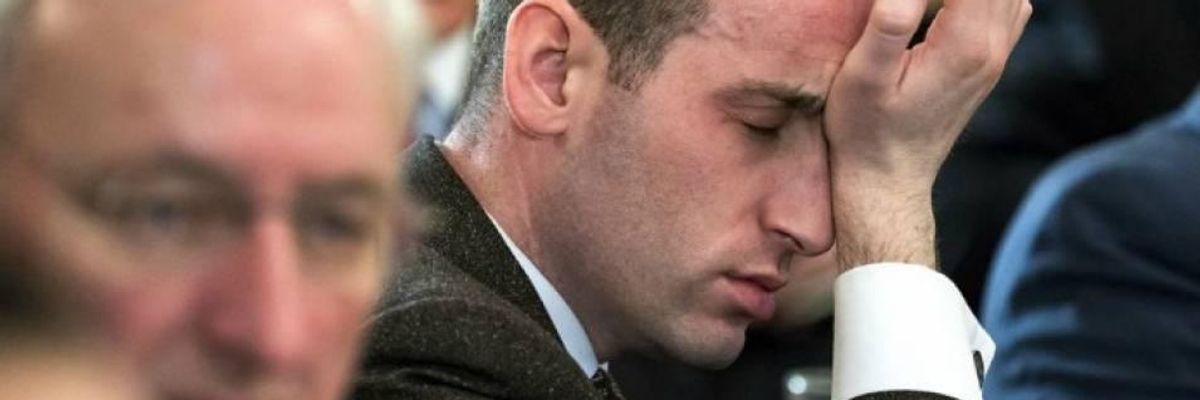
President Donald Trump's senior adviser Stephen Miller rubs his eyes during a meeting at the White House on Feb. 26. (Photo: Jim Lo Scalzo/European Pressphoto Agency)
Recounting their own family's history as immigrants from eastern Europe at the beginning of the 20th century, the uncle of Stephen Miller, one of the President's Donald Trump's top aides and the chief architect of the administration's hateful immigration agenda, has written a scathing op-ed in which he publicly confesses "his dismay and increasing horror" at the role his nephew has played in implementing the president's xenophobic and cruel border policies.
"Trump and my nephew both know their immigrant and refugee roots. Yet, they repeat the insults and false accusations of earlier generations against these refugees to make them seem less than human."
--David S. Glosser, uncle of Stephen MillerPublished in Politico on Monday, the piece by David S. Glosser--a retired neuropsychologist and the brother of Stephen's mother, Miriam Miller--begins by offering a detailed account of how his forebears fled what their home city of Antopol, in what is now Belarus, amid anti-Jewish pogroms and increased threats to their lives. His great-grandfather, Wolf-Leib Glosser, made his way to the United States, near penniless, but was able to forge a living and ultimately bring over more family members.
However, Glosser writes, "I have watched with dismay and increasing horror as my nephew, who is an educated man and well aware of his heritage, has become the architect of immigration policies that repudiate the very foundation of our family's life in this country."
He continues:
I shudder at the thought of what would have become of the Glossers had the same policies Stephen so coolly espouses-- the travel ban, the radical decrease in refugees, the separation of children from their parents, and even talk of limiting citizenship for legal immigrants-- been in effect when Wolf-Leib made his desperate bid for freedom. The Glossers came to the U.S. just a few years before the fear and prejudice of the "America First" nativists of the day closed U.S. borders to Jewish refugees. Had Wolf-Leib waited, his family would likely have been murdered by the Nazis along with all but seven of the 2,000 Jews who remained in Antopol. I would encourage Stephen to ask himself if the chanting, torch-bearing Nazis of Charlottesville, whose support his boss seems to court so cavalierly, do not envision a similar fate for him.
While Glosser said his family's history as Jewish immigrants was not free of bigotry or struggle, he argues that U.S. institutions and culture for the most part allowed his ancestors to be "left alone to live our lives and build the American dream."
Such hopeful outcomes for immigrants and their family members, he laments, are now under threat due to his nephew and the powerful boss he works for.
"Acting for so long in the theater of right wing politics, Stephen and Trump may have become numb to the resultant human tragedy and blind to the hypocrisy of their policy decisions," Glosser writes.
As a volunteer at a center that offers assistance to newly-arrived immigrants and refugees in Philadelphia, Miller's uncle paints a picture of one man he recently met there with the hope his nephew "might recognize elements of our shared heritage." He describes a Coptic Christian from Eritrea who was forced to flee violence and persecution in his home country, but who has been able--like the Glossers of last century--to make a home for him and his family in America.
"His story, though unique in its particulars, is by no means unusual," Glosser writes. "I have met Central Americans fleeing corrupt governments, violence and criminal extortion; a Yemeni woman unable to return to her war-ravaged home country and fearing sexual mutilation if she goes back to her Saudi husband; and an escaped kidnap-bride from central Asia."
Both the president, he added, and "my nephew both know their immigrant and refugee roots. Yet, they repeat the insults and false accusations of earlier generations against these refugees to make them seem less than human."
Dear Common Dreams reader, It’s been nearly 30 years since I co-founded Common Dreams with my late wife, Lina Newhouser. We had the radical notion that journalism should serve the public good, not corporate profits. It was clear to us from the outset what it would take to build such a project. No paid advertisements. No corporate sponsors. No millionaire publisher telling us what to think or do. Many people said we wouldn't last a year, but we proved those doubters wrong. Together with a tremendous team of journalists and dedicated staff, we built an independent media outlet free from the constraints of profits and corporate control. Our mission has always been simple: To inform. To inspire. To ignite change for the common good. Building Common Dreams was not easy. Our survival was never guaranteed. When you take on the most powerful forces—Wall Street greed, fossil fuel industry destruction, Big Tech lobbyists, and uber-rich oligarchs who have spent billions upon billions rigging the economy and democracy in their favor—the only bulwark you have is supporters who believe in your work. But here’s the urgent message from me today. It's never been this bad out there. And it's never been this hard to keep us going. At the very moment Common Dreams is most needed, the threats we face are intensifying. We need your support now more than ever. We don't accept corporate advertising and never will. We don't have a paywall because we don't think people should be blocked from critical news based on their ability to pay. Everything we do is funded by the donations of readers like you. When everyone does the little they can afford, we are strong. But if that support retreats or dries up, so do we. Will you donate now to make sure Common Dreams not only survives but thrives? —Craig Brown, Co-founder |
Recounting their own family's history as immigrants from eastern Europe at the beginning of the 20th century, the uncle of Stephen Miller, one of the President's Donald Trump's top aides and the chief architect of the administration's hateful immigration agenda, has written a scathing op-ed in which he publicly confesses "his dismay and increasing horror" at the role his nephew has played in implementing the president's xenophobic and cruel border policies.
"Trump and my nephew both know their immigrant and refugee roots. Yet, they repeat the insults and false accusations of earlier generations against these refugees to make them seem less than human."
--David S. Glosser, uncle of Stephen MillerPublished in Politico on Monday, the piece by David S. Glosser--a retired neuropsychologist and the brother of Stephen's mother, Miriam Miller--begins by offering a detailed account of how his forebears fled what their home city of Antopol, in what is now Belarus, amid anti-Jewish pogroms and increased threats to their lives. His great-grandfather, Wolf-Leib Glosser, made his way to the United States, near penniless, but was able to forge a living and ultimately bring over more family members.
However, Glosser writes, "I have watched with dismay and increasing horror as my nephew, who is an educated man and well aware of his heritage, has become the architect of immigration policies that repudiate the very foundation of our family's life in this country."
He continues:
I shudder at the thought of what would have become of the Glossers had the same policies Stephen so coolly espouses-- the travel ban, the radical decrease in refugees, the separation of children from their parents, and even talk of limiting citizenship for legal immigrants-- been in effect when Wolf-Leib made his desperate bid for freedom. The Glossers came to the U.S. just a few years before the fear and prejudice of the "America First" nativists of the day closed U.S. borders to Jewish refugees. Had Wolf-Leib waited, his family would likely have been murdered by the Nazis along with all but seven of the 2,000 Jews who remained in Antopol. I would encourage Stephen to ask himself if the chanting, torch-bearing Nazis of Charlottesville, whose support his boss seems to court so cavalierly, do not envision a similar fate for him.
While Glosser said his family's history as Jewish immigrants was not free of bigotry or struggle, he argues that U.S. institutions and culture for the most part allowed his ancestors to be "left alone to live our lives and build the American dream."
Such hopeful outcomes for immigrants and their family members, he laments, are now under threat due to his nephew and the powerful boss he works for.
"Acting for so long in the theater of right wing politics, Stephen and Trump may have become numb to the resultant human tragedy and blind to the hypocrisy of their policy decisions," Glosser writes.
As a volunteer at a center that offers assistance to newly-arrived immigrants and refugees in Philadelphia, Miller's uncle paints a picture of one man he recently met there with the hope his nephew "might recognize elements of our shared heritage." He describes a Coptic Christian from Eritrea who was forced to flee violence and persecution in his home country, but who has been able--like the Glossers of last century--to make a home for him and his family in America.
"His story, though unique in its particulars, is by no means unusual," Glosser writes. "I have met Central Americans fleeing corrupt governments, violence and criminal extortion; a Yemeni woman unable to return to her war-ravaged home country and fearing sexual mutilation if she goes back to her Saudi husband; and an escaped kidnap-bride from central Asia."
Both the president, he added, and "my nephew both know their immigrant and refugee roots. Yet, they repeat the insults and false accusations of earlier generations against these refugees to make them seem less than human."
Recounting their own family's history as immigrants from eastern Europe at the beginning of the 20th century, the uncle of Stephen Miller, one of the President's Donald Trump's top aides and the chief architect of the administration's hateful immigration agenda, has written a scathing op-ed in which he publicly confesses "his dismay and increasing horror" at the role his nephew has played in implementing the president's xenophobic and cruel border policies.
"Trump and my nephew both know their immigrant and refugee roots. Yet, they repeat the insults and false accusations of earlier generations against these refugees to make them seem less than human."
--David S. Glosser, uncle of Stephen MillerPublished in Politico on Monday, the piece by David S. Glosser--a retired neuropsychologist and the brother of Stephen's mother, Miriam Miller--begins by offering a detailed account of how his forebears fled what their home city of Antopol, in what is now Belarus, amid anti-Jewish pogroms and increased threats to their lives. His great-grandfather, Wolf-Leib Glosser, made his way to the United States, near penniless, but was able to forge a living and ultimately bring over more family members.
However, Glosser writes, "I have watched with dismay and increasing horror as my nephew, who is an educated man and well aware of his heritage, has become the architect of immigration policies that repudiate the very foundation of our family's life in this country."
He continues:
I shudder at the thought of what would have become of the Glossers had the same policies Stephen so coolly espouses-- the travel ban, the radical decrease in refugees, the separation of children from their parents, and even talk of limiting citizenship for legal immigrants-- been in effect when Wolf-Leib made his desperate bid for freedom. The Glossers came to the U.S. just a few years before the fear and prejudice of the "America First" nativists of the day closed U.S. borders to Jewish refugees. Had Wolf-Leib waited, his family would likely have been murdered by the Nazis along with all but seven of the 2,000 Jews who remained in Antopol. I would encourage Stephen to ask himself if the chanting, torch-bearing Nazis of Charlottesville, whose support his boss seems to court so cavalierly, do not envision a similar fate for him.
While Glosser said his family's history as Jewish immigrants was not free of bigotry or struggle, he argues that U.S. institutions and culture for the most part allowed his ancestors to be "left alone to live our lives and build the American dream."
Such hopeful outcomes for immigrants and their family members, he laments, are now under threat due to his nephew and the powerful boss he works for.
"Acting for so long in the theater of right wing politics, Stephen and Trump may have become numb to the resultant human tragedy and blind to the hypocrisy of their policy decisions," Glosser writes.
As a volunteer at a center that offers assistance to newly-arrived immigrants and refugees in Philadelphia, Miller's uncle paints a picture of one man he recently met there with the hope his nephew "might recognize elements of our shared heritage." He describes a Coptic Christian from Eritrea who was forced to flee violence and persecution in his home country, but who has been able--like the Glossers of last century--to make a home for him and his family in America.
"His story, though unique in its particulars, is by no means unusual," Glosser writes. "I have met Central Americans fleeing corrupt governments, violence and criminal extortion; a Yemeni woman unable to return to her war-ravaged home country and fearing sexual mutilation if she goes back to her Saudi husband; and an escaped kidnap-bride from central Asia."
Both the president, he added, and "my nephew both know their immigrant and refugee roots. Yet, they repeat the insults and false accusations of earlier generations against these refugees to make them seem less than human."