SUBSCRIBE TO OUR FREE NEWSLETTER
Daily news & progressive opinion—funded by the people, not the corporations—delivered straight to your inbox.
5
#000000
#FFFFFF
To donate by check, phone, or other method, see our More Ways to Give page.
Daily news & progressive opinion—funded by the people, not the corporations—delivered straight to your inbox.
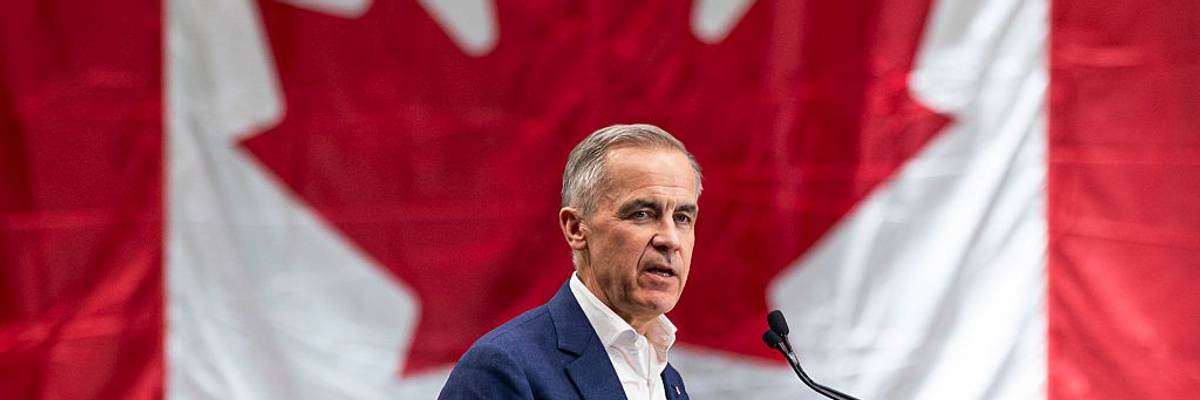
Prime Minister of Canada and Liberal Party Leader Mark Carney delivers a speech to supporters during a rally on April 23, 2025 in Surrey, Canada.
Ottawa wants Canadians to believe that a new era of strategic independence is underway, but the trade measures increasingly look performative, while the surge in military spending risks doing little to reduce Canada’s underlying dependence on the United States.
There is something almost admirable about the Canadian government’s ability to respond to an American provocation with precisely the right number of carefully selected adjectives. Washington imposes tariffs. Ottawa expresses deep disappointment. Washington threatens Canadian sovereignty. Ottawa says the relationship is changing. Washington escalates again. Ottawa announces that Canada is entering a new era. Then everyone goes home.
The problem is no longer simply that Canada’s foreign policy is too cautious. It increasingly appears to have no direction at all. Ottawa responds to American provocations with carefully worded statements, measured diplomatic language and assurances. But underneath the polished rhetoric there is no clear moral compass, little strategic spine and, most importantly, remarkably little follow-through. Canada continues to drift like seaweed, bending with every current while insisting that it is still steering the boat.
The recent tariffs should have been a wake-up call. They exposed the extraordinary vulnerability of a country whose economic fortunes are so deeply tied to a neighbor that increasingly treats trade as an instrument of coercion. The threats to Canadian sovereignty should have made the lesson even clearer: Economic integration is no guarantee of political goodwill, and decades of unquestioned alignment do not necessarily buy Canada respect or security. Canadian Prime Minister Mark Carney himself recognized the changing environment when he spoke of a world in which economic integration could be weaponized. Yet, Canada’s answer has been to dress up token diversification as strategic independence while continuing to bend to Washington on matters far beyond trade.
Cheerleading American military interventions and then dressing up Trump's annihilation rhetoric as merely the language of war is not buying Canada any goodwill in Washington.
Tariff by tariff, Ottawa has responded with declarations of retaliation and resilience. Canada announced trade missions, new partnerships, investment initiatives, and efforts to expand access to markets beyond the United States. These are bombarded as evidence that the country is moving toward a more diversified and resilient economy.
There is some truth to that, yes. The US share of Canadian merchandise exports did fall from 75.9% in 2024 to 71.7% in 2025, and while exports to countries outside the United States rose 17.2%, that headline figure conceals the limits of the transformation. Global Affairs Canada reports that the growth in non-US exports was driven largely by an exceptional increase in gold exports, with gold exports rising by $14.1 billion in 2025. The increase was driven by a 45.2% rise in gold prices, while gold export volumes actually fell 6.3%. In other words, what Ottawa can present as evidence of diversification was substantially boosted by a gold-price windfall, not simply by Canadian businesses dramatically expanding into new international markets. And among Canadian exporters whose US sales declined, most did not significantly expand sales into non-US markets.
That is not exactly the economic equivalent of escaping Washington’s orbit. It is more like rearranging the deck chairs and announcing that the ship has changed direction. Canada can announce trade missions, negotiations, and investment funds. But such announcements are not diversified supply chains. They are not new markets. They are not industrial capacity. After the magnitude of America’s pressure on Canada, the question should not be whether diversification has started. It should be whether Canada has diversified enough to reduce the vulnerability that Ottawa itself says exists. It hasn’t.
The contradiction becomes even harder to ignore when we look at defense. Canada is dramatically increasing military spending while remaining deeply embedded in a security architecture dominated by the United States. Canada plans to acquire 88 F-35 fighter aircraft at an acquisition cost of approximately $27.7 billion, with the initial Canadian aircraft scheduled to be based at Luke Air Force Base in Arizona for training. This is not at all an isolated procurement decision but part of a deeply integrated military relationship. Already, NORAD links the two countries’ air defense systems, making their military architecture deeply intertwined. Canada is consistently embedding its defense posture in a security architecture overwhelmingly shaped by the United States.
So to sum up, Canada has not escaped its dependence, either economically or militarily. It has barely moved the needle. And more importantly, it does not appear intent on doing so. Ottawa wants Canadians to believe that a new era of strategic independence is underway, but the trade measures increasingly look performative, while the surge in military spending risks doing little to reduce Canada’s underlying dependence on the United States. And if the recent United Nations General Assembly is any indication, the Carney-Anand duo has not merely failed to distance itself from Washington's military adventures. It has doubled down on its political and diplomatic alignment with them.
In his latest speech at the UN, Carney called Iran “one of the greatest threats in the current world” and described it as an “existential threat to Israel and its allies.” When asked about US President Donald Trump’s threats to annihilate or destroy Iran, he simply responded with “Well, there is a war underway, and he’s speaking the language of war.” He might as well have said, “Boys will be boys.” This time, Ottawa did not even seem interested in trying to sound politically correct. Foreign Minister Anita Anand was even more categorical. At the United Nations General Assembly, she declared: “Iran is the principal threat to peace and security in its region… Its threats to navigation rights in the Strait of Hormuz are a direct affront to international law.”
Ever since the United States and Israel launched their illegitimate war on Iran on February 28, which has already killed around 3,500 people and displaced over 3.2 million people and counting, Carney’s government continued to express support. Canada has spent months issuing statements condemning Iran, sanctioning hundreds of individuals and entities, and diplomatically isolating Tehran. Last week, Anita Anand announced sanctions against another five individuals and five entities under Canada’s Special Economic Measures (Iran) Regulations. This is where Canada’s claim to an independent foreign policy begins to look increasingly hollow. You do not need to go to Georgetown to understand what appeasement looks like. You simply need to watch Ottawa's foreign policy unfold across Gaza, the West Bank, Lebanon, Cuba, Venezuela, and now Iran. The pattern is remarkably consistent. Every single time the United States goes about their military adventurism, Canada unflinchingly finds diplomatic language to accommodate it. And the performative language of rules-based international order just whimpers out of the vocabulary.
But this time, at the UN General Assembly, Carney and his foreign minister were effectively going above and beyond, doing the public-relations work of explaining away Trump's language better than any McKinsey consultant could have managed. Canada does not merely follow Washington. Increasingly, it appears to anticipate what Washington wants and adjust its own language accordingly. The result is a foreign policy that is forceful toward countries Washington opposes while remarkably accommodating toward the power whose military, economic, and political leverage constrains Canada's choices.
And this is where the absurdity of the strategy becomes difficult to ignore. Canada has been hit with tariff after tariff, threatened over its sovereignty, and repeatedly reminded that Washington is willing to weaponize the very economic relationship on which Canada depends. Yet Ottawa continues to cower before Washington while backing its military adventures and accommodating its rhetoric. Stupidity, as the old saying goes, is doing the same thing repeatedly and expecting a different outcome. If decades of deference were supposed to buy Canada security, goodwill, or protection from American coercion, the tariffs should have demonstrated by now that the strategy has failed. Instead, Ottawa appears determined to double down.
Perhaps in a parallel universe, Canada has the courage to stand up to the United States and develop a genuinely independent foreign policy. But this is not that universe. This is Canada in which Mark Carney is prime minister and Anita Anand is foreign minister. Canada was given a wake-up call. The tariffs exposed the danger of economic dependence. The threats to Canadian sovereignty exposed the limits of political complacency. The wars and conflicts surrounding Canada's foreign policy exposed the limits of strategic independence. Ottawa's answer has been to diversify a little, spend billions on American-linked defense systems, issue carefully calibrated statements, and continue moving in Washington's direction.
Perhaps expecting this government to have the conscience to call a genocide a genocide; call for a ceasefire in Iran, Gaza, or Lebanon; or demand an end to the US blockade of Cuba is wishful thinking. But repeated tariffs and threats to Canadian sovereignty should at least force Ottawa to wake up to the obvious: Cheerleading American military interventions and then dressing up Trump's annihilation rhetoric as merely the language of war is not buying Canada any goodwill in Washington.
Nor is it reflecting the views of the Canadians this government claims to represent and hopes to win over at the next election. A clear majority of Canadians have opposed the US military action against Iran and, with every passing day, Canadians have also become increasingly critical of Israel's conduct in Gaza, with polls showing substantial support for describing Israel’s actions as genocide. Perhaps, then, after tariff after tariff, Ottawa might finally realize that subservience is not a foreign-policy strategy. So if there is any silver lining to this prolonged humiliation, it may be that Carney might be finally forced to rethink Canada's relationship with the United States and begin divesting from that dependence. Maybe it is time to stop guessing what Washington wants, stop parroting its justifications, and start listening to the Canadians this government claims to represent.
Dear Common Dreams reader, It’s been nearly 30 years since I co-founded Common Dreams with my late wife, Lina Newhouser. We had the radical notion that journalism should serve the public good, not corporate profits. It was clear to us from the outset what it would take to build such a project. No paid advertisements. No corporate sponsors. No millionaire publisher telling us what to think or do. Many people said we wouldn't last a year, but we proved those doubters wrong. Together with a tremendous team of journalists and dedicated staff, we built an independent media outlet free from the constraints of profits and corporate control. Our mission has always been simple: To inform. To inspire. To ignite change for the common good. Building Common Dreams was not easy. Our survival was never guaranteed. When you take on the most powerful forces—Wall Street greed, fossil fuel industry destruction, Big Tech lobbyists, and uber-rich oligarchs who have spent billions upon billions rigging the economy and democracy in their favor—the only bulwark you have is supporters who believe in your work. But here’s the urgent message from me today. It's never been this bad out there. And it's never been this hard to keep us going. At the very moment Common Dreams is most needed, the threats we face are intensifying. We need your support now more than ever. We don't accept corporate advertising and never will. We don't have a paywall because we don't think people should be blocked from critical news based on their ability to pay. Everything we do is funded by the donations of readers like you. When everyone does the little they can afford, we are strong. But if that support retreats or dries up, so do we. Will you donate now to make sure Common Dreams not only survives but thrives? —Craig Brown, Co-founder |
There is something almost admirable about the Canadian government’s ability to respond to an American provocation with precisely the right number of carefully selected adjectives. Washington imposes tariffs. Ottawa expresses deep disappointment. Washington threatens Canadian sovereignty. Ottawa says the relationship is changing. Washington escalates again. Ottawa announces that Canada is entering a new era. Then everyone goes home.
The problem is no longer simply that Canada’s foreign policy is too cautious. It increasingly appears to have no direction at all. Ottawa responds to American provocations with carefully worded statements, measured diplomatic language and assurances. But underneath the polished rhetoric there is no clear moral compass, little strategic spine and, most importantly, remarkably little follow-through. Canada continues to drift like seaweed, bending with every current while insisting that it is still steering the boat.
The recent tariffs should have been a wake-up call. They exposed the extraordinary vulnerability of a country whose economic fortunes are so deeply tied to a neighbor that increasingly treats trade as an instrument of coercion. The threats to Canadian sovereignty should have made the lesson even clearer: Economic integration is no guarantee of political goodwill, and decades of unquestioned alignment do not necessarily buy Canada respect or security. Canadian Prime Minister Mark Carney himself recognized the changing environment when he spoke of a world in which economic integration could be weaponized. Yet, Canada’s answer has been to dress up token diversification as strategic independence while continuing to bend to Washington on matters far beyond trade.
Cheerleading American military interventions and then dressing up Trump's annihilation rhetoric as merely the language of war is not buying Canada any goodwill in Washington.
Tariff by tariff, Ottawa has responded with declarations of retaliation and resilience. Canada announced trade missions, new partnerships, investment initiatives, and efforts to expand access to markets beyond the United States. These are bombarded as evidence that the country is moving toward a more diversified and resilient economy.
There is some truth to that, yes. The US share of Canadian merchandise exports did fall from 75.9% in 2024 to 71.7% in 2025, and while exports to countries outside the United States rose 17.2%, that headline figure conceals the limits of the transformation. Global Affairs Canada reports that the growth in non-US exports was driven largely by an exceptional increase in gold exports, with gold exports rising by $14.1 billion in 2025. The increase was driven by a 45.2% rise in gold prices, while gold export volumes actually fell 6.3%. In other words, what Ottawa can present as evidence of diversification was substantially boosted by a gold-price windfall, not simply by Canadian businesses dramatically expanding into new international markets. And among Canadian exporters whose US sales declined, most did not significantly expand sales into non-US markets.
That is not exactly the economic equivalent of escaping Washington’s orbit. It is more like rearranging the deck chairs and announcing that the ship has changed direction. Canada can announce trade missions, negotiations, and investment funds. But such announcements are not diversified supply chains. They are not new markets. They are not industrial capacity. After the magnitude of America’s pressure on Canada, the question should not be whether diversification has started. It should be whether Canada has diversified enough to reduce the vulnerability that Ottawa itself says exists. It hasn’t.
The contradiction becomes even harder to ignore when we look at defense. Canada is dramatically increasing military spending while remaining deeply embedded in a security architecture dominated by the United States. Canada plans to acquire 88 F-35 fighter aircraft at an acquisition cost of approximately $27.7 billion, with the initial Canadian aircraft scheduled to be based at Luke Air Force Base in Arizona for training. This is not at all an isolated procurement decision but part of a deeply integrated military relationship. Already, NORAD links the two countries’ air defense systems, making their military architecture deeply intertwined. Canada is consistently embedding its defense posture in a security architecture overwhelmingly shaped by the United States.
So to sum up, Canada has not escaped its dependence, either economically or militarily. It has barely moved the needle. And more importantly, it does not appear intent on doing so. Ottawa wants Canadians to believe that a new era of strategic independence is underway, but the trade measures increasingly look performative, while the surge in military spending risks doing little to reduce Canada’s underlying dependence on the United States. And if the recent United Nations General Assembly is any indication, the Carney-Anand duo has not merely failed to distance itself from Washington's military adventures. It has doubled down on its political and diplomatic alignment with them.
In his latest speech at the UN, Carney called Iran “one of the greatest threats in the current world” and described it as an “existential threat to Israel and its allies.” When asked about US President Donald Trump’s threats to annihilate or destroy Iran, he simply responded with “Well, there is a war underway, and he’s speaking the language of war.” He might as well have said, “Boys will be boys.” This time, Ottawa did not even seem interested in trying to sound politically correct. Foreign Minister Anita Anand was even more categorical. At the United Nations General Assembly, she declared: “Iran is the principal threat to peace and security in its region… Its threats to navigation rights in the Strait of Hormuz are a direct affront to international law.”
Ever since the United States and Israel launched their illegitimate war on Iran on February 28, which has already killed around 3,500 people and displaced over 3.2 million people and counting, Carney’s government continued to express support. Canada has spent months issuing statements condemning Iran, sanctioning hundreds of individuals and entities, and diplomatically isolating Tehran. Last week, Anita Anand announced sanctions against another five individuals and five entities under Canada’s Special Economic Measures (Iran) Regulations. This is where Canada’s claim to an independent foreign policy begins to look increasingly hollow. You do not need to go to Georgetown to understand what appeasement looks like. You simply need to watch Ottawa's foreign policy unfold across Gaza, the West Bank, Lebanon, Cuba, Venezuela, and now Iran. The pattern is remarkably consistent. Every single time the United States goes about their military adventurism, Canada unflinchingly finds diplomatic language to accommodate it. And the performative language of rules-based international order just whimpers out of the vocabulary.
But this time, at the UN General Assembly, Carney and his foreign minister were effectively going above and beyond, doing the public-relations work of explaining away Trump's language better than any McKinsey consultant could have managed. Canada does not merely follow Washington. Increasingly, it appears to anticipate what Washington wants and adjust its own language accordingly. The result is a foreign policy that is forceful toward countries Washington opposes while remarkably accommodating toward the power whose military, economic, and political leverage constrains Canada's choices.
And this is where the absurdity of the strategy becomes difficult to ignore. Canada has been hit with tariff after tariff, threatened over its sovereignty, and repeatedly reminded that Washington is willing to weaponize the very economic relationship on which Canada depends. Yet Ottawa continues to cower before Washington while backing its military adventures and accommodating its rhetoric. Stupidity, as the old saying goes, is doing the same thing repeatedly and expecting a different outcome. If decades of deference were supposed to buy Canada security, goodwill, or protection from American coercion, the tariffs should have demonstrated by now that the strategy has failed. Instead, Ottawa appears determined to double down.
Perhaps in a parallel universe, Canada has the courage to stand up to the United States and develop a genuinely independent foreign policy. But this is not that universe. This is Canada in which Mark Carney is prime minister and Anita Anand is foreign minister. Canada was given a wake-up call. The tariffs exposed the danger of economic dependence. The threats to Canadian sovereignty exposed the limits of political complacency. The wars and conflicts surrounding Canada's foreign policy exposed the limits of strategic independence. Ottawa's answer has been to diversify a little, spend billions on American-linked defense systems, issue carefully calibrated statements, and continue moving in Washington's direction.
Perhaps expecting this government to have the conscience to call a genocide a genocide; call for a ceasefire in Iran, Gaza, or Lebanon; or demand an end to the US blockade of Cuba is wishful thinking. But repeated tariffs and threats to Canadian sovereignty should at least force Ottawa to wake up to the obvious: Cheerleading American military interventions and then dressing up Trump's annihilation rhetoric as merely the language of war is not buying Canada any goodwill in Washington.
Nor is it reflecting the views of the Canadians this government claims to represent and hopes to win over at the next election. A clear majority of Canadians have opposed the US military action against Iran and, with every passing day, Canadians have also become increasingly critical of Israel's conduct in Gaza, with polls showing substantial support for describing Israel’s actions as genocide. Perhaps, then, after tariff after tariff, Ottawa might finally realize that subservience is not a foreign-policy strategy. So if there is any silver lining to this prolonged humiliation, it may be that Carney might be finally forced to rethink Canada's relationship with the United States and begin divesting from that dependence. Maybe it is time to stop guessing what Washington wants, stop parroting its justifications, and start listening to the Canadians this government claims to represent.
There is something almost admirable about the Canadian government’s ability to respond to an American provocation with precisely the right number of carefully selected adjectives. Washington imposes tariffs. Ottawa expresses deep disappointment. Washington threatens Canadian sovereignty. Ottawa says the relationship is changing. Washington escalates again. Ottawa announces that Canada is entering a new era. Then everyone goes home.
The problem is no longer simply that Canada’s foreign policy is too cautious. It increasingly appears to have no direction at all. Ottawa responds to American provocations with carefully worded statements, measured diplomatic language and assurances. But underneath the polished rhetoric there is no clear moral compass, little strategic spine and, most importantly, remarkably little follow-through. Canada continues to drift like seaweed, bending with every current while insisting that it is still steering the boat.
The recent tariffs should have been a wake-up call. They exposed the extraordinary vulnerability of a country whose economic fortunes are so deeply tied to a neighbor that increasingly treats trade as an instrument of coercion. The threats to Canadian sovereignty should have made the lesson even clearer: Economic integration is no guarantee of political goodwill, and decades of unquestioned alignment do not necessarily buy Canada respect or security. Canadian Prime Minister Mark Carney himself recognized the changing environment when he spoke of a world in which economic integration could be weaponized. Yet, Canada’s answer has been to dress up token diversification as strategic independence while continuing to bend to Washington on matters far beyond trade.
Cheerleading American military interventions and then dressing up Trump's annihilation rhetoric as merely the language of war is not buying Canada any goodwill in Washington.
Tariff by tariff, Ottawa has responded with declarations of retaliation and resilience. Canada announced trade missions, new partnerships, investment initiatives, and efforts to expand access to markets beyond the United States. These are bombarded as evidence that the country is moving toward a more diversified and resilient economy.
There is some truth to that, yes. The US share of Canadian merchandise exports did fall from 75.9% in 2024 to 71.7% in 2025, and while exports to countries outside the United States rose 17.2%, that headline figure conceals the limits of the transformation. Global Affairs Canada reports that the growth in non-US exports was driven largely by an exceptional increase in gold exports, with gold exports rising by $14.1 billion in 2025. The increase was driven by a 45.2% rise in gold prices, while gold export volumes actually fell 6.3%. In other words, what Ottawa can present as evidence of diversification was substantially boosted by a gold-price windfall, not simply by Canadian businesses dramatically expanding into new international markets. And among Canadian exporters whose US sales declined, most did not significantly expand sales into non-US markets.
That is not exactly the economic equivalent of escaping Washington’s orbit. It is more like rearranging the deck chairs and announcing that the ship has changed direction. Canada can announce trade missions, negotiations, and investment funds. But such announcements are not diversified supply chains. They are not new markets. They are not industrial capacity. After the magnitude of America’s pressure on Canada, the question should not be whether diversification has started. It should be whether Canada has diversified enough to reduce the vulnerability that Ottawa itself says exists. It hasn’t.
The contradiction becomes even harder to ignore when we look at defense. Canada is dramatically increasing military spending while remaining deeply embedded in a security architecture dominated by the United States. Canada plans to acquire 88 F-35 fighter aircraft at an acquisition cost of approximately $27.7 billion, with the initial Canadian aircraft scheduled to be based at Luke Air Force Base in Arizona for training. This is not at all an isolated procurement decision but part of a deeply integrated military relationship. Already, NORAD links the two countries’ air defense systems, making their military architecture deeply intertwined. Canada is consistently embedding its defense posture in a security architecture overwhelmingly shaped by the United States.
So to sum up, Canada has not escaped its dependence, either economically or militarily. It has barely moved the needle. And more importantly, it does not appear intent on doing so. Ottawa wants Canadians to believe that a new era of strategic independence is underway, but the trade measures increasingly look performative, while the surge in military spending risks doing little to reduce Canada’s underlying dependence on the United States. And if the recent United Nations General Assembly is any indication, the Carney-Anand duo has not merely failed to distance itself from Washington's military adventures. It has doubled down on its political and diplomatic alignment with them.
In his latest speech at the UN, Carney called Iran “one of the greatest threats in the current world” and described it as an “existential threat to Israel and its allies.” When asked about US President Donald Trump’s threats to annihilate or destroy Iran, he simply responded with “Well, there is a war underway, and he’s speaking the language of war.” He might as well have said, “Boys will be boys.” This time, Ottawa did not even seem interested in trying to sound politically correct. Foreign Minister Anita Anand was even more categorical. At the United Nations General Assembly, she declared: “Iran is the principal threat to peace and security in its region… Its threats to navigation rights in the Strait of Hormuz are a direct affront to international law.”
Ever since the United States and Israel launched their illegitimate war on Iran on February 28, which has already killed around 3,500 people and displaced over 3.2 million people and counting, Carney’s government continued to express support. Canada has spent months issuing statements condemning Iran, sanctioning hundreds of individuals and entities, and diplomatically isolating Tehran. Last week, Anita Anand announced sanctions against another five individuals and five entities under Canada’s Special Economic Measures (Iran) Regulations. This is where Canada’s claim to an independent foreign policy begins to look increasingly hollow. You do not need to go to Georgetown to understand what appeasement looks like. You simply need to watch Ottawa's foreign policy unfold across Gaza, the West Bank, Lebanon, Cuba, Venezuela, and now Iran. The pattern is remarkably consistent. Every single time the United States goes about their military adventurism, Canada unflinchingly finds diplomatic language to accommodate it. And the performative language of rules-based international order just whimpers out of the vocabulary.
But this time, at the UN General Assembly, Carney and his foreign minister were effectively going above and beyond, doing the public-relations work of explaining away Trump's language better than any McKinsey consultant could have managed. Canada does not merely follow Washington. Increasingly, it appears to anticipate what Washington wants and adjust its own language accordingly. The result is a foreign policy that is forceful toward countries Washington opposes while remarkably accommodating toward the power whose military, economic, and political leverage constrains Canada's choices.
And this is where the absurdity of the strategy becomes difficult to ignore. Canada has been hit with tariff after tariff, threatened over its sovereignty, and repeatedly reminded that Washington is willing to weaponize the very economic relationship on which Canada depends. Yet Ottawa continues to cower before Washington while backing its military adventures and accommodating its rhetoric. Stupidity, as the old saying goes, is doing the same thing repeatedly and expecting a different outcome. If decades of deference were supposed to buy Canada security, goodwill, or protection from American coercion, the tariffs should have demonstrated by now that the strategy has failed. Instead, Ottawa appears determined to double down.
Perhaps in a parallel universe, Canada has the courage to stand up to the United States and develop a genuinely independent foreign policy. But this is not that universe. This is Canada in which Mark Carney is prime minister and Anita Anand is foreign minister. Canada was given a wake-up call. The tariffs exposed the danger of economic dependence. The threats to Canadian sovereignty exposed the limits of political complacency. The wars and conflicts surrounding Canada's foreign policy exposed the limits of strategic independence. Ottawa's answer has been to diversify a little, spend billions on American-linked defense systems, issue carefully calibrated statements, and continue moving in Washington's direction.
Perhaps expecting this government to have the conscience to call a genocide a genocide; call for a ceasefire in Iran, Gaza, or Lebanon; or demand an end to the US blockade of Cuba is wishful thinking. But repeated tariffs and threats to Canadian sovereignty should at least force Ottawa to wake up to the obvious: Cheerleading American military interventions and then dressing up Trump's annihilation rhetoric as merely the language of war is not buying Canada any goodwill in Washington.
Nor is it reflecting the views of the Canadians this government claims to represent and hopes to win over at the next election. A clear majority of Canadians have opposed the US military action against Iran and, with every passing day, Canadians have also become increasingly critical of Israel's conduct in Gaza, with polls showing substantial support for describing Israel’s actions as genocide. Perhaps, then, after tariff after tariff, Ottawa might finally realize that subservience is not a foreign-policy strategy. So if there is any silver lining to this prolonged humiliation, it may be that Carney might be finally forced to rethink Canada's relationship with the United States and begin divesting from that dependence. Maybe it is time to stop guessing what Washington wants, stop parroting its justifications, and start listening to the Canadians this government claims to represent.