SUBSCRIBE TO OUR FREE NEWSLETTER
Daily news & progressive opinion—funded by the people, not the corporations—delivered straight to your inbox.
5
#000000
#FFFFFF
To donate by check, phone, or other method, see our More Ways to Give page.
Daily news & progressive opinion—funded by the people, not the corporations—delivered straight to your inbox.
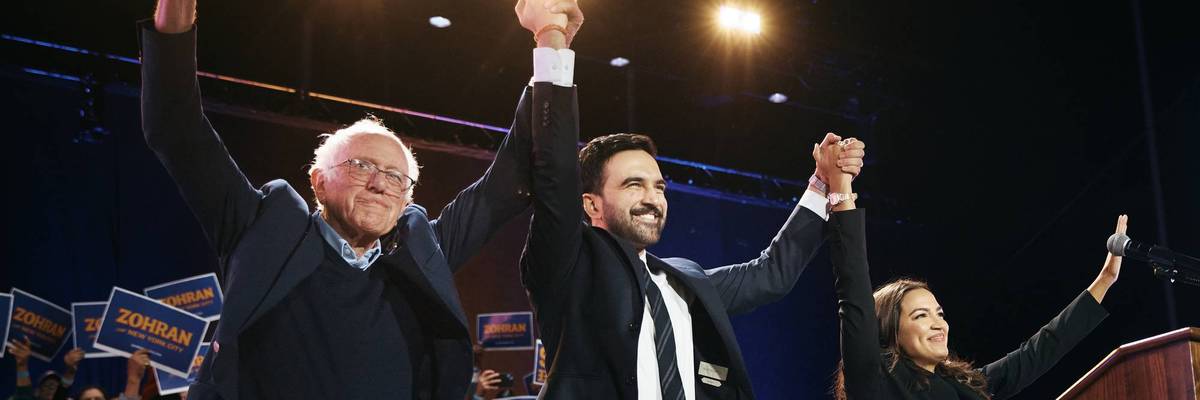
New York Mayoral Candidate Zohran Mamdani, center, celebrates with Sen. Bernie Sanders (I-VT), left, and U.S. Rep. Alexandria Ocasio-Cortez (D-NY), right, during an election rally on October 26, 2025 at Forest Hills Stadium in the Queens borough of New York City. The mayoral election will take place on November 4, 2025.
The democratic socialists are fighting the battles the Democratic Party have refused to wage. This is the way.
Maybe you’ve heard the phrase means of production and maybe you haven’t. It basically means the tools, land, factories, machines, infrastructure, and systems a society uses to make the material stuff of life. Who owns those means, who controls them, and who benefits from them is one of the oldest fights in politics.
The communists, at their extreme, think the state should own and control all of it. The capitalists, at their extreme, think it should be completely in private hands. Socialists like me think there ought to be a blend of public and private ownership, that capitalism and socialism work best when paired. The neoliberals, which is mostly what we’ve got now, think our future should be in private control but paid for by the people, maybe with a guardrail or two set up between the people and the private sector’s insatiable desire for profit.
We fought about this hard in the early 1900s. There was a big movement around labor and organizers and workers, and a lot of those folks were actual communists. The communists were fighting for the means of production and the capitalists were fighting for it too, and they fought tooth and nail. The workers were unionizing and fighting for better rights and better conditions, and these were actual fights, with guns and sticks and knives, and people got killed, mostly workers. They fought for more rights. They fought for the 40-hour week. They fought for overtime. They fought for working conditions that were safe and not deadly, and in a lot of cases they won. They won those fights with blood. They won those fights with effort. They won those fights by putting things on the line.
You might have heard of something called the weekend. Not the singer, though I love him. The idea that Monday through Friday is the work week and the weekend is for your life. You might have heard of the eight-hour day, that anything over eight hours is overtime. Both of those were brought to you by the labor movement, a labor movement that at one point was empowered not to fight for the members of its own labor union but empowered to fight for people who worked for a living. That was their mantra. That was their goal.
Then came the New Deal in the 30s, the people injecting themselves into the production of the things we needed to rebuild the country after the Great Depression. We did it through the Civilian Conservation Corps. We trained workers, we provided health care, and during the war we even created daycare centers so women could go into the factories. It was a real rebalancing of our economy between capital and labor, with the state taking part of the means of production, engineers and scientists doing the work for the people, paid for by the people, and then used by the people. Corporations got brought to heel for a while.
Then we beat the fascists, the Nazis in Germany and Italy and the imperialists in Japan, and right after that the Americans decided the biggest scourge, the biggest fear they had, was communism and socialism. Because we’d gotten a taste through the New Deal and the Arsenal of Democracy of what it was like to share in the growth, to share in the fruits of our own labor, and there was a fear that if we kept tasting it we’d decide we too deserved more, and that would mean the Vanderbilts and the railroad tycoons and the shipping barons and the oilmen would have less and the people who did the work would have more. So we fought it. We fought it through the McCarthy era, with propaganda, with all sorts of ideological battles. The idea of socialism and the idea of communism both lost. And the Democratic Party started moving away from its socialist roots and its socialist ideas toward what would ultimately become neoliberalism, the system we’ve got now.
We went through all of those fights, the prisons, the violations of the Constitution. We perverted ourselves in order to fight off socialism, to keep the means of production in the hands of the capitalists, because they alone were able to properly guide our system. And then what did they do with our productive capacity? What did they do with it through the 70s and 80s and 90s and 2000s and right up to today? They shipped it off to Mexico and China and Brazil. They gave away the very thing we fought over. And why? Because it was cheaper, more profitable, and they figured they could do it with impunity.
But when you take away people’s means of production, you also take away their means of making a living, their power and their value in life, economically and socially and every other way, and then you’ve got people fighting over what little is left, and it turns ugly and it turns dirty. Look at January 6th. Look at the riots and the protests during the Black Lives Matter movement. What you end up with is a police force that has to oppress, and private prisons that have to fill up, and a military-industrial complex that doesn’t care whether it’s participating in a genocide or not, because it’s about money and power. And ultimately what you end up with is a country that can’t defend itself or provide for itself, a giant welfare state leaning on the Chinese to make our goods and to buy our debt. A nation that no longer holds its own means of production, no longer holds its own means of making a living, no longer holds its independence, not in energy production, not in the ability to build housing or infrastructure or the things that make our lives better. We import all of it, because all we need is money, we can just make more money.
And that only works as long as the money stays in the hands of a few. All that money creation, all that expansion of wealth, would lead to massive inflation if it weren’t held by a few, and you can already see what it does, because it’s caused massive inflation in indexes and in asset prices. Bitcoin and Apple and the stock market have risen to unreasonable heights, heights that are detached from any reality. Tesla is worth more than the next 30 car companies combined, even though it doesn’t produce as much as any of the top ten and doesn’t make more profit than any of the top ten, and yet somehow it’s worth more. Why? Because the money that’s been created has caused that inflation, and the inflation stays at the top. It makes trillionaires and centibillionaires. If that same money had been shared with the rest of America without creating more productive capacity, without the ability to build more housing or train more doctors or build more hospitals, it would create massive inflation everywhere, because you’d have more money chasing fewer goods in a system that can’t produce the things anymore and just imports them. The inflation is real. It just stays at the top, in asset prices, instead of showing up at the grocery store.
So the means of production was a fight that working people lost and the capitalists won. And then the winners gave away the spoils of their own victory to other nations, because they aren’t patriots and they aren’t citizens of this country. They’re citizens of the world. They’re detached and untethered, private jets and private islands and private security forces, and at that level of wealth they don’t need this country to succeed.
But here’s the thing. The elite, for now, do need us more than we need them. We’re the ones propping them up right now.
The question with AI and robotics is not whether the machines will be powerful. They will be. The question is whether they become another offshore factory, another private island, another asset owned by people who do not need us, or whether they become part of a shared American capacity again.
We lost the last fight over the means of production, and then the winners gave it away. We should not let them do it twice.
Dear Common Dreams reader, It’s been nearly 30 years since I co-founded Common Dreams with my late wife, Lina Newhouser. We had the radical notion that journalism should serve the public good, not corporate profits. It was clear to us from the outset what it would take to build such a project. No paid advertisements. No corporate sponsors. No millionaire publisher telling us what to think or do. Many people said we wouldn't last a year, but we proved those doubters wrong. Together with a tremendous team of journalists and dedicated staff, we built an independent media outlet free from the constraints of profits and corporate control. Our mission has always been simple: To inform. To inspire. To ignite change for the common good. Building Common Dreams was not easy. Our survival was never guaranteed. When you take on the most powerful forces—Wall Street greed, fossil fuel industry destruction, Big Tech lobbyists, and uber-rich oligarchs who have spent billions upon billions rigging the economy and democracy in their favor—the only bulwark you have is supporters who believe in your work. But here’s the urgent message from me today. It's never been this bad out there. And it's never been this hard to keep us going. At the very moment Common Dreams is most needed, the threats we face are intensifying. We need your support now more than ever. We don't accept corporate advertising and never will. We don't have a paywall because we don't think people should be blocked from critical news based on their ability to pay. Everything we do is funded by the donations of readers like you. When everyone does the little they can afford, we are strong. But if that support retreats or dries up, so do we. Will you donate now to make sure Common Dreams not only survives but thrives? —Craig Brown, Co-founder |
Corbin Trent is an Appalachian-born general contractor and political organizer. He co-founded Brand New Congress and Justice Democrats, helped recruit AOC, and served as her first communications director. He publishes AmericasUndoing.com, a project exposing America’s economic decline and calling for bold, public-led rebuilding. Find morework on his TikTok, YouTube, and Facebook channels.
Maybe you’ve heard the phrase means of production and maybe you haven’t. It basically means the tools, land, factories, machines, infrastructure, and systems a society uses to make the material stuff of life. Who owns those means, who controls them, and who benefits from them is one of the oldest fights in politics.
The communists, at their extreme, think the state should own and control all of it. The capitalists, at their extreme, think it should be completely in private hands. Socialists like me think there ought to be a blend of public and private ownership, that capitalism and socialism work best when paired. The neoliberals, which is mostly what we’ve got now, think our future should be in private control but paid for by the people, maybe with a guardrail or two set up between the people and the private sector’s insatiable desire for profit.
We fought about this hard in the early 1900s. There was a big movement around labor and organizers and workers, and a lot of those folks were actual communists. The communists were fighting for the means of production and the capitalists were fighting for it too, and they fought tooth and nail. The workers were unionizing and fighting for better rights and better conditions, and these were actual fights, with guns and sticks and knives, and people got killed, mostly workers. They fought for more rights. They fought for the 40-hour week. They fought for overtime. They fought for working conditions that were safe and not deadly, and in a lot of cases they won. They won those fights with blood. They won those fights with effort. They won those fights by putting things on the line.
You might have heard of something called the weekend. Not the singer, though I love him. The idea that Monday through Friday is the work week and the weekend is for your life. You might have heard of the eight-hour day, that anything over eight hours is overtime. Both of those were brought to you by the labor movement, a labor movement that at one point was empowered not to fight for the members of its own labor union but empowered to fight for people who worked for a living. That was their mantra. That was their goal.
Then came the New Deal in the 30s, the people injecting themselves into the production of the things we needed to rebuild the country after the Great Depression. We did it through the Civilian Conservation Corps. We trained workers, we provided health care, and during the war we even created daycare centers so women could go into the factories. It was a real rebalancing of our economy between capital and labor, with the state taking part of the means of production, engineers and scientists doing the work for the people, paid for by the people, and then used by the people. Corporations got brought to heel for a while.
Then we beat the fascists, the Nazis in Germany and Italy and the imperialists in Japan, and right after that the Americans decided the biggest scourge, the biggest fear they had, was communism and socialism. Because we’d gotten a taste through the New Deal and the Arsenal of Democracy of what it was like to share in the growth, to share in the fruits of our own labor, and there was a fear that if we kept tasting it we’d decide we too deserved more, and that would mean the Vanderbilts and the railroad tycoons and the shipping barons and the oilmen would have less and the people who did the work would have more. So we fought it. We fought it through the McCarthy era, with propaganda, with all sorts of ideological battles. The idea of socialism and the idea of communism both lost. And the Democratic Party started moving away from its socialist roots and its socialist ideas toward what would ultimately become neoliberalism, the system we’ve got now.
We went through all of those fights, the prisons, the violations of the Constitution. We perverted ourselves in order to fight off socialism, to keep the means of production in the hands of the capitalists, because they alone were able to properly guide our system. And then what did they do with our productive capacity? What did they do with it through the 70s and 80s and 90s and 2000s and right up to today? They shipped it off to Mexico and China and Brazil. They gave away the very thing we fought over. And why? Because it was cheaper, more profitable, and they figured they could do it with impunity.
But when you take away people’s means of production, you also take away their means of making a living, their power and their value in life, economically and socially and every other way, and then you’ve got people fighting over what little is left, and it turns ugly and it turns dirty. Look at January 6th. Look at the riots and the protests during the Black Lives Matter movement. What you end up with is a police force that has to oppress, and private prisons that have to fill up, and a military-industrial complex that doesn’t care whether it’s participating in a genocide or not, because it’s about money and power. And ultimately what you end up with is a country that can’t defend itself or provide for itself, a giant welfare state leaning on the Chinese to make our goods and to buy our debt. A nation that no longer holds its own means of production, no longer holds its own means of making a living, no longer holds its independence, not in energy production, not in the ability to build housing or infrastructure or the things that make our lives better. We import all of it, because all we need is money, we can just make more money.
And that only works as long as the money stays in the hands of a few. All that money creation, all that expansion of wealth, would lead to massive inflation if it weren’t held by a few, and you can already see what it does, because it’s caused massive inflation in indexes and in asset prices. Bitcoin and Apple and the stock market have risen to unreasonable heights, heights that are detached from any reality. Tesla is worth more than the next 30 car companies combined, even though it doesn’t produce as much as any of the top ten and doesn’t make more profit than any of the top ten, and yet somehow it’s worth more. Why? Because the money that’s been created has caused that inflation, and the inflation stays at the top. It makes trillionaires and centibillionaires. If that same money had been shared with the rest of America without creating more productive capacity, without the ability to build more housing or train more doctors or build more hospitals, it would create massive inflation everywhere, because you’d have more money chasing fewer goods in a system that can’t produce the things anymore and just imports them. The inflation is real. It just stays at the top, in asset prices, instead of showing up at the grocery store.
So the means of production was a fight that working people lost and the capitalists won. And then the winners gave away the spoils of their own victory to other nations, because they aren’t patriots and they aren’t citizens of this country. They’re citizens of the world. They’re detached and untethered, private jets and private islands and private security forces, and at that level of wealth they don’t need this country to succeed.
But here’s the thing. The elite, for now, do need us more than we need them. We’re the ones propping them up right now.
The question with AI and robotics is not whether the machines will be powerful. They will be. The question is whether they become another offshore factory, another private island, another asset owned by people who do not need us, or whether they become part of a shared American capacity again.
We lost the last fight over the means of production, and then the winners gave it away. We should not let them do it twice.
Corbin Trent is an Appalachian-born general contractor and political organizer. He co-founded Brand New Congress and Justice Democrats, helped recruit AOC, and served as her first communications director. He publishes AmericasUndoing.com, a project exposing America’s economic decline and calling for bold, public-led rebuilding. Find morework on his TikTok, YouTube, and Facebook channels.
Maybe you’ve heard the phrase means of production and maybe you haven’t. It basically means the tools, land, factories, machines, infrastructure, and systems a society uses to make the material stuff of life. Who owns those means, who controls them, and who benefits from them is one of the oldest fights in politics.
The communists, at their extreme, think the state should own and control all of it. The capitalists, at their extreme, think it should be completely in private hands. Socialists like me think there ought to be a blend of public and private ownership, that capitalism and socialism work best when paired. The neoliberals, which is mostly what we’ve got now, think our future should be in private control but paid for by the people, maybe with a guardrail or two set up between the people and the private sector’s insatiable desire for profit.
We fought about this hard in the early 1900s. There was a big movement around labor and organizers and workers, and a lot of those folks were actual communists. The communists were fighting for the means of production and the capitalists were fighting for it too, and they fought tooth and nail. The workers were unionizing and fighting for better rights and better conditions, and these were actual fights, with guns and sticks and knives, and people got killed, mostly workers. They fought for more rights. They fought for the 40-hour week. They fought for overtime. They fought for working conditions that were safe and not deadly, and in a lot of cases they won. They won those fights with blood. They won those fights with effort. They won those fights by putting things on the line.
You might have heard of something called the weekend. Not the singer, though I love him. The idea that Monday through Friday is the work week and the weekend is for your life. You might have heard of the eight-hour day, that anything over eight hours is overtime. Both of those were brought to you by the labor movement, a labor movement that at one point was empowered not to fight for the members of its own labor union but empowered to fight for people who worked for a living. That was their mantra. That was their goal.
Then came the New Deal in the 30s, the people injecting themselves into the production of the things we needed to rebuild the country after the Great Depression. We did it through the Civilian Conservation Corps. We trained workers, we provided health care, and during the war we even created daycare centers so women could go into the factories. It was a real rebalancing of our economy between capital and labor, with the state taking part of the means of production, engineers and scientists doing the work for the people, paid for by the people, and then used by the people. Corporations got brought to heel for a while.
Then we beat the fascists, the Nazis in Germany and Italy and the imperialists in Japan, and right after that the Americans decided the biggest scourge, the biggest fear they had, was communism and socialism. Because we’d gotten a taste through the New Deal and the Arsenal of Democracy of what it was like to share in the growth, to share in the fruits of our own labor, and there was a fear that if we kept tasting it we’d decide we too deserved more, and that would mean the Vanderbilts and the railroad tycoons and the shipping barons and the oilmen would have less and the people who did the work would have more. So we fought it. We fought it through the McCarthy era, with propaganda, with all sorts of ideological battles. The idea of socialism and the idea of communism both lost. And the Democratic Party started moving away from its socialist roots and its socialist ideas toward what would ultimately become neoliberalism, the system we’ve got now.
We went through all of those fights, the prisons, the violations of the Constitution. We perverted ourselves in order to fight off socialism, to keep the means of production in the hands of the capitalists, because they alone were able to properly guide our system. And then what did they do with our productive capacity? What did they do with it through the 70s and 80s and 90s and 2000s and right up to today? They shipped it off to Mexico and China and Brazil. They gave away the very thing we fought over. And why? Because it was cheaper, more profitable, and they figured they could do it with impunity.
But when you take away people’s means of production, you also take away their means of making a living, their power and their value in life, economically and socially and every other way, and then you’ve got people fighting over what little is left, and it turns ugly and it turns dirty. Look at January 6th. Look at the riots and the protests during the Black Lives Matter movement. What you end up with is a police force that has to oppress, and private prisons that have to fill up, and a military-industrial complex that doesn’t care whether it’s participating in a genocide or not, because it’s about money and power. And ultimately what you end up with is a country that can’t defend itself or provide for itself, a giant welfare state leaning on the Chinese to make our goods and to buy our debt. A nation that no longer holds its own means of production, no longer holds its own means of making a living, no longer holds its independence, not in energy production, not in the ability to build housing or infrastructure or the things that make our lives better. We import all of it, because all we need is money, we can just make more money.
And that only works as long as the money stays in the hands of a few. All that money creation, all that expansion of wealth, would lead to massive inflation if it weren’t held by a few, and you can already see what it does, because it’s caused massive inflation in indexes and in asset prices. Bitcoin and Apple and the stock market have risen to unreasonable heights, heights that are detached from any reality. Tesla is worth more than the next 30 car companies combined, even though it doesn’t produce as much as any of the top ten and doesn’t make more profit than any of the top ten, and yet somehow it’s worth more. Why? Because the money that’s been created has caused that inflation, and the inflation stays at the top. It makes trillionaires and centibillionaires. If that same money had been shared with the rest of America without creating more productive capacity, without the ability to build more housing or train more doctors or build more hospitals, it would create massive inflation everywhere, because you’d have more money chasing fewer goods in a system that can’t produce the things anymore and just imports them. The inflation is real. It just stays at the top, in asset prices, instead of showing up at the grocery store.
So the means of production was a fight that working people lost and the capitalists won. And then the winners gave away the spoils of their own victory to other nations, because they aren’t patriots and they aren’t citizens of this country. They’re citizens of the world. They’re detached and untethered, private jets and private islands and private security forces, and at that level of wealth they don’t need this country to succeed.
But here’s the thing. The elite, for now, do need us more than we need them. We’re the ones propping them up right now.
The question with AI and robotics is not whether the machines will be powerful. They will be. The question is whether they become another offshore factory, another private island, another asset owned by people who do not need us, or whether they become part of a shared American capacity again.
We lost the last fight over the means of production, and then the winners gave it away. We should not let them do it twice.