SUBSCRIBE TO OUR FREE NEWSLETTER
Daily news & progressive opinion—funded by the people, not the corporations—delivered straight to your inbox.
5
#000000
#FFFFFF
To donate by check, phone, or other method, see our More Ways to Give page.
Daily news & progressive opinion—funded by the people, not the corporations—delivered straight to your inbox.
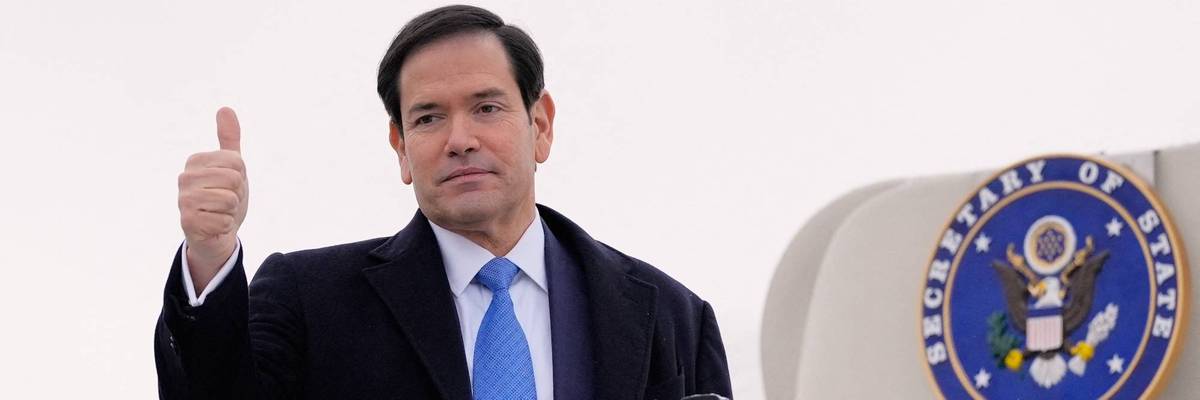
US Secretary of State Marco Rubio gives a thumbs up as he departs Munich International Airport in Munich, southern Germany, on February 15, 2026, after attending the Munich Security Conference.
The implication, delivered with straight-faced solemnity in Munich, is that the US-backed campaign against leftist movements in the Cold War was a noble defense of freedom, democracy, and Christian civilization.
Much has already been written about Secretary of State Marco Rubio's damage-control mission to the Munich Security Conference, sent to cool transatlantic tensions mere weeks after President Donald Trump hinted multiple times at annexing Greenland by force. But beneath the conciliatory tone was Rubio's explicit defense of the fight against “godless communist revolutions” and “anti-colonial uprisings” throughout the world, a horrific sanitization of the US-backed dictatorships that terrorized Latin America and beyond in the last century.
Rubio painted a sweeping narrative of Western civilization under threat. “The great Western empires had entered into terminal decline,” he declared, “accelerated by godless communist revolutions and by anti-colonial uprisings that would transform the world and drape the red hammer and sickle across vast swaths of the map.”
That line is a direct homage to the doctrines of Cold Warriors Henry Kissinger and Jeane Kirkpatrick, both of whom infamously argued that right-wing dictators were acceptable allies in the fight against communism—regardless of their brutality—because they were “authoritarian” rather than "totalitarian.” Yes, even if those “communists” were democratically elected, popular, and nonviolent.
The implication, delivered with straight-faced solemnity in Munich, is that the US-backed campaign against leftist movements in the Cold War was a noble defense of freedom, democracy, and Christian civilization.
The United States can continue down the path outlined by Rubio’s speech, but it will only accelerate its decline, alienate its allies, and create the very chaos it claims to fight.
In the 1970s and 1980s, the US helped set up Operation Condor, a network that far-right dictatorships operated throughout the 1970s and 1980s as a coordinated system of state terror across South America. The Chilean intelligence service chillingly described it as “something similar to what Interpol has in Paris, but devoted to subversion.” It was, also important to mention, explicitly framed by the US government to defend Christian civilization (also called the Banzer Plan).
Rubio's Christian civilization trope is an ode to a very specific, pro-corporate, pro-authoritarian, and white-supremacist Christianity, the same ideology championed by Donald Trump's MAGA movement. This is the same ideology that colonized, enslaved, and subjugated Latin America and the Global South, through the European institutions he lifted up in his speech. Centuries later, the United States resurrected this crusade through the CIA, which funded and even armed the rise of far-right, pro-capitalist Evangelical movements, to actively oppose and dismantle the more redistributive, popular Catholic churches rooted in liberation theology.
Many of the right-wing paramilitaries and dictatorships backed by the US were explicitly Christian. They, however, killed priests who did not adhere to rigid far-right fundamentalism—Catholic groups were central to the resistance. That Evangelical fundamentalism now fuels the region's new wave of right-wing leaders, including Jair Bolsonaro, Javier Milei, Maria Corina Machado, and José Antonio Kast, who are also fanatical supporters of Israel.
The Condor system maintained a centralized database tracking guerrilla movements, left-wing parties, trade unionists, religious groups, liberal politicians, and anyone deemed an enemy of the authoritarian regimes. These designated “terrorists” were hunted across borders, tracked down, and eliminated throughout the Americas and even in Europe, including France, Spain, Italy, and Portugal.
The United States actively designed, funded, and supported this architecture of repression, and then helped cover it up. The infamous, still-open School of the Americas trained torturers, while CIA stations shared intelligence with Condor operatives. US Embassies smoothed relations with allies and propagandized local populations.
In Bolivia, the US backed Hugo Banzer after his predecessor convened a People's Assembly of proletarian sectors to usher in populist reforms. That president was later kidnapped, tortured, and assassinated by the Condor system.
In Brazil, Washington supported the neo-Nazi-backed military coup that deposed social democrat João Goulart after he attempted mild economic reforms, ushering in two decades of brutal military rule.
In Chile, the US organized against socialist president Salvador Allende, who was instituting democratic, redistributive reforms. The Nixon administration famously declared it would “make the economy scream” in Chile, and went on to support Augusto Pinochet's coup, which brought torture, disappearances, and a dictatorship that murdered thousands. Rubio and the US currently back its Pinochet-supporting, grandson-of-an-SS-lieutenant President, Jose Antonio Kast.
On the topic of the SS, the US used Nazis as part of their anti-leftist subversion campaign in the Cold War. After World War II, the US set up “ratlines,” or escape routes, for Nazis and Nazi sympathizers throughout Latin America and Europe, to escape prosecution. They ended up being key architects of the US-backed right-wing dictatorships throughout the world including in Latin America, while many even joined anti-communist death squads.
Final Solution architects Adolf Eichmann, Klaus Barbie, Josef Mengele, and countless others all left for South America with help from the US State Department, which Rubio now commands.
The US also deposed socialist governments and installed brutal right-wing regimes in the Dominican Republic, Ecuador, Haiti (multiple times), Mexico, Nicaragua (multiple times through the Somoza family), Costa Rica, Honduras (multiple times), El Salvador, and Panama.
In Guatemala, the CIA overthrew socialist president Jacobo Arbenz after he dared to enact land reform that threatened the American United Fruit Company, whose political connections apparently mattered more than Guatemalan democracy. Guatemala was ruled by brutal military dictators for decades afterward, also regimes the US supported.
Mind you, this is only in Latin America—the US did plenty more of this in Europe, Asia, and Africa. This was all less than 50 years ago, and continues to this day.
Such is the legacy that Rubio defends when he mourns the setbacks to “Western civilization” made by “anti-colonial uprisings.” We must ask, why did those uprisings occur? Is Rubio implying that opposing colonialism is bad? Most of them occurred after centuries of slavery and subjugation, some of which was inflicted by the US.
This historical whitewashing serves Rubio's contemporary objectives. The United States is currently engaged in a multi-front campaign to reshape Latin America into a bastion of pro-American right-wing populism.
The administration has waged economic war on Venezuela, and Cuba, now on the verge of total humanitarian collapse. It swayed the last election in Honduras through disinformation and threats—continuing a pattern of US intervention that began with the Obama administration's 2009 backing of a coup against socialist Manuel Zelaya. Trump's first term engineered a coup in Bolivia against socialist Evo Morales, that Rubio enthusiastically supported.
Trump’s second administration has threatened strikes on Mexico and Colombia, imposed sanctions and tariffs on Brazil, and openly and covertly supported authoritarian parties throughout the hemisphere, including the Bolsonaros in Brazil, Milei in Argentina, Nayib Bukele in El Salvador, Daniel Noboa in Ecuador, Tuto Quiroga in Bolivia, and opposition figures across the region.
There is something profoundly ignorant in Rubio's performance. He and his boss have championed authoritarian tactics, openly supported neo-Nazi politics, praised dictators abroad, and destroyed democracy and the Constitution at home. To then stand before the world to declare that America defends freedom, democracy, and Judeo-Christian principles against godless revolutionaries is a ridiculous diminution of those very principles.
As Salvador Allende put it mere hours before his death at the hands of US forces at the Palacio de la Moneda, “While they have strength and will be able to dominate us, social processes can be arrested neither by crime nor force.”
In Haiti, more than a century of US interventions, coups, and support for corrupt and violent figures has produced a humanitarian catastrophe that now generates waves of migration, while the American right has the gall to turn around and fearmonger about Haitian migrants invading the country.
As Brazilian President Luiz Inácio Lula da Silva says, “Foreign intervention can cause more damage than it seeks to prevent.” They create the migration crises that then become fodder for right-wing demagogues. They alienate Latin American populations, who increasingly view China more favorably than the United States, because while Washington offers only militarism and domination, Beijing offers infrastructure investment and trade (however problematic its own debt traps may be).
Many Latin American states would rather navigate imbalanced partnerships with China than submit to foreign invasions and coups from Washington.
The United States can continue down the path outlined by Rubio’s speech, but it will only accelerate its decline, alienate its allies, and create the very chaos it claims to fight. Or it could finally reckon honestly with its history and chart a different, humane course.
Eduardo Galeano once said, “Latin America is part of the world, which was for many years condemned to the system of power where intimidation had more strength than the vote.” By sanitizing these atrocities, Rubio is condemning Latin America and the world to that fate once again.
Dear Common Dreams reader, It’s been nearly 30 years since I co-founded Common Dreams with my late wife, Lina Newhouser. We had the radical notion that journalism should serve the public good, not corporate profits. It was clear to us from the outset what it would take to build such a project. No paid advertisements. No corporate sponsors. No millionaire publisher telling us what to think or do. Many people said we wouldn't last a year, but we proved those doubters wrong. Together with a tremendous team of journalists and dedicated staff, we built an independent media outlet free from the constraints of profits and corporate control. Our mission has always been simple: To inform. To inspire. To ignite change for the common good. Building Common Dreams was not easy. Our survival was never guaranteed. When you take on the most powerful forces—Wall Street greed, fossil fuel industry destruction, Big Tech lobbyists, and uber-rich oligarchs who have spent billions upon billions rigging the economy and democracy in their favor—the only bulwark you have is supporters who believe in your work. But here’s the urgent message from me today. It's never been this bad out there. And it's never been this hard to keep us going. At the very moment Common Dreams is most needed, the threats we face are intensifying. We need your support now more than ever. We don't accept corporate advertising and never will. We don't have a paywall because we don't think people should be blocked from critical news based on their ability to pay. Everything we do is funded by the donations of readers like you. When everyone does the little they can afford, we are strong. But if that support retreats or dries up, so do we. Will you donate now to make sure Common Dreams not only survives but thrives? —Craig Brown, Co-founder |
Much has already been written about Secretary of State Marco Rubio's damage-control mission to the Munich Security Conference, sent to cool transatlantic tensions mere weeks after President Donald Trump hinted multiple times at annexing Greenland by force. But beneath the conciliatory tone was Rubio's explicit defense of the fight against “godless communist revolutions” and “anti-colonial uprisings” throughout the world, a horrific sanitization of the US-backed dictatorships that terrorized Latin America and beyond in the last century.
Rubio painted a sweeping narrative of Western civilization under threat. “The great Western empires had entered into terminal decline,” he declared, “accelerated by godless communist revolutions and by anti-colonial uprisings that would transform the world and drape the red hammer and sickle across vast swaths of the map.”
That line is a direct homage to the doctrines of Cold Warriors Henry Kissinger and Jeane Kirkpatrick, both of whom infamously argued that right-wing dictators were acceptable allies in the fight against communism—regardless of their brutality—because they were “authoritarian” rather than "totalitarian.” Yes, even if those “communists” were democratically elected, popular, and nonviolent.
The implication, delivered with straight-faced solemnity in Munich, is that the US-backed campaign against leftist movements in the Cold War was a noble defense of freedom, democracy, and Christian civilization.
The United States can continue down the path outlined by Rubio’s speech, but it will only accelerate its decline, alienate its allies, and create the very chaos it claims to fight.
In the 1970s and 1980s, the US helped set up Operation Condor, a network that far-right dictatorships operated throughout the 1970s and 1980s as a coordinated system of state terror across South America. The Chilean intelligence service chillingly described it as “something similar to what Interpol has in Paris, but devoted to subversion.” It was, also important to mention, explicitly framed by the US government to defend Christian civilization (also called the Banzer Plan).
Rubio's Christian civilization trope is an ode to a very specific, pro-corporate, pro-authoritarian, and white-supremacist Christianity, the same ideology championed by Donald Trump's MAGA movement. This is the same ideology that colonized, enslaved, and subjugated Latin America and the Global South, through the European institutions he lifted up in his speech. Centuries later, the United States resurrected this crusade through the CIA, which funded and even armed the rise of far-right, pro-capitalist Evangelical movements, to actively oppose and dismantle the more redistributive, popular Catholic churches rooted in liberation theology.
Many of the right-wing paramilitaries and dictatorships backed by the US were explicitly Christian. They, however, killed priests who did not adhere to rigid far-right fundamentalism—Catholic groups were central to the resistance. That Evangelical fundamentalism now fuels the region's new wave of right-wing leaders, including Jair Bolsonaro, Javier Milei, Maria Corina Machado, and José Antonio Kast, who are also fanatical supporters of Israel.
The Condor system maintained a centralized database tracking guerrilla movements, left-wing parties, trade unionists, religious groups, liberal politicians, and anyone deemed an enemy of the authoritarian regimes. These designated “terrorists” were hunted across borders, tracked down, and eliminated throughout the Americas and even in Europe, including France, Spain, Italy, and Portugal.
The United States actively designed, funded, and supported this architecture of repression, and then helped cover it up. The infamous, still-open School of the Americas trained torturers, while CIA stations shared intelligence with Condor operatives. US Embassies smoothed relations with allies and propagandized local populations.
In Bolivia, the US backed Hugo Banzer after his predecessor convened a People's Assembly of proletarian sectors to usher in populist reforms. That president was later kidnapped, tortured, and assassinated by the Condor system.
In Brazil, Washington supported the neo-Nazi-backed military coup that deposed social democrat João Goulart after he attempted mild economic reforms, ushering in two decades of brutal military rule.
In Chile, the US organized against socialist president Salvador Allende, who was instituting democratic, redistributive reforms. The Nixon administration famously declared it would “make the economy scream” in Chile, and went on to support Augusto Pinochet's coup, which brought torture, disappearances, and a dictatorship that murdered thousands. Rubio and the US currently back its Pinochet-supporting, grandson-of-an-SS-lieutenant President, Jose Antonio Kast.
On the topic of the SS, the US used Nazis as part of their anti-leftist subversion campaign in the Cold War. After World War II, the US set up “ratlines,” or escape routes, for Nazis and Nazi sympathizers throughout Latin America and Europe, to escape prosecution. They ended up being key architects of the US-backed right-wing dictatorships throughout the world including in Latin America, while many even joined anti-communist death squads.
Final Solution architects Adolf Eichmann, Klaus Barbie, Josef Mengele, and countless others all left for South America with help from the US State Department, which Rubio now commands.
The US also deposed socialist governments and installed brutal right-wing regimes in the Dominican Republic, Ecuador, Haiti (multiple times), Mexico, Nicaragua (multiple times through the Somoza family), Costa Rica, Honduras (multiple times), El Salvador, and Panama.
In Guatemala, the CIA overthrew socialist president Jacobo Arbenz after he dared to enact land reform that threatened the American United Fruit Company, whose political connections apparently mattered more than Guatemalan democracy. Guatemala was ruled by brutal military dictators for decades afterward, also regimes the US supported.
Mind you, this is only in Latin America—the US did plenty more of this in Europe, Asia, and Africa. This was all less than 50 years ago, and continues to this day.
Such is the legacy that Rubio defends when he mourns the setbacks to “Western civilization” made by “anti-colonial uprisings.” We must ask, why did those uprisings occur? Is Rubio implying that opposing colonialism is bad? Most of them occurred after centuries of slavery and subjugation, some of which was inflicted by the US.
This historical whitewashing serves Rubio's contemporary objectives. The United States is currently engaged in a multi-front campaign to reshape Latin America into a bastion of pro-American right-wing populism.
The administration has waged economic war on Venezuela, and Cuba, now on the verge of total humanitarian collapse. It swayed the last election in Honduras through disinformation and threats—continuing a pattern of US intervention that began with the Obama administration's 2009 backing of a coup against socialist Manuel Zelaya. Trump's first term engineered a coup in Bolivia against socialist Evo Morales, that Rubio enthusiastically supported.
Trump’s second administration has threatened strikes on Mexico and Colombia, imposed sanctions and tariffs on Brazil, and openly and covertly supported authoritarian parties throughout the hemisphere, including the Bolsonaros in Brazil, Milei in Argentina, Nayib Bukele in El Salvador, Daniel Noboa in Ecuador, Tuto Quiroga in Bolivia, and opposition figures across the region.
There is something profoundly ignorant in Rubio's performance. He and his boss have championed authoritarian tactics, openly supported neo-Nazi politics, praised dictators abroad, and destroyed democracy and the Constitution at home. To then stand before the world to declare that America defends freedom, democracy, and Judeo-Christian principles against godless revolutionaries is a ridiculous diminution of those very principles.
As Salvador Allende put it mere hours before his death at the hands of US forces at the Palacio de la Moneda, “While they have strength and will be able to dominate us, social processes can be arrested neither by crime nor force.”
In Haiti, more than a century of US interventions, coups, and support for corrupt and violent figures has produced a humanitarian catastrophe that now generates waves of migration, while the American right has the gall to turn around and fearmonger about Haitian migrants invading the country.
As Brazilian President Luiz Inácio Lula da Silva says, “Foreign intervention can cause more damage than it seeks to prevent.” They create the migration crises that then become fodder for right-wing demagogues. They alienate Latin American populations, who increasingly view China more favorably than the United States, because while Washington offers only militarism and domination, Beijing offers infrastructure investment and trade (however problematic its own debt traps may be).
Many Latin American states would rather navigate imbalanced partnerships with China than submit to foreign invasions and coups from Washington.
The United States can continue down the path outlined by Rubio’s speech, but it will only accelerate its decline, alienate its allies, and create the very chaos it claims to fight. Or it could finally reckon honestly with its history and chart a different, humane course.
Eduardo Galeano once said, “Latin America is part of the world, which was for many years condemned to the system of power where intimidation had more strength than the vote.” By sanitizing these atrocities, Rubio is condemning Latin America and the world to that fate once again.
Much has already been written about Secretary of State Marco Rubio's damage-control mission to the Munich Security Conference, sent to cool transatlantic tensions mere weeks after President Donald Trump hinted multiple times at annexing Greenland by force. But beneath the conciliatory tone was Rubio's explicit defense of the fight against “godless communist revolutions” and “anti-colonial uprisings” throughout the world, a horrific sanitization of the US-backed dictatorships that terrorized Latin America and beyond in the last century.
Rubio painted a sweeping narrative of Western civilization under threat. “The great Western empires had entered into terminal decline,” he declared, “accelerated by godless communist revolutions and by anti-colonial uprisings that would transform the world and drape the red hammer and sickle across vast swaths of the map.”
That line is a direct homage to the doctrines of Cold Warriors Henry Kissinger and Jeane Kirkpatrick, both of whom infamously argued that right-wing dictators were acceptable allies in the fight against communism—regardless of their brutality—because they were “authoritarian” rather than "totalitarian.” Yes, even if those “communists” were democratically elected, popular, and nonviolent.
The implication, delivered with straight-faced solemnity in Munich, is that the US-backed campaign against leftist movements in the Cold War was a noble defense of freedom, democracy, and Christian civilization.
The United States can continue down the path outlined by Rubio’s speech, but it will only accelerate its decline, alienate its allies, and create the very chaos it claims to fight.
In the 1970s and 1980s, the US helped set up Operation Condor, a network that far-right dictatorships operated throughout the 1970s and 1980s as a coordinated system of state terror across South America. The Chilean intelligence service chillingly described it as “something similar to what Interpol has in Paris, but devoted to subversion.” It was, also important to mention, explicitly framed by the US government to defend Christian civilization (also called the Banzer Plan).
Rubio's Christian civilization trope is an ode to a very specific, pro-corporate, pro-authoritarian, and white-supremacist Christianity, the same ideology championed by Donald Trump's MAGA movement. This is the same ideology that colonized, enslaved, and subjugated Latin America and the Global South, through the European institutions he lifted up in his speech. Centuries later, the United States resurrected this crusade through the CIA, which funded and even armed the rise of far-right, pro-capitalist Evangelical movements, to actively oppose and dismantle the more redistributive, popular Catholic churches rooted in liberation theology.
Many of the right-wing paramilitaries and dictatorships backed by the US were explicitly Christian. They, however, killed priests who did not adhere to rigid far-right fundamentalism—Catholic groups were central to the resistance. That Evangelical fundamentalism now fuels the region's new wave of right-wing leaders, including Jair Bolsonaro, Javier Milei, Maria Corina Machado, and José Antonio Kast, who are also fanatical supporters of Israel.
The Condor system maintained a centralized database tracking guerrilla movements, left-wing parties, trade unionists, religious groups, liberal politicians, and anyone deemed an enemy of the authoritarian regimes. These designated “terrorists” were hunted across borders, tracked down, and eliminated throughout the Americas and even in Europe, including France, Spain, Italy, and Portugal.
The United States actively designed, funded, and supported this architecture of repression, and then helped cover it up. The infamous, still-open School of the Americas trained torturers, while CIA stations shared intelligence with Condor operatives. US Embassies smoothed relations with allies and propagandized local populations.
In Bolivia, the US backed Hugo Banzer after his predecessor convened a People's Assembly of proletarian sectors to usher in populist reforms. That president was later kidnapped, tortured, and assassinated by the Condor system.
In Brazil, Washington supported the neo-Nazi-backed military coup that deposed social democrat João Goulart after he attempted mild economic reforms, ushering in two decades of brutal military rule.
In Chile, the US organized against socialist president Salvador Allende, who was instituting democratic, redistributive reforms. The Nixon administration famously declared it would “make the economy scream” in Chile, and went on to support Augusto Pinochet's coup, which brought torture, disappearances, and a dictatorship that murdered thousands. Rubio and the US currently back its Pinochet-supporting, grandson-of-an-SS-lieutenant President, Jose Antonio Kast.
On the topic of the SS, the US used Nazis as part of their anti-leftist subversion campaign in the Cold War. After World War II, the US set up “ratlines,” or escape routes, for Nazis and Nazi sympathizers throughout Latin America and Europe, to escape prosecution. They ended up being key architects of the US-backed right-wing dictatorships throughout the world including in Latin America, while many even joined anti-communist death squads.
Final Solution architects Adolf Eichmann, Klaus Barbie, Josef Mengele, and countless others all left for South America with help from the US State Department, which Rubio now commands.
The US also deposed socialist governments and installed brutal right-wing regimes in the Dominican Republic, Ecuador, Haiti (multiple times), Mexico, Nicaragua (multiple times through the Somoza family), Costa Rica, Honduras (multiple times), El Salvador, and Panama.
In Guatemala, the CIA overthrew socialist president Jacobo Arbenz after he dared to enact land reform that threatened the American United Fruit Company, whose political connections apparently mattered more than Guatemalan democracy. Guatemala was ruled by brutal military dictators for decades afterward, also regimes the US supported.
Mind you, this is only in Latin America—the US did plenty more of this in Europe, Asia, and Africa. This was all less than 50 years ago, and continues to this day.
Such is the legacy that Rubio defends when he mourns the setbacks to “Western civilization” made by “anti-colonial uprisings.” We must ask, why did those uprisings occur? Is Rubio implying that opposing colonialism is bad? Most of them occurred after centuries of slavery and subjugation, some of which was inflicted by the US.
This historical whitewashing serves Rubio's contemporary objectives. The United States is currently engaged in a multi-front campaign to reshape Latin America into a bastion of pro-American right-wing populism.
The administration has waged economic war on Venezuela, and Cuba, now on the verge of total humanitarian collapse. It swayed the last election in Honduras through disinformation and threats—continuing a pattern of US intervention that began with the Obama administration's 2009 backing of a coup against socialist Manuel Zelaya. Trump's first term engineered a coup in Bolivia against socialist Evo Morales, that Rubio enthusiastically supported.
Trump’s second administration has threatened strikes on Mexico and Colombia, imposed sanctions and tariffs on Brazil, and openly and covertly supported authoritarian parties throughout the hemisphere, including the Bolsonaros in Brazil, Milei in Argentina, Nayib Bukele in El Salvador, Daniel Noboa in Ecuador, Tuto Quiroga in Bolivia, and opposition figures across the region.
There is something profoundly ignorant in Rubio's performance. He and his boss have championed authoritarian tactics, openly supported neo-Nazi politics, praised dictators abroad, and destroyed democracy and the Constitution at home. To then stand before the world to declare that America defends freedom, democracy, and Judeo-Christian principles against godless revolutionaries is a ridiculous diminution of those very principles.
As Salvador Allende put it mere hours before his death at the hands of US forces at the Palacio de la Moneda, “While they have strength and will be able to dominate us, social processes can be arrested neither by crime nor force.”
In Haiti, more than a century of US interventions, coups, and support for corrupt and violent figures has produced a humanitarian catastrophe that now generates waves of migration, while the American right has the gall to turn around and fearmonger about Haitian migrants invading the country.
As Brazilian President Luiz Inácio Lula da Silva says, “Foreign intervention can cause more damage than it seeks to prevent.” They create the migration crises that then become fodder for right-wing demagogues. They alienate Latin American populations, who increasingly view China more favorably than the United States, because while Washington offers only militarism and domination, Beijing offers infrastructure investment and trade (however problematic its own debt traps may be).
Many Latin American states would rather navigate imbalanced partnerships with China than submit to foreign invasions and coups from Washington.
The United States can continue down the path outlined by Rubio’s speech, but it will only accelerate its decline, alienate its allies, and create the very chaos it claims to fight. Or it could finally reckon honestly with its history and chart a different, humane course.
Eduardo Galeano once said, “Latin America is part of the world, which was for many years condemned to the system of power where intimidation had more strength than the vote.” By sanitizing these atrocities, Rubio is condemning Latin America and the world to that fate once again.