SUBSCRIBE TO OUR FREE NEWSLETTER
Daily news & progressive opinion—funded by the people, not the corporations—delivered straight to your inbox.
5
#000000
#FFFFFF
To donate by check, phone, or other method, see our More Ways to Give page.
Daily news & progressive opinion—funded by the people, not the corporations—delivered straight to your inbox.
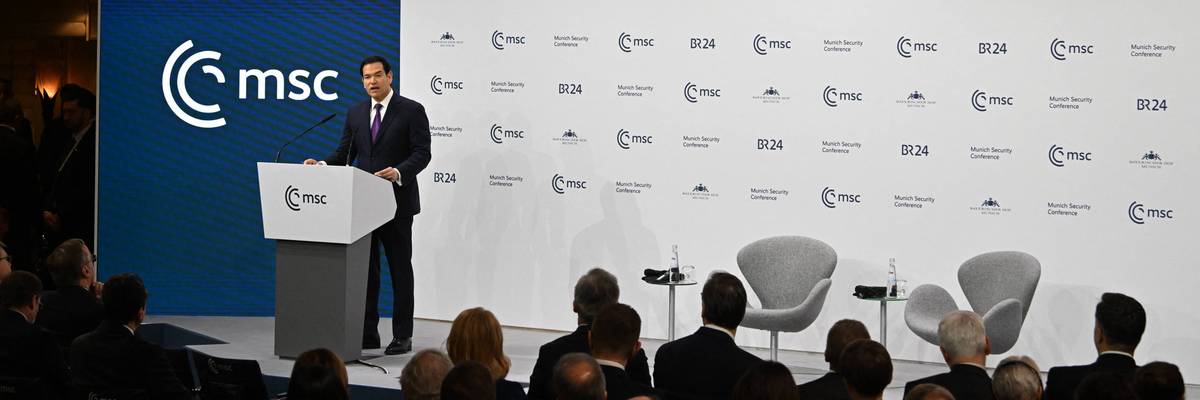
US Secretary of State Marco Rubio speaks during the 62nd Munich Security Conference on February 14, 2026 in Munich, southern Germany.
As he is surely a 2028 presidential hopeful, Marco Rubio is a real threat to the better world we hope to build.
MAGA has been, throughout, an amorphous entity—curling, folding, dividing—as it slimed and slithered its way into this American life. Neocon MAGA is one particularly noteworthy division within, a more-than-slightly schizophrenic aberration that, if MAGA-world had any interest in maintaining conceptual coherence, would surely have long ago been run out of town.
Secretary of State Marco Rubio is Neocon MAGA’s chief exemplar. In contrast to unreconstructed neocons like Lindsay Graham and John Bolton, who have tried to bootlick their way into President Donald Trump's good graces with spotty results, “Little Marco” was a neoconservative boy who has growth-spurted his way into a Neocon MAGA man.
Rubio recently gave a very buzzy speech at the Munich Security Conference on the 14 of February. This speech was received warmly by a crowd of beleaguered European leaders, threadbare from a year of belligerent rhetoric and mercenary tariff threats by the very Trump administration that Rubio is also underwritten by. In this speech, Rubio argued passionately that the West has lost its mojo. Rubio confidently slalom-skied his way through ideas and histories whose engagement he has only a mediocre competency, replete with omissions and partial truths that start to make one think he just might not be an honest broker. As his speech rounded one particular bend, his central thesis came into view: that ever since 1945, with the formation of the United Nations and what is often called the rules-based order, the West has become, despite its gloriously pearlescent past, a civilization in “terminal decline.” But with strategic solidarity (between Europe and the US), we might restore this civilization to its former greatness. That is his thesis.
There is a lot that is concerning about this speech. Rubio presented anti-colonialist uprisings as a categorically negative thing. He trumpeted dominance as the long-lost coin of the realm. He posited guilt and shame as some pathetic weakness, without any acknowledgment of the truly generative corrective that these kinds of senses can perform. He sounded the alarm about “civilizational erasure,” without buckling even a little under the weight of the cultural and racial supremacy on full display in his language and its implications. This was an expansionary speech, hoisting the sails of Make America Great Again into a full armada of Make Imperialist West Imperialist Again, with all the attendant wink-wink, nudge-nudging that sets folks like this Munich audience into full transfiguration mode, their countenance aglow.
To say European settler immigrants failed to assimilate once they got here would be a remarkable understatement.
But one significant contradiction in his speech that warrants analysis—if not only by me, then his lovingly concerned, anti-immigrant MAGA brothers and sisters—is his profuse, unqualified celebration of relentless, centuries-long, mass migration: the mass migration of westerners to remote corners of the world. In a section of his speech, Rubio enthusiastically proclaims: “For five centuries, before the end of the Second World War, the West had been expanding—its missionaries, its pilgrims, its soldiers, its explorers pouring out from its shores to cross oceans, settle new continents, build vast empires extending out across the globe.” I mean, come on. Eat your heart out, leftists (or at least the conservative caricature of leftists)! If ever there was a sentiment expressed about a world without borders, this is it.
If JD Vance is concerned about Ohio Haitians eating cats or Randi Fine is concerned that immigrants are here to get “free stuff,” Vance and Fine's vision quests and critical discourse are in pursuit of small potatoes compared with the horrors Western settlers propagated in the “new world.” To say European settler immigrants failed to assimilate once they got here would be a remarkable understatement. Rubio enthusiastically and playfully (he got some laughs; he was working the room) detailed the many, MAGA would say, illegitimate border-crossers (illegals?!) who radically altered the fabric of life of the people who lived in these lands: Italian explorers, English settlers, German farmers, and French fur traders.
But, in a section just a little bit earlier, Rubio seemed to suggest migration is a bad thing, saying, “Mass migration is not, was not, isn’t some fringe concern of little consequence. It was and continues to be a crisis that is transforming and destabilizing societies all across the West.” How far can coherence stretch before it snaps? What are the material differences between one migration and this other migration?! It can not only be because now is the time of nation-states who “have a right to exist” and require hardened borders, but then was a time of exploration, expansion, and settlements—different times, different rules—because Rubio is, in a very Winkelmannian sense (J.J. Winkelmann, the German neoclassical art historian extraordinaire), imploring us to do now as our imperialist forbears did then. To do as great men of great civilizations did is the way for us to become great. If that is the logic, then what really is the difference among these migrations?
In, what was meant to be a particularly touching section of the speech, Rubio details his Sardinian and Spanish ancestry, name-dropping good old Lorenzo and Catalina Geroldi and Jose and Manuela Reina, who he feels could not have fathomed (and he probably believes would have been very proud) that their direct descendant would have graduated from neocon “Little Marco” to Big Boy Marco giving his big boy speech. But that story excludes an even more critical and thoroughly American portion of the Rubio family history. The Rubios are a family of immigrants, of course. They migrated at some point from Southern Europe to Cuba; the details of what prompted that migration are perhaps lost to history. But then Marco Rubio’s parents migrated from Cuba to the US, not as refugees fleeing the Castro regime and the supposed horrors of communism as he has erroneously claimed. But rather as economic migrants seeking a more prosperous life for their family in the US, a few years before Fidel Castro started organizing in the Sierra Maestra mountains, propelled by the very same economic misery that caused the Rubios to leave a few years earlier.
While Rubio’s family moved around the US a bit when he was quite young, the South Florida Cuban migrant community was enormously culturally, politically, and spiritually (Marco received his first communion in Miami in 1984) formative. Many have speculated that his false claims of his parents being political refugees forced to leave Cuba post-revolution, which were debunked by the Washington Post in 2011, were motivated by the reality that, as a young South Floridian politician, one has far more electoral opportunities connected to such a political-victim narrative. The Post stated, “[in] Florida, being connected to the post-revolution exile community gives a politician cachet that could never be achieved by someone identified with the pre-Castro exodus, a group sometimes viewed with suspicion." Rubio has argued his narrative was not meant to deceive for political gain, but rather he was just innocently presenting “family lore.”
The reality is that in a speech like what Marco Rubio gave in Munich, there are many assumptions, biases, and contradictions harbored unexamined by this dominant neoliberal capitalist logic. A “migration for me, not for thee” doctrine is allowed to float unimpeded and unquestioned out of the mouths of low melanin-faced folks who hail from particularly choice real-estate markets (preferably Western Europe and the US) because it is underwritten by a system of logic that forgives an ethnic cleansing here, a theft of Black and brown bodies there on the grounds of the “price of doing business.” There is a straight and logical line between the enclosures of common land and the attendant immiseration of peasants and the consolidation of wealth and power among the elites in England in the 16th to 19th centuries, and the brutal colonial enclosure of the Americas in this same period. The difference is scale, not type.
An alternate logic to the domination, conquest, and hard borders of global capitalism is left internationalism. In global capitalism, goods and wealth freely pass across borders, while workers’ bodies and their class solidarities are captured and enclosed. Left internationalist logic is the inverse of global capitalist logic. Left internationalism promotes class solidarity across borders, it rejects nationalist ideologies that align workers with their exploiters, and it seeks global well-being in the face of the very kind of neo-imperialism with which Rubio’s speech is shot through. Left internationalism asks us to see the Global South as an opportunity for planetary solidarity—a real lifting of all boats—not as a region of resource riches ripe for plunder.
There was a time in our not-so-distant past when the US border was far more porous than even the laxest moments of the Biden years. This was a border over which migrant workers came and went, sometimes in the same day, sometimes for a season, to work in various opportunity regions in the US. They would do their work here and then return to their homes and families on the other side of the border. This was a remarkably open flow of bodies across borders, not because of any dominant radical-leftist theory, but because it was a practical arrangement that offered benefits to the greatest number of people. And it worked. If only Make America Great Again harkened back to instances like this, or when American communists and anarchists agitated for and won (for all of us) better working conditions and an eight-hour workday. These are times in our history when the US still had enormous problems, of course. But these were also times when we were seeing real progress, won together across cultural and racial differences in class solidarity.
In 2015, Pope Francis addressed the US Congress, saying, “Millions of people came to this land to pursue their dream of building a future in freedom. We, the people of this continent, are not fearful of foreigners because most of us were once foreigners. I say this to you as the son of immigrants, knowing that so many of you are also descendants of immigrants.” It was reported at the time that then-Senator and candidate for president Marco Rubio became emotional from this speech, stating later that he was “moved” by the Pope’s statements. Some reported he wiped a tear from his eye. This suggests that Rubio, like all of us, holds his contradictions in his body. And sometimes, we experience an involuntary, emotionally eruptive response to our efforts to contain those contradictions inside. Rubio’s contradictions, of course, include the incongruent differences between MAGA and neoconservatism. But his emotional display may, just may, evidence contradictions inherent in his status as a self-hating child of immigrants, making his otherwise frictionless slide toward neo-imperialist par excellence perhaps a bit complicated.
As he is surely a 2028 presidential hopeful, he is a real threat to the better world we hope to build. The prayers and tears of Marco Rubio may have the potential of curtailing (or at least moderating) Little Marco’s seeming unobstructed pathway to the tyrannical monster he may one day be. But left to this administration’s current direction and the almost unprecedented amount of power Rubio has amassed as both the US secretary of state and national security adviser serving under a remarkably distractible and aimless president, MAGA may very well complete its foul transmutation into MIWIA (Make Imperialist West Imperialist Again).
Dear Common Dreams reader, It’s been nearly 30 years since I co-founded Common Dreams with my late wife, Lina Newhouser. We had the radical notion that journalism should serve the public good, not corporate profits. It was clear to us from the outset what it would take to build such a project. No paid advertisements. No corporate sponsors. No millionaire publisher telling us what to think or do. Many people said we wouldn't last a year, but we proved those doubters wrong. Together with a tremendous team of journalists and dedicated staff, we built an independent media outlet free from the constraints of profits and corporate control. Our mission has always been simple: To inform. To inspire. To ignite change for the common good. Building Common Dreams was not easy. Our survival was never guaranteed. When you take on the most powerful forces—Wall Street greed, fossil fuel industry destruction, Big Tech lobbyists, and uber-rich oligarchs who have spent billions upon billions rigging the economy and democracy in their favor—the only bulwark you have is supporters who believe in your work. But here’s the urgent message from me today. It's never been this bad out there. And it's never been this hard to keep us going. At the very moment Common Dreams is most needed, the threats we face are intensifying. We need your support now more than ever. We don't accept corporate advertising and never will. We don't have a paywall because we don't think people should be blocked from critical news based on their ability to pay. Everything we do is funded by the donations of readers like you. When everyone does the little they can afford, we are strong. But if that support retreats or dries up, so do we. Will you donate now to make sure Common Dreams not only survives but thrives? —Craig Brown, Co-founder |
MAGA has been, throughout, an amorphous entity—curling, folding, dividing—as it slimed and slithered its way into this American life. Neocon MAGA is one particularly noteworthy division within, a more-than-slightly schizophrenic aberration that, if MAGA-world had any interest in maintaining conceptual coherence, would surely have long ago been run out of town.
Secretary of State Marco Rubio is Neocon MAGA’s chief exemplar. In contrast to unreconstructed neocons like Lindsay Graham and John Bolton, who have tried to bootlick their way into President Donald Trump's good graces with spotty results, “Little Marco” was a neoconservative boy who has growth-spurted his way into a Neocon MAGA man.
Rubio recently gave a very buzzy speech at the Munich Security Conference on the 14 of February. This speech was received warmly by a crowd of beleaguered European leaders, threadbare from a year of belligerent rhetoric and mercenary tariff threats by the very Trump administration that Rubio is also underwritten by. In this speech, Rubio argued passionately that the West has lost its mojo. Rubio confidently slalom-skied his way through ideas and histories whose engagement he has only a mediocre competency, replete with omissions and partial truths that start to make one think he just might not be an honest broker. As his speech rounded one particular bend, his central thesis came into view: that ever since 1945, with the formation of the United Nations and what is often called the rules-based order, the West has become, despite its gloriously pearlescent past, a civilization in “terminal decline.” But with strategic solidarity (between Europe and the US), we might restore this civilization to its former greatness. That is his thesis.
There is a lot that is concerning about this speech. Rubio presented anti-colonialist uprisings as a categorically negative thing. He trumpeted dominance as the long-lost coin of the realm. He posited guilt and shame as some pathetic weakness, without any acknowledgment of the truly generative corrective that these kinds of senses can perform. He sounded the alarm about “civilizational erasure,” without buckling even a little under the weight of the cultural and racial supremacy on full display in his language and its implications. This was an expansionary speech, hoisting the sails of Make America Great Again into a full armada of Make Imperialist West Imperialist Again, with all the attendant wink-wink, nudge-nudging that sets folks like this Munich audience into full transfiguration mode, their countenance aglow.
To say European settler immigrants failed to assimilate once they got here would be a remarkable understatement.
But one significant contradiction in his speech that warrants analysis—if not only by me, then his lovingly concerned, anti-immigrant MAGA brothers and sisters—is his profuse, unqualified celebration of relentless, centuries-long, mass migration: the mass migration of westerners to remote corners of the world. In a section of his speech, Rubio enthusiastically proclaims: “For five centuries, before the end of the Second World War, the West had been expanding—its missionaries, its pilgrims, its soldiers, its explorers pouring out from its shores to cross oceans, settle new continents, build vast empires extending out across the globe.” I mean, come on. Eat your heart out, leftists (or at least the conservative caricature of leftists)! If ever there was a sentiment expressed about a world without borders, this is it.
If JD Vance is concerned about Ohio Haitians eating cats or Randi Fine is concerned that immigrants are here to get “free stuff,” Vance and Fine's vision quests and critical discourse are in pursuit of small potatoes compared with the horrors Western settlers propagated in the “new world.” To say European settler immigrants failed to assimilate once they got here would be a remarkable understatement. Rubio enthusiastically and playfully (he got some laughs; he was working the room) detailed the many, MAGA would say, illegitimate border-crossers (illegals?!) who radically altered the fabric of life of the people who lived in these lands: Italian explorers, English settlers, German farmers, and French fur traders.
But, in a section just a little bit earlier, Rubio seemed to suggest migration is a bad thing, saying, “Mass migration is not, was not, isn’t some fringe concern of little consequence. It was and continues to be a crisis that is transforming and destabilizing societies all across the West.” How far can coherence stretch before it snaps? What are the material differences between one migration and this other migration?! It can not only be because now is the time of nation-states who “have a right to exist” and require hardened borders, but then was a time of exploration, expansion, and settlements—different times, different rules—because Rubio is, in a very Winkelmannian sense (J.J. Winkelmann, the German neoclassical art historian extraordinaire), imploring us to do now as our imperialist forbears did then. To do as great men of great civilizations did is the way for us to become great. If that is the logic, then what really is the difference among these migrations?
In, what was meant to be a particularly touching section of the speech, Rubio details his Sardinian and Spanish ancestry, name-dropping good old Lorenzo and Catalina Geroldi and Jose and Manuela Reina, who he feels could not have fathomed (and he probably believes would have been very proud) that their direct descendant would have graduated from neocon “Little Marco” to Big Boy Marco giving his big boy speech. But that story excludes an even more critical and thoroughly American portion of the Rubio family history. The Rubios are a family of immigrants, of course. They migrated at some point from Southern Europe to Cuba; the details of what prompted that migration are perhaps lost to history. But then Marco Rubio’s parents migrated from Cuba to the US, not as refugees fleeing the Castro regime and the supposed horrors of communism as he has erroneously claimed. But rather as economic migrants seeking a more prosperous life for their family in the US, a few years before Fidel Castro started organizing in the Sierra Maestra mountains, propelled by the very same economic misery that caused the Rubios to leave a few years earlier.
While Rubio’s family moved around the US a bit when he was quite young, the South Florida Cuban migrant community was enormously culturally, politically, and spiritually (Marco received his first communion in Miami in 1984) formative. Many have speculated that his false claims of his parents being political refugees forced to leave Cuba post-revolution, which were debunked by the Washington Post in 2011, were motivated by the reality that, as a young South Floridian politician, one has far more electoral opportunities connected to such a political-victim narrative. The Post stated, “[in] Florida, being connected to the post-revolution exile community gives a politician cachet that could never be achieved by someone identified with the pre-Castro exodus, a group sometimes viewed with suspicion." Rubio has argued his narrative was not meant to deceive for political gain, but rather he was just innocently presenting “family lore.”
The reality is that in a speech like what Marco Rubio gave in Munich, there are many assumptions, biases, and contradictions harbored unexamined by this dominant neoliberal capitalist logic. A “migration for me, not for thee” doctrine is allowed to float unimpeded and unquestioned out of the mouths of low melanin-faced folks who hail from particularly choice real-estate markets (preferably Western Europe and the US) because it is underwritten by a system of logic that forgives an ethnic cleansing here, a theft of Black and brown bodies there on the grounds of the “price of doing business.” There is a straight and logical line between the enclosures of common land and the attendant immiseration of peasants and the consolidation of wealth and power among the elites in England in the 16th to 19th centuries, and the brutal colonial enclosure of the Americas in this same period. The difference is scale, not type.
An alternate logic to the domination, conquest, and hard borders of global capitalism is left internationalism. In global capitalism, goods and wealth freely pass across borders, while workers’ bodies and their class solidarities are captured and enclosed. Left internationalist logic is the inverse of global capitalist logic. Left internationalism promotes class solidarity across borders, it rejects nationalist ideologies that align workers with their exploiters, and it seeks global well-being in the face of the very kind of neo-imperialism with which Rubio’s speech is shot through. Left internationalism asks us to see the Global South as an opportunity for planetary solidarity—a real lifting of all boats—not as a region of resource riches ripe for plunder.
There was a time in our not-so-distant past when the US border was far more porous than even the laxest moments of the Biden years. This was a border over which migrant workers came and went, sometimes in the same day, sometimes for a season, to work in various opportunity regions in the US. They would do their work here and then return to their homes and families on the other side of the border. This was a remarkably open flow of bodies across borders, not because of any dominant radical-leftist theory, but because it was a practical arrangement that offered benefits to the greatest number of people. And it worked. If only Make America Great Again harkened back to instances like this, or when American communists and anarchists agitated for and won (for all of us) better working conditions and an eight-hour workday. These are times in our history when the US still had enormous problems, of course. But these were also times when we were seeing real progress, won together across cultural and racial differences in class solidarity.
In 2015, Pope Francis addressed the US Congress, saying, “Millions of people came to this land to pursue their dream of building a future in freedom. We, the people of this continent, are not fearful of foreigners because most of us were once foreigners. I say this to you as the son of immigrants, knowing that so many of you are also descendants of immigrants.” It was reported at the time that then-Senator and candidate for president Marco Rubio became emotional from this speech, stating later that he was “moved” by the Pope’s statements. Some reported he wiped a tear from his eye. This suggests that Rubio, like all of us, holds his contradictions in his body. And sometimes, we experience an involuntary, emotionally eruptive response to our efforts to contain those contradictions inside. Rubio’s contradictions, of course, include the incongruent differences between MAGA and neoconservatism. But his emotional display may, just may, evidence contradictions inherent in his status as a self-hating child of immigrants, making his otherwise frictionless slide toward neo-imperialist par excellence perhaps a bit complicated.
As he is surely a 2028 presidential hopeful, he is a real threat to the better world we hope to build. The prayers and tears of Marco Rubio may have the potential of curtailing (or at least moderating) Little Marco’s seeming unobstructed pathway to the tyrannical monster he may one day be. But left to this administration’s current direction and the almost unprecedented amount of power Rubio has amassed as both the US secretary of state and national security adviser serving under a remarkably distractible and aimless president, MAGA may very well complete its foul transmutation into MIWIA (Make Imperialist West Imperialist Again).
MAGA has been, throughout, an amorphous entity—curling, folding, dividing—as it slimed and slithered its way into this American life. Neocon MAGA is one particularly noteworthy division within, a more-than-slightly schizophrenic aberration that, if MAGA-world had any interest in maintaining conceptual coherence, would surely have long ago been run out of town.
Secretary of State Marco Rubio is Neocon MAGA’s chief exemplar. In contrast to unreconstructed neocons like Lindsay Graham and John Bolton, who have tried to bootlick their way into President Donald Trump's good graces with spotty results, “Little Marco” was a neoconservative boy who has growth-spurted his way into a Neocon MAGA man.
Rubio recently gave a very buzzy speech at the Munich Security Conference on the 14 of February. This speech was received warmly by a crowd of beleaguered European leaders, threadbare from a year of belligerent rhetoric and mercenary tariff threats by the very Trump administration that Rubio is also underwritten by. In this speech, Rubio argued passionately that the West has lost its mojo. Rubio confidently slalom-skied his way through ideas and histories whose engagement he has only a mediocre competency, replete with omissions and partial truths that start to make one think he just might not be an honest broker. As his speech rounded one particular bend, his central thesis came into view: that ever since 1945, with the formation of the United Nations and what is often called the rules-based order, the West has become, despite its gloriously pearlescent past, a civilization in “terminal decline.” But with strategic solidarity (between Europe and the US), we might restore this civilization to its former greatness. That is his thesis.
There is a lot that is concerning about this speech. Rubio presented anti-colonialist uprisings as a categorically negative thing. He trumpeted dominance as the long-lost coin of the realm. He posited guilt and shame as some pathetic weakness, without any acknowledgment of the truly generative corrective that these kinds of senses can perform. He sounded the alarm about “civilizational erasure,” without buckling even a little under the weight of the cultural and racial supremacy on full display in his language and its implications. This was an expansionary speech, hoisting the sails of Make America Great Again into a full armada of Make Imperialist West Imperialist Again, with all the attendant wink-wink, nudge-nudging that sets folks like this Munich audience into full transfiguration mode, their countenance aglow.
To say European settler immigrants failed to assimilate once they got here would be a remarkable understatement.
But one significant contradiction in his speech that warrants analysis—if not only by me, then his lovingly concerned, anti-immigrant MAGA brothers and sisters—is his profuse, unqualified celebration of relentless, centuries-long, mass migration: the mass migration of westerners to remote corners of the world. In a section of his speech, Rubio enthusiastically proclaims: “For five centuries, before the end of the Second World War, the West had been expanding—its missionaries, its pilgrims, its soldiers, its explorers pouring out from its shores to cross oceans, settle new continents, build vast empires extending out across the globe.” I mean, come on. Eat your heart out, leftists (or at least the conservative caricature of leftists)! If ever there was a sentiment expressed about a world without borders, this is it.
If JD Vance is concerned about Ohio Haitians eating cats or Randi Fine is concerned that immigrants are here to get “free stuff,” Vance and Fine's vision quests and critical discourse are in pursuit of small potatoes compared with the horrors Western settlers propagated in the “new world.” To say European settler immigrants failed to assimilate once they got here would be a remarkable understatement. Rubio enthusiastically and playfully (he got some laughs; he was working the room) detailed the many, MAGA would say, illegitimate border-crossers (illegals?!) who radically altered the fabric of life of the people who lived in these lands: Italian explorers, English settlers, German farmers, and French fur traders.
But, in a section just a little bit earlier, Rubio seemed to suggest migration is a bad thing, saying, “Mass migration is not, was not, isn’t some fringe concern of little consequence. It was and continues to be a crisis that is transforming and destabilizing societies all across the West.” How far can coherence stretch before it snaps? What are the material differences between one migration and this other migration?! It can not only be because now is the time of nation-states who “have a right to exist” and require hardened borders, but then was a time of exploration, expansion, and settlements—different times, different rules—because Rubio is, in a very Winkelmannian sense (J.J. Winkelmann, the German neoclassical art historian extraordinaire), imploring us to do now as our imperialist forbears did then. To do as great men of great civilizations did is the way for us to become great. If that is the logic, then what really is the difference among these migrations?
In, what was meant to be a particularly touching section of the speech, Rubio details his Sardinian and Spanish ancestry, name-dropping good old Lorenzo and Catalina Geroldi and Jose and Manuela Reina, who he feels could not have fathomed (and he probably believes would have been very proud) that their direct descendant would have graduated from neocon “Little Marco” to Big Boy Marco giving his big boy speech. But that story excludes an even more critical and thoroughly American portion of the Rubio family history. The Rubios are a family of immigrants, of course. They migrated at some point from Southern Europe to Cuba; the details of what prompted that migration are perhaps lost to history. But then Marco Rubio’s parents migrated from Cuba to the US, not as refugees fleeing the Castro regime and the supposed horrors of communism as he has erroneously claimed. But rather as economic migrants seeking a more prosperous life for their family in the US, a few years before Fidel Castro started organizing in the Sierra Maestra mountains, propelled by the very same economic misery that caused the Rubios to leave a few years earlier.
While Rubio’s family moved around the US a bit when he was quite young, the South Florida Cuban migrant community was enormously culturally, politically, and spiritually (Marco received his first communion in Miami in 1984) formative. Many have speculated that his false claims of his parents being political refugees forced to leave Cuba post-revolution, which were debunked by the Washington Post in 2011, were motivated by the reality that, as a young South Floridian politician, one has far more electoral opportunities connected to such a political-victim narrative. The Post stated, “[in] Florida, being connected to the post-revolution exile community gives a politician cachet that could never be achieved by someone identified with the pre-Castro exodus, a group sometimes viewed with suspicion." Rubio has argued his narrative was not meant to deceive for political gain, but rather he was just innocently presenting “family lore.”
The reality is that in a speech like what Marco Rubio gave in Munich, there are many assumptions, biases, and contradictions harbored unexamined by this dominant neoliberal capitalist logic. A “migration for me, not for thee” doctrine is allowed to float unimpeded and unquestioned out of the mouths of low melanin-faced folks who hail from particularly choice real-estate markets (preferably Western Europe and the US) because it is underwritten by a system of logic that forgives an ethnic cleansing here, a theft of Black and brown bodies there on the grounds of the “price of doing business.” There is a straight and logical line between the enclosures of common land and the attendant immiseration of peasants and the consolidation of wealth and power among the elites in England in the 16th to 19th centuries, and the brutal colonial enclosure of the Americas in this same period. The difference is scale, not type.
An alternate logic to the domination, conquest, and hard borders of global capitalism is left internationalism. In global capitalism, goods and wealth freely pass across borders, while workers’ bodies and their class solidarities are captured and enclosed. Left internationalist logic is the inverse of global capitalist logic. Left internationalism promotes class solidarity across borders, it rejects nationalist ideologies that align workers with their exploiters, and it seeks global well-being in the face of the very kind of neo-imperialism with which Rubio’s speech is shot through. Left internationalism asks us to see the Global South as an opportunity for planetary solidarity—a real lifting of all boats—not as a region of resource riches ripe for plunder.
There was a time in our not-so-distant past when the US border was far more porous than even the laxest moments of the Biden years. This was a border over which migrant workers came and went, sometimes in the same day, sometimes for a season, to work in various opportunity regions in the US. They would do their work here and then return to their homes and families on the other side of the border. This was a remarkably open flow of bodies across borders, not because of any dominant radical-leftist theory, but because it was a practical arrangement that offered benefits to the greatest number of people. And it worked. If only Make America Great Again harkened back to instances like this, or when American communists and anarchists agitated for and won (for all of us) better working conditions and an eight-hour workday. These are times in our history when the US still had enormous problems, of course. But these were also times when we were seeing real progress, won together across cultural and racial differences in class solidarity.
In 2015, Pope Francis addressed the US Congress, saying, “Millions of people came to this land to pursue their dream of building a future in freedom. We, the people of this continent, are not fearful of foreigners because most of us were once foreigners. I say this to you as the son of immigrants, knowing that so many of you are also descendants of immigrants.” It was reported at the time that then-Senator and candidate for president Marco Rubio became emotional from this speech, stating later that he was “moved” by the Pope’s statements. Some reported he wiped a tear from his eye. This suggests that Rubio, like all of us, holds his contradictions in his body. And sometimes, we experience an involuntary, emotionally eruptive response to our efforts to contain those contradictions inside. Rubio’s contradictions, of course, include the incongruent differences between MAGA and neoconservatism. But his emotional display may, just may, evidence contradictions inherent in his status as a self-hating child of immigrants, making his otherwise frictionless slide toward neo-imperialist par excellence perhaps a bit complicated.
As he is surely a 2028 presidential hopeful, he is a real threat to the better world we hope to build. The prayers and tears of Marco Rubio may have the potential of curtailing (or at least moderating) Little Marco’s seeming unobstructed pathway to the tyrannical monster he may one day be. But left to this administration’s current direction and the almost unprecedented amount of power Rubio has amassed as both the US secretary of state and national security adviser serving under a remarkably distractible and aimless president, MAGA may very well complete its foul transmutation into MIWIA (Make Imperialist West Imperialist Again).