SUBSCRIBE TO OUR FREE NEWSLETTER
Daily news & progressive opinion—funded by the people, not the corporations—delivered straight to your inbox.
5
#000000
#FFFFFF
To donate by check, phone, or other method, see our More Ways to Give page.
Daily news & progressive opinion—funded by the people, not the corporations—delivered straight to your inbox.
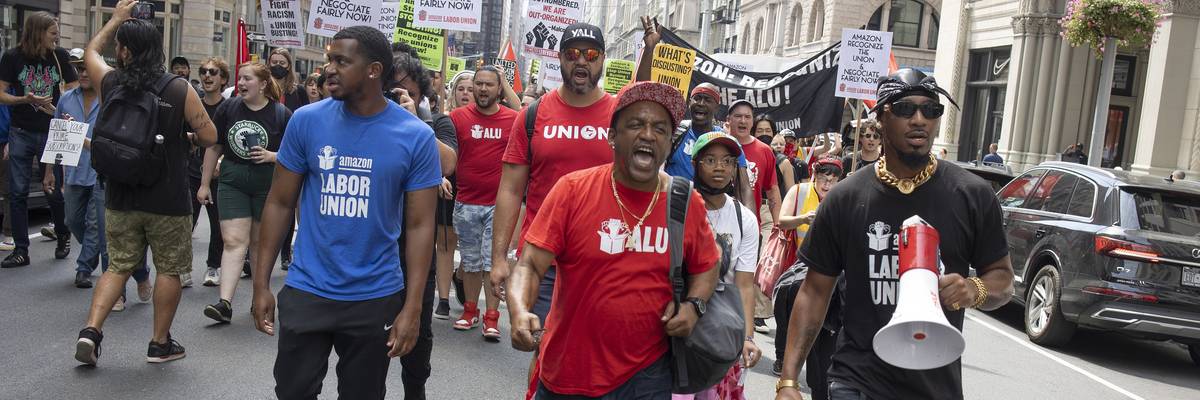
Chris Smalls, a leader of the Amazon Labor Union, leads a march of Starbucks and Amazon workers and their allies to the homes of their CEOs to protest union busting on Labor Day, September 5, 2022, in New York City, New York.
Labor Day can be converted from just a symbolic holiday into a day of mass action, democratic deliberation, and binding commitments.
Unfortunately, Labor Day has become a long weekend for mattress sales and political platitudes when it should be the annual day when working people present the case for taking control of our country back from the corporatists who shape our political economy. The first Monday in September is a massive, unused civic asset, a legally recognized national holiday that could function as a recurring general assembly of America’s workers—if we choose to reclaim it.
Instead of being about the power of labor over capital, Labor Day has been domesticated into barbecues and ballgames while giant corporations tighten their grip on our economy, our governments, and the daily lives of all Americans, regardless of political labels.
Tens of millions of workers are still paid wages that cannot support a decent life, forced into permanent economic insecurity by part‑time jobs, gig “contracts,” and union‑busting consultants. Workplace democracy doesn’t exist: You are more likely to be punished for organizing a union than to be protected for exercising your basic rights. Corporate crime—tax evasions, wage theft, unsafe conditions, and violations of environmental and consumer protections—goes largely unprosecuted. At most, corporations are punished with wrist‑slap fines that CEOs quietly treat as a cost of doing business. In the richest country on Earth, we still lack universal healthcare, universal childcare, paid family leave, and a fair progressive tax system to provide needed revenues. Worker productivity rises, and the wealth of the top 1% reaches obscene levels. It is time for unions to take on the corporate predators who are wrecking our economy and democracy.
Meanwhile, politicians of both major parties take to Labor Day podiums, praise “the hardworking men and women of this country,” and then return to Washington and state capitols to do the bidding of campaign donors. They vote for trade deals that outsource jobs, deregulation that strips away workplace protections, and budgets that starve labor law enforcement. Public‑sector workers are vilified as “special interests” for wanting a decent pension.
Reclaiming Labor Day requires workers, unions, and allied organizations to decide that enough is enough and that this one annual holiday is theirs, with the media taking notice.
It does not have to be this way. Labor Day can be converted from just a symbolic holiday into a day of mass action, democratic deliberation, and binding commitments. Imagine Labor Day not as a backdrop for store sales, but as a day when a pro-worker agenda is presented. In cities and towns across the country, Labor Day could be an occasion for workers to convene meetings—at union halls, school auditoriums, public parks, and town squares—to deliver their demands to elected officials and the public.
At the center of this reclaimed Labor Day should be a Worker Compact for America—a concise, concrete program of rights, protections, and public investments that elected officials pledge, in writing, to support (see my column: "Long-Overdue Domestic Compact for America"). The Compact could include a living wage pegged to the real cost of housing, food, and healthcare; card‑check recognition and real penalties for employers who retaliate against organizing; universal healthcare as a right; paid family and medical leave; universal, publicly supported childcare; and serious criminal and civil sanctions for corporate abuses such as wage and pension theft and workplace safety violations.
Labor Day should also be the moment when workers formally summon their representatives to account. Every senator, every representative, every governor, every mayor, and every state legislator whose constituents work for a living should receive a written summons well in advance of Labor Day: “You are Summoned and morally obligated to engage with a workers’ assembly in your district on this date, at this time, to answer questions and respond to demands of the Worker Compact.” Those who appear would be questioned, on the record, about their votes and their pledges to support the Worker Compact.
Those who refuse to appear would be named from the podium and in the local media as having chosen their corporate patrons over the workers who elect them.
Unions must be at the forefront of this transformation, but they cannot do it alone. The AFL‑CIO and national unions should provide muscle, resources, and experienced organizers. Local unions, especially those that have led recent organizing drives, should be the anchors in their communities. But civic groups, faith communities, student organizations, tenant unions, consumer advocates, and environmental justice campaigns—all of them have a direct stake in a stronger labor movement and should be invited to help expose the carnage caused by unchecked Corporate Power (see the AFL-CIO’s Worker Foundation of Trump’s Second-Term Agenda).
Much of the infrastructure already exists; it is the public reshaping of Labor Day that needs to change. Parades, where they still occur, should shift from generic celebration to worker agenda‑driven demonstrations. Floats should not just carry politicians waving; they should carry workers demanding specific changes: warehouse workers calling for safe staffing, nurses calling for safe patient ratios, and transit workers calling for investment in public transportation. Marching bands can be joined by marching delegations of workers—each with their banners and demands. Voter registration tables, ballot measure petitions, and sign‑up sheets for organizing committees should line the parade routes.
Because of the election calendar, Labor Day signals the final stretch of every general election. Candidate forums convened by workers on Labor Day should not end at sundown; they should kick off sustained, workplace-based, and neighborhood‑based organizing that runs through Election Day and beyond. Every candidate who signs the Worker Compact on Labor Day should be evaluated: Did they co‑sponsor the bills they promised to support, vote the way they pledged, and stand with workers in strikes and organizing drives? The next Labor Day, those records should again be publicized.
Reclaiming Labor Day requires workers, unions, and allied organizations to decide that enough is enough and that this one annual holiday is theirs, with the media taking notice.
The question posed every first Monday in September is the old union question: Which side are you on? If we are on the side of workers, then we must act like it—organizing, summoning, demanding, and voting for candidates who stand with the workers, not the vastly under-taxed corporate predators and plutocrats.
If you are interested in organizing events in your community, contact us at LaborDay@nader.org
Dear Common Dreams reader, It’s been nearly 30 years since I co-founded Common Dreams with my late wife, Lina Newhouser. We had the radical notion that journalism should serve the public good, not corporate profits. It was clear to us from the outset what it would take to build such a project. No paid advertisements. No corporate sponsors. No millionaire publisher telling us what to think or do. Many people said we wouldn't last a year, but we proved those doubters wrong. Together with a tremendous team of journalists and dedicated staff, we built an independent media outlet free from the constraints of profits and corporate control. Our mission has always been simple: To inform. To inspire. To ignite change for the common good. Building Common Dreams was not easy. Our survival was never guaranteed. When you take on the most powerful forces—Wall Street greed, fossil fuel industry destruction, Big Tech lobbyists, and uber-rich oligarchs who have spent billions upon billions rigging the economy and democracy in their favor—the only bulwark you have is supporters who believe in your work. But here’s the urgent message from me today. It's never been this bad out there. And it's never been this hard to keep us going. At the very moment Common Dreams is most needed, the threats we face are intensifying. We need your support now more than ever. We don't accept corporate advertising and never will. We don't have a paywall because we don't think people should be blocked from critical news based on their ability to pay. Everything we do is funded by the donations of readers like you. When everyone does the little they can afford, we are strong. But if that support retreats or dries up, so do we. Will you donate now to make sure Common Dreams not only survives but thrives? —Craig Brown, Co-founder |
Unfortunately, Labor Day has become a long weekend for mattress sales and political platitudes when it should be the annual day when working people present the case for taking control of our country back from the corporatists who shape our political economy. The first Monday in September is a massive, unused civic asset, a legally recognized national holiday that could function as a recurring general assembly of America’s workers—if we choose to reclaim it.
Instead of being about the power of labor over capital, Labor Day has been domesticated into barbecues and ballgames while giant corporations tighten their grip on our economy, our governments, and the daily lives of all Americans, regardless of political labels.
Tens of millions of workers are still paid wages that cannot support a decent life, forced into permanent economic insecurity by part‑time jobs, gig “contracts,” and union‑busting consultants. Workplace democracy doesn’t exist: You are more likely to be punished for organizing a union than to be protected for exercising your basic rights. Corporate crime—tax evasions, wage theft, unsafe conditions, and violations of environmental and consumer protections—goes largely unprosecuted. At most, corporations are punished with wrist‑slap fines that CEOs quietly treat as a cost of doing business. In the richest country on Earth, we still lack universal healthcare, universal childcare, paid family leave, and a fair progressive tax system to provide needed revenues. Worker productivity rises, and the wealth of the top 1% reaches obscene levels. It is time for unions to take on the corporate predators who are wrecking our economy and democracy.
Meanwhile, politicians of both major parties take to Labor Day podiums, praise “the hardworking men and women of this country,” and then return to Washington and state capitols to do the bidding of campaign donors. They vote for trade deals that outsource jobs, deregulation that strips away workplace protections, and budgets that starve labor law enforcement. Public‑sector workers are vilified as “special interests” for wanting a decent pension.
Reclaiming Labor Day requires workers, unions, and allied organizations to decide that enough is enough and that this one annual holiday is theirs, with the media taking notice.
It does not have to be this way. Labor Day can be converted from just a symbolic holiday into a day of mass action, democratic deliberation, and binding commitments. Imagine Labor Day not as a backdrop for store sales, but as a day when a pro-worker agenda is presented. In cities and towns across the country, Labor Day could be an occasion for workers to convene meetings—at union halls, school auditoriums, public parks, and town squares—to deliver their demands to elected officials and the public.
At the center of this reclaimed Labor Day should be a Worker Compact for America—a concise, concrete program of rights, protections, and public investments that elected officials pledge, in writing, to support (see my column: "Long-Overdue Domestic Compact for America"). The Compact could include a living wage pegged to the real cost of housing, food, and healthcare; card‑check recognition and real penalties for employers who retaliate against organizing; universal healthcare as a right; paid family and medical leave; universal, publicly supported childcare; and serious criminal and civil sanctions for corporate abuses such as wage and pension theft and workplace safety violations.
Labor Day should also be the moment when workers formally summon their representatives to account. Every senator, every representative, every governor, every mayor, and every state legislator whose constituents work for a living should receive a written summons well in advance of Labor Day: “You are Summoned and morally obligated to engage with a workers’ assembly in your district on this date, at this time, to answer questions and respond to demands of the Worker Compact.” Those who appear would be questioned, on the record, about their votes and their pledges to support the Worker Compact.
Those who refuse to appear would be named from the podium and in the local media as having chosen their corporate patrons over the workers who elect them.
Unions must be at the forefront of this transformation, but they cannot do it alone. The AFL‑CIO and national unions should provide muscle, resources, and experienced organizers. Local unions, especially those that have led recent organizing drives, should be the anchors in their communities. But civic groups, faith communities, student organizations, tenant unions, consumer advocates, and environmental justice campaigns—all of them have a direct stake in a stronger labor movement and should be invited to help expose the carnage caused by unchecked Corporate Power (see the AFL-CIO’s Worker Foundation of Trump’s Second-Term Agenda).
Much of the infrastructure already exists; it is the public reshaping of Labor Day that needs to change. Parades, where they still occur, should shift from generic celebration to worker agenda‑driven demonstrations. Floats should not just carry politicians waving; they should carry workers demanding specific changes: warehouse workers calling for safe staffing, nurses calling for safe patient ratios, and transit workers calling for investment in public transportation. Marching bands can be joined by marching delegations of workers—each with their banners and demands. Voter registration tables, ballot measure petitions, and sign‑up sheets for organizing committees should line the parade routes.
Because of the election calendar, Labor Day signals the final stretch of every general election. Candidate forums convened by workers on Labor Day should not end at sundown; they should kick off sustained, workplace-based, and neighborhood‑based organizing that runs through Election Day and beyond. Every candidate who signs the Worker Compact on Labor Day should be evaluated: Did they co‑sponsor the bills they promised to support, vote the way they pledged, and stand with workers in strikes and organizing drives? The next Labor Day, those records should again be publicized.
Reclaiming Labor Day requires workers, unions, and allied organizations to decide that enough is enough and that this one annual holiday is theirs, with the media taking notice.
The question posed every first Monday in September is the old union question: Which side are you on? If we are on the side of workers, then we must act like it—organizing, summoning, demanding, and voting for candidates who stand with the workers, not the vastly under-taxed corporate predators and plutocrats.
If you are interested in organizing events in your community, contact us at LaborDay@nader.org
Unfortunately, Labor Day has become a long weekend for mattress sales and political platitudes when it should be the annual day when working people present the case for taking control of our country back from the corporatists who shape our political economy. The first Monday in September is a massive, unused civic asset, a legally recognized national holiday that could function as a recurring general assembly of America’s workers—if we choose to reclaim it.
Instead of being about the power of labor over capital, Labor Day has been domesticated into barbecues and ballgames while giant corporations tighten their grip on our economy, our governments, and the daily lives of all Americans, regardless of political labels.
Tens of millions of workers are still paid wages that cannot support a decent life, forced into permanent economic insecurity by part‑time jobs, gig “contracts,” and union‑busting consultants. Workplace democracy doesn’t exist: You are more likely to be punished for organizing a union than to be protected for exercising your basic rights. Corporate crime—tax evasions, wage theft, unsafe conditions, and violations of environmental and consumer protections—goes largely unprosecuted. At most, corporations are punished with wrist‑slap fines that CEOs quietly treat as a cost of doing business. In the richest country on Earth, we still lack universal healthcare, universal childcare, paid family leave, and a fair progressive tax system to provide needed revenues. Worker productivity rises, and the wealth of the top 1% reaches obscene levels. It is time for unions to take on the corporate predators who are wrecking our economy and democracy.
Meanwhile, politicians of both major parties take to Labor Day podiums, praise “the hardworking men and women of this country,” and then return to Washington and state capitols to do the bidding of campaign donors. They vote for trade deals that outsource jobs, deregulation that strips away workplace protections, and budgets that starve labor law enforcement. Public‑sector workers are vilified as “special interests” for wanting a decent pension.
Reclaiming Labor Day requires workers, unions, and allied organizations to decide that enough is enough and that this one annual holiday is theirs, with the media taking notice.
It does not have to be this way. Labor Day can be converted from just a symbolic holiday into a day of mass action, democratic deliberation, and binding commitments. Imagine Labor Day not as a backdrop for store sales, but as a day when a pro-worker agenda is presented. In cities and towns across the country, Labor Day could be an occasion for workers to convene meetings—at union halls, school auditoriums, public parks, and town squares—to deliver their demands to elected officials and the public.
At the center of this reclaimed Labor Day should be a Worker Compact for America—a concise, concrete program of rights, protections, and public investments that elected officials pledge, in writing, to support (see my column: "Long-Overdue Domestic Compact for America"). The Compact could include a living wage pegged to the real cost of housing, food, and healthcare; card‑check recognition and real penalties for employers who retaliate against organizing; universal healthcare as a right; paid family and medical leave; universal, publicly supported childcare; and serious criminal and civil sanctions for corporate abuses such as wage and pension theft and workplace safety violations.
Labor Day should also be the moment when workers formally summon their representatives to account. Every senator, every representative, every governor, every mayor, and every state legislator whose constituents work for a living should receive a written summons well in advance of Labor Day: “You are Summoned and morally obligated to engage with a workers’ assembly in your district on this date, at this time, to answer questions and respond to demands of the Worker Compact.” Those who appear would be questioned, on the record, about their votes and their pledges to support the Worker Compact.
Those who refuse to appear would be named from the podium and in the local media as having chosen their corporate patrons over the workers who elect them.
Unions must be at the forefront of this transformation, but they cannot do it alone. The AFL‑CIO and national unions should provide muscle, resources, and experienced organizers. Local unions, especially those that have led recent organizing drives, should be the anchors in their communities. But civic groups, faith communities, student organizations, tenant unions, consumer advocates, and environmental justice campaigns—all of them have a direct stake in a stronger labor movement and should be invited to help expose the carnage caused by unchecked Corporate Power (see the AFL-CIO’s Worker Foundation of Trump’s Second-Term Agenda).
Much of the infrastructure already exists; it is the public reshaping of Labor Day that needs to change. Parades, where they still occur, should shift from generic celebration to worker agenda‑driven demonstrations. Floats should not just carry politicians waving; they should carry workers demanding specific changes: warehouse workers calling for safe staffing, nurses calling for safe patient ratios, and transit workers calling for investment in public transportation. Marching bands can be joined by marching delegations of workers—each with their banners and demands. Voter registration tables, ballot measure petitions, and sign‑up sheets for organizing committees should line the parade routes.
Because of the election calendar, Labor Day signals the final stretch of every general election. Candidate forums convened by workers on Labor Day should not end at sundown; they should kick off sustained, workplace-based, and neighborhood‑based organizing that runs through Election Day and beyond. Every candidate who signs the Worker Compact on Labor Day should be evaluated: Did they co‑sponsor the bills they promised to support, vote the way they pledged, and stand with workers in strikes and organizing drives? The next Labor Day, those records should again be publicized.
Reclaiming Labor Day requires workers, unions, and allied organizations to decide that enough is enough and that this one annual holiday is theirs, with the media taking notice.
The question posed every first Monday in September is the old union question: Which side are you on? If we are on the side of workers, then we must act like it—organizing, summoning, demanding, and voting for candidates who stand with the workers, not the vastly under-taxed corporate predators and plutocrats.
If you are interested in organizing events in your community, contact us at LaborDay@nader.org