SUBSCRIBE TO OUR FREE NEWSLETTER
Daily news & progressive opinion—funded by the people, not the corporations—delivered straight to your inbox.
5
#000000
#FFFFFF
To donate by check, phone, or other method, see our More Ways to Give page.
Daily news & progressive opinion—funded by the people, not the corporations—delivered straight to your inbox.
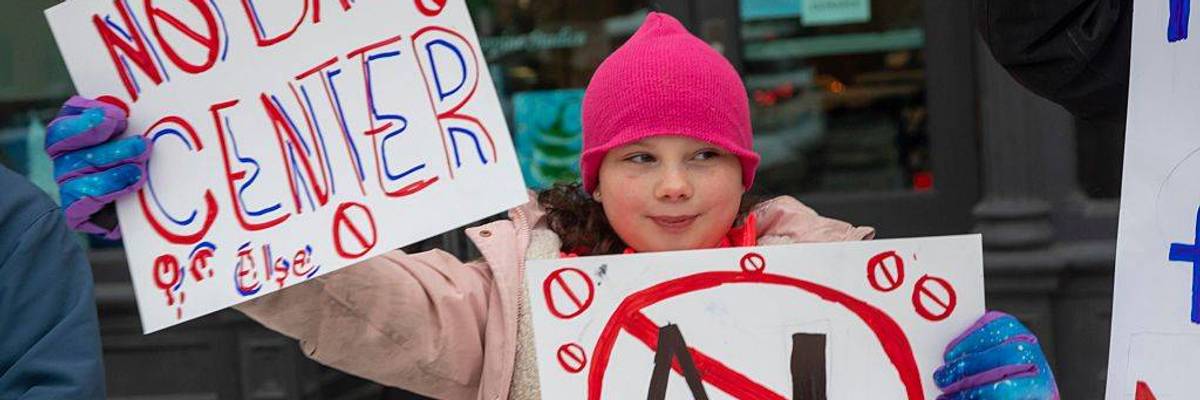
Residents in Saline, Michigan rally against the $7 billion Stargate data center planned on southeast Michigan farm land on December 1, 2025.
We need to keep listening—and we need to keep speaking. For we don’t know whose “yopp” or “yapp” or any other utterance will break through the racket of the Big Tech buildout.
When my son was three years old, he insisted upon hearing Horton Hears a Who! every night. Twice. As this lasted for several months, I got pretty good at reading quickly, tearing through the opening page in one breath—"On the 15th of May, in the Jungle of Nool, In the heat of the day, in the cool of the pool"—so that the words ran together, like a kind of Dr. Seuss verbal soup. Horton is a sweet story about a keen-eared elephant determined, against all odds,to save the diminutive Whos, despite being ridiculed because no one else could hear them.
Given all the great picture books around, this restrictive reading diet left me perplexed. Was its appeal that it was set on May 15, the day before my son’s birthday? (To this day we all mark “Horton’s Day” with a round of silly texts.) Or that it was the teensiest Who whose off-hand “yopp” finally nudged Whoville past the aural threshold? Perhaps it was Horton’s stalwart conviction that "a person’s a person, no matter how small," a sentiment that must have enchanted a small boy stuck in a land of grownups. I venture it’s all three.
The feeling the story evokes so well—that of being invisible, and, in this case, inaudible—is universal. Everyone who was once a child has been there. Despite writing a bunch of books and giving all sorts of talks, this feeling now resonates far more than when I was a young mom speed-reading to my toddler. For you don’t need to live on a speck of dust to know that today, more than ever, little people aren’t seen and their concerns rarely get heard.
We are all Whos now.
There is indeed a crescendo of voices railing against the spoilage and surrender of nature for tech.
One scenario that really makes me feel like a Who—pounding brass pans so that someone, anyone, listens—is the way new technology buildouts are harming the natural world. Here in New England, forests and once-productive farms are being cleared for solar, while water-hungry data centers claim chunks of land in areas vulnerable to drought. Around the globe—from India to Mexico, Papua New Guinea to Mongolia—entire areas are rendered toxic due to mining the metals that animate our devices. In several places, most notoriously Congo’s cobalt mines, children as young as six spend their days in tunnels plying ores with their bare hands.
In the book, Horton is repeatedly mocked for tending the particle upon which the Whos live. The mama kangaroo and her joey say, "Humpf!" and the gang of monkeys calls the existence of Whos “nonsense”—before conspiring to drop the speck in a sea of clover. Here in our jungle equivalent, hostility to tech infrastructure is derided as “NIMBYISM” and those opposed to it scorned as Luddites. Expanding computation and energy capacity is vital for progress, even marquee environmentalists tell us. As for the ecological and human cost, well, we can’t achieve a “green energy transition” without making a bit of a mess.
We also hear from our political reps, many of whom stand to benefit handily from AI expansion, that the spread of resource-intensive computational apparatus is “unstoppable” and “not going away.” Really? The truth is: People don’t want this. At college commencements, tech titans called in to inspire new graduates about AI’s rosy future have been met with boos. But you have to listen hard, past the din of machines and the money—a bunch of zeros on a screen—that feeds them. It seems the plan is to ram all this development through so that a critical mass are dependent on the technology and the rest of us have no choice but to use it. “Inevitable,” indeed.
We need to keep listening—and we need to keep speaking. For we don’t know whose “yopp” or “yapp” or any other utterance will break through the racket. It could be the cries of juvenile sea turtles that drift about the Blake Plateau, a biodiverse undersea basin now eyed for mining nodules rich in rare metals. Or the weeping of Gullah-Geechee ancestors, thousands of whom died here during the Middle Passage en route to Charleston. Or the plaint of hundreds of villagers in a 1,000-year-old Scottish village gathered to call bullshit on claims that a massive new “hyperscale” data center would serve the community. Or the high-pitched cackle of the Andean Flamingo: outrageously pink on stick-thin legs—Dr. Seuss would have had fun drawing them. The birds are lamenting that their wetland habitat in the Atacama Desert highlands is being pumped to produce the lithium essential for energy storage.
There is indeed a crescendo of voices railing against the spoilage and surrender of nature for tech. Just like the townsfolk of Whoville, we need all of us to exclaim, "We are here! We are here! We are here!"
Dear Common Dreams reader, It’s been nearly 30 years since I co-founded Common Dreams with my late wife, Lina Newhouser. We had the radical notion that journalism should serve the public good, not corporate profits. It was clear to us from the outset what it would take to build such a project. No paid advertisements. No corporate sponsors. No millionaire publisher telling us what to think or do. Many people said we wouldn't last a year, but we proved those doubters wrong. Together with a tremendous team of journalists and dedicated staff, we built an independent media outlet free from the constraints of profits and corporate control. Our mission has always been simple: To inform. To inspire. To ignite change for the common good. Building Common Dreams was not easy. Our survival was never guaranteed. When you take on the most powerful forces—Wall Street greed, fossil fuel industry destruction, Big Tech lobbyists, and uber-rich oligarchs who have spent billions upon billions rigging the economy and democracy in their favor—the only bulwark you have is supporters who believe in your work. But here’s the urgent message from me today. It's never been this bad out there. And it's never been this hard to keep us going. At the very moment Common Dreams is most needed, the threats we face are intensifying. We need your support now more than ever. We don't accept corporate advertising and never will. We don't have a paywall because we don't think people should be blocked from critical news based on their ability to pay. Everything we do is funded by the donations of readers like you. When everyone does the little they can afford, we are strong. But if that support retreats or dries up, so do we. Will you donate now to make sure Common Dreams not only survives but thrives? —Craig Brown, Co-founder |
When my son was three years old, he insisted upon hearing Horton Hears a Who! every night. Twice. As this lasted for several months, I got pretty good at reading quickly, tearing through the opening page in one breath—"On the 15th of May, in the Jungle of Nool, In the heat of the day, in the cool of the pool"—so that the words ran together, like a kind of Dr. Seuss verbal soup. Horton is a sweet story about a keen-eared elephant determined, against all odds,to save the diminutive Whos, despite being ridiculed because no one else could hear them.
Given all the great picture books around, this restrictive reading diet left me perplexed. Was its appeal that it was set on May 15, the day before my son’s birthday? (To this day we all mark “Horton’s Day” with a round of silly texts.) Or that it was the teensiest Who whose off-hand “yopp” finally nudged Whoville past the aural threshold? Perhaps it was Horton’s stalwart conviction that "a person’s a person, no matter how small," a sentiment that must have enchanted a small boy stuck in a land of grownups. I venture it’s all three.
The feeling the story evokes so well—that of being invisible, and, in this case, inaudible—is universal. Everyone who was once a child has been there. Despite writing a bunch of books and giving all sorts of talks, this feeling now resonates far more than when I was a young mom speed-reading to my toddler. For you don’t need to live on a speck of dust to know that today, more than ever, little people aren’t seen and their concerns rarely get heard.
We are all Whos now.
There is indeed a crescendo of voices railing against the spoilage and surrender of nature for tech.
One scenario that really makes me feel like a Who—pounding brass pans so that someone, anyone, listens—is the way new technology buildouts are harming the natural world. Here in New England, forests and once-productive farms are being cleared for solar, while water-hungry data centers claim chunks of land in areas vulnerable to drought. Around the globe—from India to Mexico, Papua New Guinea to Mongolia—entire areas are rendered toxic due to mining the metals that animate our devices. In several places, most notoriously Congo’s cobalt mines, children as young as six spend their days in tunnels plying ores with their bare hands.
In the book, Horton is repeatedly mocked for tending the particle upon which the Whos live. The mama kangaroo and her joey say, "Humpf!" and the gang of monkeys calls the existence of Whos “nonsense”—before conspiring to drop the speck in a sea of clover. Here in our jungle equivalent, hostility to tech infrastructure is derided as “NIMBYISM” and those opposed to it scorned as Luddites. Expanding computation and energy capacity is vital for progress, even marquee environmentalists tell us. As for the ecological and human cost, well, we can’t achieve a “green energy transition” without making a bit of a mess.
We also hear from our political reps, many of whom stand to benefit handily from AI expansion, that the spread of resource-intensive computational apparatus is “unstoppable” and “not going away.” Really? The truth is: People don’t want this. At college commencements, tech titans called in to inspire new graduates about AI’s rosy future have been met with boos. But you have to listen hard, past the din of machines and the money—a bunch of zeros on a screen—that feeds them. It seems the plan is to ram all this development through so that a critical mass are dependent on the technology and the rest of us have no choice but to use it. “Inevitable,” indeed.
We need to keep listening—and we need to keep speaking. For we don’t know whose “yopp” or “yapp” or any other utterance will break through the racket. It could be the cries of juvenile sea turtles that drift about the Blake Plateau, a biodiverse undersea basin now eyed for mining nodules rich in rare metals. Or the weeping of Gullah-Geechee ancestors, thousands of whom died here during the Middle Passage en route to Charleston. Or the plaint of hundreds of villagers in a 1,000-year-old Scottish village gathered to call bullshit on claims that a massive new “hyperscale” data center would serve the community. Or the high-pitched cackle of the Andean Flamingo: outrageously pink on stick-thin legs—Dr. Seuss would have had fun drawing them. The birds are lamenting that their wetland habitat in the Atacama Desert highlands is being pumped to produce the lithium essential for energy storage.
There is indeed a crescendo of voices railing against the spoilage and surrender of nature for tech. Just like the townsfolk of Whoville, we need all of us to exclaim, "We are here! We are here! We are here!"
When my son was three years old, he insisted upon hearing Horton Hears a Who! every night. Twice. As this lasted for several months, I got pretty good at reading quickly, tearing through the opening page in one breath—"On the 15th of May, in the Jungle of Nool, In the heat of the day, in the cool of the pool"—so that the words ran together, like a kind of Dr. Seuss verbal soup. Horton is a sweet story about a keen-eared elephant determined, against all odds,to save the diminutive Whos, despite being ridiculed because no one else could hear them.
Given all the great picture books around, this restrictive reading diet left me perplexed. Was its appeal that it was set on May 15, the day before my son’s birthday? (To this day we all mark “Horton’s Day” with a round of silly texts.) Or that it was the teensiest Who whose off-hand “yopp” finally nudged Whoville past the aural threshold? Perhaps it was Horton’s stalwart conviction that "a person’s a person, no matter how small," a sentiment that must have enchanted a small boy stuck in a land of grownups. I venture it’s all three.
The feeling the story evokes so well—that of being invisible, and, in this case, inaudible—is universal. Everyone who was once a child has been there. Despite writing a bunch of books and giving all sorts of talks, this feeling now resonates far more than when I was a young mom speed-reading to my toddler. For you don’t need to live on a speck of dust to know that today, more than ever, little people aren’t seen and their concerns rarely get heard.
We are all Whos now.
There is indeed a crescendo of voices railing against the spoilage and surrender of nature for tech.
One scenario that really makes me feel like a Who—pounding brass pans so that someone, anyone, listens—is the way new technology buildouts are harming the natural world. Here in New England, forests and once-productive farms are being cleared for solar, while water-hungry data centers claim chunks of land in areas vulnerable to drought. Around the globe—from India to Mexico, Papua New Guinea to Mongolia—entire areas are rendered toxic due to mining the metals that animate our devices. In several places, most notoriously Congo’s cobalt mines, children as young as six spend their days in tunnels plying ores with their bare hands.
In the book, Horton is repeatedly mocked for tending the particle upon which the Whos live. The mama kangaroo and her joey say, "Humpf!" and the gang of monkeys calls the existence of Whos “nonsense”—before conspiring to drop the speck in a sea of clover. Here in our jungle equivalent, hostility to tech infrastructure is derided as “NIMBYISM” and those opposed to it scorned as Luddites. Expanding computation and energy capacity is vital for progress, even marquee environmentalists tell us. As for the ecological and human cost, well, we can’t achieve a “green energy transition” without making a bit of a mess.
We also hear from our political reps, many of whom stand to benefit handily from AI expansion, that the spread of resource-intensive computational apparatus is “unstoppable” and “not going away.” Really? The truth is: People don’t want this. At college commencements, tech titans called in to inspire new graduates about AI’s rosy future have been met with boos. But you have to listen hard, past the din of machines and the money—a bunch of zeros on a screen—that feeds them. It seems the plan is to ram all this development through so that a critical mass are dependent on the technology and the rest of us have no choice but to use it. “Inevitable,” indeed.
We need to keep listening—and we need to keep speaking. For we don’t know whose “yopp” or “yapp” or any other utterance will break through the racket. It could be the cries of juvenile sea turtles that drift about the Blake Plateau, a biodiverse undersea basin now eyed for mining nodules rich in rare metals. Or the weeping of Gullah-Geechee ancestors, thousands of whom died here during the Middle Passage en route to Charleston. Or the plaint of hundreds of villagers in a 1,000-year-old Scottish village gathered to call bullshit on claims that a massive new “hyperscale” data center would serve the community. Or the high-pitched cackle of the Andean Flamingo: outrageously pink on stick-thin legs—Dr. Seuss would have had fun drawing them. The birds are lamenting that their wetland habitat in the Atacama Desert highlands is being pumped to produce the lithium essential for energy storage.
There is indeed a crescendo of voices railing against the spoilage and surrender of nature for tech. Just like the townsfolk of Whoville, we need all of us to exclaim, "We are here! We are here! We are here!"