SUBSCRIBE TO OUR FREE NEWSLETTER
Daily news & progressive opinion—funded by the people, not the corporations—delivered straight to your inbox.
5
#000000
#FFFFFF
To donate by check, phone, or other method, see our More Ways to Give page.
Daily news & progressive opinion—funded by the people, not the corporations—delivered straight to your inbox.
If he really wants to be remembered as a peacemaker, not a warmonger, Trump had better make the necessary personnel changes to his inner circle before it is too late.
Donald Trump campaigned on ending endless wars and now boasts that he has resolved eight wars. In reality, this claim is delusional, and his foreign policy is a disaster. The United States remains mired in ongoing wars in the Middle East and Ukraine, and now Trump is careening blindly into new wars in Latin America.
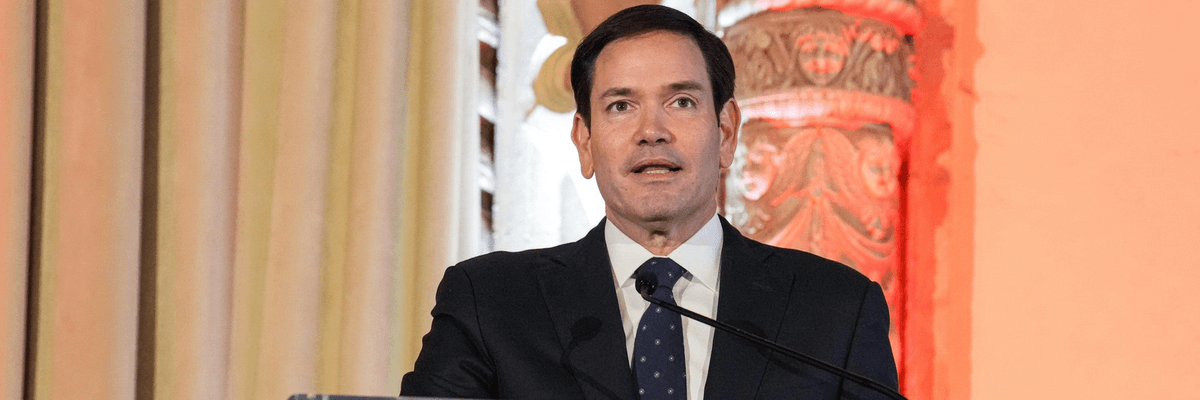
The dangerous disconnect between Trump’s delusions and the real-world impacts of his policies is on full display in his new National Security Strategy document. But this schism has been exacerbated by putting US foreign policy in the hands of Secretary of State Marco Rubio, whose neocon worldview and behind-the-scenes maneuvering has consistently undercut Trump’s professed goals of diplomacy, negotiated settlements and “America First” priorities.
The eight wars Trump claims he has ended include non-existent wars between Egypt and Ethiopia, and Serbia and Kosovo, and the war between Armenia and Azerbaijan that ended in 2023, after Azerbaijan invaded and ethnically cleansed the ancient Armenian community of Nagorno-Karabakh. Trump stole credit for peace between Thailand and Cambodia, which was actually mediated by Malaysia, while India insists that it ended its war with Pakistan without help from Trump.
Trump recently invited the presidents of Rwanda and the DRC to Washington to sign a peace deal, but it’s only the latest of many agreements that have failed to end decades of war and proxy war that rage on in the eastern Congo.
Trump even claims to have brought peace to Iran, which was not at war until he and Netanyahu plotted to attack it. Now diplomacy with Iran is dead—torpedoed by Trump’s treacherous use of negotiations as cover for the US-Israeli surprise attack in June, an illegal war right out of Rubio’s neocon playbook.
Rubio has undermined diplomacy with Iran for years. As a senator, he worked to kill the JCPOA nuclear agreement, framed negotiations as appeasement, and repeatedly demanded harsher sanctions or military action. He defended the US and Israeli attacks in June, which confirmed the claims of Iranian hardliners that the United States cannot be trusted. He makes meaningful talks with Iran impossible by insisting that Iran cease all nuclear enrichment and long-range missile development. By aligning US policy with Israel’s, Rubio closed off the only path that has ever reduced tensions with Iran: sustained, good-faith diplomacy.
Trump’s eighth claimed peace agreement was his Gaza “peace plan,” under which Israel still kills and maims Palestinians every day and allows only 200 truckloads per day of food, water, medicine, and relief supplies into Gaza. With Israeli forces still occupying most of Gaza, no country is sending troops to join Trump’s “stabilization force,” nor will Hamas disarm and leave its people defenseless. Israel still calls the shots, and will only allow rebuilding in Israeli-occupied areas.
As secretary of state, it was Marco Rubio’s job to negotiate peace and an end to the occupation of Palestine. But Rubio’s entire political career has been defined by unwavering support for Israel and corrupted by over a million dollars from pro-Israel donor groups like AIPAC. He refuses to speak to Hamas, insisting on its total isolation and destruction.
Rubio even refuses to negotiate with the weakest, most compromised, but still internationally recognized, Palestinian Authority. In the Senate, he worked to defund and delegitimize the PA, and now he insists it should play no role in Gaza’s future, but he offers no alternative. Contrast this with China, which recently convened fourteen Palestinian factions for dialogue. With a US secretary of state who won’t talk to any Palestinian actors, the United States is only supporting endless war and occupation.
Ukraine is not on Trump’s list of “eight wars,” but it is the conflict he most loudly promised to end on day one. Trump took his first steps to resolve the crisis in Ukraine with phone calls with Putin and Zelenskyy on February 12, 2025. War Secretary Pete Hegseth told a meeting of America’s NATO allies in Brussels that the US was taking Ukraine’s long-promised NATO membership off the table, and that “we must start by recognizing that returning to Ukraine’s pre-2014 borders is an unrealistic objective. Chasing this illusionary goal will only prolong the war and cause more suffering.”
Zelenskyy and his European backers are still trying to persuade Trump that, with his support, they can win back at the negotiating table what Ukraine and its western allies lost by their tragic decision to reject a negotiated peace in April 2022. Russia was ready to withdraw from all the land it had just occupied, but the US and UK persuaded NATO and Ukraine to instead embark on this long war of attrition, in which their negotiating position only grows weaker as Ukraine’s losses mount.
On November 21st, Trump unveiled a 28-point peace plan for Ukraine that was built around the policy Trump and Hegseth had announced in February: no NATO membership, and no return to pre-2014 borders. But once Rubio arrived to lead the US negotiating team in talks in Geneva, he let Zelenskyy’s chief of staff, Andriy Yermak, and the Europeans put NATO membership and Ukraine’s pre-2014 borders back on the table.
War with Venezuela is easily avoidable, since the whole world already knows the US pretexts for war are fabricated and false.
This was a poison pill to deliberately undermine the basic concept of Ukrainian neutrality that Russia insists is the only way to resolve the security dilemma facing both NATO and Russia and ensure a stable and lasting peace. As a European official crowed to Politico, “Things went in the right direction in Geneva. Still a work in progress, but looking much better now… Rubio is a pro who knows his stuff.”
Andriy Yermak, who led Ukraine’s negotiating team in Geneva, has now been fired in a corruption scandal, reportedly at Trump’s behest, as has Trump’s envoy to Kyiv, Keith Kellogg, who apparently leaked Trump’s plan to the press.
Trump is facing a schism in his foreign policy team that echoes his first term, when he appointed a revolving door of neocons, retired generals, and arms industry insiders to top jobs. This time, he has already fired his first National Security Advisor, Mike Waltz, several NSC staff, and now General Kellogg,
Trump’s team on Ukraine now includes Vice President J.D. Vance, Steve Witkoff, Jared Kushner, Deputy National Security Advisor Andy Baker and Army Secretary Dan Driscoll, who all seem to be on board with the basic policy that Trump and Hegseth announced in February.
But Rubio is keeping alive European hopes of a ceasefire that postpones negotiations over NATO membership and Ukraine’s borders for a later date, to allow NATO to once again build, arm and train Ukrainian forces to retake its lost territories by force, as it did from 2015 to 2022 under cover of the MInsk Accords.
This raises the questions: Does Rubio, like the Europeans and the neocons in Congress, still back the Biden-era strategy of fighting a long proxy war to the last Ukrainian? And if so, is he now in fact working to undermine Trump’s peace efforts?
Ray McGovern, the founder of Veteran Intelligence Professionals for Sanity, thinks so, writing “...we are at the threshold on Ukraine, at the beginning of a consequential battle between the neocons and Europeans on one side, and Donald Trump and the realists on the other. Will Trump show the fortitude to see this through and overcome his secretary of state?”
But it’s perhaps in Latin America where Rubio is playing the most aggressive role. Rubio has always promoted regime-change policies, economic strangulation, and US interference targeting left-leaning governments in Latin America. Coming from a conservative Cuban familiy, he has long been one of the most hard-line voices in Washington on Cuba, championing sanctions, opposing any easing of the embargo, and working to reverse Obama-era diplomatic openings.
His position on Venezuela is similar. He was a leading architect of the Trump administration’s failed “maximum pressure” campaign against Venezuela, promoting crippling sanctions that devastated civilians, while openly endorsing failed coups and military threats.
Now Rubio is pushing Trump into a catastrophic, criminal war with Venezuela. In early 2025, Trump’s administration briefly pursued a diplomatic track with Venezuelan President Nicolás Maduro, spearheaded by envoy Richard Grenell. But Marco Rubio’s hard-line, pressure-first approach gradually overtook the negotiation channel: Trump suspended talks in October 2025, and US policy shifted toward intensified sanctions and military posturing.
Rubio’s hostility extends across the region: he has attacked progressive leaders in Colombia, Chile, Bolivia, Honduras, and Brazil, while supporting authoritarians aligned with US and Israeli interests. While Trump has warmed to Brazil’s president Lula and craves access to its reserves of rare earth elements, the second largest after China’s, Lula has no illusions about Rubio’s hostility and has refused to even meet with him.
Rubio’s approach is the opposite of diplomacy. He refuses engagement with governments he dislikes, undermines regional institutions, and encourages Washington to isolate and punish rather than negotiate. Instead of supporting peace agreements—such as Colombia’s fragile accords or regional efforts to stabilize Haiti—he treats Latin America as a battleground for ideological crusades.
Rubio’s influence has helped block humanitarian relief, deepen polarization, and shatter openings for regional dialogue. A Secretary of State committed to peace would work with Latin American partners to resolve conflicts, strengthen democracy, and reduce US militarization in the hemisphere. Rubio does the reverse: he inflames tensions, sabotages diplomacy, and pushes US policy back toward the dark era of coups, blockades, proxy wars, and death squads.
So why is Trump betraying his most loyal MAGA supporters, who take his promises to “end the era of endless wars” at face value? Why is his administration supporting the same out-of-control American war machine that has run rampant around the world since the rise of neocons like Dick Cheney and Hillary Clinton in the 1990s?
Is Trump simply unable to resist the lure of destructive military power that seduces every American president? Trump’s MAGA true believers would like to think that he and they represent a rejection of American imperialism and a new “America First” policy that prioritizes national sovereignty and shared domestic prosperity. But MAGA leaders like Marjorie Taylor Green can see that is not what Trump is delivering.
US secretaries of state wield considerable power, and Trump is not the first president to be led astray by his secretary of state. President Eisenhower is remembered as a champion of peace, for quickly ending the Korean War—then slashing the military budget—and for two defining speeches at the beginning and end of his presidency: his “Chance for Peace” speech after the death of Soviet premier Josef Stalin in 1953; and his Farewell Address in 1960, in which he warned Americans against the “unwarranted influence” of the “military-industrial complex.”
For most of his presidency though, Eisenhower gave his Secretary of State, John Foster Dulles, free rein to manage US foreign policy. By the time Eisenhower fully grasped the dangers of Dulles’ brinksmanship with the USSR and China, the Cold War arms race was running wild. Then Eisenhower’s belated outreach to the Soviets was interrupted by his own ill-health and the U-2 crisis. Hillary Clinton had a similarly destructive and destabilizing impact on Obama’s first-term foreign policy, in Afghanistan, Iran, Libya, Syria and Honduras.
These should be cautionary tales for Trump. If he really wants to be remembered as a peacemaker, not a warmonger, he had better make the necessary personnel changes to his inner circle before it is too late. War with Venezuela is easily avoidable, since the whole world already knows the US pretexts for war are fabricated and false. Rubio has stoked the underlying tensions and led this escalating campaign of lies, threats and murders, so Trump would be wise to replace him before his march to war crosses the point of no return.
This would allow Trump and Rubio’s successor to start rebuilding relations with our neighbors in Latin America and the Caribbean, and to finally change longstanding US policies that keep the Middle East, and now Ukraine, trapped in endless war.
Dear Common Dreams reader, It’s been nearly 30 years since I co-founded Common Dreams with my late wife, Lina Newhouser. We had the radical notion that journalism should serve the public good, not corporate profits. It was clear to us from the outset what it would take to build such a project. No paid advertisements. No corporate sponsors. No millionaire publisher telling us what to think or do. Many people said we wouldn't last a year, but we proved those doubters wrong. Together with a tremendous team of journalists and dedicated staff, we built an independent media outlet free from the constraints of profits and corporate control. Our mission has always been simple: To inform. To inspire. To ignite change for the common good. Building Common Dreams was not easy. Our survival was never guaranteed. When you take on the most powerful forces—Wall Street greed, fossil fuel industry destruction, Big Tech lobbyists, and uber-rich oligarchs who have spent billions upon billions rigging the economy and democracy in their favor—the only bulwark you have is supporters who believe in your work. But here’s the urgent message from me today. It's never been this bad out there. And it's never been this hard to keep us going. At the very moment Common Dreams is most needed, the threats we face are intensifying. We need your support now more than ever. We don't accept corporate advertising and never will. We don't have a paywall because we don't think people should be blocked from critical news based on their ability to pay. Everything we do is funded by the donations of readers like you. When everyone does the little they can afford, we are strong. But if that support retreats or dries up, so do we. Will you donate now to make sure Common Dreams not only survives but thrives? —Craig Brown, Co-founder |
Donald Trump campaigned on ending endless wars and now boasts that he has resolved eight wars. In reality, this claim is delusional, and his foreign policy is a disaster. The United States remains mired in ongoing wars in the Middle East and Ukraine, and now Trump is careening blindly into new wars in Latin America.
The dangerous disconnect between Trump’s delusions and the real-world impacts of his policies is on full display in his new National Security Strategy document. But this schism has been exacerbated by putting US foreign policy in the hands of Secretary of State Marco Rubio, whose neocon worldview and behind-the-scenes maneuvering has consistently undercut Trump’s professed goals of diplomacy, negotiated settlements and “America First” priorities.
The eight wars Trump claims he has ended include non-existent wars between Egypt and Ethiopia, and Serbia and Kosovo, and the war between Armenia and Azerbaijan that ended in 2023, after Azerbaijan invaded and ethnically cleansed the ancient Armenian community of Nagorno-Karabakh. Trump stole credit for peace between Thailand and Cambodia, which was actually mediated by Malaysia, while India insists that it ended its war with Pakistan without help from Trump.
Trump recently invited the presidents of Rwanda and the DRC to Washington to sign a peace deal, but it’s only the latest of many agreements that have failed to end decades of war and proxy war that rage on in the eastern Congo.
Trump even claims to have brought peace to Iran, which was not at war until he and Netanyahu plotted to attack it. Now diplomacy with Iran is dead—torpedoed by Trump’s treacherous use of negotiations as cover for the US-Israeli surprise attack in June, an illegal war right out of Rubio’s neocon playbook.
Rubio has undermined diplomacy with Iran for years. As a senator, he worked to kill the JCPOA nuclear agreement, framed negotiations as appeasement, and repeatedly demanded harsher sanctions or military action. He defended the US and Israeli attacks in June, which confirmed the claims of Iranian hardliners that the United States cannot be trusted. He makes meaningful talks with Iran impossible by insisting that Iran cease all nuclear enrichment and long-range missile development. By aligning US policy with Israel’s, Rubio closed off the only path that has ever reduced tensions with Iran: sustained, good-faith diplomacy.
Trump’s eighth claimed peace agreement was his Gaza “peace plan,” under which Israel still kills and maims Palestinians every day and allows only 200 truckloads per day of food, water, medicine, and relief supplies into Gaza. With Israeli forces still occupying most of Gaza, no country is sending troops to join Trump’s “stabilization force,” nor will Hamas disarm and leave its people defenseless. Israel still calls the shots, and will only allow rebuilding in Israeli-occupied areas.
As secretary of state, it was Marco Rubio’s job to negotiate peace and an end to the occupation of Palestine. But Rubio’s entire political career has been defined by unwavering support for Israel and corrupted by over a million dollars from pro-Israel donor groups like AIPAC. He refuses to speak to Hamas, insisting on its total isolation and destruction.
Rubio even refuses to negotiate with the weakest, most compromised, but still internationally recognized, Palestinian Authority. In the Senate, he worked to defund and delegitimize the PA, and now he insists it should play no role in Gaza’s future, but he offers no alternative. Contrast this with China, which recently convened fourteen Palestinian factions for dialogue. With a US secretary of state who won’t talk to any Palestinian actors, the United States is only supporting endless war and occupation.
Ukraine is not on Trump’s list of “eight wars,” but it is the conflict he most loudly promised to end on day one. Trump took his first steps to resolve the crisis in Ukraine with phone calls with Putin and Zelenskyy on February 12, 2025. War Secretary Pete Hegseth told a meeting of America’s NATO allies in Brussels that the US was taking Ukraine’s long-promised NATO membership off the table, and that “we must start by recognizing that returning to Ukraine’s pre-2014 borders is an unrealistic objective. Chasing this illusionary goal will only prolong the war and cause more suffering.”
Zelenskyy and his European backers are still trying to persuade Trump that, with his support, they can win back at the negotiating table what Ukraine and its western allies lost by their tragic decision to reject a negotiated peace in April 2022. Russia was ready to withdraw from all the land it had just occupied, but the US and UK persuaded NATO and Ukraine to instead embark on this long war of attrition, in which their negotiating position only grows weaker as Ukraine’s losses mount.
On November 21st, Trump unveiled a 28-point peace plan for Ukraine that was built around the policy Trump and Hegseth had announced in February: no NATO membership, and no return to pre-2014 borders. But once Rubio arrived to lead the US negotiating team in talks in Geneva, he let Zelenskyy’s chief of staff, Andriy Yermak, and the Europeans put NATO membership and Ukraine’s pre-2014 borders back on the table.
War with Venezuela is easily avoidable, since the whole world already knows the US pretexts for war are fabricated and false.
This was a poison pill to deliberately undermine the basic concept of Ukrainian neutrality that Russia insists is the only way to resolve the security dilemma facing both NATO and Russia and ensure a stable and lasting peace. As a European official crowed to Politico, “Things went in the right direction in Geneva. Still a work in progress, but looking much better now… Rubio is a pro who knows his stuff.”
Andriy Yermak, who led Ukraine’s negotiating team in Geneva, has now been fired in a corruption scandal, reportedly at Trump’s behest, as has Trump’s envoy to Kyiv, Keith Kellogg, who apparently leaked Trump’s plan to the press.
Trump is facing a schism in his foreign policy team that echoes his first term, when he appointed a revolving door of neocons, retired generals, and arms industry insiders to top jobs. This time, he has already fired his first National Security Advisor, Mike Waltz, several NSC staff, and now General Kellogg,
Trump’s team on Ukraine now includes Vice President J.D. Vance, Steve Witkoff, Jared Kushner, Deputy National Security Advisor Andy Baker and Army Secretary Dan Driscoll, who all seem to be on board with the basic policy that Trump and Hegseth announced in February.
But Rubio is keeping alive European hopes of a ceasefire that postpones negotiations over NATO membership and Ukraine’s borders for a later date, to allow NATO to once again build, arm and train Ukrainian forces to retake its lost territories by force, as it did from 2015 to 2022 under cover of the MInsk Accords.
This raises the questions: Does Rubio, like the Europeans and the neocons in Congress, still back the Biden-era strategy of fighting a long proxy war to the last Ukrainian? And if so, is he now in fact working to undermine Trump’s peace efforts?
Ray McGovern, the founder of Veteran Intelligence Professionals for Sanity, thinks so, writing “...we are at the threshold on Ukraine, at the beginning of a consequential battle between the neocons and Europeans on one side, and Donald Trump and the realists on the other. Will Trump show the fortitude to see this through and overcome his secretary of state?”
But it’s perhaps in Latin America where Rubio is playing the most aggressive role. Rubio has always promoted regime-change policies, economic strangulation, and US interference targeting left-leaning governments in Latin America. Coming from a conservative Cuban familiy, he has long been one of the most hard-line voices in Washington on Cuba, championing sanctions, opposing any easing of the embargo, and working to reverse Obama-era diplomatic openings.
His position on Venezuela is similar. He was a leading architect of the Trump administration’s failed “maximum pressure” campaign against Venezuela, promoting crippling sanctions that devastated civilians, while openly endorsing failed coups and military threats.
Now Rubio is pushing Trump into a catastrophic, criminal war with Venezuela. In early 2025, Trump’s administration briefly pursued a diplomatic track with Venezuelan President Nicolás Maduro, spearheaded by envoy Richard Grenell. But Marco Rubio’s hard-line, pressure-first approach gradually overtook the negotiation channel: Trump suspended talks in October 2025, and US policy shifted toward intensified sanctions and military posturing.
Rubio’s hostility extends across the region: he has attacked progressive leaders in Colombia, Chile, Bolivia, Honduras, and Brazil, while supporting authoritarians aligned with US and Israeli interests. While Trump has warmed to Brazil’s president Lula and craves access to its reserves of rare earth elements, the second largest after China’s, Lula has no illusions about Rubio’s hostility and has refused to even meet with him.
Rubio’s approach is the opposite of diplomacy. He refuses engagement with governments he dislikes, undermines regional institutions, and encourages Washington to isolate and punish rather than negotiate. Instead of supporting peace agreements—such as Colombia’s fragile accords or regional efforts to stabilize Haiti—he treats Latin America as a battleground for ideological crusades.
Rubio’s influence has helped block humanitarian relief, deepen polarization, and shatter openings for regional dialogue. A Secretary of State committed to peace would work with Latin American partners to resolve conflicts, strengthen democracy, and reduce US militarization in the hemisphere. Rubio does the reverse: he inflames tensions, sabotages diplomacy, and pushes US policy back toward the dark era of coups, blockades, proxy wars, and death squads.
So why is Trump betraying his most loyal MAGA supporters, who take his promises to “end the era of endless wars” at face value? Why is his administration supporting the same out-of-control American war machine that has run rampant around the world since the rise of neocons like Dick Cheney and Hillary Clinton in the 1990s?
Is Trump simply unable to resist the lure of destructive military power that seduces every American president? Trump’s MAGA true believers would like to think that he and they represent a rejection of American imperialism and a new “America First” policy that prioritizes national sovereignty and shared domestic prosperity. But MAGA leaders like Marjorie Taylor Green can see that is not what Trump is delivering.
US secretaries of state wield considerable power, and Trump is not the first president to be led astray by his secretary of state. President Eisenhower is remembered as a champion of peace, for quickly ending the Korean War—then slashing the military budget—and for two defining speeches at the beginning and end of his presidency: his “Chance for Peace” speech after the death of Soviet premier Josef Stalin in 1953; and his Farewell Address in 1960, in which he warned Americans against the “unwarranted influence” of the “military-industrial complex.”
For most of his presidency though, Eisenhower gave his Secretary of State, John Foster Dulles, free rein to manage US foreign policy. By the time Eisenhower fully grasped the dangers of Dulles’ brinksmanship with the USSR and China, the Cold War arms race was running wild. Then Eisenhower’s belated outreach to the Soviets was interrupted by his own ill-health and the U-2 crisis. Hillary Clinton had a similarly destructive and destabilizing impact on Obama’s first-term foreign policy, in Afghanistan, Iran, Libya, Syria and Honduras.
These should be cautionary tales for Trump. If he really wants to be remembered as a peacemaker, not a warmonger, he had better make the necessary personnel changes to his inner circle before it is too late. War with Venezuela is easily avoidable, since the whole world already knows the US pretexts for war are fabricated and false. Rubio has stoked the underlying tensions and led this escalating campaign of lies, threats and murders, so Trump would be wise to replace him before his march to war crosses the point of no return.
This would allow Trump and Rubio’s successor to start rebuilding relations with our neighbors in Latin America and the Caribbean, and to finally change longstanding US policies that keep the Middle East, and now Ukraine, trapped in endless war.
Donald Trump campaigned on ending endless wars and now boasts that he has resolved eight wars. In reality, this claim is delusional, and his foreign policy is a disaster. The United States remains mired in ongoing wars in the Middle East and Ukraine, and now Trump is careening blindly into new wars in Latin America.
The dangerous disconnect between Trump’s delusions and the real-world impacts of his policies is on full display in his new National Security Strategy document. But this schism has been exacerbated by putting US foreign policy in the hands of Secretary of State Marco Rubio, whose neocon worldview and behind-the-scenes maneuvering has consistently undercut Trump’s professed goals of diplomacy, negotiated settlements and “America First” priorities.
The eight wars Trump claims he has ended include non-existent wars between Egypt and Ethiopia, and Serbia and Kosovo, and the war between Armenia and Azerbaijan that ended in 2023, after Azerbaijan invaded and ethnically cleansed the ancient Armenian community of Nagorno-Karabakh. Trump stole credit for peace between Thailand and Cambodia, which was actually mediated by Malaysia, while India insists that it ended its war with Pakistan without help from Trump.
Trump recently invited the presidents of Rwanda and the DRC to Washington to sign a peace deal, but it’s only the latest of many agreements that have failed to end decades of war and proxy war that rage on in the eastern Congo.
Trump even claims to have brought peace to Iran, which was not at war until he and Netanyahu plotted to attack it. Now diplomacy with Iran is dead—torpedoed by Trump’s treacherous use of negotiations as cover for the US-Israeli surprise attack in June, an illegal war right out of Rubio’s neocon playbook.
Rubio has undermined diplomacy with Iran for years. As a senator, he worked to kill the JCPOA nuclear agreement, framed negotiations as appeasement, and repeatedly demanded harsher sanctions or military action. He defended the US and Israeli attacks in June, which confirmed the claims of Iranian hardliners that the United States cannot be trusted. He makes meaningful talks with Iran impossible by insisting that Iran cease all nuclear enrichment and long-range missile development. By aligning US policy with Israel’s, Rubio closed off the only path that has ever reduced tensions with Iran: sustained, good-faith diplomacy.
Trump’s eighth claimed peace agreement was his Gaza “peace plan,” under which Israel still kills and maims Palestinians every day and allows only 200 truckloads per day of food, water, medicine, and relief supplies into Gaza. With Israeli forces still occupying most of Gaza, no country is sending troops to join Trump’s “stabilization force,” nor will Hamas disarm and leave its people defenseless. Israel still calls the shots, and will only allow rebuilding in Israeli-occupied areas.
As secretary of state, it was Marco Rubio’s job to negotiate peace and an end to the occupation of Palestine. But Rubio’s entire political career has been defined by unwavering support for Israel and corrupted by over a million dollars from pro-Israel donor groups like AIPAC. He refuses to speak to Hamas, insisting on its total isolation and destruction.
Rubio even refuses to negotiate with the weakest, most compromised, but still internationally recognized, Palestinian Authority. In the Senate, he worked to defund and delegitimize the PA, and now he insists it should play no role in Gaza’s future, but he offers no alternative. Contrast this with China, which recently convened fourteen Palestinian factions for dialogue. With a US secretary of state who won’t talk to any Palestinian actors, the United States is only supporting endless war and occupation.
Ukraine is not on Trump’s list of “eight wars,” but it is the conflict he most loudly promised to end on day one. Trump took his first steps to resolve the crisis in Ukraine with phone calls with Putin and Zelenskyy on February 12, 2025. War Secretary Pete Hegseth told a meeting of America’s NATO allies in Brussels that the US was taking Ukraine’s long-promised NATO membership off the table, and that “we must start by recognizing that returning to Ukraine’s pre-2014 borders is an unrealistic objective. Chasing this illusionary goal will only prolong the war and cause more suffering.”
Zelenskyy and his European backers are still trying to persuade Trump that, with his support, they can win back at the negotiating table what Ukraine and its western allies lost by their tragic decision to reject a negotiated peace in April 2022. Russia was ready to withdraw from all the land it had just occupied, but the US and UK persuaded NATO and Ukraine to instead embark on this long war of attrition, in which their negotiating position only grows weaker as Ukraine’s losses mount.
On November 21st, Trump unveiled a 28-point peace plan for Ukraine that was built around the policy Trump and Hegseth had announced in February: no NATO membership, and no return to pre-2014 borders. But once Rubio arrived to lead the US negotiating team in talks in Geneva, he let Zelenskyy’s chief of staff, Andriy Yermak, and the Europeans put NATO membership and Ukraine’s pre-2014 borders back on the table.
War with Venezuela is easily avoidable, since the whole world already knows the US pretexts for war are fabricated and false.
This was a poison pill to deliberately undermine the basic concept of Ukrainian neutrality that Russia insists is the only way to resolve the security dilemma facing both NATO and Russia and ensure a stable and lasting peace. As a European official crowed to Politico, “Things went in the right direction in Geneva. Still a work in progress, but looking much better now… Rubio is a pro who knows his stuff.”
Andriy Yermak, who led Ukraine’s negotiating team in Geneva, has now been fired in a corruption scandal, reportedly at Trump’s behest, as has Trump’s envoy to Kyiv, Keith Kellogg, who apparently leaked Trump’s plan to the press.
Trump is facing a schism in his foreign policy team that echoes his first term, when he appointed a revolving door of neocons, retired generals, and arms industry insiders to top jobs. This time, he has already fired his first National Security Advisor, Mike Waltz, several NSC staff, and now General Kellogg,
Trump’s team on Ukraine now includes Vice President J.D. Vance, Steve Witkoff, Jared Kushner, Deputy National Security Advisor Andy Baker and Army Secretary Dan Driscoll, who all seem to be on board with the basic policy that Trump and Hegseth announced in February.
But Rubio is keeping alive European hopes of a ceasefire that postpones negotiations over NATO membership and Ukraine’s borders for a later date, to allow NATO to once again build, arm and train Ukrainian forces to retake its lost territories by force, as it did from 2015 to 2022 under cover of the MInsk Accords.
This raises the questions: Does Rubio, like the Europeans and the neocons in Congress, still back the Biden-era strategy of fighting a long proxy war to the last Ukrainian? And if so, is he now in fact working to undermine Trump’s peace efforts?
Ray McGovern, the founder of Veteran Intelligence Professionals for Sanity, thinks so, writing “...we are at the threshold on Ukraine, at the beginning of a consequential battle between the neocons and Europeans on one side, and Donald Trump and the realists on the other. Will Trump show the fortitude to see this through and overcome his secretary of state?”
But it’s perhaps in Latin America where Rubio is playing the most aggressive role. Rubio has always promoted regime-change policies, economic strangulation, and US interference targeting left-leaning governments in Latin America. Coming from a conservative Cuban familiy, he has long been one of the most hard-line voices in Washington on Cuba, championing sanctions, opposing any easing of the embargo, and working to reverse Obama-era diplomatic openings.
His position on Venezuela is similar. He was a leading architect of the Trump administration’s failed “maximum pressure” campaign against Venezuela, promoting crippling sanctions that devastated civilians, while openly endorsing failed coups and military threats.
Now Rubio is pushing Trump into a catastrophic, criminal war with Venezuela. In early 2025, Trump’s administration briefly pursued a diplomatic track with Venezuelan President Nicolás Maduro, spearheaded by envoy Richard Grenell. But Marco Rubio’s hard-line, pressure-first approach gradually overtook the negotiation channel: Trump suspended talks in October 2025, and US policy shifted toward intensified sanctions and military posturing.
Rubio’s hostility extends across the region: he has attacked progressive leaders in Colombia, Chile, Bolivia, Honduras, and Brazil, while supporting authoritarians aligned with US and Israeli interests. While Trump has warmed to Brazil’s president Lula and craves access to its reserves of rare earth elements, the second largest after China’s, Lula has no illusions about Rubio’s hostility and has refused to even meet with him.
Rubio’s approach is the opposite of diplomacy. He refuses engagement with governments he dislikes, undermines regional institutions, and encourages Washington to isolate and punish rather than negotiate. Instead of supporting peace agreements—such as Colombia’s fragile accords or regional efforts to stabilize Haiti—he treats Latin America as a battleground for ideological crusades.
Rubio’s influence has helped block humanitarian relief, deepen polarization, and shatter openings for regional dialogue. A Secretary of State committed to peace would work with Latin American partners to resolve conflicts, strengthen democracy, and reduce US militarization in the hemisphere. Rubio does the reverse: he inflames tensions, sabotages diplomacy, and pushes US policy back toward the dark era of coups, blockades, proxy wars, and death squads.
So why is Trump betraying his most loyal MAGA supporters, who take his promises to “end the era of endless wars” at face value? Why is his administration supporting the same out-of-control American war machine that has run rampant around the world since the rise of neocons like Dick Cheney and Hillary Clinton in the 1990s?
Is Trump simply unable to resist the lure of destructive military power that seduces every American president? Trump’s MAGA true believers would like to think that he and they represent a rejection of American imperialism and a new “America First” policy that prioritizes national sovereignty and shared domestic prosperity. But MAGA leaders like Marjorie Taylor Green can see that is not what Trump is delivering.
US secretaries of state wield considerable power, and Trump is not the first president to be led astray by his secretary of state. President Eisenhower is remembered as a champion of peace, for quickly ending the Korean War—then slashing the military budget—and for two defining speeches at the beginning and end of his presidency: his “Chance for Peace” speech after the death of Soviet premier Josef Stalin in 1953; and his Farewell Address in 1960, in which he warned Americans against the “unwarranted influence” of the “military-industrial complex.”
For most of his presidency though, Eisenhower gave his Secretary of State, John Foster Dulles, free rein to manage US foreign policy. By the time Eisenhower fully grasped the dangers of Dulles’ brinksmanship with the USSR and China, the Cold War arms race was running wild. Then Eisenhower’s belated outreach to the Soviets was interrupted by his own ill-health and the U-2 crisis. Hillary Clinton had a similarly destructive and destabilizing impact on Obama’s first-term foreign policy, in Afghanistan, Iran, Libya, Syria and Honduras.
These should be cautionary tales for Trump. If he really wants to be remembered as a peacemaker, not a warmonger, he had better make the necessary personnel changes to his inner circle before it is too late. War with Venezuela is easily avoidable, since the whole world already knows the US pretexts for war are fabricated and false. Rubio has stoked the underlying tensions and led this escalating campaign of lies, threats and murders, so Trump would be wise to replace him before his march to war crosses the point of no return.
This would allow Trump and Rubio’s successor to start rebuilding relations with our neighbors in Latin America and the Caribbean, and to finally change longstanding US policies that keep the Middle East, and now Ukraine, trapped in endless war.