
Everything I’m about to write is fairly obvious. But since wildfires, and hence smoke, will persist all summer, and since the hot world we’re creating produces ever more wildfire and hence an endless supply of future smoke, I think it’s worth taking a moment to get all this on the record.
Also, the flow of smoke down from Canada has produced a perfect MRI of the MAGA nervous system, revealing with unparalleled clarity the belligerence, ignorance, self-love, and utter lack of irony that mark the species.
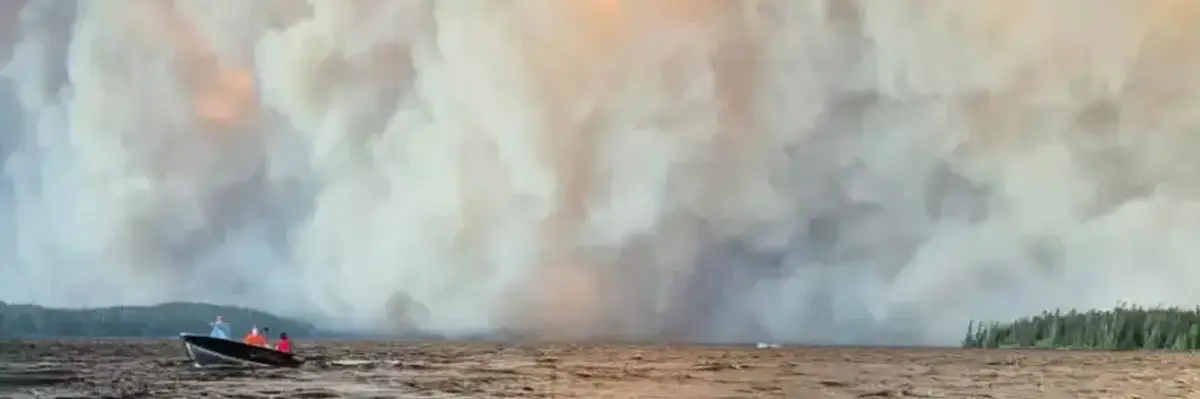
To hit the basics: Roughly 1,000 wildfires are currently burning in Canada, many in northern reaches of the province of Ontario. Much of the direct fire damage is being borne by members of Canada’s First Nation communities, whose small communities are the main inhabitants of these wild places. People are crowded into Thunder Bay, Ontario, where every hotel room is filled; the stories of escapes like the one pictured above are truly harrowing. Alessandra Freitas, for instance, interviewed members of the Namaygoosisagagun First Nation in the northwest part of the province. Here, for instance, is the account of Miiyah Paavola:
“It was all very fast-paced. There was not really much time to think about what was happening,” Paavola told CNN.
She grabbed a wet towel before squeezing aboard a small aluminum boat with five other people, three dogs, and a cat. The isolated community, also known as Collins First Nation, has no road access, only a railway line and Collins Lake.
Paavola couldn’t fully grasp the scope of the danger until her boat pulled away.
“All you could see was orange and gray and it was very dark,” she said. But as they sailed away, she could finally see just how close they’d been to the fires. “When I was going across maybe about the second island, that’s when I watched it. I could just barely see the flames reach the shoreline. And it was a very thick wall of smoke that followed it very quickly.”
“If we had waited any longer, we would have been dead.”
As Johnnie Jae, the founder of Red Pop! News pointed out:
It's NOT just that people and wildlife are losing their homes... it's the history that is being lost for generations to come.
It's tribal records, artifacts, art, regalia, ceremonial grounds, things that have been passed from generation to generation, hidden, protected and preserved, repatriated and restored.
So, just to be clear—the most powerful disruption from these fires is to small bands of people who have done nothing to cause them, and whose culture has been endlessly damaged by the larger Western project of settlement and control.
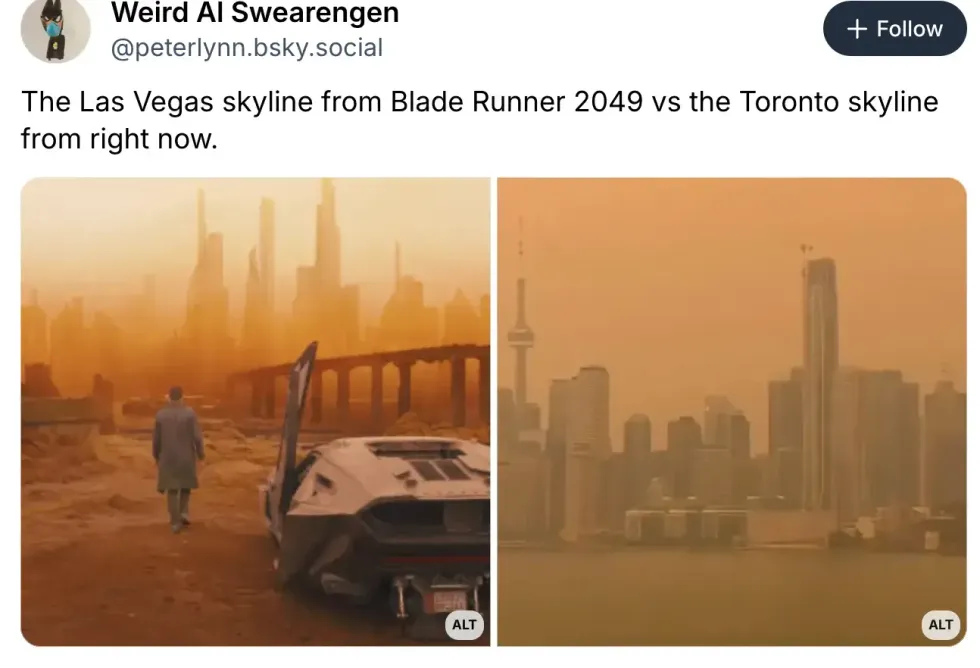
But flame, of course, is not the only product of fire. There’s also smoke, which contains high concentrations of particulates, the solid and liquid droplets in all forms of air pollution that are especially dangerous because they can slip past a body’s natural filters, aggravating asthma and pulmonary disease and contributing to heart attacks and smoke. Those clouds of smoke drift on the prevailing winds, which have been blowing south towards southern Ontario, where Toronto has been engulfed in smoke. Here’s a particularly vivid portrayal of the life in North America’s fourth-largest city.
But of course the border with the US does not prevent smoke from spilling across, and some of the most densely populated parts of America have been inundated with smoke as well. Last Thursday, for instance, Detroit had the most polluted air in the world, as Charles Ramirez chronicled:
Detroit had an air quality index, or AQI, of 724 at one point, the No. 1 spot on IQAir’s ranking of the most polluted global major cities on Thursday. IQAir makes air quality monitoring and air cleaning products. The index is a measure of PM2.5 or particulate matter, and the index reading makes the air “hazardous,” according to the company, which means unhealthy for everyone.
By 5:00 pm, Detroit’s index number had fallen to 341 and its ranking to second, behind Chicago’s 402. Both measures were considered “hazardous.”
Parts of Ohio were even worse. Toledo, for instance, doubled its old record for air pollution, and nearby Monroe recorded AQI values above 800. I’ve been in Beijing and Delhi on days when you couldn’t see across the street, and this was worse.
Jeff Masters has the most comprehensive set of numbers, as per usual:
The award for worst air in the nation on July 16 went to the city that has in the past billed itself as a climate haven: Duluth, Minnesota. The city’s 24-hour air quality index, or AQI, for PM2.5 particle pollution hit 934, over three times the threshold for “Hazardous” pollution. This shattered Duluth’s previous all-time AQI record of 159 set July 20, 2021. EPA pollution records go back to 1999.
Now, in a normal world, this scenario would trigger a compassionate response, as leaders sought to help the people most at risk. But MAGA is an almost perfect mirror world, where every impulse is bad. On Fox, for instance, the channel’s public health expert timidly (“I know you’re going to cringe”) recommended that people at risk wear KN95 masks to prevent particulates from getting sucked down your throat. “Not a chance. Not a chance,” said host Brian Kilmeade.
Meanwhile, a series of Republican “leaders” started producing angry denunciations of Canada, for polluting America’s air with their thoughtless fires:
Michigan congressman John James, whose campaign for state governor has been endorsed by President Donald Trump wrote in an X post on Thursday: “FINAL WARNING TO CANADA: Manage your forests to prevent these fires. American lungs are paying the price for Canadian inaction, year after year.”
Ohio Sen. Bernie Moreno, longtime car dealer, said he planned to introduce “a bill next week to sanction Canada and the responsible Canadian government officials for this atrocity.”
And of course the ultimate source of all MAGA craziness weighed in as well. Here’s Donald Trump:
We are holding Canada responsible for the fact that they are not properly maintaining their Forests, and Brush therein, and the United States is being unnecessarily invaded by filthy, polluted, and unhealthy air, the quality of which is dangerous, and totally unacceptable!
Trump promised tariffs to make up for the costs, and indeed—and remember this—insisted that “maybe they should pay us some damages.”
The GOP case, such as it is, rests on the idea that Canada has erred in “managing” its woodlands, an outgrowth of the idea that he expressed during one wave of California’s hideous fires that the state should simply “rake its forests.” Or, as he expressed it during its first term, “You gotta clean your floors.”
Whatever the use of this prescription in America’s forests, it doesn’t apply to most of the land now burning in Canada. That’s because Canada has never managed these forests in any way, certainly not to suppress burning the way that America did across the 20th century. These are not forests with roads; these are vast, trackless expanses. Climate analyst Zeke Hausfather has performed his usual public service by actually looking at the data:
Here’s the short version. Canada’s area burned has surged, and it has surged in step with warming: hot, dry fire seasons burn far more forest, with area burned rises roughly 80% for each 1°C increase in fire-season temperature (with a correlation coefficient of 0.61). This relationship is robust to a variety of statistical tests and controlling for confounding variables. The boreal burns in rare, high-intensity crown fires on a natural cycle measured in a century or more, across enormous remote areas that have never been logged, thinned, or effectively suppressed. Only about a fifth of Canada’s burned area over the past four decades was even inside forest regions that have ever been actively managed. You cannot have a fuel-buildup from forest mismanagement in a forest you were never managing.
As he points out, even if the Canadians somehow decided to go “thin the forest,” it wouldn’t work:
The boreal is on the order of 3 million square kilometers. You are not going to thin or prescribe-burn your way across it, and the crown fires that produce the smoke wouldn’t stop at a fuel break anyway.
So what is driving the huge increase in Canadian wildfires? It appears some mysterious force is raising the temperature of the Earth. As Quinn Gablicki points out, quoting the University of Michigan climate scientist Jonathan Overpeck:
As long as humans continue to burn fossil fuels, global temperatures will increase, droughts will worsen, and there will be bigger, more frequent wildfires and smoke events.
The haze hanging over much of the United States today, Dr. Overpeck said, is “the harbinger of worse times to come.”
Or, as Eleanor Olszewski, Canada’s minister of emergency management put it on Friday:
“Warmer, drier weather is becoming more common, increasing wildfire risk in Canada and around the world,” she wrote. “Northern Ontario and Quebec, for example, received less than 40% of normal precipitation this June, with temperatures above historical averages.”
None of this, of course, is surprising in any way. America’s forests are currently on fire too, and in remarkable fashion. With our no-pack snowpack year, large fires are burning across the interior West—and what do you know, lots of the smoke is drifting north into Canada, causing bad air quality in British Columbia:
“As wildfire activity increases, so has smoke across many areas of the region. Much of this smoke is originating from fires south of the Canada-US border and will have varying impacts over the coming days,” an update Saturday evening from the provincial wildfire service said.
This is far from the smallest irony in this saga. In fact, “irony” hardly seems an apt word, suggesting that there is something even slightly subtle about the idiocy. For instance, as our leaders complain about Canada, it seems as if it might be nice if they also noted that our neighbors to the north have consistently set firefighters south to help America fight its great blazes. When Los Angeles caught on fire in January of 2025, Ontario deployed 150 firefighters to help:
“Our closest friend and our closest ally needs help, and we’re going to make sure we’re going to be there supporting them,” the province’s premier said.
And what do you know, last week a Canadian pilot died fighting one of the vast conflagrations on the Colorado-Utah border. As Michele Brunoro reports, Nicholas Dale left behind a wife and two sons:
“He was out there doing his best and just so very sad that we lost a great person and an experienced person fighting something, a natural disaster,” said Dale’s long-time friend Adam Gilliver.
While we’re on ironies, let’s note in passing that the smoke pouring out of these great blazes temporarily diminishes the power of the solar panels that are our main weapon in slowing the heating of the Earth. Miriam Wasser reports on the experience of one Massachusetts homeowner:
In the two days before the first big plume arrived, Stephen Gordon’s solar array produced about 53 kilowatt-hours of power per day—an amount he said is typical for a warm summer day, and more than covers his household needs during daylight hours.
Then came Wednesday, when people throughout New England woke up to gray or even orange-tinted skies. Gordon’s total output that day was just under 23 kilowatt hours, less than half of what his panels generated the previous day.
But of course all of those ironies pale next to the main one: Smoke drifts across borders when there’s a big fire, but carbon dioxide constantly drifts across every border every day. And if you could see carbon dioxide, and watch its flow over time, the biggest single cloud has emanated from the United States. China may catch us someday, but we’re the ones who have produced the current mess.
I’m sitting listening to David Wallace-Wells lecture this morning at the Chautauqua Institution, and he reminds us that the carbon humans have produced “weighs more than everything we have ever built on the surface of this planet. It weighs more than the total mass of life on the planet. It weighs more than the total mass of life and buildings combined.”
So—if there are “damages” to be paid, who should pay them? Canada, whose forests are burning? Or America, who set those forests on fire.
This is not an academic question. Lots of players are trying to extract damages from the fossil fuel companies. As the Center for Climate Integrity documented:
Eleven US states and dozens of city, county, and tribal governments collectively representing more than 1 in 4 Americans are currently taking major oil and gas companies to court to hold them accountable for deceiving the public about the dangers of fossil fuels and make them pay for the resulting damages.
And MAGA politicians are doing everything they can to try and stop those suits from succeeding. As Abraham Lustgarten reported in April:
Republican-led state legislatures are passing a slate of laws that effectively shield oil and gas companies from legal claims that they are responsible for the destruction and mounting toll caused by climate change. Fifteen laws have either been passed or are currently being debated in 11 states. Together, they threaten to remove long-standing tools for the public to hold corporations accountable.
A ProPublica investigation has found that most of these bills are part of a coordinated effort, orchestrated by a constellation of groups that share staff or have funding ties to the prominent conservative activist Leonard Leo, who is credited with placing conservative justices on the US Supreme Court. These groups have drafted state legislation, planned its dissemination and engaged a well-connected lobbying firm to get them signed into law.
At the federal level, the very same politicians complaining about Canadian wildfires are trying to moment, this takes the form of the Stop Climate Shakedowns Act. They’ve drawn support from the industry that owns them:
“We thank Senator Cruz and Rep. Hageman for introducing legislation to stop a growing patchwork of state laws and lawsuits that threaten American energy and risk raising costs for consumers,” said American Fuel & Petrochemical Manufacturers (AFPM) President and CEO Chet Thompson and American Petroleum Institute (API) President and CEO Mike Sommers in a joint statement.
America, though the all-time champion, is not alone in spewing fossil fuels, of course. One of the other ironies of the moment is that just as Canada catches on fire, its Prime Minister Mark Carney is announcing a new system of pipelines from the tar sands of Alberta. As veteran climate journalist Adam Radwanski wrote in the Toronto Star, under Toronto’s “dystopian haze” Canada’s pivot away from climate action is “impossible to ignore.” In her excellent new newsletter Patterns, Naomi Klein writes, “As the nation burns, Carney celebrates new fossil fuel projects as 'nation building.'”
So irony drifts back and forth. But responsibility can never really be shed. MAGA means never having to say you’re sorry, but that’s simply not true.
Everything I’m about to write is fairly obvious. But since wildfires, and hence smoke, will persist all summer, and since the hot world we’re creating produces ever more wildfire and hence an endless supply of future smoke, I think it’s worth taking a moment to get all this on the record.
Also, the flow of smoke down from Canada has produced a perfect MRI of the MAGA nervous system, revealing with unparalleled clarity the belligerence, ignorance, self-love, and utter lack of irony that mark the species.
To hit the basics: Roughly 1,000 wildfires are currently burning in Canada, many in northern reaches of the province of Ontario. Much of the direct fire damage is being borne by members of Canada’s First Nation communities, whose small communities are the main inhabitants of these wild places. People are crowded into Thunder Bay, Ontario, where every hotel room is filled; the stories of escapes like the one pictured above are truly harrowing. Alessandra Freitas, for instance, interviewed members of the Namaygoosisagagun First Nation in the northwest part of the province. Here, for instance, is the account of Miiyah Paavola:
“It was all very fast-paced. There was not really much time to think about what was happening,” Paavola told CNN.
She grabbed a wet towel before squeezing aboard a small aluminum boat with five other people, three dogs, and a cat. The isolated community, also known as Collins First Nation, has no road access, only a railway line and Collins Lake.
Paavola couldn’t fully grasp the scope of the danger until her boat pulled away.
“All you could see was orange and gray and it was very dark,” she said. But as they sailed away, she could finally see just how close they’d been to the fires. “When I was going across maybe about the second island, that’s when I watched it. I could just barely see the flames reach the shoreline. And it was a very thick wall of smoke that followed it very quickly.”
“If we had waited any longer, we would have been dead.”
As Johnnie Jae, the founder of Red Pop! News pointed out:
It's NOT just that people and wildlife are losing their homes... it's the history that is being lost for generations to come.
It's tribal records, artifacts, art, regalia, ceremonial grounds, things that have been passed from generation to generation, hidden, protected and preserved, repatriated and restored.
So, just to be clear—the most powerful disruption from these fires is to small bands of people who have done nothing to cause them, and whose culture has been endlessly damaged by the larger Western project of settlement and control.
But flame, of course, is not the only product of fire. There’s also smoke, which contains high concentrations of particulates, the solid and liquid droplets in all forms of air pollution that are especially dangerous because they can slip past a body’s natural filters, aggravating asthma and pulmonary disease and contributing to heart attacks and smoke. Those clouds of smoke drift on the prevailing winds, which have been blowing south towards southern Ontario, where Toronto has been engulfed in smoke. Here’s a particularly vivid portrayal of the life in North America’s fourth-largest city.
But of course the border with the US does not prevent smoke from spilling across, and some of the most densely populated parts of America have been inundated with smoke as well. Last Thursday, for instance, Detroit had the most polluted air in the world, as Charles Ramirez chronicled:
Detroit had an air quality index, or AQI, of 724 at one point, the No. 1 spot on IQAir’s ranking of the most polluted global major cities on Thursday. IQAir makes air quality monitoring and air cleaning products. The index is a measure of PM2.5 or particulate matter, and the index reading makes the air “hazardous,” according to the company, which means unhealthy for everyone.
By 5:00 pm, Detroit’s index number had fallen to 341 and its ranking to second, behind Chicago’s 402. Both measures were considered “hazardous.”
Parts of Ohio were even worse. Toledo, for instance, doubled its old record for air pollution, and nearby Monroe recorded AQI values above 800. I’ve been in Beijing and Delhi on days when you couldn’t see across the street, and this was worse.
Jeff Masters has the most comprehensive set of numbers, as per usual:
The award for worst air in the nation on July 16 went to the city that has in the past billed itself as a climate haven: Duluth, Minnesota. The city’s 24-hour air quality index, or AQI, for PM2.5 particle pollution hit 934, over three times the threshold for “Hazardous” pollution. This shattered Duluth’s previous all-time AQI record of 159 set July 20, 2021. EPA pollution records go back to 1999.
Now, in a normal world, this scenario would trigger a compassionate response, as leaders sought to help the people most at risk. But MAGA is an almost perfect mirror world, where every impulse is bad. On Fox, for instance, the channel’s public health expert timidly (“I know you’re going to cringe”) recommended that people at risk wear KN95 masks to prevent particulates from getting sucked down your throat. “Not a chance. Not a chance,” said host Brian Kilmeade.
Meanwhile, a series of Republican “leaders” started producing angry denunciations of Canada, for polluting America’s air with their thoughtless fires:
Michigan congressman John James, whose campaign for state governor has been endorsed by President Donald Trump wrote in an X post on Thursday: “FINAL WARNING TO CANADA: Manage your forests to prevent these fires. American lungs are paying the price for Canadian inaction, year after year.”
Ohio Sen. Bernie Moreno, longtime car dealer, said he planned to introduce “a bill next week to sanction Canada and the responsible Canadian government officials for this atrocity.”
And of course the ultimate source of all MAGA craziness weighed in as well. Here’s Donald Trump:
We are holding Canada responsible for the fact that they are not properly maintaining their Forests, and Brush therein, and the United States is being unnecessarily invaded by filthy, polluted, and unhealthy air, the quality of which is dangerous, and totally unacceptable!
Trump promised tariffs to make up for the costs, and indeed—and remember this—insisted that “maybe they should pay us some damages.”
The GOP case, such as it is, rests on the idea that Canada has erred in “managing” its woodlands, an outgrowth of the idea that he expressed during one wave of California’s hideous fires that the state should simply “rake its forests.” Or, as he expressed it during its first term, “You gotta clean your floors.”
Whatever the use of this prescription in America’s forests, it doesn’t apply to most of the land now burning in Canada. That’s because Canada has never managed these forests in any way, certainly not to suppress burning the way that America did across the 20th century. These are not forests with roads; these are vast, trackless expanses. Climate analyst Zeke Hausfather has performed his usual public service by actually looking at the data:
Here’s the short version. Canada’s area burned has surged, and it has surged in step with warming: hot, dry fire seasons burn far more forest, with area burned rises roughly 80% for each 1°C increase in fire-season temperature (with a correlation coefficient of 0.61). This relationship is robust to a variety of statistical tests and controlling for confounding variables. The boreal burns in rare, high-intensity crown fires on a natural cycle measured in a century or more, across enormous remote areas that have never been logged, thinned, or effectively suppressed. Only about a fifth of Canada’s burned area over the past four decades was even inside forest regions that have ever been actively managed. You cannot have a fuel-buildup from forest mismanagement in a forest you were never managing.
As he points out, even if the Canadians somehow decided to go “thin the forest,” it wouldn’t work:
The boreal is on the order of 3 million square kilometers. You are not going to thin or prescribe-burn your way across it, and the crown fires that produce the smoke wouldn’t stop at a fuel break anyway.
So what is driving the huge increase in Canadian wildfires? It appears some mysterious force is raising the temperature of the Earth. As Quinn Gablicki points out, quoting the University of Michigan climate scientist Jonathan Overpeck:
As long as humans continue to burn fossil fuels, global temperatures will increase, droughts will worsen, and there will be bigger, more frequent wildfires and smoke events.
The haze hanging over much of the United States today, Dr. Overpeck said, is “the harbinger of worse times to come.”
Or, as Eleanor Olszewski, Canada’s minister of emergency management put it on Friday:
“Warmer, drier weather is becoming more common, increasing wildfire risk in Canada and around the world,” she wrote. “Northern Ontario and Quebec, for example, received less than 40% of normal precipitation this June, with temperatures above historical averages.”
None of this, of course, is surprising in any way. America’s forests are currently on fire too, and in remarkable fashion. With our no-pack snowpack year, large fires are burning across the interior West—and what do you know, lots of the smoke is drifting north into Canada, causing bad air quality in British Columbia:
“As wildfire activity increases, so has smoke across many areas of the region. Much of this smoke is originating from fires south of the Canada-US border and will have varying impacts over the coming days,” an update Saturday evening from the provincial wildfire service said.
This is far from the smallest irony in this saga. In fact, “irony” hardly seems an apt word, suggesting that there is something even slightly subtle about the idiocy. For instance, as our leaders complain about Canada, it seems as if it might be nice if they also noted that our neighbors to the north have consistently set firefighters south to help America fight its great blazes. When Los Angeles caught on fire in January of 2025, Ontario deployed 150 firefighters to help:
“Our closest friend and our closest ally needs help, and we’re going to make sure we’re going to be there supporting them,” the province’s premier said.
And what do you know, last week a Canadian pilot died fighting one of the vast conflagrations on the Colorado-Utah border. As Michele Brunoro reports, Nicholas Dale left behind a wife and two sons:
“He was out there doing his best and just so very sad that we lost a great person and an experienced person fighting something, a natural disaster,” said Dale’s long-time friend Adam Gilliver.
While we’re on ironies, let’s note in passing that the smoke pouring out of these great blazes temporarily diminishes the power of the solar panels that are our main weapon in slowing the heating of the Earth. Miriam Wasser reports on the experience of one Massachusetts homeowner:
In the two days before the first big plume arrived, Stephen Gordon’s solar array produced about 53 kilowatt-hours of power per day—an amount he said is typical for a warm summer day, and more than covers his household needs during daylight hours.
Then came Wednesday, when people throughout New England woke up to gray or even orange-tinted skies. Gordon’s total output that day was just under 23 kilowatt hours, less than half of what his panels generated the previous day.
But of course all of those ironies pale next to the main one: Smoke drifts across borders when there’s a big fire, but carbon dioxide constantly drifts across every border every day. And if you could see carbon dioxide, and watch its flow over time, the biggest single cloud has emanated from the United States. China may catch us someday, but we’re the ones who have produced the current mess.
I’m sitting listening to David Wallace-Wells lecture this morning at the Chautauqua Institution, and he reminds us that the carbon humans have produced “weighs more than everything we have ever built on the surface of this planet. It weighs more than the total mass of life on the planet. It weighs more than the total mass of life and buildings combined.”
So—if there are “damages” to be paid, who should pay them? Canada, whose forests are burning? Or America, who set those forests on fire.
This is not an academic question. Lots of players are trying to extract damages from the fossil fuel companies. As the Center for Climate Integrity documented:
Eleven US states and dozens of city, county, and tribal governments collectively representing more than 1 in 4 Americans are currently taking major oil and gas companies to court to hold them accountable for deceiving the public about the dangers of fossil fuels and make them pay for the resulting damages.
And MAGA politicians are doing everything they can to try and stop those suits from succeeding. As Abraham Lustgarten reported in April:
Republican-led state legislatures are passing a slate of laws that effectively shield oil and gas companies from legal claims that they are responsible for the destruction and mounting toll caused by climate change. Fifteen laws have either been passed or are currently being debated in 11 states. Together, they threaten to remove long-standing tools for the public to hold corporations accountable.
A ProPublica investigation has found that most of these bills are part of a coordinated effort, orchestrated by a constellation of groups that share staff or have funding ties to the prominent conservative activist Leonard Leo, who is credited with placing conservative justices on the US Supreme Court. These groups have drafted state legislation, planned its dissemination and engaged a well-connected lobbying firm to get them signed into law.
At the federal level, the very same politicians complaining about Canadian wildfires are trying to moment, this takes the form of the Stop Climate Shakedowns Act. They’ve drawn support from the industry that owns them:
“We thank Senator Cruz and Rep. Hageman for introducing legislation to stop a growing patchwork of state laws and lawsuits that threaten American energy and risk raising costs for consumers,” said American Fuel & Petrochemical Manufacturers (AFPM) President and CEO Chet Thompson and American Petroleum Institute (API) President and CEO Mike Sommers in a joint statement.
America, though the all-time champion, is not alone in spewing fossil fuels, of course. One of the other ironies of the moment is that just as Canada catches on fire, its Prime Minister Mark Carney is announcing a new system of pipelines from the tar sands of Alberta. As veteran climate journalist Adam Radwanski wrote in the Toronto Star, under Toronto’s “dystopian haze” Canada’s pivot away from climate action is “impossible to ignore.” In her excellent new newsletter Patterns, Naomi Klein writes, “As the nation burns, Carney celebrates new fossil fuel projects as 'nation building.'”
So irony drifts back and forth. But responsibility can never really be shed. MAGA means never having to say you’re sorry, but that’s simply not true.
- Critics Say Trump Got 'Nothing Right' About Causes of LA Wildfires ›
- Massive Surge in US Wildfire Smoke Chokes Air Quality Progress for Tens of Millions ›
- 'Declare a Climate Emergency': Biden Urged to Act as Wildfire Smoke Chokes Eastern US ›
- Climate Crisis-Denying Trump Threatens Canada With New Tariffs Over Wildfire Smoke ›
- Life Under the Spooky, Shrouded, Trumpian Sun ›
Everything I’m about to write is fairly obvious. But since wildfires, and hence smoke, will persist all summer, and since the hot world we’re creating produces ever more wildfire and hence an endless supply of future smoke, I think it’s worth taking a moment to get all this on the record.
Also, the flow of smoke down from Canada has produced a perfect MRI of the MAGA nervous system, revealing with unparalleled clarity the belligerence, ignorance, self-love, and utter lack of irony that mark the species.
To hit the basics: Roughly 1,000 wildfires are currently burning in Canada, many in northern reaches of the province of Ontario. Much of the direct fire damage is being borne by members of Canada’s First Nation communities, whose small communities are the main inhabitants of these wild places. People are crowded into Thunder Bay, Ontario, where every hotel room is filled; the stories of escapes like the one pictured above are truly harrowing. Alessandra Freitas, for instance, interviewed members of the Namaygoosisagagun First Nation in the northwest part of the province. Here, for instance, is the account of Miiyah Paavola:
“It was all very fast-paced. There was not really much time to think about what was happening,” Paavola told CNN.
She grabbed a wet towel before squeezing aboard a small aluminum boat with five other people, three dogs, and a cat. The isolated community, also known as Collins First Nation, has no road access, only a railway line and Collins Lake.
Paavola couldn’t fully grasp the scope of the danger until her boat pulled away.
“All you could see was orange and gray and it was very dark,” she said. But as they sailed away, she could finally see just how close they’d been to the fires. “When I was going across maybe about the second island, that’s when I watched it. I could just barely see the flames reach the shoreline. And it was a very thick wall of smoke that followed it very quickly.”
“If we had waited any longer, we would have been dead.”
As Johnnie Jae, the founder of Red Pop! News pointed out:
It's NOT just that people and wildlife are losing their homes... it's the history that is being lost for generations to come.
It's tribal records, artifacts, art, regalia, ceremonial grounds, things that have been passed from generation to generation, hidden, protected and preserved, repatriated and restored.
So, just to be clear—the most powerful disruption from these fires is to small bands of people who have done nothing to cause them, and whose culture has been endlessly damaged by the larger Western project of settlement and control.
But flame, of course, is not the only product of fire. There’s also smoke, which contains high concentrations of particulates, the solid and liquid droplets in all forms of air pollution that are especially dangerous because they can slip past a body’s natural filters, aggravating asthma and pulmonary disease and contributing to heart attacks and smoke. Those clouds of smoke drift on the prevailing winds, which have been blowing south towards southern Ontario, where Toronto has been engulfed in smoke. Here’s a particularly vivid portrayal of the life in North America’s fourth-largest city.
But of course the border with the US does not prevent smoke from spilling across, and some of the most densely populated parts of America have been inundated with smoke as well. Last Thursday, for instance, Detroit had the most polluted air in the world, as Charles Ramirez chronicled:
Detroit had an air quality index, or AQI, of 724 at one point, the No. 1 spot on IQAir’s ranking of the most polluted global major cities on Thursday. IQAir makes air quality monitoring and air cleaning products. The index is a measure of PM2.5 or particulate matter, and the index reading makes the air “hazardous,” according to the company, which means unhealthy for everyone.
By 5:00 pm, Detroit’s index number had fallen to 341 and its ranking to second, behind Chicago’s 402. Both measures were considered “hazardous.”
Parts of Ohio were even worse. Toledo, for instance, doubled its old record for air pollution, and nearby Monroe recorded AQI values above 800. I’ve been in Beijing and Delhi on days when you couldn’t see across the street, and this was worse.
Jeff Masters has the most comprehensive set of numbers, as per usual:
The award for worst air in the nation on July 16 went to the city that has in the past billed itself as a climate haven: Duluth, Minnesota. The city’s 24-hour air quality index, or AQI, for PM2.5 particle pollution hit 934, over three times the threshold for “Hazardous” pollution. This shattered Duluth’s previous all-time AQI record of 159 set July 20, 2021. EPA pollution records go back to 1999.
Now, in a normal world, this scenario would trigger a compassionate response, as leaders sought to help the people most at risk. But MAGA is an almost perfect mirror world, where every impulse is bad. On Fox, for instance, the channel’s public health expert timidly (“I know you’re going to cringe”) recommended that people at risk wear KN95 masks to prevent particulates from getting sucked down your throat. “Not a chance. Not a chance,” said host Brian Kilmeade.
Meanwhile, a series of Republican “leaders” started producing angry denunciations of Canada, for polluting America’s air with their thoughtless fires:
Michigan congressman John James, whose campaign for state governor has been endorsed by President Donald Trump wrote in an X post on Thursday: “FINAL WARNING TO CANADA: Manage your forests to prevent these fires. American lungs are paying the price for Canadian inaction, year after year.”
Ohio Sen. Bernie Moreno, longtime car dealer, said he planned to introduce “a bill next week to sanction Canada and the responsible Canadian government officials for this atrocity.”
And of course the ultimate source of all MAGA craziness weighed in as well. Here’s Donald Trump:
We are holding Canada responsible for the fact that they are not properly maintaining their Forests, and Brush therein, and the United States is being unnecessarily invaded by filthy, polluted, and unhealthy air, the quality of which is dangerous, and totally unacceptable!
Trump promised tariffs to make up for the costs, and indeed—and remember this—insisted that “maybe they should pay us some damages.”
The GOP case, such as it is, rests on the idea that Canada has erred in “managing” its woodlands, an outgrowth of the idea that he expressed during one wave of California’s hideous fires that the state should simply “rake its forests.” Or, as he expressed it during its first term, “You gotta clean your floors.”
Whatever the use of this prescription in America’s forests, it doesn’t apply to most of the land now burning in Canada. That’s because Canada has never managed these forests in any way, certainly not to suppress burning the way that America did across the 20th century. These are not forests with roads; these are vast, trackless expanses. Climate analyst Zeke Hausfather has performed his usual public service by actually looking at the data:
Here’s the short version. Canada’s area burned has surged, and it has surged in step with warming: hot, dry fire seasons burn far more forest, with area burned rises roughly 80% for each 1°C increase in fire-season temperature (with a correlation coefficient of 0.61). This relationship is robust to a variety of statistical tests and controlling for confounding variables. The boreal burns in rare, high-intensity crown fires on a natural cycle measured in a century or more, across enormous remote areas that have never been logged, thinned, or effectively suppressed. Only about a fifth of Canada’s burned area over the past four decades was even inside forest regions that have ever been actively managed. You cannot have a fuel-buildup from forest mismanagement in a forest you were never managing.
As he points out, even if the Canadians somehow decided to go “thin the forest,” it wouldn’t work:
The boreal is on the order of 3 million square kilometers. You are not going to thin or prescribe-burn your way across it, and the crown fires that produce the smoke wouldn’t stop at a fuel break anyway.
So what is driving the huge increase in Canadian wildfires? It appears some mysterious force is raising the temperature of the Earth. As Quinn Gablicki points out, quoting the University of Michigan climate scientist Jonathan Overpeck:
As long as humans continue to burn fossil fuels, global temperatures will increase, droughts will worsen, and there will be bigger, more frequent wildfires and smoke events.
The haze hanging over much of the United States today, Dr. Overpeck said, is “the harbinger of worse times to come.”
Or, as Eleanor Olszewski, Canada’s minister of emergency management put it on Friday:
“Warmer, drier weather is becoming more common, increasing wildfire risk in Canada and around the world,” she wrote. “Northern Ontario and Quebec, for example, received less than 40% of normal precipitation this June, with temperatures above historical averages.”
None of this, of course, is surprising in any way. America’s forests are currently on fire too, and in remarkable fashion. With our no-pack snowpack year, large fires are burning across the interior West—and what do you know, lots of the smoke is drifting north into Canada, causing bad air quality in British Columbia:
“As wildfire activity increases, so has smoke across many areas of the region. Much of this smoke is originating from fires south of the Canada-US border and will have varying impacts over the coming days,” an update Saturday evening from the provincial wildfire service said.
This is far from the smallest irony in this saga. In fact, “irony” hardly seems an apt word, suggesting that there is something even slightly subtle about the idiocy. For instance, as our leaders complain about Canada, it seems as if it might be nice if they also noted that our neighbors to the north have consistently set firefighters south to help America fight its great blazes. When Los Angeles caught on fire in January of 2025, Ontario deployed 150 firefighters to help:
“Our closest friend and our closest ally needs help, and we’re going to make sure we’re going to be there supporting them,” the province’s premier said.
And what do you know, last week a Canadian pilot died fighting one of the vast conflagrations on the Colorado-Utah border. As Michele Brunoro reports, Nicholas Dale left behind a wife and two sons:
“He was out there doing his best and just so very sad that we lost a great person and an experienced person fighting something, a natural disaster,” said Dale’s long-time friend Adam Gilliver.
While we’re on ironies, let’s note in passing that the smoke pouring out of these great blazes temporarily diminishes the power of the solar panels that are our main weapon in slowing the heating of the Earth. Miriam Wasser reports on the experience of one Massachusetts homeowner:
In the two days before the first big plume arrived, Stephen Gordon’s solar array produced about 53 kilowatt-hours of power per day—an amount he said is typical for a warm summer day, and more than covers his household needs during daylight hours.
Then came Wednesday, when people throughout New England woke up to gray or even orange-tinted skies. Gordon’s total output that day was just under 23 kilowatt hours, less than half of what his panels generated the previous day.
But of course all of those ironies pale next to the main one: Smoke drifts across borders when there’s a big fire, but carbon dioxide constantly drifts across every border every day. And if you could see carbon dioxide, and watch its flow over time, the biggest single cloud has emanated from the United States. China may catch us someday, but we’re the ones who have produced the current mess.
I’m sitting listening to David Wallace-Wells lecture this morning at the Chautauqua Institution, and he reminds us that the carbon humans have produced “weighs more than everything we have ever built on the surface of this planet. It weighs more than the total mass of life on the planet. It weighs more than the total mass of life and buildings combined.”
So—if there are “damages” to be paid, who should pay them? Canada, whose forests are burning? Or America, who set those forests on fire.
This is not an academic question. Lots of players are trying to extract damages from the fossil fuel companies. As the Center for Climate Integrity documented:
Eleven US states and dozens of city, county, and tribal governments collectively representing more than 1 in 4 Americans are currently taking major oil and gas companies to court to hold them accountable for deceiving the public about the dangers of fossil fuels and make them pay for the resulting damages.
And MAGA politicians are doing everything they can to try and stop those suits from succeeding. As Abraham Lustgarten reported in April:
Republican-led state legislatures are passing a slate of laws that effectively shield oil and gas companies from legal claims that they are responsible for the destruction and mounting toll caused by climate change. Fifteen laws have either been passed or are currently being debated in 11 states. Together, they threaten to remove long-standing tools for the public to hold corporations accountable.
A ProPublica investigation has found that most of these bills are part of a coordinated effort, orchestrated by a constellation of groups that share staff or have funding ties to the prominent conservative activist Leonard Leo, who is credited with placing conservative justices on the US Supreme Court. These groups have drafted state legislation, planned its dissemination and engaged a well-connected lobbying firm to get them signed into law.
At the federal level, the very same politicians complaining about Canadian wildfires are trying to moment, this takes the form of the Stop Climate Shakedowns Act. They’ve drawn support from the industry that owns them:
“We thank Senator Cruz and Rep. Hageman for introducing legislation to stop a growing patchwork of state laws and lawsuits that threaten American energy and risk raising costs for consumers,” said American Fuel & Petrochemical Manufacturers (AFPM) President and CEO Chet Thompson and American Petroleum Institute (API) President and CEO Mike Sommers in a joint statement.
America, though the all-time champion, is not alone in spewing fossil fuels, of course. One of the other ironies of the moment is that just as Canada catches on fire, its Prime Minister Mark Carney is announcing a new system of pipelines from the tar sands of Alberta. As veteran climate journalist Adam Radwanski wrote in the Toronto Star, under Toronto’s “dystopian haze” Canada’s pivot away from climate action is “impossible to ignore.” In her excellent new newsletter Patterns, Naomi Klein writes, “As the nation burns, Carney celebrates new fossil fuel projects as 'nation building.'”
So irony drifts back and forth. But responsibility can never really be shed. MAGA means never having to say you’re sorry, but that’s simply not true.
- Critics Say Trump Got 'Nothing Right' About Causes of LA Wildfires ›
- Massive Surge in US Wildfire Smoke Chokes Air Quality Progress for Tens of Millions ›
- 'Declare a Climate Emergency': Biden Urged to Act as Wildfire Smoke Chokes Eastern US ›
- Climate Crisis-Denying Trump Threatens Canada With New Tariffs Over Wildfire Smoke ›
- Life Under the Spooky, Shrouded, Trumpian Sun ›