5
#000000
#FFFFFF
To donate by check, phone, or other method, see our More Ways to Give page.
Daily news & progressive opinion—funded by the people, not the corporations—delivered straight to your inbox.
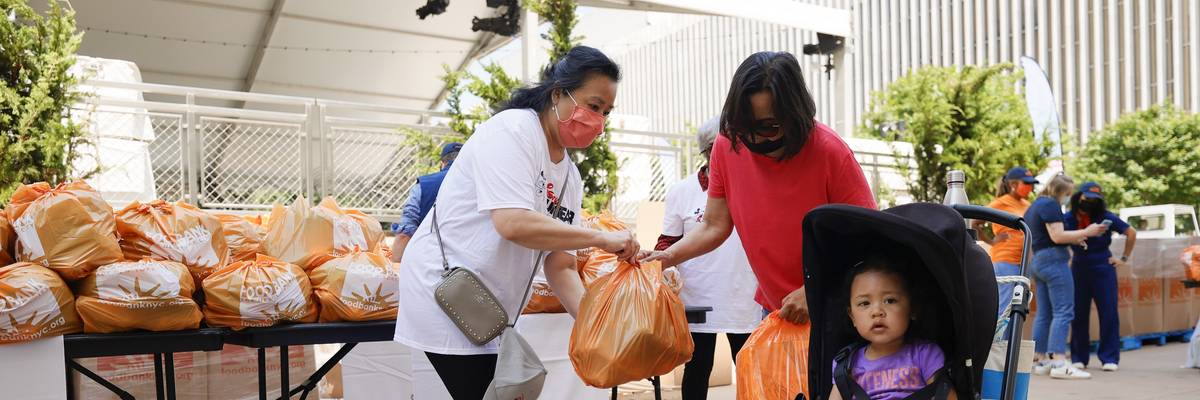
Local residents receive food items during a Pop-Up Food Distribution and Vaccination Event with Lincoln Center, Disney, and WABC at Lincoln Center on May 26, 2021 in New York City.
Such an immense issue as food insecurity cannot be wholly solved by one channel or one institution alone; it takes policy advocacy, community organizing, and self-reliance moving hand-in-hand.
Bread for the World recently held its annual Advocacy Summit in Washington, DC. As a board member, I was honored to be part of conversations on how public policies affect people experiencing hunger and poverty. People from all walks of life and all backgrounds united with the common goal of developing institutions that advance food security.
This moment was especially full of policy discussions as midterm season is in full swing across the country. Leaders are itching to advance on the campaign trail. They are more likely to be on the ground listening to what we have to say, so the opportunity is ripe to share what we care about. We can ask them what they will do to reduce hunger and improve food security for those in poverty. We can push for accountability.
But first, we must understand the current policies and context today that create and maintain food apartheid.
As of the 2017 Census, Black farmers were reported to own just 0.32% of US farmland, a number which has been continuously decreasing over the past century. They are denied grants disproportionately to their white counterparts and earn approximately one-seventh of the income that their white counterparts bring in. Land ownership is steadily being stripped from us.
Hunger is not inevitable. It is possible to make change.
In the last year and a half, the Supplemental Nutrition Assistance Program (SNAP) has been on the chopping block many times. Since July of 2025, well over 3.5 million people have been pushed out of the program as a result of cuts in the federal budget. Newly enacted work requirements unjustly require people to qualify themselves to eat.
SNAP’s program for Women, Infants, and Children (WIC) is facing even further underfunding. Recent cuts will take away over $141 million in funds to feed over 5 million new mothers and young children—particularly funds designated for fresh fruits and vegetables. They are literally taking food out of the mouths of children.
This says nothing of the centuries of racism, blocked resources, and stolen land that brought us here today. It barely scratches the surface of all the factors influencing security today. We are facing hateful rhetoric; regressive social policies; global instability; and widespread threats to Black, brown, and immigrant communities. All this uncertainty makes us feel vulnerable. It makes food security and, indeed, any economic stability more tenuous.
There is no question that we need change; now is the moment to demand it from our leaders. Just as there are policies that harm access to nutritious food, there are certainly policies that can expand access.
We can remove work requirements for SNAP that pick and choose who gets to eat without regard for what they are going through. We can expand funding and access so that no one is left without nutritious food to sustain them. We can enact reparations to return land and opportunities to Black communities, and we can support the Black farmers and organizations working to feed people.
But, as we raise our voices for policy change, we must not overlook actions in our own neighborhoods.
I will always fight for a more representative government which supports the needs of our people. However, the government is still imperfect to say the least; we cannot wait for them while hunger runs rampant. We can take matters into our own hands.
Community organizing and self-reliance offers security especially when our government fails us; this is what we work for at The Black Church Food Security Network. We meet people where they are. We grow the food ourselves and distribute it throughout the community. We work together to build autonomy within our own communities.
Such an immense issue as food insecurity cannot be wholly solved by one channel or one institution alone. It takes policy advocacy, community organizing, and self-reliance moving hand-in-hand. Progress is possible when we approach it as a united front.
As Bread for the World reminded us through the advocacy summit, hunger is not inevitable. It is possible to make change. If we come together to uplift our communities and advance essential policies, we can create an environment where people are not only fed, but they are in a better position to feed themselves.
Dear Common Dreams reader, It’s been nearly 30 years since I co-founded Common Dreams with my late wife, Lina Newhouser. We had the radical notion that journalism should serve the public good, not corporate profits. It was clear to us from the outset what it would take to build such a project. No paid advertisements. No corporate sponsors. No millionaire publisher telling us what to think or do. Many people said we wouldn't last a year, but we proved those doubters wrong. Together with a tremendous team of journalists and dedicated staff, we built an independent media outlet free from the constraints of profits and corporate control. Our mission has always been simple: To inform. To inspire. To ignite change for the common good. Building Common Dreams was not easy. Our survival was never guaranteed. When you take on the most powerful forces—Wall Street greed, fossil fuel industry destruction, Big Tech lobbyists, and uber-rich oligarchs who have spent billions upon billions rigging the economy and democracy in their favor—the only bulwark you have is supporters who believe in your work. But here’s the urgent message from me today. It's never been this bad out there. And it's never been this hard to keep us going. At the very moment Common Dreams is most needed, the threats we face are intensifying. We need your support now more than ever. We don't accept corporate advertising and never will. We don't have a paywall because we don't think people should be blocked from critical news based on their ability to pay. Everything we do is funded by the donations of readers like you. When everyone does the little they can afford, we are strong. But if that support retreats or dries up, so do we. Will you donate now to make sure Common Dreams not only survives but thrives? —Craig Brown, Co-founder |
Bread for the World recently held its annual Advocacy Summit in Washington, DC. As a board member, I was honored to be part of conversations on how public policies affect people experiencing hunger and poverty. People from all walks of life and all backgrounds united with the common goal of developing institutions that advance food security.
This moment was especially full of policy discussions as midterm season is in full swing across the country. Leaders are itching to advance on the campaign trail. They are more likely to be on the ground listening to what we have to say, so the opportunity is ripe to share what we care about. We can ask them what they will do to reduce hunger and improve food security for those in poverty. We can push for accountability.
But first, we must understand the current policies and context today that create and maintain food apartheid.
As of the 2017 Census, Black farmers were reported to own just 0.32% of US farmland, a number which has been continuously decreasing over the past century. They are denied grants disproportionately to their white counterparts and earn approximately one-seventh of the income that their white counterparts bring in. Land ownership is steadily being stripped from us.
Hunger is not inevitable. It is possible to make change.
In the last year and a half, the Supplemental Nutrition Assistance Program (SNAP) has been on the chopping block many times. Since July of 2025, well over 3.5 million people have been pushed out of the program as a result of cuts in the federal budget. Newly enacted work requirements unjustly require people to qualify themselves to eat.
SNAP’s program for Women, Infants, and Children (WIC) is facing even further underfunding. Recent cuts will take away over $141 million in funds to feed over 5 million new mothers and young children—particularly funds designated for fresh fruits and vegetables. They are literally taking food out of the mouths of children.
This says nothing of the centuries of racism, blocked resources, and stolen land that brought us here today. It barely scratches the surface of all the factors influencing security today. We are facing hateful rhetoric; regressive social policies; global instability; and widespread threats to Black, brown, and immigrant communities. All this uncertainty makes us feel vulnerable. It makes food security and, indeed, any economic stability more tenuous.
There is no question that we need change; now is the moment to demand it from our leaders. Just as there are policies that harm access to nutritious food, there are certainly policies that can expand access.
We can remove work requirements for SNAP that pick and choose who gets to eat without regard for what they are going through. We can expand funding and access so that no one is left without nutritious food to sustain them. We can enact reparations to return land and opportunities to Black communities, and we can support the Black farmers and organizations working to feed people.
But, as we raise our voices for policy change, we must not overlook actions in our own neighborhoods.
I will always fight for a more representative government which supports the needs of our people. However, the government is still imperfect to say the least; we cannot wait for them while hunger runs rampant. We can take matters into our own hands.
Community organizing and self-reliance offers security especially when our government fails us; this is what we work for at The Black Church Food Security Network. We meet people where they are. We grow the food ourselves and distribute it throughout the community. We work together to build autonomy within our own communities.
Such an immense issue as food insecurity cannot be wholly solved by one channel or one institution alone. It takes policy advocacy, community organizing, and self-reliance moving hand-in-hand. Progress is possible when we approach it as a united front.
As Bread for the World reminded us through the advocacy summit, hunger is not inevitable. It is possible to make change. If we come together to uplift our communities and advance essential policies, we can create an environment where people are not only fed, but they are in a better position to feed themselves.
Bread for the World recently held its annual Advocacy Summit in Washington, DC. As a board member, I was honored to be part of conversations on how public policies affect people experiencing hunger and poverty. People from all walks of life and all backgrounds united with the common goal of developing institutions that advance food security.
This moment was especially full of policy discussions as midterm season is in full swing across the country. Leaders are itching to advance on the campaign trail. They are more likely to be on the ground listening to what we have to say, so the opportunity is ripe to share what we care about. We can ask them what they will do to reduce hunger and improve food security for those in poverty. We can push for accountability.
But first, we must understand the current policies and context today that create and maintain food apartheid.
As of the 2017 Census, Black farmers were reported to own just 0.32% of US farmland, a number which has been continuously decreasing over the past century. They are denied grants disproportionately to their white counterparts and earn approximately one-seventh of the income that their white counterparts bring in. Land ownership is steadily being stripped from us.
Hunger is not inevitable. It is possible to make change.
In the last year and a half, the Supplemental Nutrition Assistance Program (SNAP) has been on the chopping block many times. Since July of 2025, well over 3.5 million people have been pushed out of the program as a result of cuts in the federal budget. Newly enacted work requirements unjustly require people to qualify themselves to eat.
SNAP’s program for Women, Infants, and Children (WIC) is facing even further underfunding. Recent cuts will take away over $141 million in funds to feed over 5 million new mothers and young children—particularly funds designated for fresh fruits and vegetables. They are literally taking food out of the mouths of children.
This says nothing of the centuries of racism, blocked resources, and stolen land that brought us here today. It barely scratches the surface of all the factors influencing security today. We are facing hateful rhetoric; regressive social policies; global instability; and widespread threats to Black, brown, and immigrant communities. All this uncertainty makes us feel vulnerable. It makes food security and, indeed, any economic stability more tenuous.
There is no question that we need change; now is the moment to demand it from our leaders. Just as there are policies that harm access to nutritious food, there are certainly policies that can expand access.
We can remove work requirements for SNAP that pick and choose who gets to eat without regard for what they are going through. We can expand funding and access so that no one is left without nutritious food to sustain them. We can enact reparations to return land and opportunities to Black communities, and we can support the Black farmers and organizations working to feed people.
But, as we raise our voices for policy change, we must not overlook actions in our own neighborhoods.
I will always fight for a more representative government which supports the needs of our people. However, the government is still imperfect to say the least; we cannot wait for them while hunger runs rampant. We can take matters into our own hands.
Community organizing and self-reliance offers security especially when our government fails us; this is what we work for at The Black Church Food Security Network. We meet people where they are. We grow the food ourselves and distribute it throughout the community. We work together to build autonomy within our own communities.
Such an immense issue as food insecurity cannot be wholly solved by one channel or one institution alone. It takes policy advocacy, community organizing, and self-reliance moving hand-in-hand. Progress is possible when we approach it as a united front.
As Bread for the World reminded us through the advocacy summit, hunger is not inevitable. It is possible to make change. If we come together to uplift our communities and advance essential policies, we can create an environment where people are not only fed, but they are in a better position to feed themselves.