5
#000000
#FFFFFF
To donate by check, phone, or other method, see our More Ways to Give page.
Daily news & progressive opinion—funded by the people, not the corporations—delivered straight to your inbox.
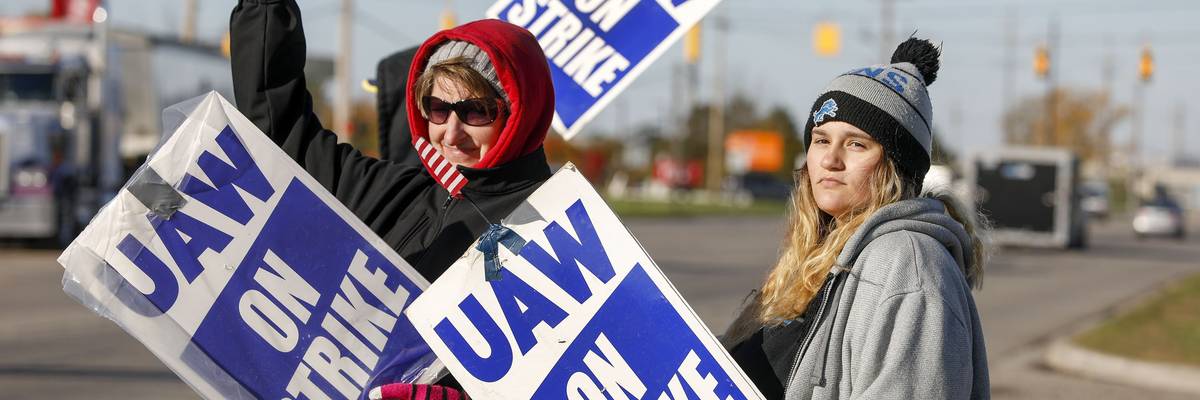
United Auto Workers union members picket at the General Motors Flint Engine plant for the sixth week of their national strike against General Motors on October 23, 2019 in Flint, Michigan.
If both DSA and the Democratic Party want to be of and not just for the working class, broadly defined, they have a long way to go. But the work is vital.
The Democratic Party and the Democratic Socialists of America share a problem. As organizations largely run by and involved with college-educated voters, they are physically and psychically removed from working people without four-year degrees. Both the Democrats and DSA claim they are speaking for the working class, but they are not, at present, political organizations of the working class.
The Democrats have tried to avoid their working-class problem by embracing suburban Republicans and independents who have been repulsed by the GOP’s extremism. The Democrats’ embrace of Wall Street and Hollywood big money—and NAFTA—has pushed working people out of the coalition.
For DSA, on the other hand, the easiest way to address the problem is to define it away. DSA uses a broad definition of the working class that includes underpaid college-educated graduate students, unemployed and underemployed college graduates, and a host of other college-educated workers who suffer from insecure jobs and the high cost of living. While these educated workers are sometimes financially akin to the working class, the majority of working people—nearly 60 percent—do not have four-year college degrees.
And that’s the way the 2024 vote went. Trump had a 14-point advantage among voters without college degrees, while Harris carried college graduates, 56 percent to 43 percent. If DSA and the Democrats remain organizations largely of the highly educated, they will lose.
Racial Silos?
Looking at voters as racial groups is another way to avoid dealing with the working-class issues the Democrats and DSA face.
The Democrats have historically done well with Black and Hispanic voters, and the working class is increasingly multiracial. The idea is that if we stop viewing the working class as dominated by white workers, people of color will lead to stronger vote totals for the Democrats.
Alas, ethnicity is no longer a sure sign of voting Democratic because working-class Black and Hispanic voters have been leaving the party. Twenty percent of Black voters without four-year degrees and 48 percent of Hispanic voters without four-year degrees supported Trump in 2024.
White voters without four-year college degrees made up 42 percent of the 2024 electorate nationally. In seven states where Democrats have largely abandoned the political field—Oklahoma, Kansas, Nebraska, South Dakota, North Dakota, Montana, and Idaho—they constituted a majority of voters, ranging from 51 percent in Kansas to 58 percent in Montana and Idaho.
No significant progressive political movement can succeed without attracting large numbers of working-class voters of all colors. (Please see my latest book for the development of this argument.)
The Fox News Strategy?
Perhaps a good way to reach the working class is through conservative media. Some in DSA believe that their base can be extended by appearing on Fox News and making their case.
According to Pew Research, the median age of Fox viewers is 55, and most are Republicans or Republican-leaning independents. Michigan Senate candidate Abdul El-Sayed has been making Fox News appearances lately that have drawn attention, but it’s not at all clear that Fox News reaches deeply into younger working-class communities, especially those independents who are open to progressive economic populism. A good case could be made that progressives are wasting their time on conservative media, though El-Sayed’s performance this November could change my mind.
Electoral Canvassing?
DSA has done a remarkable job of fielding large numbers of door knockers during its political campaigns. The one-on-one conversations that take place are key to getting out the vote and sharing information about progressive policies such as taxing billionaires and Medicare for All. When thousands of DSA activists hit the streets during an election, public education certainly takes place.
But where and with whom?
Most DSA canvassing to date takes place in blue districts. And within those districts, it’s not clear whether working-class areas have been targeted. Often in political campaigns, the goal of canvassing is to find those voters most likely to support your candidate and make sure they vote. Harvesting the most likely supporters usually means targeting the areas where they live. Since DSA candidates thrive among college-educated voters, there is likely to be a tendency to concentrate canvassing in gentrified and upper-middle-class areas. Working-class urban areas will also be reached, but the balance is likely to tilt toward where the most likely supporters live.
More importantly, to date, most of the canvassing has taken place in urban areas and in and around college towns. Maybe I’m missing something, but reaching deeply into red working-class communities has not yet become a significant part of DSA’s ground game.
Long-Term Engagement with Working-Class Union People?
Unless and until DSA—and the Democrats, for that matter—set up precinct-level organizations in working-class neighborhoods, electioneering will be episodic and superficial. Door-to-door conversations are worthwhile, but they are no substitute for continual engagement within local organizations.
In my opinion, the best way to reach the working class is to engage with people through their labor organizations. The labor movement is much smaller than it was a generation ago, but there are still thousands of union meetings taking place each month, ranging from small local union gatherings to larger regional and national conferences. Political activists need to show up and listen to what union members care about.
It takes work, often hard work, to get in the door. That’s something the Labor Institute, which I cofounded, had to do a half century ago when we started our work. To get educational opportunities, we reached out to countless labor leaders and activists, gradually gaining their trust and finding venues to show our wares.
It takes lots of time and lots of trust-building, but the conversations that emerge through ongoing educational engagement taught us as much as we taught others, greatly enriching what we were able to offer. DSA would broaden its support and deepen its connections with working people if it engaged with large numbers of blue-collar and service workers in trade unions.
If DSA wants to be of and not just for the working class, broadly defined, it will have to get in the labor door. It will need to learn how to have a dialogue with working-class groups who might be progressive populists but are also likely to have concerns about socialism and whether DSA really can advance the cause of non-college-educated working people.
DSA, more than the Democrats, has the troops and the energy to do that work. The jury is out, however, on whether it can deploy that passion, and commitment to engage with working people who don’t already agree with them.
This country and this world are at a monumental crossroads. US voters have an opportunity to beat back the forces of fascism and confront the billionaires who are rigging the economy, our media system, and our democracy, making it increasingly impossible for ordinary people to get by. We’re not just talking about the election. We’re talking about what must be done once these fascist elements are vanquished from power. We need a bolder set of solutions than what either major party has so far been willing to offer and a working-class movement ready to fight like hell for it. Trump didn't emerge from nowhere. The conditions that fueled MAGA authoritarianism were created by decades of radical neoliberal economic policies and a corrupt political system dominated by corporate interests. They slashed taxes on the super-rich, promising that the benefits would trickle down. They said giveaways to the corporate titans would make life more affordable for the rest of us. It was all bullshit. And when a bitter, betrayed populace searches for someone to blame, right-wing demagogues have little trouble finding scapegoats. People know when they're being lied to, but you won't hear any of this from the corporate media. Only independent journalism—powered and funded by people who believe in building a better world—can deliver truly trustworthy daily news. If you share our vision, please contribute whatever you can to sustain our work. |
Les Leopold is the executive director of the Labor Institute and author of the new book, “The Billionaires Have Two Parties, We Need a Party of Our Own” (2026). His previous books include: “Wall Street’s War on Workers: How Mass Layoffs and Greed Are Destroying the Working Class and What to Do About It" (2024); "Runaway Inequality: An Activist's Guide to Economic Justice" (2015); and “The Man Who Hated Work and Loved Labor: The Life and Times of Tony Mazzocchi” (2007). Read more of his work on his substack here.
The Democratic Party and the Democratic Socialists of America share a problem. As organizations largely run by and involved with college-educated voters, they are physically and psychically removed from working people without four-year degrees. Both the Democrats and DSA claim they are speaking for the working class, but they are not, at present, political organizations of the working class.
The Democrats have tried to avoid their working-class problem by embracing suburban Republicans and independents who have been repulsed by the GOP’s extremism. The Democrats’ embrace of Wall Street and Hollywood big money—and NAFTA—has pushed working people out of the coalition.
For DSA, on the other hand, the easiest way to address the problem is to define it away. DSA uses a broad definition of the working class that includes underpaid college-educated graduate students, unemployed and underemployed college graduates, and a host of other college-educated workers who suffer from insecure jobs and the high cost of living. While these educated workers are sometimes financially akin to the working class, the majority of working people—nearly 60 percent—do not have four-year college degrees.
And that’s the way the 2024 vote went. Trump had a 14-point advantage among voters without college degrees, while Harris carried college graduates, 56 percent to 43 percent. If DSA and the Democrats remain organizations largely of the highly educated, they will lose.
Racial Silos?
Looking at voters as racial groups is another way to avoid dealing with the working-class issues the Democrats and DSA face.
The Democrats have historically done well with Black and Hispanic voters, and the working class is increasingly multiracial. The idea is that if we stop viewing the working class as dominated by white workers, people of color will lead to stronger vote totals for the Democrats.
Alas, ethnicity is no longer a sure sign of voting Democratic because working-class Black and Hispanic voters have been leaving the party. Twenty percent of Black voters without four-year degrees and 48 percent of Hispanic voters without four-year degrees supported Trump in 2024.
White voters without four-year college degrees made up 42 percent of the 2024 electorate nationally. In seven states where Democrats have largely abandoned the political field—Oklahoma, Kansas, Nebraska, South Dakota, North Dakota, Montana, and Idaho—they constituted a majority of voters, ranging from 51 percent in Kansas to 58 percent in Montana and Idaho.
No significant progressive political movement can succeed without attracting large numbers of working-class voters of all colors. (Please see my latest book for the development of this argument.)
The Fox News Strategy?
Perhaps a good way to reach the working class is through conservative media. Some in DSA believe that their base can be extended by appearing on Fox News and making their case.
According to Pew Research, the median age of Fox viewers is 55, and most are Republicans or Republican-leaning independents. Michigan Senate candidate Abdul El-Sayed has been making Fox News appearances lately that have drawn attention, but it’s not at all clear that Fox News reaches deeply into younger working-class communities, especially those independents who are open to progressive economic populism. A good case could be made that progressives are wasting their time on conservative media, though El-Sayed’s performance this November could change my mind.
Electoral Canvassing?
DSA has done a remarkable job of fielding large numbers of door knockers during its political campaigns. The one-on-one conversations that take place are key to getting out the vote and sharing information about progressive policies such as taxing billionaires and Medicare for All. When thousands of DSA activists hit the streets during an election, public education certainly takes place.
But where and with whom?
Most DSA canvassing to date takes place in blue districts. And within those districts, it’s not clear whether working-class areas have been targeted. Often in political campaigns, the goal of canvassing is to find those voters most likely to support your candidate and make sure they vote. Harvesting the most likely supporters usually means targeting the areas where they live. Since DSA candidates thrive among college-educated voters, there is likely to be a tendency to concentrate canvassing in gentrified and upper-middle-class areas. Working-class urban areas will also be reached, but the balance is likely to tilt toward where the most likely supporters live.
More importantly, to date, most of the canvassing has taken place in urban areas and in and around college towns. Maybe I’m missing something, but reaching deeply into red working-class communities has not yet become a significant part of DSA’s ground game.
Long-Term Engagement with Working-Class Union People?
Unless and until DSA—and the Democrats, for that matter—set up precinct-level organizations in working-class neighborhoods, electioneering will be episodic and superficial. Door-to-door conversations are worthwhile, but they are no substitute for continual engagement within local organizations.
In my opinion, the best way to reach the working class is to engage with people through their labor organizations. The labor movement is much smaller than it was a generation ago, but there are still thousands of union meetings taking place each month, ranging from small local union gatherings to larger regional and national conferences. Political activists need to show up and listen to what union members care about.
It takes work, often hard work, to get in the door. That’s something the Labor Institute, which I cofounded, had to do a half century ago when we started our work. To get educational opportunities, we reached out to countless labor leaders and activists, gradually gaining their trust and finding venues to show our wares.
It takes lots of time and lots of trust-building, but the conversations that emerge through ongoing educational engagement taught us as much as we taught others, greatly enriching what we were able to offer. DSA would broaden its support and deepen its connections with working people if it engaged with large numbers of blue-collar and service workers in trade unions.
If DSA wants to be of and not just for the working class, broadly defined, it will have to get in the labor door. It will need to learn how to have a dialogue with working-class groups who might be progressive populists but are also likely to have concerns about socialism and whether DSA really can advance the cause of non-college-educated working people.
DSA, more than the Democrats, has the troops and the energy to do that work. The jury is out, however, on whether it can deploy that passion, and commitment to engage with working people who don’t already agree with them.