SUBSCRIBE TO OUR FREE NEWSLETTER
Daily news & progressive opinion—funded by the people, not the corporations—delivered straight to your inbox.
5
#000000
#FFFFFF
To donate by check, phone, or other method, see our More Ways to Give page.
Daily news & progressive opinion—funded by the people, not the corporations—delivered straight to your inbox.
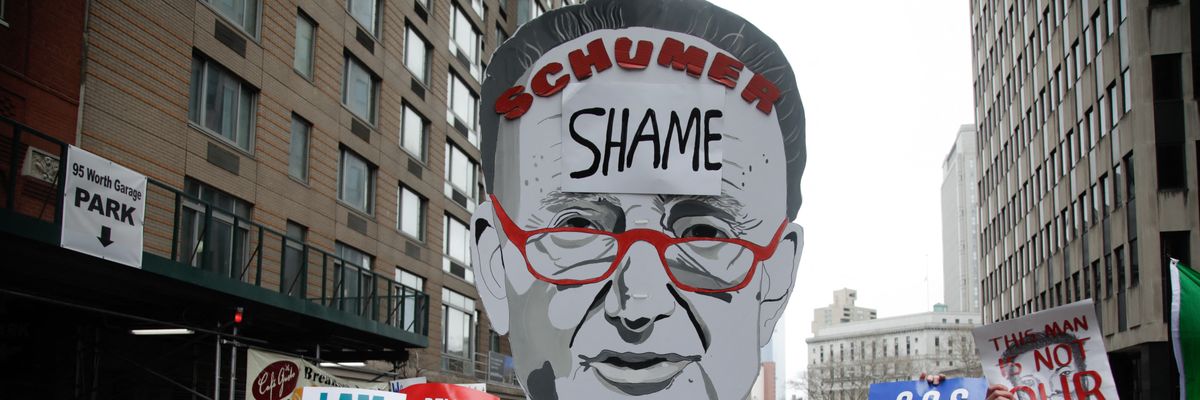
Dmonstrators take part in a "March to Stop the Cuts" protest in New York on March 15, 2025.
The Democratic Party’s retreat to centrism—from welfare reform in the 90s to recent budget deals—has consistently weakened its own base while signaling to Republicans that cruelty works.
It’s a tale as old as American liberalism: Say the right thing—but only when it’s safe, and only after the damage is done.
Earlier this month, Senate Minority Leader Chuck Schumer (D-N.Y.) had a choice to draw the line and stand up to a Republican-led budget that proposed slashing essential services like the Supplemental Nutrition Assistance Program (SNAP) and Section 8 housing assistance. Instead, after publicly criticizing the bill, he reversed course in under 24 hours and urged Democrats to pass it—calling it the “best path forward to avoid a shutdown.”
This is what establishment leadership looks like: performative urgency wrapped in political safety.The families who rely on SNAP and Section 8 aren’t breathing easier because D.C. stayed open. They’re still wondering how to put food on the table and keep a roof over their heads.
Schumer and Newsom want to be seen as steady hands.The country doesn’t need politicians who manage decline gracefully. They need leaders who disrupt the status quo to protect the people it was never built to serve.
Meanwhile, California Gov. Gavin Newsom decided to deny support to trans athletes. On the first episode of his new podcast, This Is Gavin Newsom, he said it was “deeply unfair” for trans women to compete in women’s sports—framing that echoed right-wing rhetoric used to push anti-trans legislation.
And he didn’t say it to a neutral audience—he said it to Charlie Kirk, a far-right extremist who has spent years spreading anti-LGBTQ+ disinformation and promoting voter suppression through Turning Point USA.
Newsom invited him on as his first guest in an effort to appear “bipartisan.” That move alone signals more than a desire to reach across the aisle—it signals whose approval he’s seeking.
This wasn’t a spontaneous exchange—it was a calculated move, and a political wink to the center-right, packaged as “balance.” And it came from the same man who once signed a bill making California a sanctuary state for trans youth. That contrast gave right-wing media a fresh soundbite.
Even Rep.Sarah McBride (D-Del.)—the first openly trans member of Congress—recently urged Democrats to make room for people with “honest questions” about trans inclusion in sports. But those questions aren’t neutral. They’re part of a long, strategic assault on trans people’s dignity.
State Sen. Scott Wiener (D-11), one of the few who consistently shows up for trans communities, called it out immediately: “Trans people are under attack. They need support, not betrayal.”
In March 2024, Schumer gave a speech condemning Israeli leader Benjamin Netanyahu and calling for elections in Israel—after more than 30,000 Palestinians were already dead. The speech was safe, and the policy—uninterrupted U.S. military aid—remained unchanged.
This is what performative politics looks like in action: too late, too safe, and too empty.
We’re told these are “tough choices.” But they’re only tough if your priority is your career. When Democrats lose ground, they often shift to the center—abandoning bold policies and the people who need them most.
But history shows that doesn’t win back power—it loses trust. As American Affairs Journal outlines, the party’s retreat to centrism—from welfare reform in the 90s to recent budget deals—has consistently weakened its own base while signaling to Republicans that cruelty works.
I know the cost of centrist politics because I lived it. In the 90s, Democrats embraced welfare reform and tough-on-crime laws to look “tough” and “moderate.”
That turn helped criminalize poverty. I was convicted of welfare fraud. I wasn’t gaming the system; I was surviving it. Whole communities were punished in the name of bipartisanship. So when Democrats today praise “moderation,” I hear echoes of policies that nearly erased me.
If you’re poor, trans, undocumented, disabled, or Palestinian—these choices don’t look tough. They look familiar.
And they cause harm. When people with power echo right-wing talking points, they legitimize them. They embolden bills that restrict bodily autonomy, gut benefits, and criminalize survival. They signal that marginalized people—their lives and dignity—are negotiable.
Schumer and Newsom want to be seen as steady hands.The country doesn’t need politicians who manage decline gracefully. They need leaders who disrupt the status quo to protect the people it was never built to serve.
So where are the leaders?
Not the ones who speak up after it’s politically safe. Not the ones who adjust their stances based on polling data, shifting with the wind instead of standing for something. Where are the ones who lead from the front?
Real leadership is not polished. It’s the woman clearing her record. It’s the trans activist running mutual aid while dodging attacks. It’s the undocumented student organizing for housing justice with no promise of safety.
And it is me, a formerly incarcerated queer Black woman who went back to college in her 50s. Who found her voice not in press rooms but in courtrooms, classrooms, and community spaces. Who survived systems designed to erase her and came back fighting for others still trapped inside them.
Real change doesn’t trickle down—it rises up. From organizing, solidarity, and movements that center the people most impacted and most ignored.
Real leaders are not waiting on permission. They are building with the people already creating justice—one expungement, one coalition, one unapologetic truth at a time.
This country and this world are at a monumental crossroads. US voters have an opportunity to beat back the forces of fascism and confront the billionaires who are rigging the economy, our media system, and our democracy, making it increasingly impossible for ordinary people to get by. We’re not just talking about the election. We’re talking about what must be done once these fascist elements are vanquished from power. We need a bolder set of solutions than what either major party has so far been willing to offer and a working-class movement ready to fight like hell for it. Trump didn't emerge from nowhere. The conditions that fueled MAGA authoritarianism were created by decades of radical neoliberal economic policies and a corrupt political system dominated by corporate interests. They slashed taxes on the super-rich, promising that the benefits would trickle down. They said giveaways to the corporate titans would make life more affordable for the rest of us. It was all bullshit. And when a bitter, betrayed populace searches for someone to blame, right-wing demagogues have little trouble finding scapegoats. People know when they're being lied to, but you won't hear any of this from the corporate media. Only independent journalism—powered and funded by people who believe in building a better world—can deliver truly trustworthy daily news. If you share our vision, please contribute whatever you can to sustain our work. |
It’s a tale as old as American liberalism: Say the right thing—but only when it’s safe, and only after the damage is done.
Earlier this month, Senate Minority Leader Chuck Schumer (D-N.Y.) had a choice to draw the line and stand up to a Republican-led budget that proposed slashing essential services like the Supplemental Nutrition Assistance Program (SNAP) and Section 8 housing assistance. Instead, after publicly criticizing the bill, he reversed course in under 24 hours and urged Democrats to pass it—calling it the “best path forward to avoid a shutdown.”
This is what establishment leadership looks like: performative urgency wrapped in political safety.The families who rely on SNAP and Section 8 aren’t breathing easier because D.C. stayed open. They’re still wondering how to put food on the table and keep a roof over their heads.
Schumer and Newsom want to be seen as steady hands.The country doesn’t need politicians who manage decline gracefully. They need leaders who disrupt the status quo to protect the people it was never built to serve.
Meanwhile, California Gov. Gavin Newsom decided to deny support to trans athletes. On the first episode of his new podcast, This Is Gavin Newsom, he said it was “deeply unfair” for trans women to compete in women’s sports—framing that echoed right-wing rhetoric used to push anti-trans legislation.
And he didn’t say it to a neutral audience—he said it to Charlie Kirk, a far-right extremist who has spent years spreading anti-LGBTQ+ disinformation and promoting voter suppression through Turning Point USA.
Newsom invited him on as his first guest in an effort to appear “bipartisan.” That move alone signals more than a desire to reach across the aisle—it signals whose approval he’s seeking.
This wasn’t a spontaneous exchange—it was a calculated move, and a political wink to the center-right, packaged as “balance.” And it came from the same man who once signed a bill making California a sanctuary state for trans youth. That contrast gave right-wing media a fresh soundbite.
Even Rep.Sarah McBride (D-Del.)—the first openly trans member of Congress—recently urged Democrats to make room for people with “honest questions” about trans inclusion in sports. But those questions aren’t neutral. They’re part of a long, strategic assault on trans people’s dignity.
State Sen. Scott Wiener (D-11), one of the few who consistently shows up for trans communities, called it out immediately: “Trans people are under attack. They need support, not betrayal.”
In March 2024, Schumer gave a speech condemning Israeli leader Benjamin Netanyahu and calling for elections in Israel—after more than 30,000 Palestinians were already dead. The speech was safe, and the policy—uninterrupted U.S. military aid—remained unchanged.
This is what performative politics looks like in action: too late, too safe, and too empty.
We’re told these are “tough choices.” But they’re only tough if your priority is your career. When Democrats lose ground, they often shift to the center—abandoning bold policies and the people who need them most.
But history shows that doesn’t win back power—it loses trust. As American Affairs Journal outlines, the party’s retreat to centrism—from welfare reform in the 90s to recent budget deals—has consistently weakened its own base while signaling to Republicans that cruelty works.
I know the cost of centrist politics because I lived it. In the 90s, Democrats embraced welfare reform and tough-on-crime laws to look “tough” and “moderate.”
That turn helped criminalize poverty. I was convicted of welfare fraud. I wasn’t gaming the system; I was surviving it. Whole communities were punished in the name of bipartisanship. So when Democrats today praise “moderation,” I hear echoes of policies that nearly erased me.
If you’re poor, trans, undocumented, disabled, or Palestinian—these choices don’t look tough. They look familiar.
And they cause harm. When people with power echo right-wing talking points, they legitimize them. They embolden bills that restrict bodily autonomy, gut benefits, and criminalize survival. They signal that marginalized people—their lives and dignity—are negotiable.
Schumer and Newsom want to be seen as steady hands.The country doesn’t need politicians who manage decline gracefully. They need leaders who disrupt the status quo to protect the people it was never built to serve.
So where are the leaders?
Not the ones who speak up after it’s politically safe. Not the ones who adjust their stances based on polling data, shifting with the wind instead of standing for something. Where are the ones who lead from the front?
Real leadership is not polished. It’s the woman clearing her record. It’s the trans activist running mutual aid while dodging attacks. It’s the undocumented student organizing for housing justice with no promise of safety.
And it is me, a formerly incarcerated queer Black woman who went back to college in her 50s. Who found her voice not in press rooms but in courtrooms, classrooms, and community spaces. Who survived systems designed to erase her and came back fighting for others still trapped inside them.
Real change doesn’t trickle down—it rises up. From organizing, solidarity, and movements that center the people most impacted and most ignored.
Real leaders are not waiting on permission. They are building with the people already creating justice—one expungement, one coalition, one unapologetic truth at a time.