5
#000000
#FFFFFF
To donate by check, phone, or other method, see our More Ways to Give page.
Daily news & progressive opinion—funded by the people, not the corporations—delivered straight to your inbox.
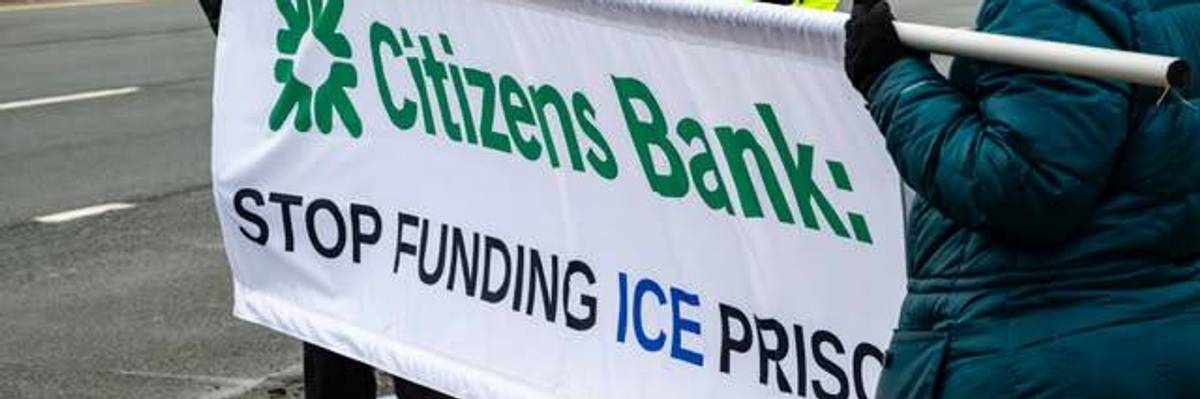
Protesters call on Citizens Bank to stop funding prison companies that work with Immigration and Customs Enforcement.
The grassroots effort was a textbook example of sustained, targeted civil resistance that can undermine Trump administration policies; by chipping away at corporate supporters of programs like ICE, citizen activism can erode and stop these initiatives.
Just as a great loaf of bread requires the right ingredients to rise, a winning civil resistance campaign needs three essentials to rise up: a compelling vision, broad community engagement, and a spark for action.
The De-ICE Citizens Bank campaign had all these ingredients, which is why it succeeded in forcing Citizens Bank to stop financing prison company giants, CoreCivic and GEO Group, operating dozens of detention centers for US Immigration and Customs Enforcement (ICE). The Rhode Island bank severed its ties in mid-July after months of protests and other targeted actions across the country.
Hundreds of rallies, faith-led actions, shareholder demands, billboard and flyover campaigns, and withering financial pressure—withdrawals totaling $380 million, with more still happening—created a tsunami of opposition the bank could not ignore.
It is a textbook example of sustained, targeted civil resistance that can undermine Trump administration policies. By chipping away at corporate supporters of programs like ICE, citizen activism can erode and stop these initiatives.
While Bank of America and a half-dozen other banks ended their relationships with private prison companies in 2019, Citizens strengthened its ties, providing more than $2.8 billion in loans and other credit to CoreCivic and GEO Group over a dozen years.
“No, Citizens Bank won’t credit you at all for its decision, but it is what it is,” MSNBC’s Rachel Maddow said, during a 10-minute segment on the campaign win in late July. “Actions have consequences, including when you work hard, when you organize, and when you decide to just never give up.
"And then the day does come when you win.”
This civil resistance story began with a single person, a woman in Texas, taking a stand. She didn’t carry a protest sign or march alone. She built a website.
Horrified by ICE’s mass incarceration campaign early last year, research-nerd activist Laura Berlin, a mother of two teenagers, built a website, boycottcitizens.org, to expose Citizens Bank’s role.
While Bank of America and a half-dozen other banks ended their relationships with private prison companies in 2019, Citizens strengthened its ties, providing more than $2.8 billion in loans and other credit to CoreCivic and GEO Group over a dozen years.
Drawing on Securities and Exchange Commission filings and other documents, the website showed Citizen’s duplicity, loan-by-loan, year-by-year. Still, the website didn’t get much attention when it was launched 13 months ago, only a dozen or so views a day in the first few months.
That all changed in January when ICE’s aggressive crackdown sparked and exploded. Just as a dozen Northeast activists were organizing their first coordinated protest day against Citizens Ban—an effort of the new De-ICE Citizens Bank Coalition—mother and poet Renee Good was gunned down January 7 by an ICE agent in Minneapolis.
Campaign interest and traffic on Berlin’s website took off. When Alex Pretti, an intensive care nurse, was shot and killed 17 days later in the same city, momentum skyrocketed.
On January 24, the campaign held three-dozen rallies in six states. By March, there were 70 protests in a dozen states. Three months later, 140 protests were organized nationwide, drawing in thousands of regular people angry about an immigration crackdown that has booked and detained more than 600,000 people, 66,000 of whom have been deported.
As protests swelled, coalition members brought new partners into the campaign. One brought in a key union group and activist students at Brown University. Others brought in faith groups. Dozens of local Indivisible groups also joined, including a Rightful Resistance group in New York City that specialized in billboard campaigns.
The Greater Boston Interfaith Organization (GBIO), a powerful faith group with deep historic ties to Citizens Bank, was an especially important partner.
The city’s pullout was a bit of a surprise, with the vote and initial withdrawal of $150 million happening in less than 24 hours. It was a clear sign that the campaign, which had swelled to 175 groups in 17 states, was now a movement.
In the early 2000s, GBIO teamed up with Citizens to offer a financial literacy program for its immigrant members around Boston. The bank also lowered fees for immigrants sending remittances to their families. “We were proud to bank with Citizens, and I was proud to be a member of the bank’s board of directors at that time,” wrote Rev. Ray Hammond, a key GBIO leader, in a recent column.
By winter 2026, the good vibes were over.
In early March, GBIO sent a letter to the bank requesting it cut financial ties with the prison companies. In April, Hammond and other shareholders confronted Citizens CEO Bruce Van Saun at the bank’s annual meeting in Providence. As Van Saun answered questions about reputation and legal risks, hundreds of protesters, young and old, sang and chanted loudly outside. They also pledged to withdraw their deposits if changes were not made.
The financial pressure campaign, "Not with Our Money, Citizens," came at a key moment. While rallies and billboards boosted awareness and sullied the bank’s reputation, the campaign now had a lever to harm the bank financially.
Within a few weeks, GBIO and the coalition had mobilized $20 million in withdrawal pledges by churches, synagogues, nonprofits, and individual customers angered by the bank’s role in bankrolling prisons. By May, GBIO had pulled $2 million of its deposits, while a similar faith organization in Ohio, the Greater Cleveland Congregations, was threatening to do the same.
Millions of withdrawals may sound like a lot, but it’s relatively small for a bank like Citizens, with $233 billion in assets. At weekly meetings, coalition members brainstormed how it could increase the financial bleeding—to turn those millions into hundreds of millions.
The answer came in June and the spark came from New Jersey. After weeks of hunger strikes and protests at GEO Group’s Delaney Hall ICE prison in Newark, municipalities started fighting back. The first blow was Jersey City’s June 7 vote to close its accounts with Citizens and pull all $276 million of its deposits.
The city’s pullout was a bit of a surprise, with the vote and initial withdrawal of $150 million happening in less than 24 hours. It was a clear sign that the campaign, which had swelled to 175 groups in 17 states, was now a movement.
One month later, Montclair, New Jersey did the same—another $91 million in deposits out the door. And other communities, including Bloomfield and Hoboken, were looking to follow suit.
Three days after Montclair’s vote, Citizens Bank called it quits. With no public fanfare, it released a statement to a Boston Globe reporter saying, “Citizens has determined that it is now appropriate to exit the credit facilities for these clients.”
The bank called it a ‘business decision,” while repeatedly downplaying the role of activists.
We know better.
Dear Common Dreams reader, It’s been nearly 30 years since I co-founded Common Dreams with my late wife, Lina Newhouser. We had the radical notion that journalism should serve the public good, not corporate profits. It was clear to us from the outset what it would take to build such a project. No paid advertisements. No corporate sponsors. No millionaire publisher telling us what to think or do. Many people said we wouldn't last a year, but we proved those doubters wrong. Together with a tremendous team of journalists and dedicated staff, we built an independent media outlet free from the constraints of profits and corporate control. Our mission has always been simple: To inform. To inspire. To ignite change for the common good. Building Common Dreams was not easy. Our survival was never guaranteed. When you take on the most powerful forces—Wall Street greed, fossil fuel industry destruction, Big Tech lobbyists, and uber-rich oligarchs who have spent billions upon billions rigging the economy and democracy in their favor—the only bulwark you have is supporters who believe in your work. But here’s the urgent message from me today. It's never been this bad out there. And it's never been this hard to keep us going. At the very moment Common Dreams is most needed, the threats we face are intensifying. We need your support now more than ever. We don't accept corporate advertising and never will. We don't have a paywall because we don't think people should be blocked from critical news based on their ability to pay. Everything we do is funded by the donations of readers like you. When everyone does the little they can afford, we are strong. But if that support retreats or dries up, so do we. Will you donate now to make sure Common Dreams not only survives but thrives? —Craig Brown, Co-founder |
Just as a great loaf of bread requires the right ingredients to rise, a winning civil resistance campaign needs three essentials to rise up: a compelling vision, broad community engagement, and a spark for action.
The De-ICE Citizens Bank campaign had all these ingredients, which is why it succeeded in forcing Citizens Bank to stop financing prison company giants, CoreCivic and GEO Group, operating dozens of detention centers for US Immigration and Customs Enforcement (ICE). The Rhode Island bank severed its ties in mid-July after months of protests and other targeted actions across the country.
Hundreds of rallies, faith-led actions, shareholder demands, billboard and flyover campaigns, and withering financial pressure—withdrawals totaling $380 million, with more still happening—created a tsunami of opposition the bank could not ignore.
It is a textbook example of sustained, targeted civil resistance that can undermine Trump administration policies. By chipping away at corporate supporters of programs like ICE, citizen activism can erode and stop these initiatives.
While Bank of America and a half-dozen other banks ended their relationships with private prison companies in 2019, Citizens strengthened its ties, providing more than $2.8 billion in loans and other credit to CoreCivic and GEO Group over a dozen years.
“No, Citizens Bank won’t credit you at all for its decision, but it is what it is,” MSNBC’s Rachel Maddow said, during a 10-minute segment on the campaign win in late July. “Actions have consequences, including when you work hard, when you organize, and when you decide to just never give up.
"And then the day does come when you win.”
This civil resistance story began with a single person, a woman in Texas, taking a stand. She didn’t carry a protest sign or march alone. She built a website.
Horrified by ICE’s mass incarceration campaign early last year, research-nerd activist Laura Berlin, a mother of two teenagers, built a website, boycottcitizens.org, to expose Citizens Bank’s role.
While Bank of America and a half-dozen other banks ended their relationships with private prison companies in 2019, Citizens strengthened its ties, providing more than $2.8 billion in loans and other credit to CoreCivic and GEO Group over a dozen years.
Drawing on Securities and Exchange Commission filings and other documents, the website showed Citizen’s duplicity, loan-by-loan, year-by-year. Still, the website didn’t get much attention when it was launched 13 months ago, only a dozen or so views a day in the first few months.
That all changed in January when ICE’s aggressive crackdown sparked and exploded. Just as a dozen Northeast activists were organizing their first coordinated protest day against Citizens Ban—an effort of the new De-ICE Citizens Bank Coalition—mother and poet Renee Good was gunned down January 7 by an ICE agent in Minneapolis.
Campaign interest and traffic on Berlin’s website took off. When Alex Pretti, an intensive care nurse, was shot and killed 17 days later in the same city, momentum skyrocketed.
On January 24, the campaign held three-dozen rallies in six states. By March, there were 70 protests in a dozen states. Three months later, 140 protests were organized nationwide, drawing in thousands of regular people angry about an immigration crackdown that has booked and detained more than 600,000 people, 66,000 of whom have been deported.
As protests swelled, coalition members brought new partners into the campaign. One brought in a key union group and activist students at Brown University. Others brought in faith groups. Dozens of local Indivisible groups also joined, including a Rightful Resistance group in New York City that specialized in billboard campaigns.
The Greater Boston Interfaith Organization (GBIO), a powerful faith group with deep historic ties to Citizens Bank, was an especially important partner.
The city’s pullout was a bit of a surprise, with the vote and initial withdrawal of $150 million happening in less than 24 hours. It was a clear sign that the campaign, which had swelled to 175 groups in 17 states, was now a movement.
In the early 2000s, GBIO teamed up with Citizens to offer a financial literacy program for its immigrant members around Boston. The bank also lowered fees for immigrants sending remittances to their families. “We were proud to bank with Citizens, and I was proud to be a member of the bank’s board of directors at that time,” wrote Rev. Ray Hammond, a key GBIO leader, in a recent column.
By winter 2026, the good vibes were over.
In early March, GBIO sent a letter to the bank requesting it cut financial ties with the prison companies. In April, Hammond and other shareholders confronted Citizens CEO Bruce Van Saun at the bank’s annual meeting in Providence. As Van Saun answered questions about reputation and legal risks, hundreds of protesters, young and old, sang and chanted loudly outside. They also pledged to withdraw their deposits if changes were not made.
The financial pressure campaign, "Not with Our Money, Citizens," came at a key moment. While rallies and billboards boosted awareness and sullied the bank’s reputation, the campaign now had a lever to harm the bank financially.
Within a few weeks, GBIO and the coalition had mobilized $20 million in withdrawal pledges by churches, synagogues, nonprofits, and individual customers angered by the bank’s role in bankrolling prisons. By May, GBIO had pulled $2 million of its deposits, while a similar faith organization in Ohio, the Greater Cleveland Congregations, was threatening to do the same.
Millions of withdrawals may sound like a lot, but it’s relatively small for a bank like Citizens, with $233 billion in assets. At weekly meetings, coalition members brainstormed how it could increase the financial bleeding—to turn those millions into hundreds of millions.
The answer came in June and the spark came from New Jersey. After weeks of hunger strikes and protests at GEO Group’s Delaney Hall ICE prison in Newark, municipalities started fighting back. The first blow was Jersey City’s June 7 vote to close its accounts with Citizens and pull all $276 million of its deposits.
The city’s pullout was a bit of a surprise, with the vote and initial withdrawal of $150 million happening in less than 24 hours. It was a clear sign that the campaign, which had swelled to 175 groups in 17 states, was now a movement.
One month later, Montclair, New Jersey did the same—another $91 million in deposits out the door. And other communities, including Bloomfield and Hoboken, were looking to follow suit.
Three days after Montclair’s vote, Citizens Bank called it quits. With no public fanfare, it released a statement to a Boston Globe reporter saying, “Citizens has determined that it is now appropriate to exit the credit facilities for these clients.”
The bank called it a ‘business decision,” while repeatedly downplaying the role of activists.
We know better.
Just as a great loaf of bread requires the right ingredients to rise, a winning civil resistance campaign needs three essentials to rise up: a compelling vision, broad community engagement, and a spark for action.
The De-ICE Citizens Bank campaign had all these ingredients, which is why it succeeded in forcing Citizens Bank to stop financing prison company giants, CoreCivic and GEO Group, operating dozens of detention centers for US Immigration and Customs Enforcement (ICE). The Rhode Island bank severed its ties in mid-July after months of protests and other targeted actions across the country.
Hundreds of rallies, faith-led actions, shareholder demands, billboard and flyover campaigns, and withering financial pressure—withdrawals totaling $380 million, with more still happening—created a tsunami of opposition the bank could not ignore.
It is a textbook example of sustained, targeted civil resistance that can undermine Trump administration policies. By chipping away at corporate supporters of programs like ICE, citizen activism can erode and stop these initiatives.
While Bank of America and a half-dozen other banks ended their relationships with private prison companies in 2019, Citizens strengthened its ties, providing more than $2.8 billion in loans and other credit to CoreCivic and GEO Group over a dozen years.
“No, Citizens Bank won’t credit you at all for its decision, but it is what it is,” MSNBC’s Rachel Maddow said, during a 10-minute segment on the campaign win in late July. “Actions have consequences, including when you work hard, when you organize, and when you decide to just never give up.
"And then the day does come when you win.”
This civil resistance story began with a single person, a woman in Texas, taking a stand. She didn’t carry a protest sign or march alone. She built a website.
Horrified by ICE’s mass incarceration campaign early last year, research-nerd activist Laura Berlin, a mother of two teenagers, built a website, boycottcitizens.org, to expose Citizens Bank’s role.
While Bank of America and a half-dozen other banks ended their relationships with private prison companies in 2019, Citizens strengthened its ties, providing more than $2.8 billion in loans and other credit to CoreCivic and GEO Group over a dozen years.
Drawing on Securities and Exchange Commission filings and other documents, the website showed Citizen’s duplicity, loan-by-loan, year-by-year. Still, the website didn’t get much attention when it was launched 13 months ago, only a dozen or so views a day in the first few months.
That all changed in January when ICE’s aggressive crackdown sparked and exploded. Just as a dozen Northeast activists were organizing their first coordinated protest day against Citizens Ban—an effort of the new De-ICE Citizens Bank Coalition—mother and poet Renee Good was gunned down January 7 by an ICE agent in Minneapolis.
Campaign interest and traffic on Berlin’s website took off. When Alex Pretti, an intensive care nurse, was shot and killed 17 days later in the same city, momentum skyrocketed.
On January 24, the campaign held three-dozen rallies in six states. By March, there were 70 protests in a dozen states. Three months later, 140 protests were organized nationwide, drawing in thousands of regular people angry about an immigration crackdown that has booked and detained more than 600,000 people, 66,000 of whom have been deported.
As protests swelled, coalition members brought new partners into the campaign. One brought in a key union group and activist students at Brown University. Others brought in faith groups. Dozens of local Indivisible groups also joined, including a Rightful Resistance group in New York City that specialized in billboard campaigns.
The Greater Boston Interfaith Organization (GBIO), a powerful faith group with deep historic ties to Citizens Bank, was an especially important partner.
The city’s pullout was a bit of a surprise, with the vote and initial withdrawal of $150 million happening in less than 24 hours. It was a clear sign that the campaign, which had swelled to 175 groups in 17 states, was now a movement.
In the early 2000s, GBIO teamed up with Citizens to offer a financial literacy program for its immigrant members around Boston. The bank also lowered fees for immigrants sending remittances to their families. “We were proud to bank with Citizens, and I was proud to be a member of the bank’s board of directors at that time,” wrote Rev. Ray Hammond, a key GBIO leader, in a recent column.
By winter 2026, the good vibes were over.
In early March, GBIO sent a letter to the bank requesting it cut financial ties with the prison companies. In April, Hammond and other shareholders confronted Citizens CEO Bruce Van Saun at the bank’s annual meeting in Providence. As Van Saun answered questions about reputation and legal risks, hundreds of protesters, young and old, sang and chanted loudly outside. They also pledged to withdraw their deposits if changes were not made.
The financial pressure campaign, "Not with Our Money, Citizens," came at a key moment. While rallies and billboards boosted awareness and sullied the bank’s reputation, the campaign now had a lever to harm the bank financially.
Within a few weeks, GBIO and the coalition had mobilized $20 million in withdrawal pledges by churches, synagogues, nonprofits, and individual customers angered by the bank’s role in bankrolling prisons. By May, GBIO had pulled $2 million of its deposits, while a similar faith organization in Ohio, the Greater Cleveland Congregations, was threatening to do the same.
Millions of withdrawals may sound like a lot, but it’s relatively small for a bank like Citizens, with $233 billion in assets. At weekly meetings, coalition members brainstormed how it could increase the financial bleeding—to turn those millions into hundreds of millions.
The answer came in June and the spark came from New Jersey. After weeks of hunger strikes and protests at GEO Group’s Delaney Hall ICE prison in Newark, municipalities started fighting back. The first blow was Jersey City’s June 7 vote to close its accounts with Citizens and pull all $276 million of its deposits.
The city’s pullout was a bit of a surprise, with the vote and initial withdrawal of $150 million happening in less than 24 hours. It was a clear sign that the campaign, which had swelled to 175 groups in 17 states, was now a movement.
One month later, Montclair, New Jersey did the same—another $91 million in deposits out the door. And other communities, including Bloomfield and Hoboken, were looking to follow suit.
Three days after Montclair’s vote, Citizens Bank called it quits. With no public fanfare, it released a statement to a Boston Globe reporter saying, “Citizens has determined that it is now appropriate to exit the credit facilities for these clients.”
The bank called it a ‘business decision,” while repeatedly downplaying the role of activists.
We know better.