SUBSCRIBE TO OUR FREE NEWSLETTER
Daily news & progressive opinion—funded by the people, not the corporations—delivered straight to your inbox.
5
#000000
#FFFFFF
To donate by check, phone, or other method, see our More Ways to Give page.
Daily news & progressive opinion—funded by the people, not the corporations—delivered straight to your inbox.
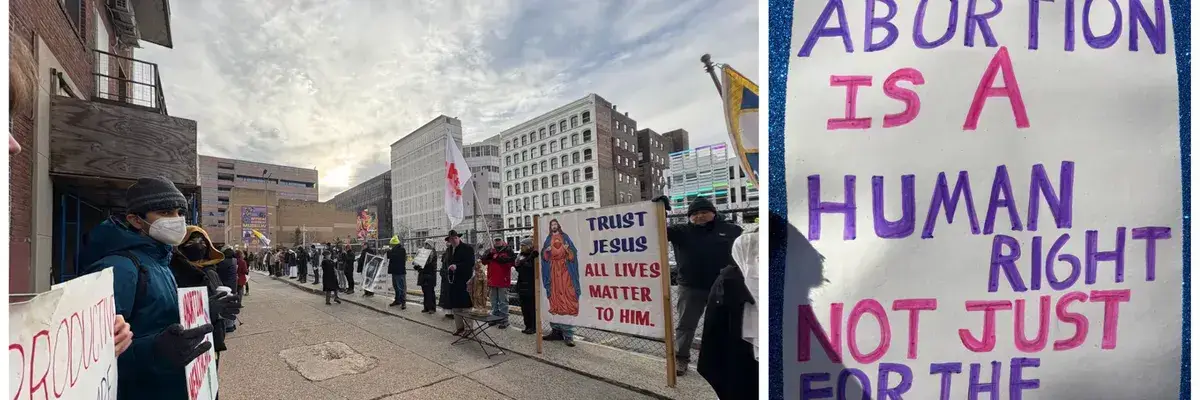
A “Clinic Defense” protest is organized by Abortion Rights Philly on February 8, 2025.
I’m a climate justice organizer. Here's why I’m fighting for reproductive justice.
Earlier this year, in a horrific conversation with white supremacist podcaster Joe Rogan, Meta CEO Mark Zuckerberg, who started Facebook to rank women’s appearances in 2004, argued that the tech world needs more masculine energy.
Any serious look at the tech world and it’s clear it’s a space already overrun by the male ultra-wealthy class: 88.92% of IT CEOs alone are white men. This is the same cultural demographic and argument now overtaking our governmental systems as well. It’s an arrogance that demands control of all, from the bodies of women, trans folks, queer folks, and young people, to violent control of our environment, the plants, animals, landscapes, and non-human bodies that provide the world’s strength.
Days after serial-sexual-assaulter and white supremacist Donald Trump won the 2024 US presidential election, neo-Nazi Nick Fuentes tweeted, “Your body; my choice.” At his inauguration, Trump proclaimed (insert characteristic Trump voice), “We’re going to drill, baby, drill.”
These two statements are deeply related, echoing the same narratives of control, extraction, exploitation, and domination over our bodies, relatives, and communities.
Our movements must understand the intuitive reality that the attacks on reproductive rights, on reproductive access, and on our bodily autonomy are the same attacks as those on our environment.
All of this is why I found myself outside the Philadelphia Women’s Center near my college on February 8. With dozens of local community members from the grassroots organization Abortion Rights Philadelphia, we chanted, “Abortion is a human right, not just for the rich and white.” Together, we sang Chappell Roan and Beyoncé, building a wall of joy between the clinic’s patients and the masses of anti-abortion protesters, by and large older white men, who had gathered with dramatized pictures of fetuses, attempting to dox and scare patients from accessing their healthcare.
Our movements must understand the intuitive reality that the attacks on reproductive rights, on reproductive access, and on our bodily autonomy are the same attacks as those on our environment. And we must understand the inverse as well.
As New York City-based Afro-Puerto Rican reproductive and climate justice activist Hennessy García points out, “Where we see environmental injustice, we see reproductive injustice as well.” They go hand in hand.
For example, breathing in polluted air increases the likelihood for pregnant people to give birth prematurely. The same is true for exposure to water pollution, toxins from superfund sites and brownfields, proximity to fossil fuel infrastructure, and the effects of extreme heat. All of these environmental hazards are, by and large, located in communities of color, especially low-income communities, across the country. This means that when Trump chants, “Drill, baby, drill” and loosens our already weak environmental protections, he’s putting pregnant people of color at risk of both climate and environmental injustices and harms.
This is also the case for women and transgender or non-binary (TGNB), intersex, and LGBTQIA+ people, independent of pregnancy, and for disabled people as well, due to societal structure, gendered roles, discrimination, and resource inequity. It is also true that sexual violence rates for women and TGNB folks increase significantly in the aftermath of climate disasters.
The clear takeaway here: Women and TGNB people’s lives and sexual and reproductive health are being threatened by Trump, fossil fuel companies, and their Democratic allies, worsening climate and environmental crises.
This is all intentional. While Trump bars the words “environmental justice,” “gender,” “female,” “women,” and “pregnancy” from federal agencies and refers to Gaza and Palestine as “demolition site[s],” he also pushes a proposal of a $5,000 cash “baby bonus” to every American mother after delivery. The Trump administration wants women, on one hand, to reproduce endlessly, and on the other hand, it condemns women in Black and brown communities to death, displacement, and genocide. Whether those be Black and brown communities overburdened by fossil fuels and extractive infrastructure, by police brutality and deportation, or whether they be like in Gaza, by incessant deadly bombardment.
Look at Elon Musk and his 14 children with four different younger women. In November, he tweeted, “Instead of teaching fear of pregnancy, we should teach fear of childlessness.” As Arwa Mahdawi of The Guardian argues, “It’s easy for Musk, who will never have to carry any of the children he’s so keen on having, to be blasé about pregnancy risks: He can outsource them all,” pointing to one of his partners, Grimes, who almost died during the pregnancy of their son X Æ A-12.
As Garcia says, “People with the ability to get pregnant are not machines.” But that’s exactly what the Trump-Musk administration wants.
It’s all, ultimately, about building logics for masculine control across every area of our lives, bodies, and world.
They want those who fit into their racialized view of “America” to reproduce endlessly, and they want those who don’t to be oppressed, to work as capital creators, and to, in many cases, die.
There’s a deep, contradictory nature to this logic. On one hand, Trump is trying to stop people of color from accessing abortion or contraceptive care, and on the other, he is trying to literally facilitate their deaths. And for white women, he’s encouraging them to give birth as much as possible, yet still not offering childcare or maternal care—instead, he scrubs the word “pregnancy” from the Department of Health and Human Services. He’s offering $5,000 to women who give birth—a measly sum compared to the $237,482 it takes to raise a child in the US—and simultaneously plans to limit childcare and eliminate Head Start. Ultimately, it’s not just about eugenic-reminiscent reproductive policy; it’s about control. It’s about strategic destabilization, whether it’s control of land—from Black, brown, and Indigenous communities to Gaza, Panama, and Greenland—or control of bodies and reproductive, life-making capacities, from Nick Fuentes’ “Your body; my choice” to the aforementioned actions of the administration. It’s also about exploitation, whether it’s mass deportations or labor exploitation, like the forms of slavery and exploitation for incarcerated individuals appearing across the country, from Louisiana to California.
Layer in the climate crisis and mass inaffordability, and this image of control becomes an even more frightening picture.
These same narratives of masculine control are what propel anti-climate, pro-fossil fuel policy in this current administration. Trump’s stated goal with his Department of Energy, now led by fracking CEO Chris Wright, is to “unleash [a] aolden era of American energy dominance.” He’s also created the National Energy Dominance Council to bolster fossil fuel exploitation of our climate, of indigenous lands, and of communities of color. The through line is that these men are trying to dominate.
We see this also in popular narratives against climate action. Professional misogynist and sex trafficker Andrew Tate wrote in a now-infamous Twitter exchange, ultimately leading to his arrest, “@GretaThunberg, please provide your email address so I can send a complete list of my car collection and their respective enormous emissions,” attaching an image of his collection of over 33 sports cars.
Writing about the exchange, author Rebecca Solnit wrote: “There’s a direct association between machismo and the refusal to recognize and respond appropriately to the climate catastrophe. It’s a result of versions of masculinity in which selfishness and indifference—individualism taken to its extremes—are defining characteristics, and therefore caring and acting for the collective good is their antithesis.”
Flaunting dominance over people and nature is deemed manly, whilst care is deemed as unmanly. And, taking action with respect to justice, the environment, or our collective future—as epitomized by Greta Thunberg—is deemed as womanly.
It’s all, ultimately, about building logics for masculine control across every area of our lives, bodies, and world.
These dynamics don’t care for separations between environment and climate or climate and reproduction—it’s all a question of exploitation and increased power and domination for the white male ultra-wealthy few. To face this, our movements for justice, too, must be just as deeply intersectional.
The SisterSong Women of Color Reproductive Justice Collective, a storied reproductive justice organization, defines “Reproductive Justice [as] the human right to maintain personal bodily autonomy, have children, not have children, and parent the children we have in safe and sustainable communities” (italics added).
There is no reproductive justice without ending fossil fuel expansion. There is no reproductive justice without a just, Indigenous, and worker-led societal transformation to renewable, community-controlled energy.
It means placing bodily autonomy at the center of our fight for climate justice, and breaking down the divides between our movements.
It’s time for us to incorporate reproductive justice just as deeply into our fight for climate justice. That means for us in the climate space to show up at our local abortion clinic to protect patients; it means connecting with and learning from local reproductive justice organizers in our area; and it means bringing in a reproductive justice platform into our climate policy. It doesn’t just mean supporting Planned Parenthood; it means listening to the Reproductive Justice movement and finding the local fights, whether legislative or practical, near you, and getting involved. It means funding local abortion funds that are always in need of donations, like those affiliated with the grassroots National Network of Abortion Funds.
It means placing bodily autonomy at the center of our fight for climate justice, and breaking down the divides between our movements. It means rejecting centrist politicians like New York Gov. Kathy Hochul, who claim leadership on reproductive rights and climate justice, while vetoing legislation to protect those seeking reproductive and gender-affirming care and fast-tracking new fossil fuel pipelines.
There is no other way to face the capitalist fossil-fueled heteropatriarchical oligarchy that has now overtaken our government and seeks to dominate us all.
Climate justice is reproductive justice.
Dear Common Dreams reader, It’s been nearly 30 years since I co-founded Common Dreams with my late wife, Lina Newhouser. We had the radical notion that journalism should serve the public good, not corporate profits. It was clear to us from the outset what it would take to build such a project. No paid advertisements. No corporate sponsors. No millionaire publisher telling us what to think or do. Many people said we wouldn't last a year, but we proved those doubters wrong. Together with a tremendous team of journalists and dedicated staff, we built an independent media outlet free from the constraints of profits and corporate control. Our mission has always been simple: To inform. To inspire. To ignite change for the common good. Building Common Dreams was not easy. Our survival was never guaranteed. When you take on the most powerful forces—Wall Street greed, fossil fuel industry destruction, Big Tech lobbyists, and uber-rich oligarchs who have spent billions upon billions rigging the economy and democracy in their favor—the only bulwark you have is supporters who believe in your work. But here’s the urgent message from me today. It's never been this bad out there. And it's never been this hard to keep us going. At the very moment Common Dreams is most needed, the threats we face are intensifying. We need your support now more than ever. We don't accept corporate advertising and never will. We don't have a paywall because we don't think people should be blocked from critical news based on their ability to pay. Everything we do is funded by the donations of readers like you. When everyone does the little they can afford, we are strong. But if that support retreats or dries up, so do we. Will you donate now to make sure Common Dreams not only survives but thrives? —Craig Brown, Co-founder |
Earlier this year, in a horrific conversation with white supremacist podcaster Joe Rogan, Meta CEO Mark Zuckerberg, who started Facebook to rank women’s appearances in 2004, argued that the tech world needs more masculine energy.
Any serious look at the tech world and it’s clear it’s a space already overrun by the male ultra-wealthy class: 88.92% of IT CEOs alone are white men. This is the same cultural demographic and argument now overtaking our governmental systems as well. It’s an arrogance that demands control of all, from the bodies of women, trans folks, queer folks, and young people, to violent control of our environment, the plants, animals, landscapes, and non-human bodies that provide the world’s strength.
Days after serial-sexual-assaulter and white supremacist Donald Trump won the 2024 US presidential election, neo-Nazi Nick Fuentes tweeted, “Your body; my choice.” At his inauguration, Trump proclaimed (insert characteristic Trump voice), “We’re going to drill, baby, drill.”
These two statements are deeply related, echoing the same narratives of control, extraction, exploitation, and domination over our bodies, relatives, and communities.
Our movements must understand the intuitive reality that the attacks on reproductive rights, on reproductive access, and on our bodily autonomy are the same attacks as those on our environment.
All of this is why I found myself outside the Philadelphia Women’s Center near my college on February 8. With dozens of local community members from the grassroots organization Abortion Rights Philadelphia, we chanted, “Abortion is a human right, not just for the rich and white.” Together, we sang Chappell Roan and Beyoncé, building a wall of joy between the clinic’s patients and the masses of anti-abortion protesters, by and large older white men, who had gathered with dramatized pictures of fetuses, attempting to dox and scare patients from accessing their healthcare.
Our movements must understand the intuitive reality that the attacks on reproductive rights, on reproductive access, and on our bodily autonomy are the same attacks as those on our environment. And we must understand the inverse as well.
As New York City-based Afro-Puerto Rican reproductive and climate justice activist Hennessy García points out, “Where we see environmental injustice, we see reproductive injustice as well.” They go hand in hand.
For example, breathing in polluted air increases the likelihood for pregnant people to give birth prematurely. The same is true for exposure to water pollution, toxins from superfund sites and brownfields, proximity to fossil fuel infrastructure, and the effects of extreme heat. All of these environmental hazards are, by and large, located in communities of color, especially low-income communities, across the country. This means that when Trump chants, “Drill, baby, drill” and loosens our already weak environmental protections, he’s putting pregnant people of color at risk of both climate and environmental injustices and harms.
This is also the case for women and transgender or non-binary (TGNB), intersex, and LGBTQIA+ people, independent of pregnancy, and for disabled people as well, due to societal structure, gendered roles, discrimination, and resource inequity. It is also true that sexual violence rates for women and TGNB folks increase significantly in the aftermath of climate disasters.
The clear takeaway here: Women and TGNB people’s lives and sexual and reproductive health are being threatened by Trump, fossil fuel companies, and their Democratic allies, worsening climate and environmental crises.
This is all intentional. While Trump bars the words “environmental justice,” “gender,” “female,” “women,” and “pregnancy” from federal agencies and refers to Gaza and Palestine as “demolition site[s],” he also pushes a proposal of a $5,000 cash “baby bonus” to every American mother after delivery. The Trump administration wants women, on one hand, to reproduce endlessly, and on the other hand, it condemns women in Black and brown communities to death, displacement, and genocide. Whether those be Black and brown communities overburdened by fossil fuels and extractive infrastructure, by police brutality and deportation, or whether they be like in Gaza, by incessant deadly bombardment.
Look at Elon Musk and his 14 children with four different younger women. In November, he tweeted, “Instead of teaching fear of pregnancy, we should teach fear of childlessness.” As Arwa Mahdawi of The Guardian argues, “It’s easy for Musk, who will never have to carry any of the children he’s so keen on having, to be blasé about pregnancy risks: He can outsource them all,” pointing to one of his partners, Grimes, who almost died during the pregnancy of their son X Æ A-12.
As Garcia says, “People with the ability to get pregnant are not machines.” But that’s exactly what the Trump-Musk administration wants.
It’s all, ultimately, about building logics for masculine control across every area of our lives, bodies, and world.
They want those who fit into their racialized view of “America” to reproduce endlessly, and they want those who don’t to be oppressed, to work as capital creators, and to, in many cases, die.
There’s a deep, contradictory nature to this logic. On one hand, Trump is trying to stop people of color from accessing abortion or contraceptive care, and on the other, he is trying to literally facilitate their deaths. And for white women, he’s encouraging them to give birth as much as possible, yet still not offering childcare or maternal care—instead, he scrubs the word “pregnancy” from the Department of Health and Human Services. He’s offering $5,000 to women who give birth—a measly sum compared to the $237,482 it takes to raise a child in the US—and simultaneously plans to limit childcare and eliminate Head Start. Ultimately, it’s not just about eugenic-reminiscent reproductive policy; it’s about control. It’s about strategic destabilization, whether it’s control of land—from Black, brown, and Indigenous communities to Gaza, Panama, and Greenland—or control of bodies and reproductive, life-making capacities, from Nick Fuentes’ “Your body; my choice” to the aforementioned actions of the administration. It’s also about exploitation, whether it’s mass deportations or labor exploitation, like the forms of slavery and exploitation for incarcerated individuals appearing across the country, from Louisiana to California.
Layer in the climate crisis and mass inaffordability, and this image of control becomes an even more frightening picture.
These same narratives of masculine control are what propel anti-climate, pro-fossil fuel policy in this current administration. Trump’s stated goal with his Department of Energy, now led by fracking CEO Chris Wright, is to “unleash [a] aolden era of American energy dominance.” He’s also created the National Energy Dominance Council to bolster fossil fuel exploitation of our climate, of indigenous lands, and of communities of color. The through line is that these men are trying to dominate.
We see this also in popular narratives against climate action. Professional misogynist and sex trafficker Andrew Tate wrote in a now-infamous Twitter exchange, ultimately leading to his arrest, “@GretaThunberg, please provide your email address so I can send a complete list of my car collection and their respective enormous emissions,” attaching an image of his collection of over 33 sports cars.
Writing about the exchange, author Rebecca Solnit wrote: “There’s a direct association between machismo and the refusal to recognize and respond appropriately to the climate catastrophe. It’s a result of versions of masculinity in which selfishness and indifference—individualism taken to its extremes—are defining characteristics, and therefore caring and acting for the collective good is their antithesis.”
Flaunting dominance over people and nature is deemed manly, whilst care is deemed as unmanly. And, taking action with respect to justice, the environment, or our collective future—as epitomized by Greta Thunberg—is deemed as womanly.
It’s all, ultimately, about building logics for masculine control across every area of our lives, bodies, and world.
These dynamics don’t care for separations between environment and climate or climate and reproduction—it’s all a question of exploitation and increased power and domination for the white male ultra-wealthy few. To face this, our movements for justice, too, must be just as deeply intersectional.
The SisterSong Women of Color Reproductive Justice Collective, a storied reproductive justice organization, defines “Reproductive Justice [as] the human right to maintain personal bodily autonomy, have children, not have children, and parent the children we have in safe and sustainable communities” (italics added).
There is no reproductive justice without ending fossil fuel expansion. There is no reproductive justice without a just, Indigenous, and worker-led societal transformation to renewable, community-controlled energy.
It means placing bodily autonomy at the center of our fight for climate justice, and breaking down the divides between our movements.
It’s time for us to incorporate reproductive justice just as deeply into our fight for climate justice. That means for us in the climate space to show up at our local abortion clinic to protect patients; it means connecting with and learning from local reproductive justice organizers in our area; and it means bringing in a reproductive justice platform into our climate policy. It doesn’t just mean supporting Planned Parenthood; it means listening to the Reproductive Justice movement and finding the local fights, whether legislative or practical, near you, and getting involved. It means funding local abortion funds that are always in need of donations, like those affiliated with the grassroots National Network of Abortion Funds.
It means placing bodily autonomy at the center of our fight for climate justice, and breaking down the divides between our movements. It means rejecting centrist politicians like New York Gov. Kathy Hochul, who claim leadership on reproductive rights and climate justice, while vetoing legislation to protect those seeking reproductive and gender-affirming care and fast-tracking new fossil fuel pipelines.
There is no other way to face the capitalist fossil-fueled heteropatriarchical oligarchy that has now overtaken our government and seeks to dominate us all.
Climate justice is reproductive justice.
Earlier this year, in a horrific conversation with white supremacist podcaster Joe Rogan, Meta CEO Mark Zuckerberg, who started Facebook to rank women’s appearances in 2004, argued that the tech world needs more masculine energy.
Any serious look at the tech world and it’s clear it’s a space already overrun by the male ultra-wealthy class: 88.92% of IT CEOs alone are white men. This is the same cultural demographic and argument now overtaking our governmental systems as well. It’s an arrogance that demands control of all, from the bodies of women, trans folks, queer folks, and young people, to violent control of our environment, the plants, animals, landscapes, and non-human bodies that provide the world’s strength.
Days after serial-sexual-assaulter and white supremacist Donald Trump won the 2024 US presidential election, neo-Nazi Nick Fuentes tweeted, “Your body; my choice.” At his inauguration, Trump proclaimed (insert characteristic Trump voice), “We’re going to drill, baby, drill.”
These two statements are deeply related, echoing the same narratives of control, extraction, exploitation, and domination over our bodies, relatives, and communities.
Our movements must understand the intuitive reality that the attacks on reproductive rights, on reproductive access, and on our bodily autonomy are the same attacks as those on our environment.
All of this is why I found myself outside the Philadelphia Women’s Center near my college on February 8. With dozens of local community members from the grassroots organization Abortion Rights Philadelphia, we chanted, “Abortion is a human right, not just for the rich and white.” Together, we sang Chappell Roan and Beyoncé, building a wall of joy between the clinic’s patients and the masses of anti-abortion protesters, by and large older white men, who had gathered with dramatized pictures of fetuses, attempting to dox and scare patients from accessing their healthcare.
Our movements must understand the intuitive reality that the attacks on reproductive rights, on reproductive access, and on our bodily autonomy are the same attacks as those on our environment. And we must understand the inverse as well.
As New York City-based Afro-Puerto Rican reproductive and climate justice activist Hennessy García points out, “Where we see environmental injustice, we see reproductive injustice as well.” They go hand in hand.
For example, breathing in polluted air increases the likelihood for pregnant people to give birth prematurely. The same is true for exposure to water pollution, toxins from superfund sites and brownfields, proximity to fossil fuel infrastructure, and the effects of extreme heat. All of these environmental hazards are, by and large, located in communities of color, especially low-income communities, across the country. This means that when Trump chants, “Drill, baby, drill” and loosens our already weak environmental protections, he’s putting pregnant people of color at risk of both climate and environmental injustices and harms.
This is also the case for women and transgender or non-binary (TGNB), intersex, and LGBTQIA+ people, independent of pregnancy, and for disabled people as well, due to societal structure, gendered roles, discrimination, and resource inequity. It is also true that sexual violence rates for women and TGNB folks increase significantly in the aftermath of climate disasters.
The clear takeaway here: Women and TGNB people’s lives and sexual and reproductive health are being threatened by Trump, fossil fuel companies, and their Democratic allies, worsening climate and environmental crises.
This is all intentional. While Trump bars the words “environmental justice,” “gender,” “female,” “women,” and “pregnancy” from federal agencies and refers to Gaza and Palestine as “demolition site[s],” he also pushes a proposal of a $5,000 cash “baby bonus” to every American mother after delivery. The Trump administration wants women, on one hand, to reproduce endlessly, and on the other hand, it condemns women in Black and brown communities to death, displacement, and genocide. Whether those be Black and brown communities overburdened by fossil fuels and extractive infrastructure, by police brutality and deportation, or whether they be like in Gaza, by incessant deadly bombardment.
Look at Elon Musk and his 14 children with four different younger women. In November, he tweeted, “Instead of teaching fear of pregnancy, we should teach fear of childlessness.” As Arwa Mahdawi of The Guardian argues, “It’s easy for Musk, who will never have to carry any of the children he’s so keen on having, to be blasé about pregnancy risks: He can outsource them all,” pointing to one of his partners, Grimes, who almost died during the pregnancy of their son X Æ A-12.
As Garcia says, “People with the ability to get pregnant are not machines.” But that’s exactly what the Trump-Musk administration wants.
It’s all, ultimately, about building logics for masculine control across every area of our lives, bodies, and world.
They want those who fit into their racialized view of “America” to reproduce endlessly, and they want those who don’t to be oppressed, to work as capital creators, and to, in many cases, die.
There’s a deep, contradictory nature to this logic. On one hand, Trump is trying to stop people of color from accessing abortion or contraceptive care, and on the other, he is trying to literally facilitate their deaths. And for white women, he’s encouraging them to give birth as much as possible, yet still not offering childcare or maternal care—instead, he scrubs the word “pregnancy” from the Department of Health and Human Services. He’s offering $5,000 to women who give birth—a measly sum compared to the $237,482 it takes to raise a child in the US—and simultaneously plans to limit childcare and eliminate Head Start. Ultimately, it’s not just about eugenic-reminiscent reproductive policy; it’s about control. It’s about strategic destabilization, whether it’s control of land—from Black, brown, and Indigenous communities to Gaza, Panama, and Greenland—or control of bodies and reproductive, life-making capacities, from Nick Fuentes’ “Your body; my choice” to the aforementioned actions of the administration. It’s also about exploitation, whether it’s mass deportations or labor exploitation, like the forms of slavery and exploitation for incarcerated individuals appearing across the country, from Louisiana to California.
Layer in the climate crisis and mass inaffordability, and this image of control becomes an even more frightening picture.
These same narratives of masculine control are what propel anti-climate, pro-fossil fuel policy in this current administration. Trump’s stated goal with his Department of Energy, now led by fracking CEO Chris Wright, is to “unleash [a] aolden era of American energy dominance.” He’s also created the National Energy Dominance Council to bolster fossil fuel exploitation of our climate, of indigenous lands, and of communities of color. The through line is that these men are trying to dominate.
We see this also in popular narratives against climate action. Professional misogynist and sex trafficker Andrew Tate wrote in a now-infamous Twitter exchange, ultimately leading to his arrest, “@GretaThunberg, please provide your email address so I can send a complete list of my car collection and their respective enormous emissions,” attaching an image of his collection of over 33 sports cars.
Writing about the exchange, author Rebecca Solnit wrote: “There’s a direct association between machismo and the refusal to recognize and respond appropriately to the climate catastrophe. It’s a result of versions of masculinity in which selfishness and indifference—individualism taken to its extremes—are defining characteristics, and therefore caring and acting for the collective good is their antithesis.”
Flaunting dominance over people and nature is deemed manly, whilst care is deemed as unmanly. And, taking action with respect to justice, the environment, or our collective future—as epitomized by Greta Thunberg—is deemed as womanly.
It’s all, ultimately, about building logics for masculine control across every area of our lives, bodies, and world.
These dynamics don’t care for separations between environment and climate or climate and reproduction—it’s all a question of exploitation and increased power and domination for the white male ultra-wealthy few. To face this, our movements for justice, too, must be just as deeply intersectional.
The SisterSong Women of Color Reproductive Justice Collective, a storied reproductive justice organization, defines “Reproductive Justice [as] the human right to maintain personal bodily autonomy, have children, not have children, and parent the children we have in safe and sustainable communities” (italics added).
There is no reproductive justice without ending fossil fuel expansion. There is no reproductive justice without a just, Indigenous, and worker-led societal transformation to renewable, community-controlled energy.
It means placing bodily autonomy at the center of our fight for climate justice, and breaking down the divides between our movements.
It’s time for us to incorporate reproductive justice just as deeply into our fight for climate justice. That means for us in the climate space to show up at our local abortion clinic to protect patients; it means connecting with and learning from local reproductive justice organizers in our area; and it means bringing in a reproductive justice platform into our climate policy. It doesn’t just mean supporting Planned Parenthood; it means listening to the Reproductive Justice movement and finding the local fights, whether legislative or practical, near you, and getting involved. It means funding local abortion funds that are always in need of donations, like those affiliated with the grassroots National Network of Abortion Funds.
It means placing bodily autonomy at the center of our fight for climate justice, and breaking down the divides between our movements. It means rejecting centrist politicians like New York Gov. Kathy Hochul, who claim leadership on reproductive rights and climate justice, while vetoing legislation to protect those seeking reproductive and gender-affirming care and fast-tracking new fossil fuel pipelines.
There is no other way to face the capitalist fossil-fueled heteropatriarchical oligarchy that has now overtaken our government and seeks to dominate us all.
Climate justice is reproductive justice.