5
#000000
#FFFFFF
To donate by check, phone, or other method, see our More Ways to Give page.
Daily news & progressive opinion—funded by the people, not the corporations—delivered straight to your inbox.
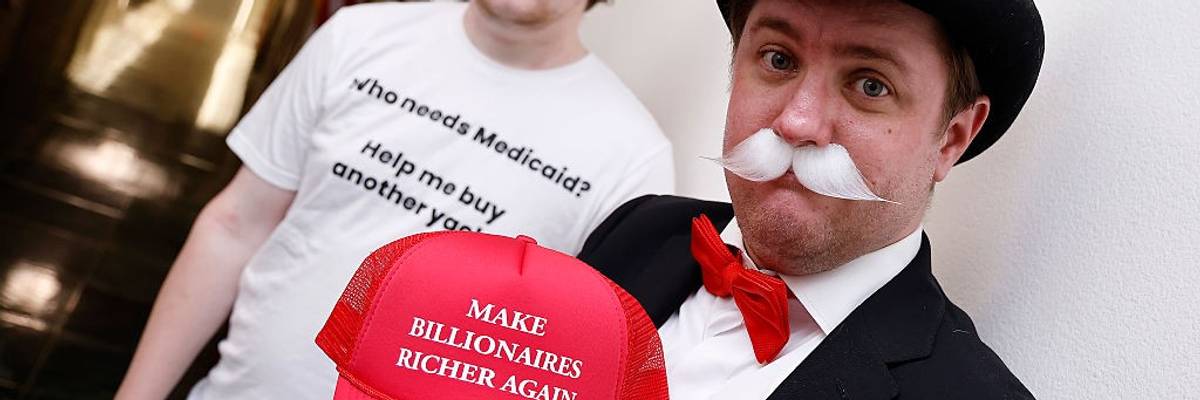
Advocates pose as Monopoly men and wealthy DOGE supporters while protesting tax breaks for billionaires and the Republican tax plan, inside and outside the Ways & Means Full Committee Markup to advance the legislation in the Longworth House Office Building on May 13, 2025 in Washington, DC.
The real crisis is America is not the deep political cultural divisions among its citizens as much as the concerted efforts of both political parties to play on imagined differences, while orchestrating a massive shift in wealth from working people to the super-rich.
At this year’s National Football League Super Bowl, the Trump regime could not resist politicizing the event by attacking the halftime performance of Bad Bunny, a celebration of Puerto Rican musical culture conducted entirely in the Spanish language. President Donald Trump endorsed an alternative country western streamed halftime program of Kid Rock, which was dedicated to the conservative icon Charlie Kirk. It was the president and his party inciting the MAGA base to campaign for congressional Republicans.
The two shows represent two radically different cultural streams in America, roughly approximating the struggle over ethnic, gender, and racial representation in public life. On a more material level, however, the unfulfilled day to day needs of working people caught up in this ideological divide suggests that rhetorical claims about the culture wars are not grounded in the quotidian realities and material demands of most people.
The real crisis is America is not the deep political cultural divisions among its citizens as much as the concerted efforts of both political parties to play on imagined differences, while orchestrating a massive shift in wealth from working people to the super-rich class, which includes the congressional millionaire unrepresentatives. At least two-thirds of the Senate membership and more than half the House are millionaires, compared to 9% of Americans overall.
Diminishing access to basic human needs, a news topic that does not attract advertising revenue, except perhaps from Big Pharma, has a huge impact on the quality and very meaning of democracy. The real crisis of the working class is not on the MSM agenda.
True to its propaganda mission of creating legitimacy for the hegemonic state, the mainstream corporate media fails to help Americans understand that in their individual family struggles to survive or just about make ends meet, they are not alone.
In the midst of the Civil War, President Abraham Lincoln referred to an ideal America as a country of, by, and for the people. Looking at the political and civic participation and well-being of people, all the people, as a proxy for democracy, it is clear that the legitimacy of the democratic state is at a dangerously low level and in inverse correspondence with the degree of American military or police aggression at home and abroad. The largest injuries of wars fall on the working class.
The lower the trust the public invests in the state, the more the ruling apparatuses are compelled to distract public attention. Trump apparently believes he can override constitutional restraints on his power mandate, ignore public opinion, and function as a quasi-autocrat. He also hopes to deflect attention from his failed economic policies by redirecting the public gaze toward a constructed enemy threat.
In 2016, Hillary Clinton melded her identity politics strategy to neoconservative, pro-Israeli, and Russophobic rhetoric bereft of any vision or coherence, in the process losing the working class, 52% to 44%, to a faux pro-labor campaigner. Her “basket of deplorables” gaffe directed at the white working class didn’t help her chances. The Democrats under the neoliberal Clinton wing of the party turned away from the New Deal and toward neoliberal, anti-welfare, corporate-friendly, austerity, and tough-on-crime policies.
In 2024, a disunited working class voted overwhelmingly in favor of Donald Trump, who was anything but a pro-labor politician. According to the Pew Research Center, 67% of Trump voters were without a college degree, a proxy for working class, compared with 51% for Harris. Clinton protégé Kamala Harris captured just 42% of working-class voters, while Trump carried 56%.
Clinton-Obama acolyte Joe Biden, often identified as progressive, cut federal food stamp and childcare benefits during his presidency and allowed child poverty to nearly triple, while millions of Americans lost Medicaid and CHIP (Children's Health Insurance Program) support. On the international front, as Barack Obama’s vice president, Biden acted like an imperial proconsul in Ukraine, forsaking even token gestures of diplomacy in dealing with the Russian head of state, whom he publicly dismissed as “a thug.” His unconditional military assistance that enabled the Israeli genocide lost him and his stand-in much of the youth vote in 2024 prior to his decision to drop out of the presidential race.
The Democrats have followed the same militaristic, hegemonic foreign policy approach as Republicans. As secretary of state, Clinton, following John Foster Dulles’ style of “brinkmanship,” promised to confront Russia in Ukraine with a “no-fly zone” that she proposed would halt Russian aid to the rebellious Donbas region in eastern Ukraine. Overall, her identity-based politics campaign strategy in 2016 lost out to a faux labor-friendly campaigner, who took 52% of the working class vote to Clinton’s 44%.
Perhaps the only thing worse than a party of the billionaire class led by a real estate tycoon is another party of the billionaire class pretending to be an alternative. In reality, the well-being of Americans has continually declined for nearly 50 years under neoliberal governments of both parties. As a result, public trust of governing institutions by 2024 had reached a near all-time low in the post-war period. Today, Democrat voters are only marginally more trusting of the federal government, 35%, than Republicans, 11%.
The purported polarization of Democrat versus Republican voters has been constructed as an ideological trope to hide the more substantive economic and class basis of the great divide, which is the public’s recognition of the corruption of the state on the one hand and the concentration of wealth and power that has hollowed out the democratic status of citizens, especially workers and urban minorities, on the other.
In November 2025, the Kettering Foundation found a new low, 24%, in its tracking of American adults who believe that democracy is working in the country. The relatively weak organic character of American democracy measured in terms of social distribution corresponds to the perception of diminished state legitimacy that is documented in several studies of public trust in state institutions. Of all public institutions in America surveyed by Gallup in 2024, the very lowest regard is held for the one body that constitutes the essence of a representative democracy, the legislature. Gallup found that trust in Congress registered a “great deal” or “quite a lot” for a total of a meager 9% of respondents.
Trust in the presidency registered 26%, the Supreme Court 30%, newspapers 18%, television news 12%, and internet news 16%. Big business was trusted by 16% and, crucially, the medical system by a minority 36%. Indeed, 80% of Americans, including 91% of Democrats, 82% of Independents, and 67% of Republicans, see the rich as wielding too much power in American politics, according to a January 2026 YouGov poll. It identified a broad public perception that the economic system works primarily on behalf of powerful interests and that members of Congress, governors, and federal officials, moreover, are likely to accept bribes.
The public is indeed very skeptical about the conduct of electoral politics: 87% of Republicans and 85% of Democrats believe the parties "are more focused on fighting each other than on solving problems.” Per Max Weber, it was the charismatic and caudillo style of Trump that served as the last though shaky refuge of public confidence in government. That lasted about one year. In March 2026, enmeshed in a brutal war without real objectives in Iran, Trump’s approval rating reached an all-time low for presidents.
A “government of the people, by the people, for the people,” to use Lincoln’s felicitous phrasing, captures the essence of democracy–over and above the right to vote, nominal free speech, or the existence of relatively independent news media, all of which in fact are under the threat or capture of partisan control. In this regard, the US has greatly declined as a democracy, even as measured by the conservative NGO Freedom House, and more closely resembles an oligarchy dominated by the billionaire class, with extremely wide income gaps and among the highest concentrations of wealth (Gini coefficient) among the Organisation for Economic Co-operation and Development (OECD) countries. Compared to the European welfare states (e.g., Nordic countries, France, Germany, and Netherlands), the US is more of a warfare state, drawing much of its wealth from military interventions, military aid (which is largely recycled back to the US), and alliances with repressive political leaders such as the Gulf autocrats.
Looking at the material and social status of working Americans as the true measure of democratic empowerment, one finds a depressed state of well-being and social economic freedom for most citizens.
A few of the indicators of social demise (a fuller list is found in my book cited, below) that has fed distrust and material polarization in America:
These are the actual data of polarization in the US, intensified in the era of neoliberalism. True to its propaganda mission of creating legitimacy for the hegemonic state, the mainstream corporate media fails to help Americans understand that in their individual family struggles to survive or just about make ends meet, they are not alone. The MSM instead misleads the public by portraying political conflict as cultural warfare rather than class warfare, thereby dividing the people and protecting the system’s class repression and small minority of billionaires controlling the most critical affairs of the state and its propaganda apparatuses.
Democracy here is defined by the equality of citizenship. In practice, this means universal access to healthcare; quality housing; higher education; clean environment; equitable income; union empowerment; racial, gender, and ethnic justice; cultural amenities for all; and other core objectives pushed by public advocacy groups. Indeed, in a more genuinely democratic society there would far less need for public advocacy, and electoral and political activities would no longer be controlled by corporate and other undemocratic institutions. The role of progressive intellectuals is to struggle for democracy along this understanding of a democratic and just society.
Dear Common Dreams reader, The U.S. is on a fast track to authoritarianism like nothing I've ever seen. Meanwhile, corporate news outlets are utterly capitulating to Trump, twisting their coverage to avoid drawing his ire while lining up to stuff cash in his pockets. That's why I believe that Common Dreams is doing the best and most consequential reporting that we've ever done. Our small but mighty team is a progressive reporting powerhouse, covering the news every day that the corporate media never will. Our mission has always been simple: To inform. To inspire. And to ignite change for the common good. Now here's the key piece that I want all our readers to understand: None of this would be possible without your financial support. That's not just some fundraising cliche. It's the absolute and literal truth. We don't accept corporate advertising and never will. We don't have a paywall because we don't think people should be blocked from critical news based on their ability to pay. Everything we do is funded by the donations of readers like you. Will you donate now to help power the nonprofit, independent reporting of Common Dreams? Thank you for being a vital member of our community. Together, we can keep independent journalism alive when it’s needed most. - Craig Brown, Co-founder |
At this year’s National Football League Super Bowl, the Trump regime could not resist politicizing the event by attacking the halftime performance of Bad Bunny, a celebration of Puerto Rican musical culture conducted entirely in the Spanish language. President Donald Trump endorsed an alternative country western streamed halftime program of Kid Rock, which was dedicated to the conservative icon Charlie Kirk. It was the president and his party inciting the MAGA base to campaign for congressional Republicans.
The two shows represent two radically different cultural streams in America, roughly approximating the struggle over ethnic, gender, and racial representation in public life. On a more material level, however, the unfulfilled day to day needs of working people caught up in this ideological divide suggests that rhetorical claims about the culture wars are not grounded in the quotidian realities and material demands of most people.
The real crisis is America is not the deep political cultural divisions among its citizens as much as the concerted efforts of both political parties to play on imagined differences, while orchestrating a massive shift in wealth from working people to the super-rich class, which includes the congressional millionaire unrepresentatives. At least two-thirds of the Senate membership and more than half the House are millionaires, compared to 9% of Americans overall.
Diminishing access to basic human needs, a news topic that does not attract advertising revenue, except perhaps from Big Pharma, has a huge impact on the quality and very meaning of democracy. The real crisis of the working class is not on the MSM agenda.
True to its propaganda mission of creating legitimacy for the hegemonic state, the mainstream corporate media fails to help Americans understand that in their individual family struggles to survive or just about make ends meet, they are not alone.
In the midst of the Civil War, President Abraham Lincoln referred to an ideal America as a country of, by, and for the people. Looking at the political and civic participation and well-being of people, all the people, as a proxy for democracy, it is clear that the legitimacy of the democratic state is at a dangerously low level and in inverse correspondence with the degree of American military or police aggression at home and abroad. The largest injuries of wars fall on the working class.
The lower the trust the public invests in the state, the more the ruling apparatuses are compelled to distract public attention. Trump apparently believes he can override constitutional restraints on his power mandate, ignore public opinion, and function as a quasi-autocrat. He also hopes to deflect attention from his failed economic policies by redirecting the public gaze toward a constructed enemy threat.
In 2016, Hillary Clinton melded her identity politics strategy to neoconservative, pro-Israeli, and Russophobic rhetoric bereft of any vision or coherence, in the process losing the working class, 52% to 44%, to a faux pro-labor campaigner. Her “basket of deplorables” gaffe directed at the white working class didn’t help her chances. The Democrats under the neoliberal Clinton wing of the party turned away from the New Deal and toward neoliberal, anti-welfare, corporate-friendly, austerity, and tough-on-crime policies.
In 2024, a disunited working class voted overwhelmingly in favor of Donald Trump, who was anything but a pro-labor politician. According to the Pew Research Center, 67% of Trump voters were without a college degree, a proxy for working class, compared with 51% for Harris. Clinton protégé Kamala Harris captured just 42% of working-class voters, while Trump carried 56%.
Clinton-Obama acolyte Joe Biden, often identified as progressive, cut federal food stamp and childcare benefits during his presidency and allowed child poverty to nearly triple, while millions of Americans lost Medicaid and CHIP (Children's Health Insurance Program) support. On the international front, as Barack Obama’s vice president, Biden acted like an imperial proconsul in Ukraine, forsaking even token gestures of diplomacy in dealing with the Russian head of state, whom he publicly dismissed as “a thug.” His unconditional military assistance that enabled the Israeli genocide lost him and his stand-in much of the youth vote in 2024 prior to his decision to drop out of the presidential race.
The Democrats have followed the same militaristic, hegemonic foreign policy approach as Republicans. As secretary of state, Clinton, following John Foster Dulles’ style of “brinkmanship,” promised to confront Russia in Ukraine with a “no-fly zone” that she proposed would halt Russian aid to the rebellious Donbas region in eastern Ukraine. Overall, her identity-based politics campaign strategy in 2016 lost out to a faux labor-friendly campaigner, who took 52% of the working class vote to Clinton’s 44%.
Perhaps the only thing worse than a party of the billionaire class led by a real estate tycoon is another party of the billionaire class pretending to be an alternative. In reality, the well-being of Americans has continually declined for nearly 50 years under neoliberal governments of both parties. As a result, public trust of governing institutions by 2024 had reached a near all-time low in the post-war period. Today, Democrat voters are only marginally more trusting of the federal government, 35%, than Republicans, 11%.
The purported polarization of Democrat versus Republican voters has been constructed as an ideological trope to hide the more substantive economic and class basis of the great divide, which is the public’s recognition of the corruption of the state on the one hand and the concentration of wealth and power that has hollowed out the democratic status of citizens, especially workers and urban minorities, on the other.
In November 2025, the Kettering Foundation found a new low, 24%, in its tracking of American adults who believe that democracy is working in the country. The relatively weak organic character of American democracy measured in terms of social distribution corresponds to the perception of diminished state legitimacy that is documented in several studies of public trust in state institutions. Of all public institutions in America surveyed by Gallup in 2024, the very lowest regard is held for the one body that constitutes the essence of a representative democracy, the legislature. Gallup found that trust in Congress registered a “great deal” or “quite a lot” for a total of a meager 9% of respondents.
Trust in the presidency registered 26%, the Supreme Court 30%, newspapers 18%, television news 12%, and internet news 16%. Big business was trusted by 16% and, crucially, the medical system by a minority 36%. Indeed, 80% of Americans, including 91% of Democrats, 82% of Independents, and 67% of Republicans, see the rich as wielding too much power in American politics, according to a January 2026 YouGov poll. It identified a broad public perception that the economic system works primarily on behalf of powerful interests and that members of Congress, governors, and federal officials, moreover, are likely to accept bribes.
The public is indeed very skeptical about the conduct of electoral politics: 87% of Republicans and 85% of Democrats believe the parties "are more focused on fighting each other than on solving problems.” Per Max Weber, it was the charismatic and caudillo style of Trump that served as the last though shaky refuge of public confidence in government. That lasted about one year. In March 2026, enmeshed in a brutal war without real objectives in Iran, Trump’s approval rating reached an all-time low for presidents.
A “government of the people, by the people, for the people,” to use Lincoln’s felicitous phrasing, captures the essence of democracy–over and above the right to vote, nominal free speech, or the existence of relatively independent news media, all of which in fact are under the threat or capture of partisan control. In this regard, the US has greatly declined as a democracy, even as measured by the conservative NGO Freedom House, and more closely resembles an oligarchy dominated by the billionaire class, with extremely wide income gaps and among the highest concentrations of wealth (Gini coefficient) among the Organisation for Economic Co-operation and Development (OECD) countries. Compared to the European welfare states (e.g., Nordic countries, France, Germany, and Netherlands), the US is more of a warfare state, drawing much of its wealth from military interventions, military aid (which is largely recycled back to the US), and alliances with repressive political leaders such as the Gulf autocrats.
Looking at the material and social status of working Americans as the true measure of democratic empowerment, one finds a depressed state of well-being and social economic freedom for most citizens.
A few of the indicators of social demise (a fuller list is found in my book cited, below) that has fed distrust and material polarization in America:
These are the actual data of polarization in the US, intensified in the era of neoliberalism. True to its propaganda mission of creating legitimacy for the hegemonic state, the mainstream corporate media fails to help Americans understand that in their individual family struggles to survive or just about make ends meet, they are not alone. The MSM instead misleads the public by portraying political conflict as cultural warfare rather than class warfare, thereby dividing the people and protecting the system’s class repression and small minority of billionaires controlling the most critical affairs of the state and its propaganda apparatuses.
Democracy here is defined by the equality of citizenship. In practice, this means universal access to healthcare; quality housing; higher education; clean environment; equitable income; union empowerment; racial, gender, and ethnic justice; cultural amenities for all; and other core objectives pushed by public advocacy groups. Indeed, in a more genuinely democratic society there would far less need for public advocacy, and electoral and political activities would no longer be controlled by corporate and other undemocratic institutions. The role of progressive intellectuals is to struggle for democracy along this understanding of a democratic and just society.
At this year’s National Football League Super Bowl, the Trump regime could not resist politicizing the event by attacking the halftime performance of Bad Bunny, a celebration of Puerto Rican musical culture conducted entirely in the Spanish language. President Donald Trump endorsed an alternative country western streamed halftime program of Kid Rock, which was dedicated to the conservative icon Charlie Kirk. It was the president and his party inciting the MAGA base to campaign for congressional Republicans.
The two shows represent two radically different cultural streams in America, roughly approximating the struggle over ethnic, gender, and racial representation in public life. On a more material level, however, the unfulfilled day to day needs of working people caught up in this ideological divide suggests that rhetorical claims about the culture wars are not grounded in the quotidian realities and material demands of most people.
The real crisis is America is not the deep political cultural divisions among its citizens as much as the concerted efforts of both political parties to play on imagined differences, while orchestrating a massive shift in wealth from working people to the super-rich class, which includes the congressional millionaire unrepresentatives. At least two-thirds of the Senate membership and more than half the House are millionaires, compared to 9% of Americans overall.
Diminishing access to basic human needs, a news topic that does not attract advertising revenue, except perhaps from Big Pharma, has a huge impact on the quality and very meaning of democracy. The real crisis of the working class is not on the MSM agenda.
True to its propaganda mission of creating legitimacy for the hegemonic state, the mainstream corporate media fails to help Americans understand that in their individual family struggles to survive or just about make ends meet, they are not alone.
In the midst of the Civil War, President Abraham Lincoln referred to an ideal America as a country of, by, and for the people. Looking at the political and civic participation and well-being of people, all the people, as a proxy for democracy, it is clear that the legitimacy of the democratic state is at a dangerously low level and in inverse correspondence with the degree of American military or police aggression at home and abroad. The largest injuries of wars fall on the working class.
The lower the trust the public invests in the state, the more the ruling apparatuses are compelled to distract public attention. Trump apparently believes he can override constitutional restraints on his power mandate, ignore public opinion, and function as a quasi-autocrat. He also hopes to deflect attention from his failed economic policies by redirecting the public gaze toward a constructed enemy threat.
In 2016, Hillary Clinton melded her identity politics strategy to neoconservative, pro-Israeli, and Russophobic rhetoric bereft of any vision or coherence, in the process losing the working class, 52% to 44%, to a faux pro-labor campaigner. Her “basket of deplorables” gaffe directed at the white working class didn’t help her chances. The Democrats under the neoliberal Clinton wing of the party turned away from the New Deal and toward neoliberal, anti-welfare, corporate-friendly, austerity, and tough-on-crime policies.
In 2024, a disunited working class voted overwhelmingly in favor of Donald Trump, who was anything but a pro-labor politician. According to the Pew Research Center, 67% of Trump voters were without a college degree, a proxy for working class, compared with 51% for Harris. Clinton protégé Kamala Harris captured just 42% of working-class voters, while Trump carried 56%.
Clinton-Obama acolyte Joe Biden, often identified as progressive, cut federal food stamp and childcare benefits during his presidency and allowed child poverty to nearly triple, while millions of Americans lost Medicaid and CHIP (Children's Health Insurance Program) support. On the international front, as Barack Obama’s vice president, Biden acted like an imperial proconsul in Ukraine, forsaking even token gestures of diplomacy in dealing with the Russian head of state, whom he publicly dismissed as “a thug.” His unconditional military assistance that enabled the Israeli genocide lost him and his stand-in much of the youth vote in 2024 prior to his decision to drop out of the presidential race.
The Democrats have followed the same militaristic, hegemonic foreign policy approach as Republicans. As secretary of state, Clinton, following John Foster Dulles’ style of “brinkmanship,” promised to confront Russia in Ukraine with a “no-fly zone” that she proposed would halt Russian aid to the rebellious Donbas region in eastern Ukraine. Overall, her identity-based politics campaign strategy in 2016 lost out to a faux labor-friendly campaigner, who took 52% of the working class vote to Clinton’s 44%.
Perhaps the only thing worse than a party of the billionaire class led by a real estate tycoon is another party of the billionaire class pretending to be an alternative. In reality, the well-being of Americans has continually declined for nearly 50 years under neoliberal governments of both parties. As a result, public trust of governing institutions by 2024 had reached a near all-time low in the post-war period. Today, Democrat voters are only marginally more trusting of the federal government, 35%, than Republicans, 11%.
The purported polarization of Democrat versus Republican voters has been constructed as an ideological trope to hide the more substantive economic and class basis of the great divide, which is the public’s recognition of the corruption of the state on the one hand and the concentration of wealth and power that has hollowed out the democratic status of citizens, especially workers and urban minorities, on the other.
In November 2025, the Kettering Foundation found a new low, 24%, in its tracking of American adults who believe that democracy is working in the country. The relatively weak organic character of American democracy measured in terms of social distribution corresponds to the perception of diminished state legitimacy that is documented in several studies of public trust in state institutions. Of all public institutions in America surveyed by Gallup in 2024, the very lowest regard is held for the one body that constitutes the essence of a representative democracy, the legislature. Gallup found that trust in Congress registered a “great deal” or “quite a lot” for a total of a meager 9% of respondents.
Trust in the presidency registered 26%, the Supreme Court 30%, newspapers 18%, television news 12%, and internet news 16%. Big business was trusted by 16% and, crucially, the medical system by a minority 36%. Indeed, 80% of Americans, including 91% of Democrats, 82% of Independents, and 67% of Republicans, see the rich as wielding too much power in American politics, according to a January 2026 YouGov poll. It identified a broad public perception that the economic system works primarily on behalf of powerful interests and that members of Congress, governors, and federal officials, moreover, are likely to accept bribes.
The public is indeed very skeptical about the conduct of electoral politics: 87% of Republicans and 85% of Democrats believe the parties "are more focused on fighting each other than on solving problems.” Per Max Weber, it was the charismatic and caudillo style of Trump that served as the last though shaky refuge of public confidence in government. That lasted about one year. In March 2026, enmeshed in a brutal war without real objectives in Iran, Trump’s approval rating reached an all-time low for presidents.
A “government of the people, by the people, for the people,” to use Lincoln’s felicitous phrasing, captures the essence of democracy–over and above the right to vote, nominal free speech, or the existence of relatively independent news media, all of which in fact are under the threat or capture of partisan control. In this regard, the US has greatly declined as a democracy, even as measured by the conservative NGO Freedom House, and more closely resembles an oligarchy dominated by the billionaire class, with extremely wide income gaps and among the highest concentrations of wealth (Gini coefficient) among the Organisation for Economic Co-operation and Development (OECD) countries. Compared to the European welfare states (e.g., Nordic countries, France, Germany, and Netherlands), the US is more of a warfare state, drawing much of its wealth from military interventions, military aid (which is largely recycled back to the US), and alliances with repressive political leaders such as the Gulf autocrats.
Looking at the material and social status of working Americans as the true measure of democratic empowerment, one finds a depressed state of well-being and social economic freedom for most citizens.
A few of the indicators of social demise (a fuller list is found in my book cited, below) that has fed distrust and material polarization in America:
These are the actual data of polarization in the US, intensified in the era of neoliberalism. True to its propaganda mission of creating legitimacy for the hegemonic state, the mainstream corporate media fails to help Americans understand that in their individual family struggles to survive or just about make ends meet, they are not alone. The MSM instead misleads the public by portraying political conflict as cultural warfare rather than class warfare, thereby dividing the people and protecting the system’s class repression and small minority of billionaires controlling the most critical affairs of the state and its propaganda apparatuses.
Democracy here is defined by the equality of citizenship. In practice, this means universal access to healthcare; quality housing; higher education; clean environment; equitable income; union empowerment; racial, gender, and ethnic justice; cultural amenities for all; and other core objectives pushed by public advocacy groups. Indeed, in a more genuinely democratic society there would far less need for public advocacy, and electoral and political activities would no longer be controlled by corporate and other undemocratic institutions. The role of progressive intellectuals is to struggle for democracy along this understanding of a democratic and just society.