SUBSCRIBE TO OUR FREE NEWSLETTER
Daily news & progressive opinion—funded by the people, not the corporations—delivered straight to your inbox.
5
#000000
#FFFFFF
To donate by check, phone, or other method, see our More Ways to Give page.
Daily news & progressive opinion—funded by the people, not the corporations—delivered straight to your inbox.
The petrochemical industry has brought us together in a perverse solidarity, having chemically trespassed into places all over the world.
Forty years ago this month, a Union Carbide pesticide factory in Bhopal, India sprung a toxic gas leak, exposing half a million people to toxic fumes. Thousands of people lost their lives in the immediate aftermath, with the death toll climbing to more than 20,000 over the next two decades. Countless others, including children of survivors, continue to endure chronic health issues.
In the United States, the events in Bhopal ignited a grassroots movement to expose and address the toxic chemicals in our water, air, and neighborhoods. In 1986, just two years after the disaster, this growing awareness led Congress to pass the first National Right to Know Act, which requires companies to publicly disclose their use of many toxic chemicals.
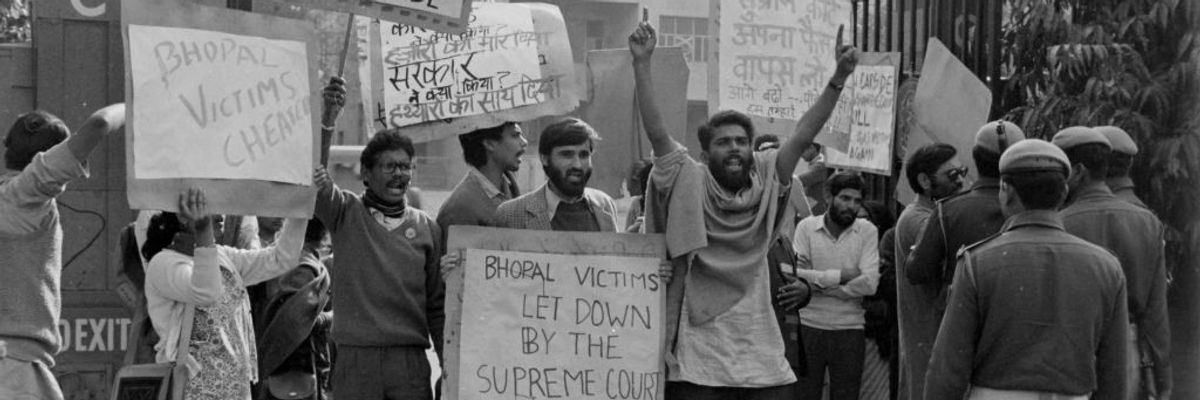
In India, Bhopal victims have had a long struggle for justice. In 1989, survivors flew to a Union Carbide shareholders meeting in Houston to protest the inadequate compensation for the trauma they’d suffered. The settlement awarded each Bhopal victim was a mere $500—which a spokesperson for Dow Chemical, Union Carbide’s parent company, called “plenty good for an Indian.”
We can take inspiration from the people of Bhopal, whose fierce commitment to health and justice sparked a global movement.
Union Carbide had the survivors arrested before they could enter the meeting. Meanwhile, their abandoned chemical factory was still leaking toxic chemicals into the surrounding neighborhoods and drinking water.
Nevertheless, Bhopal survivors never stopped fighting. They opened a free clinic to treat the intergenerational health effects caused by the disaster. They marched 500 miles between Bhopal and New Delhi. They staged hunger strikes. They created memorials to the disaster and established a museum to ensure that the horrors of their collective past are not forgotten.
The survivors even obtained an extradition order for Union Carbide’s former CEO, Warren Anderson, but the U.S. government never acted on that request. Forty years later, the factory in Bhopal has never been properly cleaned and is still leaking poison.
Unfortunately, the kinds of chemicals that flow through the veins of Bhopal survivors also flow through ours. The petrochemical industry has brought us together in a perverse solidarity, having chemically trespassed into places all over the world.
According to one figure, Americans are exposed to dangerous chemical fires, leaks, and explosions about once every two days. In one dramatic example in early 2023, a rail tanker filled with vinyl chloride derailed in East Palestine, Ohio, forcing the evacuation of 2,000 residents.
Nearly all Americans now carry toxic substances known as PFAS in our bodies. These have been linked to cancer, liver and kidney disease, and immune dysfunction. And the continued burning of fossil fuels is killing millions of people each year around the world through air pollution.
Petrochemical and fossil fuel companies know they can only survive if they avoid liability for the damage they are doing to our health and the planet’s ecosystems. That’s why they are heavily invested in lobbying to prevent any such accountability.
Polluting industries are certain to have strong allies in the coming Trump administration, which plans to open even more land to fossil fuel production and, under the blueprint for conservative governance known as Project 2025, to slash environmental and public health regulations. But we can take inspiration from the people of Bhopal, whose fierce commitment to health and justice sparked a global movement.
Earlier this month, on the 40th anniversary of the Bhopal disaster, congressional allies of this movement including U.S. Sen. Jeff Merkley (D-Ore.) and U.S. Reps. Pramila Jayapal (D-Wash.) and Rashida Tlaib (D-Mich.), introduced a resolution designating December 3 as National Chemical Disaster Awareness Day.
“Chemical disasters are often the result of corporations cutting corners and prioritizing profits over safety,” said Merkley, who chairs the U.S. Senate Environment and Public Works subcommittee. “These catastrophes cloud communities with toxic fumes, upending lives and threatening the health and property of those living and working close by.” He called for “stronger laws to prevent chemical disasters and keep our communities and workers safe.”
This growing global alliance, which has been called the largest movement for environmental health and justice in history, is fighting for a future in which everyone has the right to live in a healthy environment. It’s a movement that unites us all. Because in many ways, we all live in Bhopal now.
Dear Common Dreams reader, It’s been nearly 30 years since I co-founded Common Dreams with my late wife, Lina Newhouser. We had the radical notion that journalism should serve the public good, not corporate profits. It was clear to us from the outset what it would take to build such a project. No paid advertisements. No corporate sponsors. No millionaire publisher telling us what to think or do. Many people said we wouldn't last a year, but we proved those doubters wrong. Together with a tremendous team of journalists and dedicated staff, we built an independent media outlet free from the constraints of profits and corporate control. Our mission has always been simple: To inform. To inspire. To ignite change for the common good. Building Common Dreams was not easy. Our survival was never guaranteed. When you take on the most powerful forces—Wall Street greed, fossil fuel industry destruction, Big Tech lobbyists, and uber-rich oligarchs who have spent billions upon billions rigging the economy and democracy in their favor—the only bulwark you have is supporters who believe in your work. But here’s the urgent message from me today. It's never been this bad out there. And it's never been this hard to keep us going. At the very moment Common Dreams is most needed, the threats we face are intensifying. We need your support now more than ever. We don't accept corporate advertising and never will. We don't have a paywall because we don't think people should be blocked from critical news based on their ability to pay. Everything we do is funded by the donations of readers like you. When everyone does the little they can afford, we are strong. But if that support retreats or dries up, so do we. Will you donate now to make sure Common Dreams not only survives but thrives? —Craig Brown, Co-founder |
Forty years ago this month, a Union Carbide pesticide factory in Bhopal, India sprung a toxic gas leak, exposing half a million people to toxic fumes. Thousands of people lost their lives in the immediate aftermath, with the death toll climbing to more than 20,000 over the next two decades. Countless others, including children of survivors, continue to endure chronic health issues.
In the United States, the events in Bhopal ignited a grassroots movement to expose and address the toxic chemicals in our water, air, and neighborhoods. In 1986, just two years after the disaster, this growing awareness led Congress to pass the first National Right to Know Act, which requires companies to publicly disclose their use of many toxic chemicals.
In India, Bhopal victims have had a long struggle for justice. In 1989, survivors flew to a Union Carbide shareholders meeting in Houston to protest the inadequate compensation for the trauma they’d suffered. The settlement awarded each Bhopal victim was a mere $500—which a spokesperson for Dow Chemical, Union Carbide’s parent company, called “plenty good for an Indian.”
We can take inspiration from the people of Bhopal, whose fierce commitment to health and justice sparked a global movement.
Union Carbide had the survivors arrested before they could enter the meeting. Meanwhile, their abandoned chemical factory was still leaking toxic chemicals into the surrounding neighborhoods and drinking water.
Nevertheless, Bhopal survivors never stopped fighting. They opened a free clinic to treat the intergenerational health effects caused by the disaster. They marched 500 miles between Bhopal and New Delhi. They staged hunger strikes. They created memorials to the disaster and established a museum to ensure that the horrors of their collective past are not forgotten.
The survivors even obtained an extradition order for Union Carbide’s former CEO, Warren Anderson, but the U.S. government never acted on that request. Forty years later, the factory in Bhopal has never been properly cleaned and is still leaking poison.
Unfortunately, the kinds of chemicals that flow through the veins of Bhopal survivors also flow through ours. The petrochemical industry has brought us together in a perverse solidarity, having chemically trespassed into places all over the world.
According to one figure, Americans are exposed to dangerous chemical fires, leaks, and explosions about once every two days. In one dramatic example in early 2023, a rail tanker filled with vinyl chloride derailed in East Palestine, Ohio, forcing the evacuation of 2,000 residents.
Nearly all Americans now carry toxic substances known as PFAS in our bodies. These have been linked to cancer, liver and kidney disease, and immune dysfunction. And the continued burning of fossil fuels is killing millions of people each year around the world through air pollution.
Petrochemical and fossil fuel companies know they can only survive if they avoid liability for the damage they are doing to our health and the planet’s ecosystems. That’s why they are heavily invested in lobbying to prevent any such accountability.
Polluting industries are certain to have strong allies in the coming Trump administration, which plans to open even more land to fossil fuel production and, under the blueprint for conservative governance known as Project 2025, to slash environmental and public health regulations. But we can take inspiration from the people of Bhopal, whose fierce commitment to health and justice sparked a global movement.
Earlier this month, on the 40th anniversary of the Bhopal disaster, congressional allies of this movement including U.S. Sen. Jeff Merkley (D-Ore.) and U.S. Reps. Pramila Jayapal (D-Wash.) and Rashida Tlaib (D-Mich.), introduced a resolution designating December 3 as National Chemical Disaster Awareness Day.
“Chemical disasters are often the result of corporations cutting corners and prioritizing profits over safety,” said Merkley, who chairs the U.S. Senate Environment and Public Works subcommittee. “These catastrophes cloud communities with toxic fumes, upending lives and threatening the health and property of those living and working close by.” He called for “stronger laws to prevent chemical disasters and keep our communities and workers safe.”
This growing global alliance, which has been called the largest movement for environmental health and justice in history, is fighting for a future in which everyone has the right to live in a healthy environment. It’s a movement that unites us all. Because in many ways, we all live in Bhopal now.
Forty years ago this month, a Union Carbide pesticide factory in Bhopal, India sprung a toxic gas leak, exposing half a million people to toxic fumes. Thousands of people lost their lives in the immediate aftermath, with the death toll climbing to more than 20,000 over the next two decades. Countless others, including children of survivors, continue to endure chronic health issues.
In the United States, the events in Bhopal ignited a grassroots movement to expose and address the toxic chemicals in our water, air, and neighborhoods. In 1986, just two years after the disaster, this growing awareness led Congress to pass the first National Right to Know Act, which requires companies to publicly disclose their use of many toxic chemicals.
In India, Bhopal victims have had a long struggle for justice. In 1989, survivors flew to a Union Carbide shareholders meeting in Houston to protest the inadequate compensation for the trauma they’d suffered. The settlement awarded each Bhopal victim was a mere $500—which a spokesperson for Dow Chemical, Union Carbide’s parent company, called “plenty good for an Indian.”
We can take inspiration from the people of Bhopal, whose fierce commitment to health and justice sparked a global movement.
Union Carbide had the survivors arrested before they could enter the meeting. Meanwhile, their abandoned chemical factory was still leaking toxic chemicals into the surrounding neighborhoods and drinking water.
Nevertheless, Bhopal survivors never stopped fighting. They opened a free clinic to treat the intergenerational health effects caused by the disaster. They marched 500 miles between Bhopal and New Delhi. They staged hunger strikes. They created memorials to the disaster and established a museum to ensure that the horrors of their collective past are not forgotten.
The survivors even obtained an extradition order for Union Carbide’s former CEO, Warren Anderson, but the U.S. government never acted on that request. Forty years later, the factory in Bhopal has never been properly cleaned and is still leaking poison.
Unfortunately, the kinds of chemicals that flow through the veins of Bhopal survivors also flow through ours. The petrochemical industry has brought us together in a perverse solidarity, having chemically trespassed into places all over the world.
According to one figure, Americans are exposed to dangerous chemical fires, leaks, and explosions about once every two days. In one dramatic example in early 2023, a rail tanker filled with vinyl chloride derailed in East Palestine, Ohio, forcing the evacuation of 2,000 residents.
Nearly all Americans now carry toxic substances known as PFAS in our bodies. These have been linked to cancer, liver and kidney disease, and immune dysfunction. And the continued burning of fossil fuels is killing millions of people each year around the world through air pollution.
Petrochemical and fossil fuel companies know they can only survive if they avoid liability for the damage they are doing to our health and the planet’s ecosystems. That’s why they are heavily invested in lobbying to prevent any such accountability.
Polluting industries are certain to have strong allies in the coming Trump administration, which plans to open even more land to fossil fuel production and, under the blueprint for conservative governance known as Project 2025, to slash environmental and public health regulations. But we can take inspiration from the people of Bhopal, whose fierce commitment to health and justice sparked a global movement.
Earlier this month, on the 40th anniversary of the Bhopal disaster, congressional allies of this movement including U.S. Sen. Jeff Merkley (D-Ore.) and U.S. Reps. Pramila Jayapal (D-Wash.) and Rashida Tlaib (D-Mich.), introduced a resolution designating December 3 as National Chemical Disaster Awareness Day.
“Chemical disasters are often the result of corporations cutting corners and prioritizing profits over safety,” said Merkley, who chairs the U.S. Senate Environment and Public Works subcommittee. “These catastrophes cloud communities with toxic fumes, upending lives and threatening the health and property of those living and working close by.” He called for “stronger laws to prevent chemical disasters and keep our communities and workers safe.”
This growing global alliance, which has been called the largest movement for environmental health and justice in history, is fighting for a future in which everyone has the right to live in a healthy environment. It’s a movement that unites us all. Because in many ways, we all live in Bhopal now.