SUBSCRIBE TO OUR FREE NEWSLETTER
Daily news & progressive opinion—funded by the people, not the corporations—delivered straight to your inbox.
5
#000000
#FFFFFF
To donate by check, phone, or other method, see our More Ways to Give page.


Daily news & progressive opinion—funded by the people, not the corporations—delivered straight to your inbox.
Colleen Cullen (IFAW, Headquarters)
Tel: 508 648 3586
Email: ccullen@ifaw.org
Chris Cutter (IFAW, Headquarters)
Tel: 508 744 2066
Email: ccutter@ifaw.org
For the first time in nearly 10 years, international trade in elephant ivory has been sanctioned by the UN-backed Convention on International Trade in Endangered Species (CITES). Approximately 119 tons (108 tonnes) of stockpiled ivory, the remnants of 10,000+ elephants, will be auctioned from four southern African nations beginning in two weeks.
The 57th session of the Standing Committee for the Convention on International Trade in Endangered Species (CITES) ruled just months ago that China was fit to become a trading partner for the ivory, while Japan was previously approved. Both nations are known to be among the world's largest illegal ivory markets. Several multiple ton seizures have been made at Chinese ports in recent years. The lack of enforcement for the registration systems in both countries also provides a convenient loophole for illegal traders.
"Even though the ivory was not obtained through illegal poaching activities, these legal sales only encourage poachers to launder their illegal stocks," said Michael Wamithi, Program Director for the International Fund for Animal Welfare's (IFAW - www.ifaw.org) global elephants program and former director of the Kenya Wildlife Service.
The total amounts being auctioned are: Botswana ~44K kg; Namibia ~9K kg; South Africa ~51K kg; and Zimbabwe ~4K kg. Significant amounts of ivory in these stocks have been collected through culling which is itself a controversial means to control elephant populations.
"We have no doubt that flooding the market with over 100 tons of ivory will put this endangered species in even further jeopardy," continued Wamithi. Throughout west and central Africa, isolated populations have actually been wiped out completely due to illegal hunting. If we do not take this trade seriously, we will surely continue see the demise of these majestic creatures - and sooner rather than later."
Jason Bell-Leask, Regional Director for IFAW's southern Africa office also expressed his disdain. "The international trade in ivory simply cannot be justified by a perceived short-term gain such as profits from these sales. Not only are elephants a keystone species, but African tourism relies on their existence. To toy with that is to toy with the livelihoods of the citizens within these poor African nations."
IFAW's 2007 China ivory trade poll report revealed the low awareness of the current ivory control system in China, and also citizens' unwillingness to comply with this framework. According to the report, among the 14.5 per cent that were actually admitted consumers of ivory, 75.7 per cent would willingly violate the control system in order to obtain ivory at a cheaper price.
In 1989, CITES Parties listed the African elephant on Appendix I, effectively prohibiting all international trade in elephants and their derivatives, including ivory, but in 1997 this was resanctioned and certain populations were down-listed to Appendix II, allowing trade with special permissions from CITES. These sales will be the second time in nearly two decades that the international sale in ivory has been authorized since the initial ban.
One year ago, a suspension of at least nine years on international elephant ivory trade was approved at the 14th meeting of the CITES Conference of the Parties. This trade ban is set to come into affect after the stockpiles sales are completed.
The International Fund for Animal Welfare works to improve animal welfare, prevent animal cruelty and abuse, protect wildlife and provide animal rescue around the world. From stopping the elephant ivory trade, to ending the Canadian seal hunt and saving the whales from extinction, IFAW works to create solutions that benefit both animals and people.
"I am not buying Starbucks and you should not either."
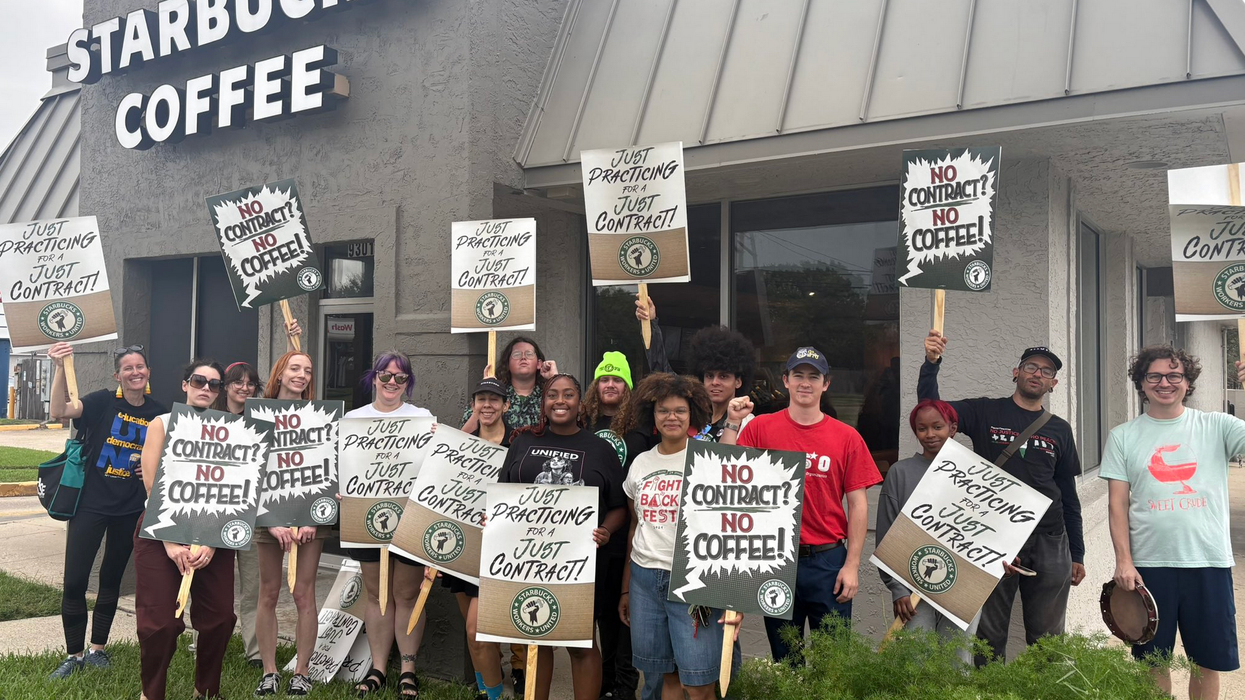
The mayors-elect in both Seattle and New York City are backing the nationwide strike by Starbucks baristas launched this week, calling on the people of their respective cities to honor the consumer boycott of the coffee giant running parallel to the strike so that workers can win their fight for better working conditions.
“Together, we can send a powerful message: No contract, no coffee,” Zohran Mamdani, the democratic socialist who will take control of the New York City's mayor office on January 1, declared in a social media post to his more than 1 million followers.
In Seattle, mayor-elect Katie Wilson, who on Thursday was declared the winner of the race in Seattle, where Starbucks was founded and where its corporate headquarters remains, joined the picket line with striking workers in her city on the very same day to show them her support.
"I am not buying Starbucks and you should not either,” Wilson told the crowd.
She also delivered a message directly to the corporate leadership of Starbucks. "This is your hometown and mine," she said. "Seattle's making some changes right now, and I urge you to do the right thing. Because in Seattle, when workers' rights are under attack, what do we do?" To which the crowd responded in a chant-style response: "Stand up! Fight back!"
Socialist Seattle Mayor-elect Katie Wilson's first move after winning the election was to boycott Starbucks, a hometown company. pic.twitter.com/zPoNULxfuk
— Ari Hoffman 🎗 (@thehoffather) November 14, 2025
In his post, Mamdani said, "Starbucks workers across the country are on an Unfair Labor Practices strike, fighting for a fair contract," as he called for people everywhere to honor the picket line by not buying from the company.
At a rally with New York City workers outside a Starbucks location on Thursday, Mamdani referenced the massive disparity between profits and executive pay at the company compared to what the average barista makes.
Zohran Mamdani says that New York City stands with Starbucks employees!He points out their CEO made 96 billion last year. That’s 6,666 times the median Starbucks worker salary. Boycott Starbucks. Support the workers. Demand they receive a living wage.
[image or embed]
— Kelly (@broadwaybabyto.bsky.social) November 12, 2025 at 10:45 PM
The striking workers, said Mamdani, "are asking for a salary they can actually live off of. They are asking for hours they can actually build their life around. They are asking for the violations of labor law to finally be resolved. And they deserve a city that has their back and I am here to say that is what New York City will be."
Of 614 people on list who may have been unlawfully arrested and detained by federal officials, only 16 had a criminal record of any kind.
President Donald Trump and his administration have claimed repeatedly that the immigration raids that have terrorized communities nationwide this year are focused on getting the "worst of the worst" off the streets and out of the country, but new detention data filed by the Department of Justice on Friday shows that only a tiny fraction of the more than 600 people who remain in detention in the Chicago area from raids over recent months have any criminal record, bolstering anecdotal evidence that many of those targeted for by ICE and federal border agents are hard-working, law-abiding members of society.
According to the Chicago Tribune:
The Trump administration on Friday released the names of 614 people whose Chicago-area immigration arrests may have violated a 2022 consent decree, and only 16 of them have criminal histories that present a “high public safety risk.”
The list was produced as part of an ongoing lawsuit alleging immigration agents have repeatedly violated the terms of the in-court settlement, mostly during “Operation Midway Blitz,” that puts a high bar on making so-called warrantless arrests without a prior warrant or probable cause.
The newspaper reports that of the 16 people arrested with criminal histories—representing just 2.6% of the total listed in the filing— "five involved domestic battery, two were related to drunken driving, and one allegedly had an unidentified criminal history in another country." None had criminal backgrounds that included worst-of-the-worst offenses like rape or murder.
Earlier this week, U.S. District Judge Jeffrey Cummings ordered the government to provide more information about the more than 600 people being held in detention and suggested that he would order their release if compelling reasons for public safety were not presented. While ordering the immediate release of 13 people he deemed were arrested unlawfully, Cummings gave the government until Friday to release the additional information on those being held.
The Chicago Sun-Times reports that the list of 614 detainees comes from a longer list of roughly 1,800 individuals arrested by U.S. Immigration and Customs Enforcement in the Chicago area between June 11 and October 7, of which "only about 750 of them remain in the country." Most of the others were deported, and their criminal histories were not presented in Friday's disclosure.
The consent decree at issue, known as the Castañon-Nava settlement agreement, restricts the ability of ICE agents or others working with them to make warrantless arrests in the state of Illinois.
“Communities throughout the Chicago area have been traumatized by ICE and other federal agents’ chaotic and violent actions in our neighborhoods in recent months, and potentially hundreds of families already have been permanently separated as a result of unlawful arrests and rapid deportations without due process," said Mark Fleming, associate director of litigation for the National Immigration Justice Center (NIJC), who is backing the legal case against the unlawful arrests and detentions in Chicago, after the order issued by Cummings on Wednesday.
"NIJC and our partners will continue to demand justice for our communities and accountability for the lawless administration we all are facing.”
During Wednesday's hearing, the judge suggested many of those who remain in detention likely have no history of criminal conduct and were targeted by federal agents simply for fitting a specific profile. As the Sun-Times reports:
Cummings said that 54 of those people were arrested at work, including 20 landscapers and four ride-share or taxi drivers. Twenty were arrested commuting to or from work, he added, and nine were arrested at a Home Depot or Menards, “presumably either seeking work or to pick up supplies.”
Seven were also arrested at an “immigration-related hearing,” Cummings said, while 11 were arrested in public places like a park, gas station or even a Dunkin’ Donuts drive-thru.
“It seems highly likely to me that at least some of those individuals are among the 615 detainees who are not subject to mandatory detention,” Cummings said. He also found them unlikely to be members of gangs, “assorted other ne’er-do-wells” or the “worst of the worst.”
Community members living in Chicago and its outlying suburbs, including Broadview, have expressed anger at Trump's ICE operations in the region, which have seen school teachers, childcare providers, day laborers, and other neighbors targeted and arrested.
On Friday, 21 people were arrested outside the immigration detention center in Broadview following a morning demonstration outside the facility.
The administration is "now acknowledging what economists and business leaders have told us from the beginning: that tariffs are driving up prices," said one journalist.
Although President Donald Trump didn't actually confess that his global trade war is driving up the cost of groceries for Americans, he did finally drop his dubiously named "reciprocal" tariffs on key imports on Friday.
According to a White House fact sheet, Trump's new executive order ends his tariffs on beef; cocoa and spices; coffee and tea; bananas, oranges, and tomatoes; other tropical fruits and fruit juices; and fertilizers.
The New York Times had reported Thursday that "the Trump administration is preparing broad exemptions to certain tariffs in an effort to ease elevated food prices that have provoked anxiety for American consumers."
The reporting drew critiques of the administration's economic policies, including from members of Congress such as Senate Finance Committee Ranking Member Ron Wyden (D-Ore.), who said that "Trump just admitted it: Americans are footing the bill for his disastrous tariffs."
"While this move may alleviate some of the cost increases Trump caused, it will not stop the larger problems of rising inflation, business uncertainty, and economic damage done by Trump's crazy tariff scheme."
Also responding to the Times reporting, Sen. Elizabeth Warren (D-Mass.) wrote on social media Friday: "After months of increasing grocery prices, Donald Trump is finally admitting he was wrong. Americans are literally paying the price for Trump's mistakes."
More lawmakers and other critics piled on after Trump issued the order. CNN's Jim Sciutto said: "Trump administration now acknowledging what economists and business leaders have told us from the beginning: that tariffs are driving up prices."
MeidasTouch and its editor in chief, Ron Filipkowski, also called out the president on social media, with the outlet sarcastically noting, "But Trump said his tariffs don't raise prices."
OR, Trump Admits His Tariffs Caused Grocery Prices to Rise.
[image or embed]
— Ron Filipkowski (@ronfilipkowski.bsky.social) November 14, 2025 at 5:52 PM
Congressman Don Beyer (D-Va), who serves on the House Ways and Means Subcommittee on Trade, said in a Friday statement that "President Trump is finally admitting what we always knew: His tariffs are raising prices for the American people."
"After getting drubbed in recent elections because of voters' fury that Trump has broken his promises to fix inflation, the White House is trying to cast this tariff retreat as a 'pivot to affordability,'" Beyer said, referencing Democrats who won key races last week, from more moderate Mikie Sherrill and Abigail Spanberger, the incoming governors of New Jersey and Virginia, to democratic socialist Mayors-elect Zohran Mamdani of New York City and Katie Wilson of Seattle.
In addition to those electoral victories for Democrats, last week featured a debate over Trump's trade war at the US Supreme Court. According to Beyer: "The simple truth is that Republicans want credit for something they think the Supreme Court will force them to do anyway, after oral arguments before the court on Trump's illegal abuses of trade authorities went badly for the administration. Trump is still keeping the vast majority of his tariffs in place, and his administration is also planning new tariffs in anticipation of a Supreme Court loss."
"The same logic—that Trump's tariffs are driving up prices on coffee, fruit, and other comestibles—is equally true for the thousands of other goods on which his tariffs remain," he continued. "While this move may alleviate some of the cost increases Trump caused, it will not stop the larger problems of rising inflation, business uncertainty, and economic damage done by Trump's crazy tariff scheme."
"Only Congress can do that, by reclaiming its legal responsibility under the Constitution to regulate trade, and permanently ending Trump's trade war chaos," he stressed. "All but a handful of Republicans in Congress are still refusing to stand up to Trump, stop his tariffs, and lower costs for the American people, and unless they find a backbone, our economy will continue to suffer."
Huh. Trump dropped the tariffs on coffee, beef, and tropical fruit to LOWER PRICES. I thought other countries paid for those?
— Angry (@angrystaffer.bsky.social) November 14, 2025 at 5:50 PM
As the Associated Press noted Friday, "The president signed the executive order after announcing that the U.S. had reached framework agreements with Ecuador, Guatemala, El Salvador, and Argentina designed to ease import levies on agricultural products produced in those countries."
Trump's order also came just a day after Democrats on the congressional Joint Economic Committee released a report showing that US families are paying roughly $700 more each month for basic items since Trump returned to office in January—with households in some states, such as Alaska and California, facing an average of over $1,000 monthly.
The president has floated sending Americans a $2,000 check, purportedly funded by revenue collected from his tariffs, but as Common Dreams reported Wednesday, economist Dean Baker of the Center for Economic and Policy Research crunched the numbers and found that the proposed "dividend" doesn't add up.