SUBSCRIBE TO OUR FREE NEWSLETTER
Daily news & progressive opinion—funded by the people, not the corporations—delivered straight to your inbox.
5
#000000
#FFFFFF
To donate by check, phone, or other method, see our More Ways to Give page.
Daily news & progressive opinion—funded by the people, not the corporations—delivered straight to your inbox.
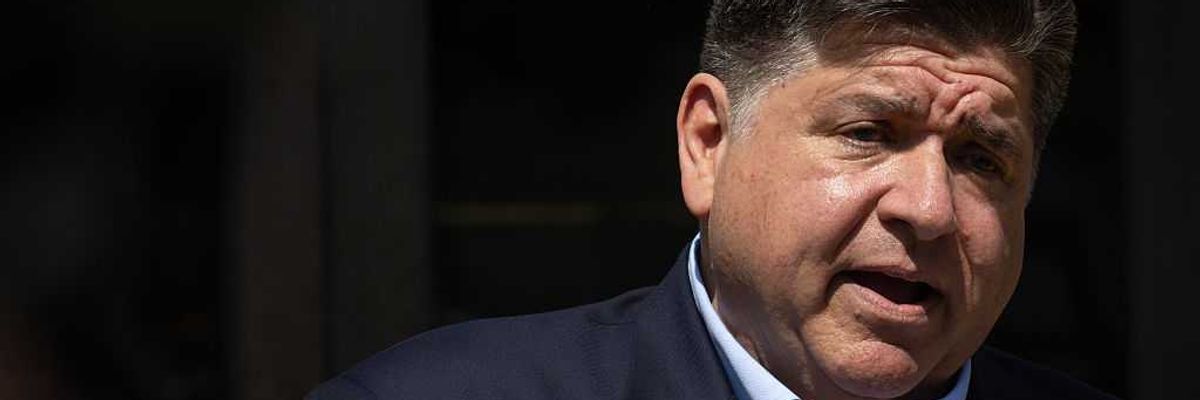
Illinois Governor JB Pritzker speaks to the press following a visit to the National Museum of Mexican Art in the Pilsen neighborhood on September 9, 2025 in Chicago, Illinois.
"He’s going to do everything in his power to distract,” said the Illinois governor.
As President Donald Trump escalated tensions in the Caribbean with its deployment of an aircraft carrier and warships, one of his top critics in the Democratic Party warned that Trump could follow through on earlier threats to strike Venezuela as newly released documents shed light on a topic the White House has sought to keep secret: the details of the president's friendship with convicted sex offender Jeffrey Epstein.
“My great fear, of course, is that with the release of that information, which I think will be devastating for Trump, he’s going to do everything in his power to distract,” Illinois Gov. JB Pritzker told the Associated Press on Wednesday. “What does that mean? I mean, he might take us to war with Venezuela just to get a distraction in the news and take it out of the headlines.”
Democrats on the House Oversight Committee released a series of emails in which Epstein, who died in prison in 2019, told a friend he spent Thanksgiving 2017 with Trump, informed a former New York Times journalist he had a "photo of donald and girls in bikinis," and suggested he had briefed Russia’s ambassador to the United Nations, Vitaly Churkin, on Trump in 2018.
Trump has long claimed he cut ties with Epstein in the mid-2000s after Epstein recruited girls at the president's Florida estate, Mar-a-Lago.
After the Democrats released the emails, the Republican-controlled committee disclosed 20,000 pages of messages from the financier, who was arrested on federal sex trafficking charges in 2019. Those messages, which were obtained from the Epstein estate in response to a subpoena, included a comment from Epstein that he was “the one able to take [Trump] down" and suggestions that he had knowledge of the president's real estate and business dealings.
Epstein also told journalist Michael Wolff of Trump, "Of course he knew about the girls." He told his longtime associate Ghislaine Maxwell, who was also convicted of helping Epstein with his sex trafficking operation, that the president was "the dog that hasn't barked" in a 2011 email and said Trump had spent "hours at my house" with one of Epstein's well-known victims, Virginia Giuffre.
Pritzker on Wednesday demanded the full release of the Epstein files, saying Trump was "silent because he knows what's inside."
The release of the documents came after months of demands from Democrats that the US Department of Justice fully disclose files related to the Epstein case, which they believe would implicate Trump.
On Wednesday, House Speaker Mike Johnson (R-La.) said he plans to hold a vote next week on releasing the files. Johnson finally swore in Rep. Adelita Grijalva (D-Ariz.) on Wednesday after a weekslong delay he tried to blame on the government shutdown and Grijalva promptly became the 218th lawmaker to sign a discharge petition forcing the vote.
The president said late Wednesday that "the Democrats are using the Jeffrey Epstein Hoax to try and deflect from their massive failures."
But as Pritzker pointed out, the new developments in the Epstein saga follow the Trump administration's threats against Venezuela and his bombings of boats in the Caribbean and the eastern Pacific Ocean—strikes that have killed at least 76 people and have been denounced by legal experts and Democratic lawmakers as extrajudicial killings.
The bombings have been part of what the administration claims is a campaign to stop drug trafficking out of Venezuela—a country that, according to the United States' own intelligence and law enforcement agencies, plays virtually no role in the trafficking of fentanyl, the leading cause of overdoses in the US.
Venezuela is a transit hub for—but not a significant producer of—cocaine, which is sometimes transported via the Caribbean to the US.
But while Trump has claimed to Congress that the US is in "armed conflict" with drug cartels, drug trafficking has long been treated as a law enforcement issue—not one to be confronted through military strikes—with those suspected of transporting illicit substances arrested and their products confiscated by the Coast Guard and other agencies.
Trump has also signaled that the US could attack Venezuela directly and has authorized Central Intelligence Agency operations there, prompting Venezuelan President Nicolás Maduro to ready the country's entire military arsenal for a potential response on Tuesday. Maduro has accused Trump of seeking "regime change"—which Secretary of State Marco Rubio has long advocated for—and Trump explicitly said in 2023 that he would seek to take control of Venezuela's vast oil reserves if he won the presidency again.
On Wednesday, top military officials reportedly presented Trump options for potential military operations within Venezuela.
This country and this world are at a monumental crossroads. US voters have an opportunity to beat back the forces of fascism and confront the billionaires who are rigging the economy, our media system, and our democracy, making it increasingly impossible for ordinary people to get by. We’re not just talking about the election. We’re talking about what must be done once these fascist elements are vanquished from power. We need a bolder set of solutions than what either major party has so far been willing to offer and a working-class movement ready to fight like hell for it. Trump didn't emerge from nowhere. The conditions that fueled MAGA authoritarianism were created by decades of radical neoliberal economic policies and a corrupt political system dominated by corporate interests. They slashed taxes on the super-rich, promising that the benefits would trickle down. They said giveaways to the corporate titans would make life more affordable for the rest of us. It was all bullshit. And when a bitter, betrayed populace searches for someone to blame, right-wing demagogues have little trouble finding scapegoats. People know when they're being lied to, but you won't hear any of this from the corporate media. Only independent journalism—powered and funded by people who believe in building a better world—can deliver truly trustworthy daily news. If you share our vision, please contribute whatever you can to sustain our work. |
As President Donald Trump escalated tensions in the Caribbean with its deployment of an aircraft carrier and warships, one of his top critics in the Democratic Party warned that Trump could follow through on earlier threats to strike Venezuela as newly released documents shed light on a topic the White House has sought to keep secret: the details of the president's friendship with convicted sex offender Jeffrey Epstein.
“My great fear, of course, is that with the release of that information, which I think will be devastating for Trump, he’s going to do everything in his power to distract,” Illinois Gov. JB Pritzker told the Associated Press on Wednesday. “What does that mean? I mean, he might take us to war with Venezuela just to get a distraction in the news and take it out of the headlines.”
Democrats on the House Oversight Committee released a series of emails in which Epstein, who died in prison in 2019, told a friend he spent Thanksgiving 2017 with Trump, informed a former New York Times journalist he had a "photo of donald and girls in bikinis," and suggested he had briefed Russia’s ambassador to the United Nations, Vitaly Churkin, on Trump in 2018.
Trump has long claimed he cut ties with Epstein in the mid-2000s after Epstein recruited girls at the president's Florida estate, Mar-a-Lago.
After the Democrats released the emails, the Republican-controlled committee disclosed 20,000 pages of messages from the financier, who was arrested on federal sex trafficking charges in 2019. Those messages, which were obtained from the Epstein estate in response to a subpoena, included a comment from Epstein that he was “the one able to take [Trump] down" and suggestions that he had knowledge of the president's real estate and business dealings.
Epstein also told journalist Michael Wolff of Trump, "Of course he knew about the girls." He told his longtime associate Ghislaine Maxwell, who was also convicted of helping Epstein with his sex trafficking operation, that the president was "the dog that hasn't barked" in a 2011 email and said Trump had spent "hours at my house" with one of Epstein's well-known victims, Virginia Giuffre.
Pritzker on Wednesday demanded the full release of the Epstein files, saying Trump was "silent because he knows what's inside."
The release of the documents came after months of demands from Democrats that the US Department of Justice fully disclose files related to the Epstein case, which they believe would implicate Trump.
On Wednesday, House Speaker Mike Johnson (R-La.) said he plans to hold a vote next week on releasing the files. Johnson finally swore in Rep. Adelita Grijalva (D-Ariz.) on Wednesday after a weekslong delay he tried to blame on the government shutdown and Grijalva promptly became the 218th lawmaker to sign a discharge petition forcing the vote.
The president said late Wednesday that "the Democrats are using the Jeffrey Epstein Hoax to try and deflect from their massive failures."
But as Pritzker pointed out, the new developments in the Epstein saga follow the Trump administration's threats against Venezuela and his bombings of boats in the Caribbean and the eastern Pacific Ocean—strikes that have killed at least 76 people and have been denounced by legal experts and Democratic lawmakers as extrajudicial killings.
The bombings have been part of what the administration claims is a campaign to stop drug trafficking out of Venezuela—a country that, according to the United States' own intelligence and law enforcement agencies, plays virtually no role in the trafficking of fentanyl, the leading cause of overdoses in the US.
Venezuela is a transit hub for—but not a significant producer of—cocaine, which is sometimes transported via the Caribbean to the US.
But while Trump has claimed to Congress that the US is in "armed conflict" with drug cartels, drug trafficking has long been treated as a law enforcement issue—not one to be confronted through military strikes—with those suspected of transporting illicit substances arrested and their products confiscated by the Coast Guard and other agencies.
Trump has also signaled that the US could attack Venezuela directly and has authorized Central Intelligence Agency operations there, prompting Venezuelan President Nicolás Maduro to ready the country's entire military arsenal for a potential response on Tuesday. Maduro has accused Trump of seeking "regime change"—which Secretary of State Marco Rubio has long advocated for—and Trump explicitly said in 2023 that he would seek to take control of Venezuela's vast oil reserves if he won the presidency again.
On Wednesday, top military officials reportedly presented Trump options for potential military operations within Venezuela.