SUBSCRIBE TO OUR FREE NEWSLETTER
Daily news & progressive opinion—funded by the people, not the corporations—delivered straight to your inbox.
5
#000000
#FFFFFF
To donate by check, phone, or other method, see our More Ways to Give page.
Daily news & progressive opinion—funded by the people, not the corporations—delivered straight to your inbox.
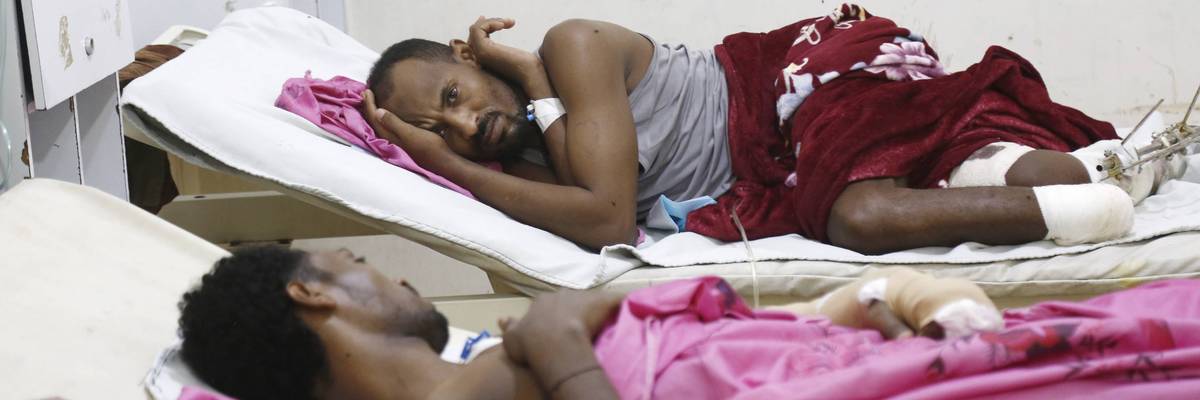
African migrants get treated at a hospital in Saada province, Yemen, on May 3, 2025, after they were wounded in a US airstrike on the detention center where they were being held.
"I have nothing left that keeps me going," said a survivor who lost a leg. "I want them to provide any type of reparation that will help with our life in any way possible. Something that will revive my hope."
A week after Democratic senators launched an investigation into US Defense Secretary Pete Hegseth's assault on federal efforts to mitigate civilian harm, Amnesty International on Tuesday renewed its call for a war crimes probe of the American airstrike on a migrant detention center in Yemen that killed dozens of people last April.
While the United States has been bombing Yemen since 2002 as part of the so-called War on Terror, the Trump administration stepped up attacks last spring, in response to Houthi rebels' resistance to Israel's genocidal war on the Gaza Strip.
"The Trump administration's approach to its airstrikes in Yemen from March to May 2025 should have set off alarm bells in the USA and around the world, clearly signaling an urgent need to strengthen measures to protect civilians," Amnesty International USA director Nadia Daar said in a statement exactly one year after the bombing in Saada.
"Instead, the US administration has systematically weakened safeguards, shrinking offices aimed at reducing civilian harm, while simultaneously displaying a dangerous disregard for the lives of civilians endangered by armed conflicts," she continued. "Against that backdrop, attacks such as the US attack on a school in Minab in Iran, which killed [155] people, including 120 children, were a tragically foreseeable consequence of a failure to implement robust civilian-harm mitigation efforts."
Amnesty concluded last month that the US bombing of the Iranian school "packed full of children" on February 28 was "a serious breach of international humanitarian law" and those responsible "must be held accountable."
Erika Guevara Rosas—Amnesty International's senior director of research, advocacy, policy, and campaigns—stressed at the time that "the US authorities could, and should, have known it was a school building. Targeting a protected civilian object, such as a school, is strictly prohibited under international humanitarian law."
In a potential preview of what Iranian families impacted by that strike will face, Guevara Rosas noted Tuesday that one year after the attack in Yemen, "US officials have failed to hold anyone accountable or even to clarify the status or outcome of the investigations they had announced a year earlier."
"Families of those killed in the attack on the detention center in Yemen are still being denied basic information about what happened, [and] remain without justice for their loved ones," she explained. "Survivors continue to struggle, lacking the means to secure a decent living or even receive adequate medical treatment."
Amnesty interviewed over a dozen survivors identified by pseudonyms, including Araya, a 22-year-old Ethiopian man, who sustained a serious arm injury and said: "If I don't take a painkiller, I feel hopeless and wish to die. I think about how, at such a young age, I can't even support myself and still rely on help from others. The metal rod inside me is very painful and uncomfortable. It drives you insane."
Jirata, a 30-year-old Ethiopian man, has a metal rod in one of his legs, and lost the other in the attack. He told Amnesty that "I have lost hope and I have nothing left that keeps me going. I came here [to Yemen] to work like everyone else to help my family and change mine and their life for the better... Now people carry me to the toilet."
"The US government caused all this and as a result [of the airstrike], I can no longer work and support myself," he detailed. "I want them to provide any type of reparation that will help with our life in any way possible. Something that will revive my hope."
Another Ethiopian man, 32-year-old Abay, similarly said that "I went to Yemen to change my family's life, but now I made my family's life even harder than it was before," due to his leg and hand injuries.
"I feel broken whenever I see their faces," said Abay, who returned to Ethiopia. "You can see the sadness on their faces. I hoped for a better life, to work and change our lives, but everything turned upside down."
Guevara Rosas said that "the story of these migrants is grim and heartbreaking. Traveling to Yemen in search of better opportunities, they were detained by the Houthis, denied their freedom, then attacked in a US airstrike. Those who survived have been left in limbo, with no justice or reparation in sight, nor an explanation for why this happened to them, an acknowledgment of the wrong done to them, or any support offered to help them carry on with their lives."
She argued that "they must receive full, effective, and prompt reparation, including restitution, compensation, rehabilitation, satisfaction, and guarantees of nonrepetition, through an effective and accessible mechanism."
According to Airwars, US forces have killed 443-642 people in Yemen since 2009. The official government estimate for civilian deaths in that time is just 13. The deadline for the Pentagon's next annual report on civilian casualties is May 1.
Guevara Rosas declared that "in order to stop this deadly spiral, the USA must ensure prompt, transparent, impartial, independent, and effective investigations into attacks that have resulted in civilian casualties, including those in Yemen and Iran."
"The US Congress must also urgently step up its oversight role and demand answers, including a public accounting of these strikes and the adequate and prompt provision of reparation to the civilians that have been harmed, and ensure it is not appropriating funds that may contribute to breaches of international law," she added.
So far, both Republican-controlled chambers of Congress have declined to pass a war powers resolution reining in President Donald Trump's illegal war on Iran, invasion of Venezuela, or bombings of boats allegedly transporting drugs on the high seas. Still, Democratic Sens. Ruben Gallego (Ariz.), Tim Kaine (Va.), and Adam Schiff (Calif.) intend to force a Tuesday vote on a measure aimed at blocking the president's use of US forces in unauthorized hostilities against Cuba.
Dear Common Dreams reader, It’s been nearly 30 years since I co-founded Common Dreams with my late wife, Lina Newhouser. We had the radical notion that journalism should serve the public good, not corporate profits. It was clear to us from the outset what it would take to build such a project. No paid advertisements. No corporate sponsors. No millionaire publisher telling us what to think or do. Many people said we wouldn't last a year, but we proved those doubters wrong. Together with a tremendous team of journalists and dedicated staff, we built an independent media outlet free from the constraints of profits and corporate control. Our mission has always been simple: To inform. To inspire. To ignite change for the common good. Building Common Dreams was not easy. Our survival was never guaranteed. When you take on the most powerful forces—Wall Street greed, fossil fuel industry destruction, Big Tech lobbyists, and uber-rich oligarchs who have spent billions upon billions rigging the economy and democracy in their favor—the only bulwark you have is supporters who believe in your work. But here’s the urgent message from me today. It's never been this bad out there. And it's never been this hard to keep us going. At the very moment Common Dreams is most needed, the threats we face are intensifying. We need your support now more than ever. We don't accept corporate advertising and never will. We don't have a paywall because we don't think people should be blocked from critical news based on their ability to pay. Everything we do is funded by the donations of readers like you. When everyone does the little they can afford, we are strong. But if that support retreats or dries up, so do we. Will you donate now to make sure Common Dreams not only survives but thrives? —Craig Brown, Co-founder |
A week after Democratic senators launched an investigation into US Defense Secretary Pete Hegseth's assault on federal efforts to mitigate civilian harm, Amnesty International on Tuesday renewed its call for a war crimes probe of the American airstrike on a migrant detention center in Yemen that killed dozens of people last April.
While the United States has been bombing Yemen since 2002 as part of the so-called War on Terror, the Trump administration stepped up attacks last spring, in response to Houthi rebels' resistance to Israel's genocidal war on the Gaza Strip.
"The Trump administration's approach to its airstrikes in Yemen from March to May 2025 should have set off alarm bells in the USA and around the world, clearly signaling an urgent need to strengthen measures to protect civilians," Amnesty International USA director Nadia Daar said in a statement exactly one year after the bombing in Saada.
"Instead, the US administration has systematically weakened safeguards, shrinking offices aimed at reducing civilian harm, while simultaneously displaying a dangerous disregard for the lives of civilians endangered by armed conflicts," she continued. "Against that backdrop, attacks such as the US attack on a school in Minab in Iran, which killed [155] people, including 120 children, were a tragically foreseeable consequence of a failure to implement robust civilian-harm mitigation efforts."
Amnesty concluded last month that the US bombing of the Iranian school "packed full of children" on February 28 was "a serious breach of international humanitarian law" and those responsible "must be held accountable."
Erika Guevara Rosas—Amnesty International's senior director of research, advocacy, policy, and campaigns—stressed at the time that "the US authorities could, and should, have known it was a school building. Targeting a protected civilian object, such as a school, is strictly prohibited under international humanitarian law."
In a potential preview of what Iranian families impacted by that strike will face, Guevara Rosas noted Tuesday that one year after the attack in Yemen, "US officials have failed to hold anyone accountable or even to clarify the status or outcome of the investigations they had announced a year earlier."
"Families of those killed in the attack on the detention center in Yemen are still being denied basic information about what happened, [and] remain without justice for their loved ones," she explained. "Survivors continue to struggle, lacking the means to secure a decent living or even receive adequate medical treatment."
Amnesty interviewed over a dozen survivors identified by pseudonyms, including Araya, a 22-year-old Ethiopian man, who sustained a serious arm injury and said: "If I don't take a painkiller, I feel hopeless and wish to die. I think about how, at such a young age, I can't even support myself and still rely on help from others. The metal rod inside me is very painful and uncomfortable. It drives you insane."
Jirata, a 30-year-old Ethiopian man, has a metal rod in one of his legs, and lost the other in the attack. He told Amnesty that "I have lost hope and I have nothing left that keeps me going. I came here [to Yemen] to work like everyone else to help my family and change mine and their life for the better... Now people carry me to the toilet."
"The US government caused all this and as a result [of the airstrike], I can no longer work and support myself," he detailed. "I want them to provide any type of reparation that will help with our life in any way possible. Something that will revive my hope."
Another Ethiopian man, 32-year-old Abay, similarly said that "I went to Yemen to change my family's life, but now I made my family's life even harder than it was before," due to his leg and hand injuries.
"I feel broken whenever I see their faces," said Abay, who returned to Ethiopia. "You can see the sadness on their faces. I hoped for a better life, to work and change our lives, but everything turned upside down."
Guevara Rosas said that "the story of these migrants is grim and heartbreaking. Traveling to Yemen in search of better opportunities, they were detained by the Houthis, denied their freedom, then attacked in a US airstrike. Those who survived have been left in limbo, with no justice or reparation in sight, nor an explanation for why this happened to them, an acknowledgment of the wrong done to them, or any support offered to help them carry on with their lives."
She argued that "they must receive full, effective, and prompt reparation, including restitution, compensation, rehabilitation, satisfaction, and guarantees of nonrepetition, through an effective and accessible mechanism."
According to Airwars, US forces have killed 443-642 people in Yemen since 2009. The official government estimate for civilian deaths in that time is just 13. The deadline for the Pentagon's next annual report on civilian casualties is May 1.
Guevara Rosas declared that "in order to stop this deadly spiral, the USA must ensure prompt, transparent, impartial, independent, and effective investigations into attacks that have resulted in civilian casualties, including those in Yemen and Iran."
"The US Congress must also urgently step up its oversight role and demand answers, including a public accounting of these strikes and the adequate and prompt provision of reparation to the civilians that have been harmed, and ensure it is not appropriating funds that may contribute to breaches of international law," she added.
So far, both Republican-controlled chambers of Congress have declined to pass a war powers resolution reining in President Donald Trump's illegal war on Iran, invasion of Venezuela, or bombings of boats allegedly transporting drugs on the high seas. Still, Democratic Sens. Ruben Gallego (Ariz.), Tim Kaine (Va.), and Adam Schiff (Calif.) intend to force a Tuesday vote on a measure aimed at blocking the president's use of US forces in unauthorized hostilities against Cuba.
A week after Democratic senators launched an investigation into US Defense Secretary Pete Hegseth's assault on federal efforts to mitigate civilian harm, Amnesty International on Tuesday renewed its call for a war crimes probe of the American airstrike on a migrant detention center in Yemen that killed dozens of people last April.
While the United States has been bombing Yemen since 2002 as part of the so-called War on Terror, the Trump administration stepped up attacks last spring, in response to Houthi rebels' resistance to Israel's genocidal war on the Gaza Strip.
"The Trump administration's approach to its airstrikes in Yemen from March to May 2025 should have set off alarm bells in the USA and around the world, clearly signaling an urgent need to strengthen measures to protect civilians," Amnesty International USA director Nadia Daar said in a statement exactly one year after the bombing in Saada.
"Instead, the US administration has systematically weakened safeguards, shrinking offices aimed at reducing civilian harm, while simultaneously displaying a dangerous disregard for the lives of civilians endangered by armed conflicts," she continued. "Against that backdrop, attacks such as the US attack on a school in Minab in Iran, which killed [155] people, including 120 children, were a tragically foreseeable consequence of a failure to implement robust civilian-harm mitigation efforts."
Amnesty concluded last month that the US bombing of the Iranian school "packed full of children" on February 28 was "a serious breach of international humanitarian law" and those responsible "must be held accountable."
Erika Guevara Rosas—Amnesty International's senior director of research, advocacy, policy, and campaigns—stressed at the time that "the US authorities could, and should, have known it was a school building. Targeting a protected civilian object, such as a school, is strictly prohibited under international humanitarian law."
In a potential preview of what Iranian families impacted by that strike will face, Guevara Rosas noted Tuesday that one year after the attack in Yemen, "US officials have failed to hold anyone accountable or even to clarify the status or outcome of the investigations they had announced a year earlier."
"Families of those killed in the attack on the detention center in Yemen are still being denied basic information about what happened, [and] remain without justice for their loved ones," she explained. "Survivors continue to struggle, lacking the means to secure a decent living or even receive adequate medical treatment."
Amnesty interviewed over a dozen survivors identified by pseudonyms, including Araya, a 22-year-old Ethiopian man, who sustained a serious arm injury and said: "If I don't take a painkiller, I feel hopeless and wish to die. I think about how, at such a young age, I can't even support myself and still rely on help from others. The metal rod inside me is very painful and uncomfortable. It drives you insane."
Jirata, a 30-year-old Ethiopian man, has a metal rod in one of his legs, and lost the other in the attack. He told Amnesty that "I have lost hope and I have nothing left that keeps me going. I came here [to Yemen] to work like everyone else to help my family and change mine and their life for the better... Now people carry me to the toilet."
"The US government caused all this and as a result [of the airstrike], I can no longer work and support myself," he detailed. "I want them to provide any type of reparation that will help with our life in any way possible. Something that will revive my hope."
Another Ethiopian man, 32-year-old Abay, similarly said that "I went to Yemen to change my family's life, but now I made my family's life even harder than it was before," due to his leg and hand injuries.
"I feel broken whenever I see their faces," said Abay, who returned to Ethiopia. "You can see the sadness on their faces. I hoped for a better life, to work and change our lives, but everything turned upside down."
Guevara Rosas said that "the story of these migrants is grim and heartbreaking. Traveling to Yemen in search of better opportunities, they were detained by the Houthis, denied their freedom, then attacked in a US airstrike. Those who survived have been left in limbo, with no justice or reparation in sight, nor an explanation for why this happened to them, an acknowledgment of the wrong done to them, or any support offered to help them carry on with their lives."
She argued that "they must receive full, effective, and prompt reparation, including restitution, compensation, rehabilitation, satisfaction, and guarantees of nonrepetition, through an effective and accessible mechanism."
According to Airwars, US forces have killed 443-642 people in Yemen since 2009. The official government estimate for civilian deaths in that time is just 13. The deadline for the Pentagon's next annual report on civilian casualties is May 1.
Guevara Rosas declared that "in order to stop this deadly spiral, the USA must ensure prompt, transparent, impartial, independent, and effective investigations into attacks that have resulted in civilian casualties, including those in Yemen and Iran."
"The US Congress must also urgently step up its oversight role and demand answers, including a public accounting of these strikes and the adequate and prompt provision of reparation to the civilians that have been harmed, and ensure it is not appropriating funds that may contribute to breaches of international law," she added.
So far, both Republican-controlled chambers of Congress have declined to pass a war powers resolution reining in President Donald Trump's illegal war on Iran, invasion of Venezuela, or bombings of boats allegedly transporting drugs on the high seas. Still, Democratic Sens. Ruben Gallego (Ariz.), Tim Kaine (Va.), and Adam Schiff (Calif.) intend to force a Tuesday vote on a measure aimed at blocking the president's use of US forces in unauthorized hostilities against Cuba.