SUBSCRIBE TO OUR FREE NEWSLETTER
Daily news & progressive opinion—funded by the people, not the corporations—delivered straight to your inbox.
5
#000000
#FFFFFF
To donate by check, phone, or other method, see our More Ways to Give page.
Daily news & progressive opinion—funded by the people, not the corporations—delivered straight to your inbox.
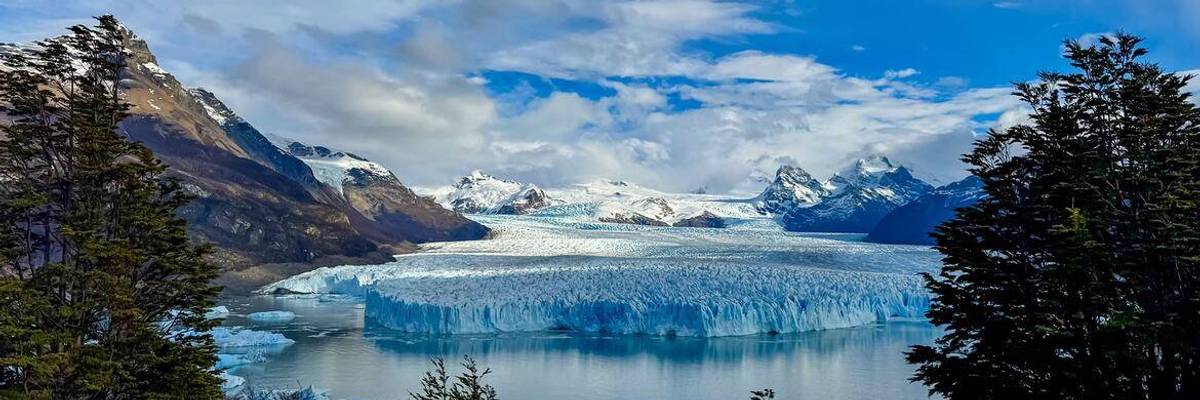
The Perito Moreno Glacier is located in El Calafate, Argentina.
"The buffers that have historically protected water security—snow, ice, groundwater—are eroding in many regions on a timescale of years, not overnight," the agency leader said, stressing "a sense of urgency, not panic."
The world's water cycle "has become more erratic and unpredictable," and recent trends have "serious implications for people and economies in the future," the United Nations' weather agency said Thursday, announcing the release of its annual report on one of the planet's most important natural resources.
Speaking at the launch of the "State of Global Water Resources 2025," World Meteorological Organization (WMO) Secretary-General Celeste Saulo explained that "some parts of this cycle—such as precipitation, river flow, soil moisture—are fast. They respond to weather within hours, days, weeks. Others, like groundwater and glaciers, are slow. They accumulate or decline over seasons to decades or longer."
"Traditionally, these slow reserves have acted as the planet's savings account: a buffer that absorbs bad years so that a single drought or a single dry season does not translate directly into a water crisis," she continued. "One of the central stories of the 2025 report is what is happening to that savings account. And the simple answer is that we are depleting it. We are spending our reserves."
According to the WMO's new report, terrestrial water storage—or the total stored in groundwater, lakes, rivers, soil moisture, vegetation, ice, and snow—has been falling since the mid-2010s. Saulo stressed that "this is not a single bad year, but it is a persistent, decadelong signal."
The agency also found that 2025 was among the driest years for river discharge worldwide in more than three decades, with below-normal flows over a third of the global basin area—and for the seventh straight year in a row, the number of river basins with "normal" conditions was in the minority.
Last year was also the fourth straight to feature widespread glacier loss across all regions. The WMO noted that the losses from 2023-25 could fill about 560 million Olympic-sized swimming pools—or about a third of annual freshwater withdrawals.
The report also "shows that water-related extreme events continue to devastate communities and economies," Saulo noted, highlighting the Early Warnings for All Initiative. "Over the past five years, Asia and Africa have accounted for at least half of all reported hydrological extreme events and more than 80% of associated deaths. And precisely these regions often lack the observations necessary for forecasts and early warnings."
Her comments came a day after the death toll from the flooding disaster in Tibet and Nepal topped 1,400. Experts have emphasized that tragedy's connection to the fossil fuel-driven climate crisis, with University of Pennsylvania professor Michael Mann writing that the "glacial collapse and deluge... was not a freak weather event; it was the structural failure of a mountain itself, nature's latest commentary on the deadly consequences of human-caused planetary warming."
That warming has also intensified the naturally occurring warm phase of a key pattern in the Pacific Ocean called El Niño, according to a study published last month. The WMO chief warned in her Wednesday remarks that "the strengthening El Niño will increase the extremes—drought in some countries and floods in others."
The agency's latest forecast, also released Wednesday, anticipates an "exceptionally high likelihood of nearly 100%" that the warm phase will persist through to February 2027. UN Secretary-General António Guterres said that "El Niño is being supersized before our eyes. The science leaves no room for doubt: The planet is in uncharted waters, and those waters are heating up."
Only when the last glacier has melted and the last reservoir has dried up will you realize that you can't drink gasoline…#climatecrisis#climatecollapse
[image or embed]
— Jürgen Döschner (@jdoeschner.bsky.social) September 17, 2026 at 4:01 PM
While the related releases generated calls for action, Saulo said that "it is not all bad news. Some regions showed improvement in 2025," pointing out that "parts of South America saw a partial recovery in water storage during 2025 after a severe multiyear deficit," while "Central and Southern Africa maintained much-above-normal water levels across several major lakes."
Still, action is needed. As Saulo put it: "The State of Global Water Resources report calls for a sense of urgency, not panic. The buffers that have historically protected water security—snow, ice, groundwater—are eroding in many regions on a timescale of years, not overnight. We have a genuine window for action: expanding early warning coverage; investing in the hydrological monitoring infrastructure; and opting for water management policies to address both water supply and use/overuse."
"My concluding message is that this report exists because members share their data and their science," she said. "This level of understanding—global, standardized, comparable year to year—did not exist a decade ago. It is the product of sustained international cooperation under WMO's mandate. And my last call is for all of you to continue to invest in it."
Dear Common Dreams reader, It’s been nearly 30 years since I co-founded Common Dreams with my late wife, Lina Newhouser. We had the radical notion that journalism should serve the public good, not corporate profits. It was clear to us from the outset what it would take to build such a project. No paid advertisements. No corporate sponsors. No millionaire publisher telling us what to think or do. Many people said we wouldn't last a year, but we proved those doubters wrong. Together with a tremendous team of journalists and dedicated staff, we built an independent media outlet free from the constraints of profits and corporate control. Our mission has always been simple: To inform. To inspire. To ignite change for the common good. Building Common Dreams was not easy. Our survival was never guaranteed. When you take on the most powerful forces—Wall Street greed, fossil fuel industry destruction, Big Tech lobbyists, and uber-rich oligarchs who have spent billions upon billions rigging the economy and democracy in their favor—the only bulwark you have is supporters who believe in your work. But here’s the urgent message from me today. It's never been this bad out there. And it's never been this hard to keep us going. At the very moment Common Dreams is most needed, the threats we face are intensifying. We need your support now more than ever. We don't accept corporate advertising and never will. We don't have a paywall because we don't think people should be blocked from critical news based on their ability to pay. Everything we do is funded by the donations of readers like you. When everyone does the little they can afford, we are strong. But if that support retreats or dries up, so do we. Will you donate now to make sure Common Dreams not only survives but thrives? —Craig Brown, Co-founder |
The world's water cycle "has become more erratic and unpredictable," and recent trends have "serious implications for people and economies in the future," the United Nations' weather agency said Thursday, announcing the release of its annual report on one of the planet's most important natural resources.
Speaking at the launch of the "State of Global Water Resources 2025," World Meteorological Organization (WMO) Secretary-General Celeste Saulo explained that "some parts of this cycle—such as precipitation, river flow, soil moisture—are fast. They respond to weather within hours, days, weeks. Others, like groundwater and glaciers, are slow. They accumulate or decline over seasons to decades or longer."
"Traditionally, these slow reserves have acted as the planet's savings account: a buffer that absorbs bad years so that a single drought or a single dry season does not translate directly into a water crisis," she continued. "One of the central stories of the 2025 report is what is happening to that savings account. And the simple answer is that we are depleting it. We are spending our reserves."
According to the WMO's new report, terrestrial water storage—or the total stored in groundwater, lakes, rivers, soil moisture, vegetation, ice, and snow—has been falling since the mid-2010s. Saulo stressed that "this is not a single bad year, but it is a persistent, decadelong signal."
The agency also found that 2025 was among the driest years for river discharge worldwide in more than three decades, with below-normal flows over a third of the global basin area—and for the seventh straight year in a row, the number of river basins with "normal" conditions was in the minority.
Last year was also the fourth straight to feature widespread glacier loss across all regions. The WMO noted that the losses from 2023-25 could fill about 560 million Olympic-sized swimming pools—or about a third of annual freshwater withdrawals.
The report also "shows that water-related extreme events continue to devastate communities and economies," Saulo noted, highlighting the Early Warnings for All Initiative. "Over the past five years, Asia and Africa have accounted for at least half of all reported hydrological extreme events and more than 80% of associated deaths. And precisely these regions often lack the observations necessary for forecasts and early warnings."
Her comments came a day after the death toll from the flooding disaster in Tibet and Nepal topped 1,400. Experts have emphasized that tragedy's connection to the fossil fuel-driven climate crisis, with University of Pennsylvania professor Michael Mann writing that the "glacial collapse and deluge... was not a freak weather event; it was the structural failure of a mountain itself, nature's latest commentary on the deadly consequences of human-caused planetary warming."
That warming has also intensified the naturally occurring warm phase of a key pattern in the Pacific Ocean called El Niño, according to a study published last month. The WMO chief warned in her Wednesday remarks that "the strengthening El Niño will increase the extremes—drought in some countries and floods in others."
The agency's latest forecast, also released Wednesday, anticipates an "exceptionally high likelihood of nearly 100%" that the warm phase will persist through to February 2027. UN Secretary-General António Guterres said that "El Niño is being supersized before our eyes. The science leaves no room for doubt: The planet is in uncharted waters, and those waters are heating up."
Only when the last glacier has melted and the last reservoir has dried up will you realize that you can't drink gasoline…#climatecrisis#climatecollapse
[image or embed]
— Jürgen Döschner (@jdoeschner.bsky.social) September 17, 2026 at 4:01 PM
While the related releases generated calls for action, Saulo said that "it is not all bad news. Some regions showed improvement in 2025," pointing out that "parts of South America saw a partial recovery in water storage during 2025 after a severe multiyear deficit," while "Central and Southern Africa maintained much-above-normal water levels across several major lakes."
Still, action is needed. As Saulo put it: "The State of Global Water Resources report calls for a sense of urgency, not panic. The buffers that have historically protected water security—snow, ice, groundwater—are eroding in many regions on a timescale of years, not overnight. We have a genuine window for action: expanding early warning coverage; investing in the hydrological monitoring infrastructure; and opting for water management policies to address both water supply and use/overuse."
"My concluding message is that this report exists because members share their data and their science," she said. "This level of understanding—global, standardized, comparable year to year—did not exist a decade ago. It is the product of sustained international cooperation under WMO's mandate. And my last call is for all of you to continue to invest in it."
The world's water cycle "has become more erratic and unpredictable," and recent trends have "serious implications for people and economies in the future," the United Nations' weather agency said Thursday, announcing the release of its annual report on one of the planet's most important natural resources.
Speaking at the launch of the "State of Global Water Resources 2025," World Meteorological Organization (WMO) Secretary-General Celeste Saulo explained that "some parts of this cycle—such as precipitation, river flow, soil moisture—are fast. They respond to weather within hours, days, weeks. Others, like groundwater and glaciers, are slow. They accumulate or decline over seasons to decades or longer."
"Traditionally, these slow reserves have acted as the planet's savings account: a buffer that absorbs bad years so that a single drought or a single dry season does not translate directly into a water crisis," she continued. "One of the central stories of the 2025 report is what is happening to that savings account. And the simple answer is that we are depleting it. We are spending our reserves."
According to the WMO's new report, terrestrial water storage—or the total stored in groundwater, lakes, rivers, soil moisture, vegetation, ice, and snow—has been falling since the mid-2010s. Saulo stressed that "this is not a single bad year, but it is a persistent, decadelong signal."
The agency also found that 2025 was among the driest years for river discharge worldwide in more than three decades, with below-normal flows over a third of the global basin area—and for the seventh straight year in a row, the number of river basins with "normal" conditions was in the minority.
Last year was also the fourth straight to feature widespread glacier loss across all regions. The WMO noted that the losses from 2023-25 could fill about 560 million Olympic-sized swimming pools—or about a third of annual freshwater withdrawals.
The report also "shows that water-related extreme events continue to devastate communities and economies," Saulo noted, highlighting the Early Warnings for All Initiative. "Over the past five years, Asia and Africa have accounted for at least half of all reported hydrological extreme events and more than 80% of associated deaths. And precisely these regions often lack the observations necessary for forecasts and early warnings."
Her comments came a day after the death toll from the flooding disaster in Tibet and Nepal topped 1,400. Experts have emphasized that tragedy's connection to the fossil fuel-driven climate crisis, with University of Pennsylvania professor Michael Mann writing that the "glacial collapse and deluge... was not a freak weather event; it was the structural failure of a mountain itself, nature's latest commentary on the deadly consequences of human-caused planetary warming."
That warming has also intensified the naturally occurring warm phase of a key pattern in the Pacific Ocean called El Niño, according to a study published last month. The WMO chief warned in her Wednesday remarks that "the strengthening El Niño will increase the extremes—drought in some countries and floods in others."
The agency's latest forecast, also released Wednesday, anticipates an "exceptionally high likelihood of nearly 100%" that the warm phase will persist through to February 2027. UN Secretary-General António Guterres said that "El Niño is being supersized before our eyes. The science leaves no room for doubt: The planet is in uncharted waters, and those waters are heating up."
Only when the last glacier has melted and the last reservoir has dried up will you realize that you can't drink gasoline…#climatecrisis#climatecollapse
[image or embed]
— Jürgen Döschner (@jdoeschner.bsky.social) September 17, 2026 at 4:01 PM
While the related releases generated calls for action, Saulo said that "it is not all bad news. Some regions showed improvement in 2025," pointing out that "parts of South America saw a partial recovery in water storage during 2025 after a severe multiyear deficit," while "Central and Southern Africa maintained much-above-normal water levels across several major lakes."
Still, action is needed. As Saulo put it: "The State of Global Water Resources report calls for a sense of urgency, not panic. The buffers that have historically protected water security—snow, ice, groundwater—are eroding in many regions on a timescale of years, not overnight. We have a genuine window for action: expanding early warning coverage; investing in the hydrological monitoring infrastructure; and opting for water management policies to address both water supply and use/overuse."
"My concluding message is that this report exists because members share their data and their science," she said. "This level of understanding—global, standardized, comparable year to year—did not exist a decade ago. It is the product of sustained international cooperation under WMO's mandate. And my last call is for all of you to continue to invest in it."