SUBSCRIBE TO OUR FREE NEWSLETTER
Daily news & progressive opinion—funded by the people, not the corporations—delivered straight to your inbox.
5
#000000
#FFFFFF
To donate by check, phone, or other method, see our More Ways to Give page.
Daily news & progressive opinion—funded by the people, not the corporations—delivered straight to your inbox.
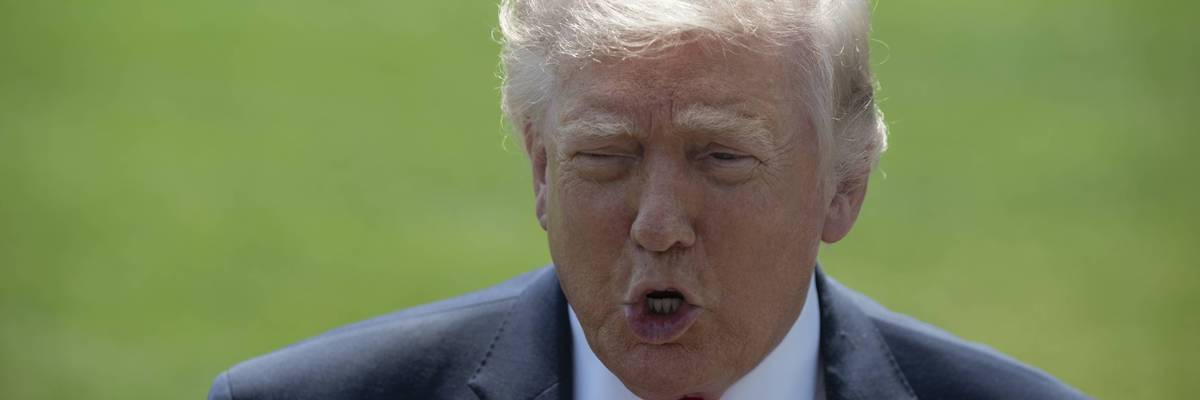
United States President Donald Trump speaks to the press on April 16, 2026, in Washington DC.
"The hypocrisy is the point," said Rep. Ayanna Pressley.
President Donald Trump has pushed to strip millions of Americans of the right to vote by mail. But he doesn't seem to think these restrictions should apply to him.
The White House confirmed to The New York Times that the president voted by mail ahead of Florida's Republican primary on Tuesday, marking at least the third time he has done so since becoming president. He also voted by mail in a state legislative special election earlier this year and in the 2020 Republican primary.
Though Trump has repeatedly characterized mail-in voting itself as a form of "cheating" and pushed to abolish it for most Americans under his proposed SAVE America Act, White House spokesperson Olivia Wales said it was a "non-story" that he chose to participate in the practice himself.
"The SAVE America Act has commonsense exceptions for Americans to use mail-in ballots for illness, disability, military, or travel— but universal mail-in voting should not be allowed because it’s highly susceptible to fraud," she said. "As everyone knows, the president is a resident of Palm Beach and participates in Florida elections, but he obviously primarily lives at the White House in Washington, DC."
Florida notably does not distinguish between absentee and other forms of mail-in voting, allowing residents to cast votes without an excuse—so the system Trump used to vote by mail is the same one he wants to make illegal.
Failing to pass his SAVE America Act through Congress, Trump has attempted to restrict mail-in voting via executive order.
An order he signed in March required states to hand over lists of eligible voters to the federal government and said that the US Postal Service could block residents of states from voting by mail if they refused to comply. The order also directed the Department of Homeland Security (DHS) to create state "citizenship lists" to be sent to election officials.
This order has been blocked in federal court, and Trump has pushed for the Supreme Court to allow it to go into effect before the November 3 midterm election. Voting rights advocates have warned that if the order goes into effect, many eligible voters will be wrongly excluded because their names don't appear on DHS's federal lists.
There is scarce evidence that any form of mail-in balloting is susceptible to fraud anywhere near the levels that would be necessary to swing the result of an election.
An analysis by the Brookings Institution last year, which examined data from the right-wing Heritage Foundation's election fraud database, found that for every 10 million mail ballots cast, about four ballots were associated with voting fraud, though the database is not exhaustive.
It's not clear why voting by mail for convenience would be any more "susceptible to fraud" than doing so for illness, disability, military, or travel, as the White House claims.
In fact, the Brookings study found that states with universal no-excuse mail-in voting have the lowest rates of mail-in fraud, and some states, like Washington, have seen reductions in fraud after transitioning to universal mail-in voting.
Advocates for universal mail-in balloting have emphasized that it makes voting easier and more accessible than when it's restricted to election days at physical polling places. They also say restricting it is especially harmful to voters from racial minority groups who face greater barriers to in-person voting and are more likely to have absentee ballot applications rejected.
Rep. Ayanna Pressley (D-Mass.) rejected the idea that the right of other Americans to vote by mail was any less legitimate than Trump's right to do so.
"Trump just voted by mail AGAIN while trying to take away the right for millions of people to do the same," Pressley wrote in a social media post. "The hypocrisy is the point. We won't let Republicans attack the sacred right to vote, including by mail."
Dear Common Dreams reader, It’s been nearly 30 years since I co-founded Common Dreams with my late wife, Lina Newhouser. We had the radical notion that journalism should serve the public good, not corporate profits. It was clear to us from the outset what it would take to build such a project. No paid advertisements. No corporate sponsors. No millionaire publisher telling us what to think or do. Many people said we wouldn't last a year, but we proved those doubters wrong. Together with a tremendous team of journalists and dedicated staff, we built an independent media outlet free from the constraints of profits and corporate control. Our mission has always been simple: To inform. To inspire. To ignite change for the common good. Building Common Dreams was not easy. Our survival was never guaranteed. When you take on the most powerful forces—Wall Street greed, fossil fuel industry destruction, Big Tech lobbyists, and uber-rich oligarchs who have spent billions upon billions rigging the economy and democracy in their favor—the only bulwark you have is supporters who believe in your work. But here’s the urgent message from me today. It's never been this bad out there. And it's never been this hard to keep us going. At the very moment Common Dreams is most needed, the threats we face are intensifying. We need your support now more than ever. We don't accept corporate advertising and never will. We don't have a paywall because we don't think people should be blocked from critical news based on their ability to pay. Everything we do is funded by the donations of readers like you. When everyone does the little they can afford, we are strong. But if that support retreats or dries up, so do we. Will you donate now to make sure Common Dreams not only survives but thrives? —Craig Brown, Co-founder |
President Donald Trump has pushed to strip millions of Americans of the right to vote by mail. But he doesn't seem to think these restrictions should apply to him.
The White House confirmed to The New York Times that the president voted by mail ahead of Florida's Republican primary on Tuesday, marking at least the third time he has done so since becoming president. He also voted by mail in a state legislative special election earlier this year and in the 2020 Republican primary.
Though Trump has repeatedly characterized mail-in voting itself as a form of "cheating" and pushed to abolish it for most Americans under his proposed SAVE America Act, White House spokesperson Olivia Wales said it was a "non-story" that he chose to participate in the practice himself.
"The SAVE America Act has commonsense exceptions for Americans to use mail-in ballots for illness, disability, military, or travel— but universal mail-in voting should not be allowed because it’s highly susceptible to fraud," she said. "As everyone knows, the president is a resident of Palm Beach and participates in Florida elections, but he obviously primarily lives at the White House in Washington, DC."
Florida notably does not distinguish between absentee and other forms of mail-in voting, allowing residents to cast votes without an excuse—so the system Trump used to vote by mail is the same one he wants to make illegal.
Failing to pass his SAVE America Act through Congress, Trump has attempted to restrict mail-in voting via executive order.
An order he signed in March required states to hand over lists of eligible voters to the federal government and said that the US Postal Service could block residents of states from voting by mail if they refused to comply. The order also directed the Department of Homeland Security (DHS) to create state "citizenship lists" to be sent to election officials.
This order has been blocked in federal court, and Trump has pushed for the Supreme Court to allow it to go into effect before the November 3 midterm election. Voting rights advocates have warned that if the order goes into effect, many eligible voters will be wrongly excluded because their names don't appear on DHS's federal lists.
There is scarce evidence that any form of mail-in balloting is susceptible to fraud anywhere near the levels that would be necessary to swing the result of an election.
An analysis by the Brookings Institution last year, which examined data from the right-wing Heritage Foundation's election fraud database, found that for every 10 million mail ballots cast, about four ballots were associated with voting fraud, though the database is not exhaustive.
It's not clear why voting by mail for convenience would be any more "susceptible to fraud" than doing so for illness, disability, military, or travel, as the White House claims.
In fact, the Brookings study found that states with universal no-excuse mail-in voting have the lowest rates of mail-in fraud, and some states, like Washington, have seen reductions in fraud after transitioning to universal mail-in voting.
Advocates for universal mail-in balloting have emphasized that it makes voting easier and more accessible than when it's restricted to election days at physical polling places. They also say restricting it is especially harmful to voters from racial minority groups who face greater barriers to in-person voting and are more likely to have absentee ballot applications rejected.
Rep. Ayanna Pressley (D-Mass.) rejected the idea that the right of other Americans to vote by mail was any less legitimate than Trump's right to do so.
"Trump just voted by mail AGAIN while trying to take away the right for millions of people to do the same," Pressley wrote in a social media post. "The hypocrisy is the point. We won't let Republicans attack the sacred right to vote, including by mail."
President Donald Trump has pushed to strip millions of Americans of the right to vote by mail. But he doesn't seem to think these restrictions should apply to him.
The White House confirmed to The New York Times that the president voted by mail ahead of Florida's Republican primary on Tuesday, marking at least the third time he has done so since becoming president. He also voted by mail in a state legislative special election earlier this year and in the 2020 Republican primary.
Though Trump has repeatedly characterized mail-in voting itself as a form of "cheating" and pushed to abolish it for most Americans under his proposed SAVE America Act, White House spokesperson Olivia Wales said it was a "non-story" that he chose to participate in the practice himself.
"The SAVE America Act has commonsense exceptions for Americans to use mail-in ballots for illness, disability, military, or travel— but universal mail-in voting should not be allowed because it’s highly susceptible to fraud," she said. "As everyone knows, the president is a resident of Palm Beach and participates in Florida elections, but he obviously primarily lives at the White House in Washington, DC."
Florida notably does not distinguish between absentee and other forms of mail-in voting, allowing residents to cast votes without an excuse—so the system Trump used to vote by mail is the same one he wants to make illegal.
Failing to pass his SAVE America Act through Congress, Trump has attempted to restrict mail-in voting via executive order.
An order he signed in March required states to hand over lists of eligible voters to the federal government and said that the US Postal Service could block residents of states from voting by mail if they refused to comply. The order also directed the Department of Homeland Security (DHS) to create state "citizenship lists" to be sent to election officials.
This order has been blocked in federal court, and Trump has pushed for the Supreme Court to allow it to go into effect before the November 3 midterm election. Voting rights advocates have warned that if the order goes into effect, many eligible voters will be wrongly excluded because their names don't appear on DHS's federal lists.
There is scarce evidence that any form of mail-in balloting is susceptible to fraud anywhere near the levels that would be necessary to swing the result of an election.
An analysis by the Brookings Institution last year, which examined data from the right-wing Heritage Foundation's election fraud database, found that for every 10 million mail ballots cast, about four ballots were associated with voting fraud, though the database is not exhaustive.
It's not clear why voting by mail for convenience would be any more "susceptible to fraud" than doing so for illness, disability, military, or travel, as the White House claims.
In fact, the Brookings study found that states with universal no-excuse mail-in voting have the lowest rates of mail-in fraud, and some states, like Washington, have seen reductions in fraud after transitioning to universal mail-in voting.
Advocates for universal mail-in balloting have emphasized that it makes voting easier and more accessible than when it's restricted to election days at physical polling places. They also say restricting it is especially harmful to voters from racial minority groups who face greater barriers to in-person voting and are more likely to have absentee ballot applications rejected.
Rep. Ayanna Pressley (D-Mass.) rejected the idea that the right of other Americans to vote by mail was any less legitimate than Trump's right to do so.
"Trump just voted by mail AGAIN while trying to take away the right for millions of people to do the same," Pressley wrote in a social media post. "The hypocrisy is the point. We won't let Republicans attack the sacred right to vote, including by mail."