SUBSCRIBE TO OUR FREE NEWSLETTER
Daily news & progressive opinion—funded by the people, not the corporations—delivered straight to your inbox.
5
#000000
#FFFFFF
To donate by check, phone, or other method, see our More Ways to Give page.
Daily news & progressive opinion—funded by the people, not the corporations—delivered straight to your inbox.
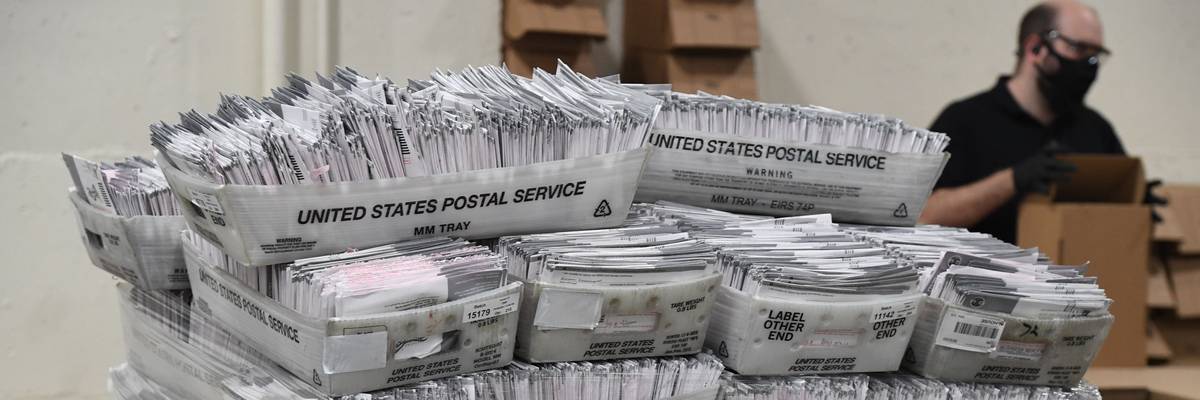
Mail-in ballots in their envelopes await processing at the Los Angeles County Registrar-Recorders' processing center in Pomona, California, October 28, 2020.
“USPS’ plan was unwise, unlawful, and a threat to the millions of voters who rely on mailed ballots to participate in our democracy," said one case litigant.
In a ruling hailed by democracy defenders, a federal court on Wednesday halted the US Postal Service's implementation of President Donald Trump's March executive order targeting mail-in ballots as part of his administration's broader attack on voting rights.
Judge Emmet Sullivan of the US District Court for the District of Columbia granted a request by the NAACP to enforce a 2021 settlement agreement requiring the USPS to protect mail-in voting and prioritize delivery of mail related to elections through 2028.
The request followed the Postal Service's publication last month of a proposed rule that would block the delivery of mail-in ballots to voters in states where election officials refused to provide certain information to USPS or use a specific envelope design. That proposal came after Trump's March executive order directing federal agencies to create a nationwide list of eligible voters using federal data.
The directive also requires the Postal Service to verify that mail-in ballots are sent and returned only by eligible voters, preserve election-related records for a longer period, and exercise heightened oversight of mailed ballots.
The Public Citizen Litigation Group and Legal Defense Fund (LDF) filed a motion on behalf of the NAACP asserting that the proposed rule "manifests USPS’ intent not to deliver certain mail-in ballots, establishing a process that directly violates its obligations under the agreement."
“The court today correctly recognized that USPS’ plan to create roadblocks to mail-in voting was inconsistent with its commitment to timely deliver election mail,” Public Citizen Litigation Group director Allison Zieve said in a statement following Sullivan's ruling. “USPS’ plan was unwise, unlawful, and a threat to the millions of voters who rely on mailed ballots to participate in our democracy.”
🚨BREAKING: In the latest blow to President Donald Trump’s anti-voting agenda, a federal court on Wednesday granted the NAACP’s request to halt the U.S. Postal Service’s (USPS) implementation of his executive order against mail voting. www.democracydocket.com/news-alerts/...
[image or embed]
— Marc Elias (@marcelias.bsky.social) July 1, 2026 at 1:41 PM
LDF associate director-counsel Sam Spital said, “Today’s decision recognizes that USPS cannot disregard its legal obligation to timely deliver mail-in ballots to all voters."
"We are glad that the court blocked a blatant attempt to renege on this commitment through a proposed rule that ran the risk of undermining the fairness of our national elections, creating particular dangers for Black voters," Spital continued. "LDF will continue to defend our democracy and combat unlawful restrictions of the right to vote.”
Anthony P. Ashton, senior associate general counsel at the NAACP, called the decision "a critical step in protecting the rights of voters who rely on the timely delivery of mail-in ballots to participate in our democracy."
Ashton continued:
The proposed USPS changes would have created unnecessary and unlawful barriers, in direct violation of the USPS’ mandate to prioritize election mail. Those barriers could have disproportionately harmed Black voters, who are more likely to rely on mail voting due to long-standing inequities in access. Put simply, the use of mail-in voting helps reduce voter intimidation at the polls and election day dirty tricks. This decision makes clear that access to the ballot cannot be tied to arbitrary requirements. The NAACP will continue to hold this government accountable when it attempts to undermine fair and equal access to the electoral process.
Wednesday's order—from a judge who's been appointed to various positions by Republican and Democratic presidents throughout his career—is the latest in a string of federal court rulings against Trump's attacks on voting rights, crowned by Monday's Watson v. Republican National Committee US Supreme Court decision, in which the justices affirmed that states may count ballots received after Election Day if they were postmarked in time.
Last week, a federal judge in Massachusetts sided with Democratic state attorneys who challenged Trump's March 2025 executive order that requires Americans to show proof of citizenship when registering to vote, while another judge in the same district blocked parts of the president's March 2026 order, which included the USPS directive.
Dear Common Dreams reader, It’s been nearly 30 years since I co-founded Common Dreams with my late wife, Lina Newhouser. We had the radical notion that journalism should serve the public good, not corporate profits. It was clear to us from the outset what it would take to build such a project. No paid advertisements. No corporate sponsors. No millionaire publisher telling us what to think or do. Many people said we wouldn't last a year, but we proved those doubters wrong. Together with a tremendous team of journalists and dedicated staff, we built an independent media outlet free from the constraints of profits and corporate control. Our mission has always been simple: To inform. To inspire. To ignite change for the common good. Building Common Dreams was not easy. Our survival was never guaranteed. When you take on the most powerful forces—Wall Street greed, fossil fuel industry destruction, Big Tech lobbyists, and uber-rich oligarchs who have spent billions upon billions rigging the economy and democracy in their favor—the only bulwark you have is supporters who believe in your work. But here’s the urgent message from me today. It's never been this bad out there. And it's never been this hard to keep us going. At the very moment Common Dreams is most needed, the threats we face are intensifying. We need your support now more than ever. We don't accept corporate advertising and never will. We don't have a paywall because we don't think people should be blocked from critical news based on their ability to pay. Everything we do is funded by the donations of readers like you. When everyone does the little they can afford, we are strong. But if that support retreats or dries up, so do we. Will you donate now to make sure Common Dreams not only survives but thrives? —Craig Brown, Co-founder |
In a ruling hailed by democracy defenders, a federal court on Wednesday halted the US Postal Service's implementation of President Donald Trump's March executive order targeting mail-in ballots as part of his administration's broader attack on voting rights.
Judge Emmet Sullivan of the US District Court for the District of Columbia granted a request by the NAACP to enforce a 2021 settlement agreement requiring the USPS to protect mail-in voting and prioritize delivery of mail related to elections through 2028.
The request followed the Postal Service's publication last month of a proposed rule that would block the delivery of mail-in ballots to voters in states where election officials refused to provide certain information to USPS or use a specific envelope design. That proposal came after Trump's March executive order directing federal agencies to create a nationwide list of eligible voters using federal data.
The directive also requires the Postal Service to verify that mail-in ballots are sent and returned only by eligible voters, preserve election-related records for a longer period, and exercise heightened oversight of mailed ballots.
The Public Citizen Litigation Group and Legal Defense Fund (LDF) filed a motion on behalf of the NAACP asserting that the proposed rule "manifests USPS’ intent not to deliver certain mail-in ballots, establishing a process that directly violates its obligations under the agreement."
“The court today correctly recognized that USPS’ plan to create roadblocks to mail-in voting was inconsistent with its commitment to timely deliver election mail,” Public Citizen Litigation Group director Allison Zieve said in a statement following Sullivan's ruling. “USPS’ plan was unwise, unlawful, and a threat to the millions of voters who rely on mailed ballots to participate in our democracy.”
🚨BREAKING: In the latest blow to President Donald Trump’s anti-voting agenda, a federal court on Wednesday granted the NAACP’s request to halt the U.S. Postal Service’s (USPS) implementation of his executive order against mail voting. www.democracydocket.com/news-alerts/...
[image or embed]
— Marc Elias (@marcelias.bsky.social) July 1, 2026 at 1:41 PM
LDF associate director-counsel Sam Spital said, “Today’s decision recognizes that USPS cannot disregard its legal obligation to timely deliver mail-in ballots to all voters."
"We are glad that the court blocked a blatant attempt to renege on this commitment through a proposed rule that ran the risk of undermining the fairness of our national elections, creating particular dangers for Black voters," Spital continued. "LDF will continue to defend our democracy and combat unlawful restrictions of the right to vote.”
Anthony P. Ashton, senior associate general counsel at the NAACP, called the decision "a critical step in protecting the rights of voters who rely on the timely delivery of mail-in ballots to participate in our democracy."
Ashton continued:
The proposed USPS changes would have created unnecessary and unlawful barriers, in direct violation of the USPS’ mandate to prioritize election mail. Those barriers could have disproportionately harmed Black voters, who are more likely to rely on mail voting due to long-standing inequities in access. Put simply, the use of mail-in voting helps reduce voter intimidation at the polls and election day dirty tricks. This decision makes clear that access to the ballot cannot be tied to arbitrary requirements. The NAACP will continue to hold this government accountable when it attempts to undermine fair and equal access to the electoral process.
Wednesday's order—from a judge who's been appointed to various positions by Republican and Democratic presidents throughout his career—is the latest in a string of federal court rulings against Trump's attacks on voting rights, crowned by Monday's Watson v. Republican National Committee US Supreme Court decision, in which the justices affirmed that states may count ballots received after Election Day if they were postmarked in time.
Last week, a federal judge in Massachusetts sided with Democratic state attorneys who challenged Trump's March 2025 executive order that requires Americans to show proof of citizenship when registering to vote, while another judge in the same district blocked parts of the president's March 2026 order, which included the USPS directive.
In a ruling hailed by democracy defenders, a federal court on Wednesday halted the US Postal Service's implementation of President Donald Trump's March executive order targeting mail-in ballots as part of his administration's broader attack on voting rights.
Judge Emmet Sullivan of the US District Court for the District of Columbia granted a request by the NAACP to enforce a 2021 settlement agreement requiring the USPS to protect mail-in voting and prioritize delivery of mail related to elections through 2028.
The request followed the Postal Service's publication last month of a proposed rule that would block the delivery of mail-in ballots to voters in states where election officials refused to provide certain information to USPS or use a specific envelope design. That proposal came after Trump's March executive order directing federal agencies to create a nationwide list of eligible voters using federal data.
The directive also requires the Postal Service to verify that mail-in ballots are sent and returned only by eligible voters, preserve election-related records for a longer period, and exercise heightened oversight of mailed ballots.
The Public Citizen Litigation Group and Legal Defense Fund (LDF) filed a motion on behalf of the NAACP asserting that the proposed rule "manifests USPS’ intent not to deliver certain mail-in ballots, establishing a process that directly violates its obligations under the agreement."
“The court today correctly recognized that USPS’ plan to create roadblocks to mail-in voting was inconsistent with its commitment to timely deliver election mail,” Public Citizen Litigation Group director Allison Zieve said in a statement following Sullivan's ruling. “USPS’ plan was unwise, unlawful, and a threat to the millions of voters who rely on mailed ballots to participate in our democracy.”
🚨BREAKING: In the latest blow to President Donald Trump’s anti-voting agenda, a federal court on Wednesday granted the NAACP’s request to halt the U.S. Postal Service’s (USPS) implementation of his executive order against mail voting. www.democracydocket.com/news-alerts/...
[image or embed]
— Marc Elias (@marcelias.bsky.social) July 1, 2026 at 1:41 PM
LDF associate director-counsel Sam Spital said, “Today’s decision recognizes that USPS cannot disregard its legal obligation to timely deliver mail-in ballots to all voters."
"We are glad that the court blocked a blatant attempt to renege on this commitment through a proposed rule that ran the risk of undermining the fairness of our national elections, creating particular dangers for Black voters," Spital continued. "LDF will continue to defend our democracy and combat unlawful restrictions of the right to vote.”
Anthony P. Ashton, senior associate general counsel at the NAACP, called the decision "a critical step in protecting the rights of voters who rely on the timely delivery of mail-in ballots to participate in our democracy."
Ashton continued:
The proposed USPS changes would have created unnecessary and unlawful barriers, in direct violation of the USPS’ mandate to prioritize election mail. Those barriers could have disproportionately harmed Black voters, who are more likely to rely on mail voting due to long-standing inequities in access. Put simply, the use of mail-in voting helps reduce voter intimidation at the polls and election day dirty tricks. This decision makes clear that access to the ballot cannot be tied to arbitrary requirements. The NAACP will continue to hold this government accountable when it attempts to undermine fair and equal access to the electoral process.
Wednesday's order—from a judge who's been appointed to various positions by Republican and Democratic presidents throughout his career—is the latest in a string of federal court rulings against Trump's attacks on voting rights, crowned by Monday's Watson v. Republican National Committee US Supreme Court decision, in which the justices affirmed that states may count ballots received after Election Day if they were postmarked in time.
Last week, a federal judge in Massachusetts sided with Democratic state attorneys who challenged Trump's March 2025 executive order that requires Americans to show proof of citizenship when registering to vote, while another judge in the same district blocked parts of the president's March 2026 order, which included the USPS directive.