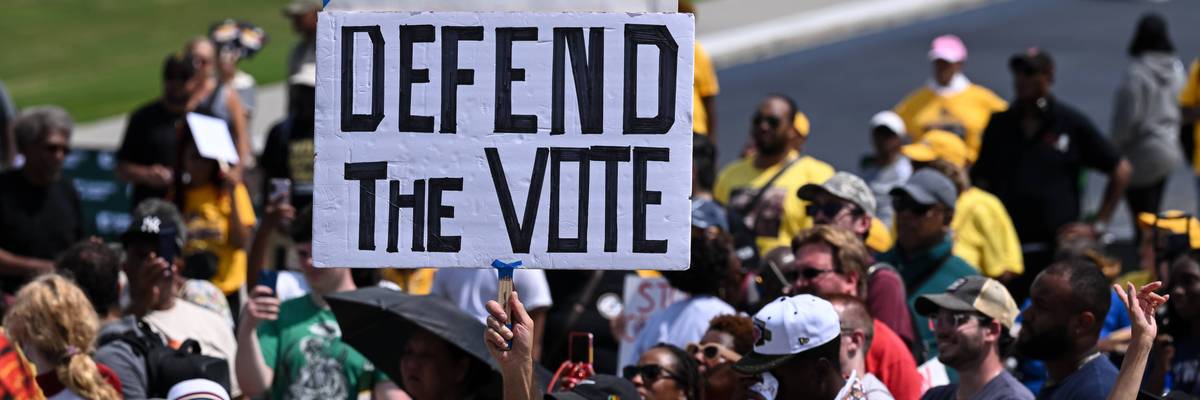
Demonstrators gather on the National Mall during a 'Defend the Vote' rally marking the 63rd anniversary of the 1963 March on Washington in Washington, DC, on August 28, 2026.
Appeals Court Rejects 'Likely Unlawful' Trump Push to Undermine Mail-In Voting as Supreme Court Looms
The First Circuit Court of Appeals found implementing Trump's order would cause "chaos and widespread disenfranchisement... between now and November 3."
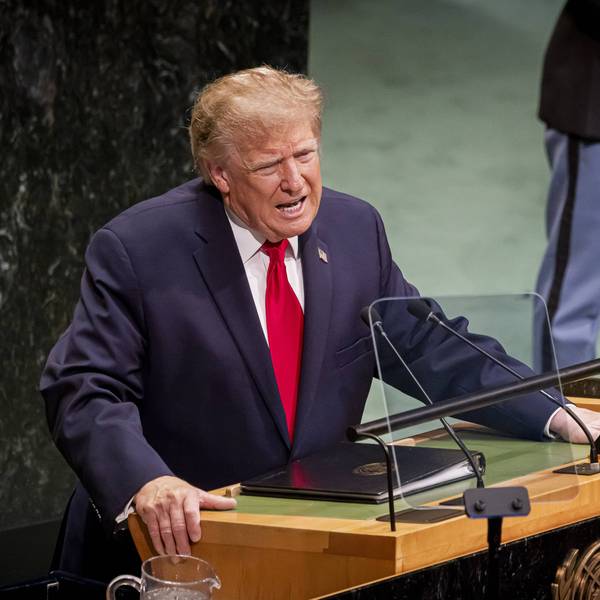
A federal court on Thursday rejected the Trump administration's request to reinstate an executive order that placed restrictions on mail-in voting ahead of the midterm elections, arguing that the order is "likely unlawful."
The US First Circuit Court of Appeals ruled that President Donald Trump's mail-in voting executive order likely violates the US Constitution's elections clause, which grants states the rights to oversee their own elections, subject to oversight from the US Congress.
The court also found that the regulations proposed by the order "could prevent millions of Americans from obtaining and returning their ballots" in the coming election.
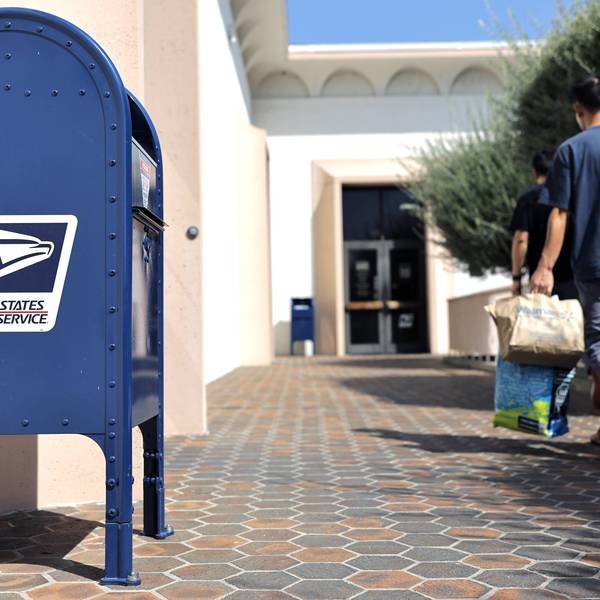
The ruling noted that the Trump executive order places a number of onerous restrictions on mail-in voting, such as requiring states to print "a voter-specific Intelligent Mail barcode ('IMb')" on all outgoing ballots as a precondition for their delivery by the United States Postal Service (USPS).
Additionally, the court wrote, the order would compel states "to obtain USPS approval for new ballot-envelope designs; to purchase new envelopes to replace those already ordered; to assure that there are technological systems in place adequate to generate IMbs; and to upload voter-specific information to a USPS online portal that is still not operational."
The court said these restrictions are so severe that they validate an earlier ruling from a federal district court, which found that implementing Trump's executive order would lead to "chaos and widespread disenfranchisement... between now and November 3."
Among other things, the court found these Trump-ordered rules would make it "impossible for some states to reprint compliant envelopes," while also creating a "herculean task" of "scanning tens of millions of ballot envelopes and reviewing for a match with information in the presently non-operative portal."
The court also took a shot at Trump administration lawyers, whom it alleged "have not even seriously challenged" the district court's finding about the chaos the president's executive order would cause.
The injunction against Trump's mail-in voting order came as a result of a complaint filed by a number of civil society groups, including the League of Women Voters and the Association of Americans Resident Overseas.
In a joint statement released after the ruling, the plaintiffs and their counsel said that the court affirmed that "the US Postal Service is not the gatekeeper for mail ballots."
"This decision rightly keeps in place an order blocking USPS from enforcing its disruptive and disenfranchising rule through the November election," they added, "and preserves the current system, which has worked safely, securely, and reliably for decades."
Democratic California Gov. Gavin Newsom took the opportunity to taunt the Trump administration for suffering yet another loss in its crusade to clamp down on mail-in voting.
"The rule of law continues to slap down Donald Trump's dangerous and un-American attacks on our free and fair elections," Newsom wrote. "California will never stop fighting for our democracy and the people's ability to exercise their constitutional right to vote."
The Trump administration has asked to the US Supreme Court to reinstate the president's voting order. With mail-in ballots for the upcoming midterms already being sent out in some states, a ruling from the nation's highest court is expected in the coming days.
We are at a crossroads
This country and this world are at a monumental crossroads. In a few short weeks, US voters will have an opportunity to beat back the forces of fascism and confront the billionaires who are rigging the economy, our media system, and our democracy, making it increasingly impossible for ordinary people to get by. We’re not just talking about the election. We’re talking about what must be done once these fascist elements are vanquished from power. We need a bolder set of solutions than what either major party has so far been willing to offer and a working-class movement ready to fight like hell for it. Trump didn't emerge from nowhere. The conditions that fueled MAGA authoritarianism were created by decades of radical neoliberal economic policies and a corrupt political system dominated by corporate interests. They slashed taxes on the super-rich, promising that the benefits would trickle down. They said giveaways to the corporate titans would make life more affordable for the rest of us. It was all bullshit. And when a bitter, betrayed populace searches for someone to blame, right-wing demagogues have little trouble finding scapegoats. People know when they're being lied to, but you won't hear any of this from the corporate media. Only independent journalism—powered and funded by people who believe in building a better world—can deliver truly trustworthy daily news. Our Fall Campaign is underway, and we need your help. To power our newsroom through the rest of the year, we need to raise $125,000 by midnight on October 31. So if you share our vision, please contribute whatever you can to sustain our work. |
A federal court on Thursday rejected the Trump administration's request to reinstate an executive order that placed restrictions on mail-in voting ahead of the midterm elections, arguing that the order is "likely unlawful."
The US First Circuit Court of Appeals ruled that President Donald Trump's mail-in voting executive order likely violates the US Constitution's elections clause, which grants states the rights to oversee their own elections, subject to oversight from the US Congress.
The court also found that the regulations proposed by the order "could prevent millions of Americans from obtaining and returning their ballots" in the coming election.
The ruling noted that the Trump executive order places a number of onerous restrictions on mail-in voting, such as requiring states to print "a voter-specific Intelligent Mail barcode ('IMb')" on all outgoing ballots as a precondition for their delivery by the United States Postal Service (USPS).
Additionally, the court wrote, the order would compel states "to obtain USPS approval for new ballot-envelope designs; to purchase new envelopes to replace those already ordered; to assure that there are technological systems in place adequate to generate IMbs; and to upload voter-specific information to a USPS online portal that is still not operational."
The court said these restrictions are so severe that they validate an earlier ruling from a federal district court, which found that implementing Trump's executive order would lead to "chaos and widespread disenfranchisement... between now and November 3."
Among other things, the court found these Trump-ordered rules would make it "impossible for some states to reprint compliant envelopes," while also creating a "herculean task" of "scanning tens of millions of ballot envelopes and reviewing for a match with information in the presently non-operative portal."
The court also took a shot at Trump administration lawyers, whom it alleged "have not even seriously challenged" the district court's finding about the chaos the president's executive order would cause.
The injunction against Trump's mail-in voting order came as a result of a complaint filed by a number of civil society groups, including the League of Women Voters and the Association of Americans Resident Overseas.
In a joint statement released after the ruling, the plaintiffs and their counsel said that the court affirmed that "the US Postal Service is not the gatekeeper for mail ballots."
"This decision rightly keeps in place an order blocking USPS from enforcing its disruptive and disenfranchising rule through the November election," they added, "and preserves the current system, which has worked safely, securely, and reliably for decades."
Democratic California Gov. Gavin Newsom took the opportunity to taunt the Trump administration for suffering yet another loss in its crusade to clamp down on mail-in voting.
"The rule of law continues to slap down Donald Trump's dangerous and un-American attacks on our free and fair elections," Newsom wrote. "California will never stop fighting for our democracy and the people's ability to exercise their constitutional right to vote."
The Trump administration has asked to the US Supreme Court to reinstate the president's voting order. With mail-in ballots for the upcoming midterms already being sent out in some states, a ruling from the nation's highest court is expected in the coming days.
- Trump's War on Mail-in Voting is Hitting a Brick Wall—But the Danger is Far From Over ›
- Young Voters Disrupt Meeting to Urge USPS Board of Governors to Reject Trump Attack on Voting ›
- In 'Win for Voters,' Another Federal Court Blocks Trump Attack on Mailed Ballots ›
- Opinion | The Supreme Court's Mail-In Voting Decision Could Determine the Future of US Democracy | Common Dreams ›
A federal court on Thursday rejected the Trump administration's request to reinstate an executive order that placed restrictions on mail-in voting ahead of the midterm elections, arguing that the order is "likely unlawful."
The US First Circuit Court of Appeals ruled that President Donald Trump's mail-in voting executive order likely violates the US Constitution's elections clause, which grants states the rights to oversee their own elections, subject to oversight from the US Congress.
The court also found that the regulations proposed by the order "could prevent millions of Americans from obtaining and returning their ballots" in the coming election.
The ruling noted that the Trump executive order places a number of onerous restrictions on mail-in voting, such as requiring states to print "a voter-specific Intelligent Mail barcode ('IMb')" on all outgoing ballots as a precondition for their delivery by the United States Postal Service (USPS).
Additionally, the court wrote, the order would compel states "to obtain USPS approval for new ballot-envelope designs; to purchase new envelopes to replace those already ordered; to assure that there are technological systems in place adequate to generate IMbs; and to upload voter-specific information to a USPS online portal that is still not operational."
The court said these restrictions are so severe that they validate an earlier ruling from a federal district court, which found that implementing Trump's executive order would lead to "chaos and widespread disenfranchisement... between now and November 3."
Among other things, the court found these Trump-ordered rules would make it "impossible for some states to reprint compliant envelopes," while also creating a "herculean task" of "scanning tens of millions of ballot envelopes and reviewing for a match with information in the presently non-operative portal."
The court also took a shot at Trump administration lawyers, whom it alleged "have not even seriously challenged" the district court's finding about the chaos the president's executive order would cause.
The injunction against Trump's mail-in voting order came as a result of a complaint filed by a number of civil society groups, including the League of Women Voters and the Association of Americans Resident Overseas.
In a joint statement released after the ruling, the plaintiffs and their counsel said that the court affirmed that "the US Postal Service is not the gatekeeper for mail ballots."
"This decision rightly keeps in place an order blocking USPS from enforcing its disruptive and disenfranchising rule through the November election," they added, "and preserves the current system, which has worked safely, securely, and reliably for decades."
Democratic California Gov. Gavin Newsom took the opportunity to taunt the Trump administration for suffering yet another loss in its crusade to clamp down on mail-in voting.
"The rule of law continues to slap down Donald Trump's dangerous and un-American attacks on our free and fair elections," Newsom wrote. "California will never stop fighting for our democracy and the people's ability to exercise their constitutional right to vote."
The Trump administration has asked to the US Supreme Court to reinstate the president's voting order. With mail-in ballots for the upcoming midterms already being sent out in some states, a ruling from the nation's highest court is expected in the coming days.
- Trump's War on Mail-in Voting is Hitting a Brick Wall—But the Danger is Far From Over ›
- Young Voters Disrupt Meeting to Urge USPS Board of Governors to Reject Trump Attack on Voting ›
- In 'Win for Voters,' Another Federal Court Blocks Trump Attack on Mailed Ballots ›
- Opinion | The Supreme Court's Mail-In Voting Decision Could Determine the Future of US Democracy | Common Dreams ›