SUBSCRIBE TO OUR FREE NEWSLETTER
Daily news & progressive opinion—funded by the people, not the corporations—delivered straight to your inbox.
5
#000000
#FFFFFF
To donate by check, phone, or other method, see our More Ways to Give page.
Daily news & progressive opinion—funded by the people, not the corporations—delivered straight to your inbox.
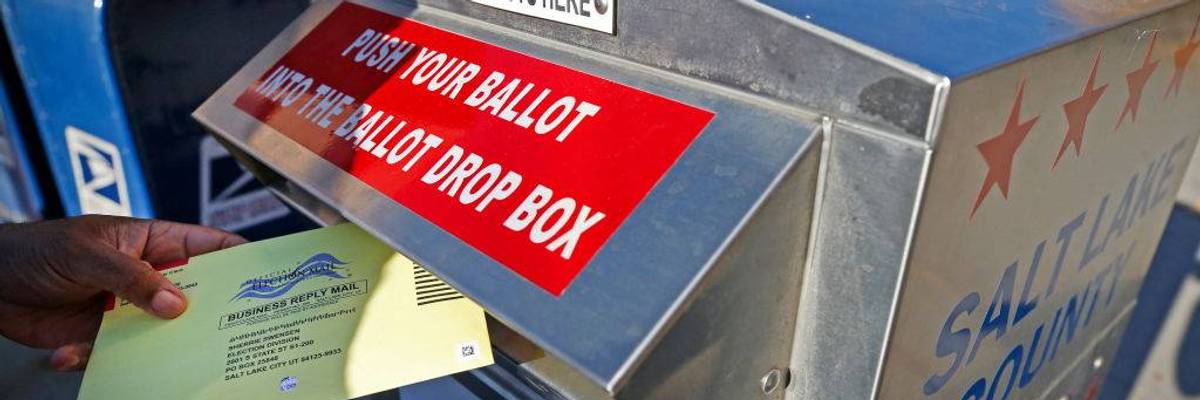
A voter drops off his mail in ballot at a dropbox at the Salt Lake County election office in Salt Lake City, Utah, on October 29, 2020.
"Our Constitution’s framers anticipated this kind of desire for absolute power."
President Donald Trump's executive order placing restrictions on mail-in voting in the US is now facing a sweeping lawsuit from the Democratic Party.
In a complaint filed Wednesday with the US District Court for the District of Columbia, the Democrats argued that Trump "has tried again and again to rewrite election rules for his own perceived partisan advantage," this time going after mail voting, which he has baselessly claimed cost him the 2020 presidential election.
The Democrats contended, however, that Trump has no constitutional authority to single-handedly rewrite election laws, noting that the US Constitution explicitly gave states the power to administer their own elections.
"Our Constitution’s framers anticipated this kind of desire for absolute power," the complaint states. "They recognized the menace it would pose to ordered liberty and the ways in which it would corrode self-government like an acid... They left most election authority with the states, permitted state regulations to be displaced only upon the agreement of both chambers of Congress, and established an independent judiciary to repel threats to individual rights."
The complaint then dives into the contents of Trump's order, which it says "seeks to impose radical changes to the manner and conditions under which citizens may cast absentee or mail-in ballots," and would "imminently threaten to disenfranchise lawful voters."
Specifically, the lawsuit argues that Trump is asking the US Postal Service to "take actions unrelated to the agency's statutory mandate that run roughshod over established protections for voters who rely on the mail to exercise their fundamental right" to vote in US elections.
Given that the order doesn't "stem either from an act of Congress or from the Constitution itself," the complaint continues, "it is an unlawful exercise of authority that must be declared invalid."
A joint statement released by Democratic leaders, including Senate Minority Leader Chuck Schumer (D-NY) and House Minority Leader Hakeem Jeffries (D-NY), accused Trump of trying to restrict mail-in voting as a last-ditch effort to stop voters from ousting his Republican congressional allies.
"The American people are fed up with Republicans’ price-spiking, healthcare-gutting agenda and are ready to vote them out," they said. "That’s why Donald Trump is desperately trying to rig our elections by making it harder to vote for seniors, Americans with disabilities, members of the military, rural communities, and other working families who rely on vote-by-mail. This move is blatantly unconstitutional, and we will fight against it."
Shortly after the Democrats filed their lawsuit, the Campaign Legal Center and Democracy Defenders Fund filed a complaint against the Trump executive order on behalf of the League of United Latin American Citizens (LULAC), Secure Families Initiative, and Arizona Students’ Association.
Danielle Lang, vice president of voting rights and the rule of law at the Campaign Legal Center, said that the suit was necessary to block Trump's "unprecedented" effort to "unconstitutionally assert total authority over our elections."
"Attempts to command the US Department of Homeland Security to work with independent agencies on efforts to disenfranchise eligible voters... are simply unconstitutional and violate long-standing protections for Americans," Lang added.
Elections expert Rick Hasen, a law professor at the University of California, argued in a Wednesday op-ed for Slate that lawsuits against Trump's executive order would probably prove successful and that it "likely will be found unconstitutional by courts."
However, Hasen also warned that the order could still create enough chaos and uncertainty to throw the outcome of close elections into doubt.
"Trump is engaging in election denialism theater," Hasen explained. "It makes voters of all sides mistrust the election process and the virtues of democracy. It convinces his supporters that Democrats have to cheat to win, something that will come in handy should Democrats take back control of the House in November with the intent of beginning investigations and potentially impeachment."
Dear Common Dreams reader, It’s been nearly 30 years since I co-founded Common Dreams with my late wife, Lina Newhouser. We had the radical notion that journalism should serve the public good, not corporate profits. It was clear to us from the outset what it would take to build such a project. No paid advertisements. No corporate sponsors. No millionaire publisher telling us what to think or do. Many people said we wouldn't last a year, but we proved those doubters wrong. Together with a tremendous team of journalists and dedicated staff, we built an independent media outlet free from the constraints of profits and corporate control. Our mission has always been simple: To inform. To inspire. To ignite change for the common good. Building Common Dreams was not easy. Our survival was never guaranteed. When you take on the most powerful forces—Wall Street greed, fossil fuel industry destruction, Big Tech lobbyists, and uber-rich oligarchs who have spent billions upon billions rigging the economy and democracy in their favor—the only bulwark you have is supporters who believe in your work. But here’s the urgent message from me today. It's never been this bad out there. And it's never been this hard to keep us going. At the very moment Common Dreams is most needed, the threats we face are intensifying. We need your support now more than ever. We don't accept corporate advertising and never will. We don't have a paywall because we don't think people should be blocked from critical news based on their ability to pay. Everything we do is funded by the donations of readers like you. When everyone does the little they can afford, we are strong. But if that support retreats or dries up, so do we. Will you donate now to make sure Common Dreams not only survives but thrives? —Craig Brown, Co-founder |
President Donald Trump's executive order placing restrictions on mail-in voting in the US is now facing a sweeping lawsuit from the Democratic Party.
In a complaint filed Wednesday with the US District Court for the District of Columbia, the Democrats argued that Trump "has tried again and again to rewrite election rules for his own perceived partisan advantage," this time going after mail voting, which he has baselessly claimed cost him the 2020 presidential election.
The Democrats contended, however, that Trump has no constitutional authority to single-handedly rewrite election laws, noting that the US Constitution explicitly gave states the power to administer their own elections.
"Our Constitution’s framers anticipated this kind of desire for absolute power," the complaint states. "They recognized the menace it would pose to ordered liberty and the ways in which it would corrode self-government like an acid... They left most election authority with the states, permitted state regulations to be displaced only upon the agreement of both chambers of Congress, and established an independent judiciary to repel threats to individual rights."
The complaint then dives into the contents of Trump's order, which it says "seeks to impose radical changes to the manner and conditions under which citizens may cast absentee or mail-in ballots," and would "imminently threaten to disenfranchise lawful voters."
Specifically, the lawsuit argues that Trump is asking the US Postal Service to "take actions unrelated to the agency's statutory mandate that run roughshod over established protections for voters who rely on the mail to exercise their fundamental right" to vote in US elections.
Given that the order doesn't "stem either from an act of Congress or from the Constitution itself," the complaint continues, "it is an unlawful exercise of authority that must be declared invalid."
A joint statement released by Democratic leaders, including Senate Minority Leader Chuck Schumer (D-NY) and House Minority Leader Hakeem Jeffries (D-NY), accused Trump of trying to restrict mail-in voting as a last-ditch effort to stop voters from ousting his Republican congressional allies.
"The American people are fed up with Republicans’ price-spiking, healthcare-gutting agenda and are ready to vote them out," they said. "That’s why Donald Trump is desperately trying to rig our elections by making it harder to vote for seniors, Americans with disabilities, members of the military, rural communities, and other working families who rely on vote-by-mail. This move is blatantly unconstitutional, and we will fight against it."
Shortly after the Democrats filed their lawsuit, the Campaign Legal Center and Democracy Defenders Fund filed a complaint against the Trump executive order on behalf of the League of United Latin American Citizens (LULAC), Secure Families Initiative, and Arizona Students’ Association.
Danielle Lang, vice president of voting rights and the rule of law at the Campaign Legal Center, said that the suit was necessary to block Trump's "unprecedented" effort to "unconstitutionally assert total authority over our elections."
"Attempts to command the US Department of Homeland Security to work with independent agencies on efforts to disenfranchise eligible voters... are simply unconstitutional and violate long-standing protections for Americans," Lang added.
Elections expert Rick Hasen, a law professor at the University of California, argued in a Wednesday op-ed for Slate that lawsuits against Trump's executive order would probably prove successful and that it "likely will be found unconstitutional by courts."
However, Hasen also warned that the order could still create enough chaos and uncertainty to throw the outcome of close elections into doubt.
"Trump is engaging in election denialism theater," Hasen explained. "It makes voters of all sides mistrust the election process and the virtues of democracy. It convinces his supporters that Democrats have to cheat to win, something that will come in handy should Democrats take back control of the House in November with the intent of beginning investigations and potentially impeachment."
President Donald Trump's executive order placing restrictions on mail-in voting in the US is now facing a sweeping lawsuit from the Democratic Party.
In a complaint filed Wednesday with the US District Court for the District of Columbia, the Democrats argued that Trump "has tried again and again to rewrite election rules for his own perceived partisan advantage," this time going after mail voting, which he has baselessly claimed cost him the 2020 presidential election.
The Democrats contended, however, that Trump has no constitutional authority to single-handedly rewrite election laws, noting that the US Constitution explicitly gave states the power to administer their own elections.
"Our Constitution’s framers anticipated this kind of desire for absolute power," the complaint states. "They recognized the menace it would pose to ordered liberty and the ways in which it would corrode self-government like an acid... They left most election authority with the states, permitted state regulations to be displaced only upon the agreement of both chambers of Congress, and established an independent judiciary to repel threats to individual rights."
The complaint then dives into the contents of Trump's order, which it says "seeks to impose radical changes to the manner and conditions under which citizens may cast absentee or mail-in ballots," and would "imminently threaten to disenfranchise lawful voters."
Specifically, the lawsuit argues that Trump is asking the US Postal Service to "take actions unrelated to the agency's statutory mandate that run roughshod over established protections for voters who rely on the mail to exercise their fundamental right" to vote in US elections.
Given that the order doesn't "stem either from an act of Congress or from the Constitution itself," the complaint continues, "it is an unlawful exercise of authority that must be declared invalid."
A joint statement released by Democratic leaders, including Senate Minority Leader Chuck Schumer (D-NY) and House Minority Leader Hakeem Jeffries (D-NY), accused Trump of trying to restrict mail-in voting as a last-ditch effort to stop voters from ousting his Republican congressional allies.
"The American people are fed up with Republicans’ price-spiking, healthcare-gutting agenda and are ready to vote them out," they said. "That’s why Donald Trump is desperately trying to rig our elections by making it harder to vote for seniors, Americans with disabilities, members of the military, rural communities, and other working families who rely on vote-by-mail. This move is blatantly unconstitutional, and we will fight against it."
Shortly after the Democrats filed their lawsuit, the Campaign Legal Center and Democracy Defenders Fund filed a complaint against the Trump executive order on behalf of the League of United Latin American Citizens (LULAC), Secure Families Initiative, and Arizona Students’ Association.
Danielle Lang, vice president of voting rights and the rule of law at the Campaign Legal Center, said that the suit was necessary to block Trump's "unprecedented" effort to "unconstitutionally assert total authority over our elections."
"Attempts to command the US Department of Homeland Security to work with independent agencies on efforts to disenfranchise eligible voters... are simply unconstitutional and violate long-standing protections for Americans," Lang added.
Elections expert Rick Hasen, a law professor at the University of California, argued in a Wednesday op-ed for Slate that lawsuits against Trump's executive order would probably prove successful and that it "likely will be found unconstitutional by courts."
However, Hasen also warned that the order could still create enough chaos and uncertainty to throw the outcome of close elections into doubt.
"Trump is engaging in election denialism theater," Hasen explained. "It makes voters of all sides mistrust the election process and the virtues of democracy. It convinces his supporters that Democrats have to cheat to win, something that will come in handy should Democrats take back control of the House in November with the intent of beginning investigations and potentially impeachment."