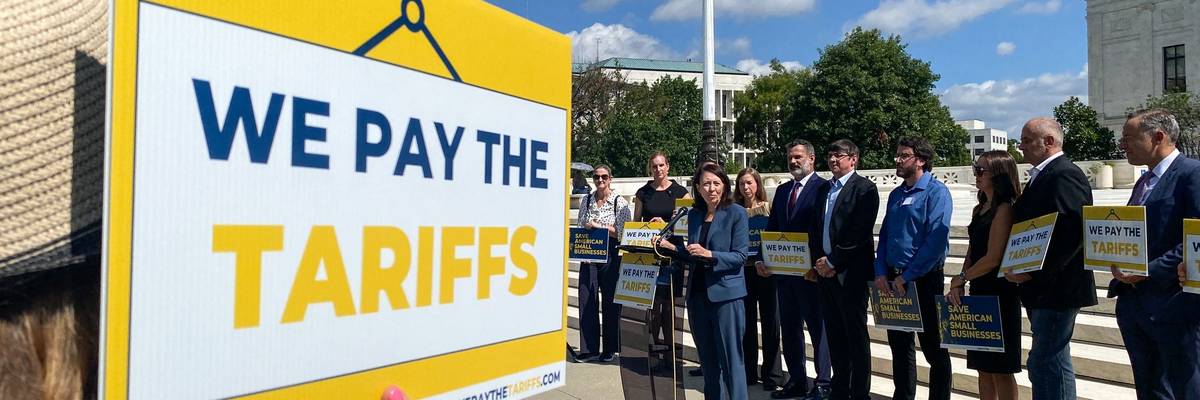
US Senator Maria Cantwell, Democrat from Washington, and small business owners hold a news conference to discuss the impacts of tariffs on businesses, outside the Supreme Court in Washington, DC, on September 18, 2025.
Trump's Tariffs Are Squeezing Small Businesses
The rising costs that small business owners are paying for imports due to President Donald Trump’s trade tariffs, a tax on American consumers and businesses, is roiling mom-and-pop shops across the US.
According to the Pew Research Center, Americans have big trust in small businesses versus big corporations.
Mom-and-pop shops will need that positive vibe and more as they approach the make-or-break year end business season, beginning with Small Business Saturday on November 29. While small business owners can’t compete on prices with larger companies, there are other factors in play such as personal service. Nevertheless, prices of goods and services do matter, so the rising costs that small business owners are paying for imports due to President Donald Trump’s trade tariffs, a tax on American consumers and businesses, is roiling mom-and-pop shops across the US.
On April 2, 2025, Trump announced that he was via tariffs “enacting fair trade policies that will restore our workforce, rebuild our economy, and finally put America First.” According to Small Business Administration Administrator Kelly Loeffler, mom-and-pop shops would reap a bounty of benefits from tariffs on imports from global trading partners: “Small businesses will no longer be crushed by foreign governments and unfair trade deals. Instead, we will put American industry, workers, and strength FIRST.”
How are these claims working out on Main Street? We turn to Fabrice Moschetti, owner of Moschetti Artisan Roasters, in Vallejo, California. Imported coffee he buys from Brazil was tariff-free until the president imposed a baseline “reciprocal tariff” of 10% on imported goods globally, then increased tariffs on Brazilian imports another 40% in July because the government of Brazil was prosecuting its past President Jair Bolsonaro, awaiting a 27-year prison sentence on appeal currently after conviction for planning a military coup against his successor, Brazilian President Luiz Inácio Lula da Silva.
"At this point, we've transitioned from working for profits to working for tariffs. We are just in business to pay off our tariff debt."
It’s been a struggle to find an adequate supply of coffee, according to Moschetti, forcing him to truck it in from cities such as Seattle versus the nearby Port of Oakland. "It's been difficult to tell the mom-and-pop owner-operators who we work with that our prices are increasing 40%," he says.
While Trump recently rolled back the 40% tariffs on coffee imports from Brazil, tariffs on imports from other global trading partners remain in place. Two examples of tariff-price hikes on imports are bags and cups made abroad in China.
Dan Anthony is the executive director of We Pay the Tariffs (WPT), a Washington, DC-based coalition of small businesses. Its aim is to advocate for policies that address the negative impacts of tariffs.
Strength in numbers is a political strategy that confronts the money-power of big banks, corporations, and the wealthy. It’s a strategy that faces enormous obstacles, economically and politically.
Meanwhile, presidential tariffs totaled $120 billion paid on US imports from March to August 2025, according to Anthony. That $120 billion compares with the spending on the National School Lunch Program and related programs for 12 months.
Joann Cartiglia is the owner-operator of The Queen's Treasures in Ticonderoga, New York. Her doll accessories and toy company is struggling with tariff-driven inventory shortages as the make-or-break holiday season approaches, according to Cartiglia. American companies paid $1.2 billion in tariffs on toy imports for the year ending in August 2025, a spike of 22.3% from 0% the past year, according to WPT, based on Census data. Meanwhile, toy imports grew 0.1% between August 2024 and August 2025.
Jared Hendricks is the owner of Village Lighting Co. in West Valley City, Utah. "We're approaching a $1 million in tariffs this year that weren't in the budget,” he says, “weren't in the forecast, and frankly, weren't in the cash flow, so we had to finance that. At this point, we've transitioned from working for profits to working for tariffs. We are just in business to pay off our tariff debt."
Currently, import prices are rising and small businesses are struggling. Anne Zimmerman is founder and owner of Zimmerman & Co. CPAs Inc. in Cleveland and Cincinnati, Ohio, and cochair of Small Business for America’s Future. The group’s new survey of 1,048 small business owners shows that 74% of them do not think that they will remain open in 2026.
“Congress needs to focus on policies that will actually help us,” Zimmerman says in a statement. “That means extending the Affordable Care Act tax credits so businesses and their employees aren’t hit with massive healthcare cost spikes. The Supreme Court needs to strike down these tariff policies that are crushing small businesses.”
We are at a crossroads
This country and this world are at a monumental crossroads. In a few short weeks, US voters will have an opportunity to beat back the forces of fascism and confront the billionaires who are rigging the economy, our media system, and our democracy, making it increasingly impossible for ordinary people to get by. We’re not just talking about the election. We’re talking about what must be done once these fascist elements are vanquished from power. We need a bolder set of solutions than what either major party has so far been willing to offer and a working-class movement ready to fight like hell for it. Trump didn't emerge from nowhere. The conditions that fueled MAGA authoritarianism were created by decades of radical neoliberal economic policies and a corrupt political system dominated by corporate interests. They slashed taxes on the super-rich, promising that the benefits would trickle down. They said giveaways to the corporate titans would make life more affordable for the rest of us. It was all bullshit. And when a bitter, betrayed populace searches for someone to blame, right-wing demagogues have little trouble finding scapegoats. People know when they're being lied to, but you won't hear any of this from the corporate media. Only independent journalism—powered and funded by people who believe in building a better world—can deliver truly trustworthy daily news. Our Fall Campaign is underway, and we need your help. To power our newsroom through the rest of the year, we need to raise $125,000 by midnight on October 31. So if you share our vision, please contribute whatever you can to sustain our work. |
According to the Pew Research Center, Americans have big trust in small businesses versus big corporations.
Mom-and-pop shops will need that positive vibe and more as they approach the make-or-break year end business season, beginning with Small Business Saturday on November 29. While small business owners can’t compete on prices with larger companies, there are other factors in play such as personal service. Nevertheless, prices of goods and services do matter, so the rising costs that small business owners are paying for imports due to President Donald Trump’s trade tariffs, a tax on American consumers and businesses, is roiling mom-and-pop shops across the US.
On April 2, 2025, Trump announced that he was via tariffs “enacting fair trade policies that will restore our workforce, rebuild our economy, and finally put America First.” According to Small Business Administration Administrator Kelly Loeffler, mom-and-pop shops would reap a bounty of benefits from tariffs on imports from global trading partners: “Small businesses will no longer be crushed by foreign governments and unfair trade deals. Instead, we will put American industry, workers, and strength FIRST.”
How are these claims working out on Main Street? We turn to Fabrice Moschetti, owner of Moschetti Artisan Roasters, in Vallejo, California. Imported coffee he buys from Brazil was tariff-free until the president imposed a baseline “reciprocal tariff” of 10% on imported goods globally, then increased tariffs on Brazilian imports another 40% in July because the government of Brazil was prosecuting its past President Jair Bolsonaro, awaiting a 27-year prison sentence on appeal currently after conviction for planning a military coup against his successor, Brazilian President Luiz Inácio Lula da Silva.
"At this point, we've transitioned from working for profits to working for tariffs. We are just in business to pay off our tariff debt."
It’s been a struggle to find an adequate supply of coffee, according to Moschetti, forcing him to truck it in from cities such as Seattle versus the nearby Port of Oakland. "It's been difficult to tell the mom-and-pop owner-operators who we work with that our prices are increasing 40%," he says.
While Trump recently rolled back the 40% tariffs on coffee imports from Brazil, tariffs on imports from other global trading partners remain in place. Two examples of tariff-price hikes on imports are bags and cups made abroad in China.
Dan Anthony is the executive director of We Pay the Tariffs (WPT), a Washington, DC-based coalition of small businesses. Its aim is to advocate for policies that address the negative impacts of tariffs.
Strength in numbers is a political strategy that confronts the money-power of big banks, corporations, and the wealthy. It’s a strategy that faces enormous obstacles, economically and politically.
Meanwhile, presidential tariffs totaled $120 billion paid on US imports from March to August 2025, according to Anthony. That $120 billion compares with the spending on the National School Lunch Program and related programs for 12 months.
Joann Cartiglia is the owner-operator of The Queen's Treasures in Ticonderoga, New York. Her doll accessories and toy company is struggling with tariff-driven inventory shortages as the make-or-break holiday season approaches, according to Cartiglia. American companies paid $1.2 billion in tariffs on toy imports for the year ending in August 2025, a spike of 22.3% from 0% the past year, according to WPT, based on Census data. Meanwhile, toy imports grew 0.1% between August 2024 and August 2025.
Jared Hendricks is the owner of Village Lighting Co. in West Valley City, Utah. "We're approaching a $1 million in tariffs this year that weren't in the budget,” he says, “weren't in the forecast, and frankly, weren't in the cash flow, so we had to finance that. At this point, we've transitioned from working for profits to working for tariffs. We are just in business to pay off our tariff debt."
Currently, import prices are rising and small businesses are struggling. Anne Zimmerman is founder and owner of Zimmerman & Co. CPAs Inc. in Cleveland and Cincinnati, Ohio, and cochair of Small Business for America’s Future. The group’s new survey of 1,048 small business owners shows that 74% of them do not think that they will remain open in 2026.
“Congress needs to focus on policies that will actually help us,” Zimmerman says in a statement. “That means extending the Affordable Care Act tax credits so businesses and their employees aren’t hit with massive healthcare cost spikes. The Supreme Court needs to strike down these tariff policies that are crushing small businesses.”
- Trump's Tariffs: Crony Capitalism and the New Economy of Obedience ›
- Trump Follows Through With High Tariffs on Canada, Mexico, and China ›
- New Ad Campaign Targets Holiday Price Spike From Trump Tariffs ›
- Analysis Finds Trump Tariffs Will Cost Average US Family $1,600 or More Per Year ›
- Khanna Sounds Alarm as 4,100+ Factory Workers Laid Off Amid Trump Tariff Chaos ›
- US Small Businesses Sue Trump Over 'Devastating' Tariffs ›
- Opinion | Trump Wants $6 Trillion Tax Hike to Fund $600 Billion in New War Spending | Common Dreams ›
- 'Pain Street': Markey Report Shows Trump Hurting Small Businesses and Working Families | Common Dreams ›
- 'Lots of Pain But Little Gains': Report Shows How Much Trump Tariffs Have Cost Americans | Common Dreams ›
- From Healthcare and Fuel Costs to Tariffs, Trump GOP's Policies 'Crushing' Small Businesses | Common Dreams ›
According to the Pew Research Center, Americans have big trust in small businesses versus big corporations.
Mom-and-pop shops will need that positive vibe and more as they approach the make-or-break year end business season, beginning with Small Business Saturday on November 29. While small business owners can’t compete on prices with larger companies, there are other factors in play such as personal service. Nevertheless, prices of goods and services do matter, so the rising costs that small business owners are paying for imports due to President Donald Trump’s trade tariffs, a tax on American consumers and businesses, is roiling mom-and-pop shops across the US.
On April 2, 2025, Trump announced that he was via tariffs “enacting fair trade policies that will restore our workforce, rebuild our economy, and finally put America First.” According to Small Business Administration Administrator Kelly Loeffler, mom-and-pop shops would reap a bounty of benefits from tariffs on imports from global trading partners: “Small businesses will no longer be crushed by foreign governments and unfair trade deals. Instead, we will put American industry, workers, and strength FIRST.”
How are these claims working out on Main Street? We turn to Fabrice Moschetti, owner of Moschetti Artisan Roasters, in Vallejo, California. Imported coffee he buys from Brazil was tariff-free until the president imposed a baseline “reciprocal tariff” of 10% on imported goods globally, then increased tariffs on Brazilian imports another 40% in July because the government of Brazil was prosecuting its past President Jair Bolsonaro, awaiting a 27-year prison sentence on appeal currently after conviction for planning a military coup against his successor, Brazilian President Luiz Inácio Lula da Silva.
"At this point, we've transitioned from working for profits to working for tariffs. We are just in business to pay off our tariff debt."
It’s been a struggle to find an adequate supply of coffee, according to Moschetti, forcing him to truck it in from cities such as Seattle versus the nearby Port of Oakland. "It's been difficult to tell the mom-and-pop owner-operators who we work with that our prices are increasing 40%," he says.
While Trump recently rolled back the 40% tariffs on coffee imports from Brazil, tariffs on imports from other global trading partners remain in place. Two examples of tariff-price hikes on imports are bags and cups made abroad in China.
Dan Anthony is the executive director of We Pay the Tariffs (WPT), a Washington, DC-based coalition of small businesses. Its aim is to advocate for policies that address the negative impacts of tariffs.
Strength in numbers is a political strategy that confronts the money-power of big banks, corporations, and the wealthy. It’s a strategy that faces enormous obstacles, economically and politically.
Meanwhile, presidential tariffs totaled $120 billion paid on US imports from March to August 2025, according to Anthony. That $120 billion compares with the spending on the National School Lunch Program and related programs for 12 months.
Joann Cartiglia is the owner-operator of The Queen's Treasures in Ticonderoga, New York. Her doll accessories and toy company is struggling with tariff-driven inventory shortages as the make-or-break holiday season approaches, according to Cartiglia. American companies paid $1.2 billion in tariffs on toy imports for the year ending in August 2025, a spike of 22.3% from 0% the past year, according to WPT, based on Census data. Meanwhile, toy imports grew 0.1% between August 2024 and August 2025.
Jared Hendricks is the owner of Village Lighting Co. in West Valley City, Utah. "We're approaching a $1 million in tariffs this year that weren't in the budget,” he says, “weren't in the forecast, and frankly, weren't in the cash flow, so we had to finance that. At this point, we've transitioned from working for profits to working for tariffs. We are just in business to pay off our tariff debt."
Currently, import prices are rising and small businesses are struggling. Anne Zimmerman is founder and owner of Zimmerman & Co. CPAs Inc. in Cleveland and Cincinnati, Ohio, and cochair of Small Business for America’s Future. The group’s new survey of 1,048 small business owners shows that 74% of them do not think that they will remain open in 2026.
“Congress needs to focus on policies that will actually help us,” Zimmerman says in a statement. “That means extending the Affordable Care Act tax credits so businesses and their employees aren’t hit with massive healthcare cost spikes. The Supreme Court needs to strike down these tariff policies that are crushing small businesses.”
- Trump's Tariffs: Crony Capitalism and the New Economy of Obedience ›
- Trump Follows Through With High Tariffs on Canada, Mexico, and China ›
- New Ad Campaign Targets Holiday Price Spike From Trump Tariffs ›
- Analysis Finds Trump Tariffs Will Cost Average US Family $1,600 or More Per Year ›
- Khanna Sounds Alarm as 4,100+ Factory Workers Laid Off Amid Trump Tariff Chaos ›
- US Small Businesses Sue Trump Over 'Devastating' Tariffs ›
- Opinion | Trump Wants $6 Trillion Tax Hike to Fund $600 Billion in New War Spending | Common Dreams ›
- 'Pain Street': Markey Report Shows Trump Hurting Small Businesses and Working Families | Common Dreams ›
- 'Lots of Pain But Little Gains': Report Shows How Much Trump Tariffs Have Cost Americans | Common Dreams ›
- From Healthcare and Fuel Costs to Tariffs, Trump GOP's Policies 'Crushing' Small Businesses | Common Dreams ›