SUBSCRIBE TO OUR FREE NEWSLETTER
Daily news & progressive opinion—funded by the people, not the corporations—delivered straight to your inbox.
5
#000000
#FFFFFF
To donate by check, phone, or other method, see our More Ways to Give page.


Daily news & progressive opinion—funded by the people, not the corporations—delivered straight to your inbox.
The president also simultaneously claimed to have left Iran's military alone and destroyed its navy and air force.
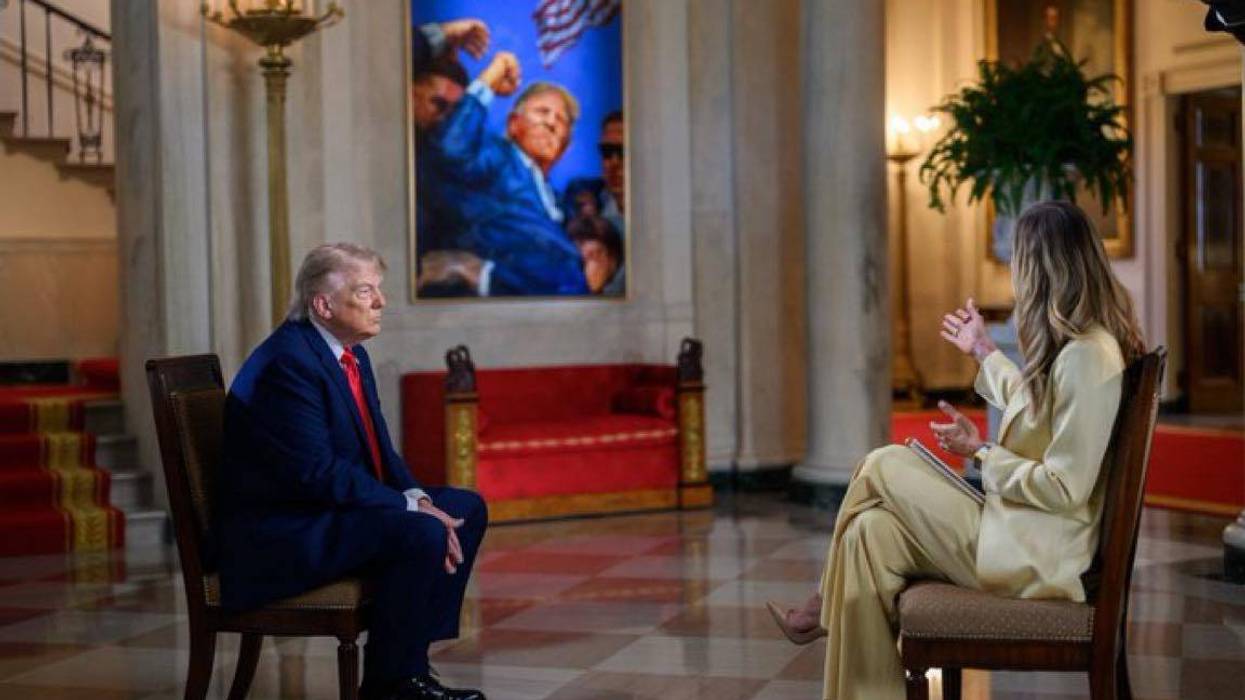
President Donald Trump said Saturday during an interview with his daughter-in-law that the US should not have waged war on Iran, while making contradictory claims about destroying Iran's military and leaving it alone.
“You look at what happened with Iraq. We did so bad. It was such a foolish thing what we did. We shouldn’t have been there in the first place, by the way,” Trump told Lara Trump, who hosts Fox News' "My View."
“We shouldn’t have been in Iran, but Iran has the capability," he said, referring to the Islamic Republic's nuclear program.
Former US Director of National Intelligence Tulsi Gabbard testified before the Senate Select Committee on Intelligence last year that “Iran is not building a nuclear weapon and [the late] Supreme Leader Khamanei had not authorized the nuclear weapons program he suspended in 2003.” US intelligence agencies have repeatedly come to the same conclusion since the George W. Bush administration.
Trump claimed that without US bombing, Iran "would have a nuclear weapon right now and will be a whole different story."
“If we didn’t hit them with B-2 bombers, nine months ago, they would have a nuclear weapon right now," he said.
"Their military, we've sort of left it alone because we think that their military is somewhat moderate," Trump said right after saying that "their navy is gone, 100%," and "their air force is gone, 100%."
The president also claimed that he will negotiate a "great" end to the war with Iran, or "we'll just go back and finish it off militarily."
"We're close to a very good deal," he said.
You saw Venezuela," Trump said, referring to the country the US bombed and invaded in January to abduct President Nicolás Maduro and bring him to the United States to face dubious narco-terrorism charges.
At least 3,468 people have been killed in US-Israeli attacks on Iran since February 28, according to Iran’s Ministry of Health, including 496 women and 376 children.
The ICJ’s landmark advisory opinion comes as legal restrictions on the right to strike are increasing around the world.
The right to strike is under attack throughout the world, including in the United States. Labor strikes are currently forbidden or restricted in the majority of countries.
Now, in a landmark 43-page advisory opinion issued May 21, the International Court of Justice (ICJ, or World Court) has determined that the right to strike is protected under the International Labour Organization’s (ILO) Convention No. 87 on Freedom of Association and Protection of the Right to Organise.
“At a moment when workers’ organizations face sustained attacks around the world, this opinion reaffirms that the freedom to withhold one’s labor is not a privilege granted by the powerful, but a fundamental human right grounded in international law,” AFL-CIO President Liz Shuler said in a statement.
The ILO is the United Nations agency that sets global labor standards. It has 187 member states and has adopted 191 conventions since its founding in 1919. The ILO considers Convention No. 87 to be one of its 11 fundamental conventions.
In 2023, the ILO asked the ICJ to settle an internal dispute about whether Convention No. 87 gives workers the right to strike, which is not specifically addressed in the convention. Although advisory opinions of the ICJ are not legally binding, many courts accept them as authoritative legal decisions.
The ICJ ruled in its 10-4 opinion that a strike “is one of the main activities engaged in and tools used by workers and their organizations to promote their interests and improve conditions of labour, thereby ensuring the effective exercise of the freedom of association protected under Convention No. 87.”
The Court found “that protection of the right to strike is encompassed in the protection of the freedom of association provided for in Convention No. 87.”
In reaching that conclusion, the Court considered provisions in two 1996 Covenants that contain relevant rules of international law regarding the right to strike. Both refer to Convention No. 87.
Article 8, paragraph 1 (d) of the International Covenant on Economic, Social and Cultural Rights (ICESCR) expressly protects the right to strike, if it is exercised in conformity with domestic laws.
Article 22, paragraph 1 of the International Covenant on Civil and Political Rights (ICCPR) provides for the right to freedom of association. The ICJ noted that for more than 25 years, the Human Rights Committee — which monitors the implementation of the ICCPR — has considered the right to strike to be encompassed in the protection of freedom of association.
Due to the high degree of overlap between the states parties to the ICESCR and ICCPR, and Convention No. 87, the ICJ determined there was a common understanding among them on the right to strike. The Court thus concluded “that an interpretation taking into account the relevant rules of international law contained in the ICESCR and the ICCPR indicates that the protection of the right to strike is encompassed in the protection of the freedom of association provided by Convention No. 87.”
“For generations, working people have understood a simple truth: The freedom to join a union means nothing if you cannot withhold your labor when bosses refuse to listen. Now, the world’s highest court has affirmed that truth,” said Jeffrey Vogt, director of the International Lawyers Assisting Workers (ILAW) Network, which issued the call for the ILO referral of this case to the ICJ.
The ICJ decision “affirms decades of judicial precedent and what workers around the world know: there is no right to organize and bargain collectively without the right to strike,” Shuler said in her statement. “When workers are barred from taking collective action on the job, they cannot defend their rights and demand the workplace conditions and contracts they are owed. The freedom to join a union becomes an empty formality.”
“This is an important day for the International Labor Organization [ILO], and for its continued relevance in the world of work. However, the significance of this opinion extends well beyond the institutional context in Geneva,” the ILAW Network wrote in a statement.
The ICJ advisory opinion came “at a moment of acute pressure on the international labour rights system,” ILAW stated. “Across the world, the right to strike is under sustained attack — through restrictive legislation, expansive judicial interpretation of essential services, the criminalisation of trade union activity, and the use of dismissals, injunctions, and damages claims to deter collective action.”
Legal restrictions on the right to strike are increasing. In 2022, strikes were outlawed or stringently restricted in 129 of the 148 countries tallied by the International Trade Union Confederation (ITUC), one of the six organizations with consultative status at the ILO Governing Body.
The ITUC, which represents 191 million workers in 169 countries and territories, is dedicated to trade union democracy and independence. It has regional organizations in Africa, Asia, and Latin America. The ICJ decision “is important not only for workers and trade unions, but also for governments and responsible businesses,” ITUC stressed.
This decision “will serve as a powerful interpretive tool before national constitutional and labour courts, before regional human rights bodies, and before the ILO’s own supervisory bodies,” ILAW noted. “It strengthens the hand of every worker and union challenging strike bans, broad essential-services designations, criminal sanctions against strikers, prohibitions on solidarity and political strikes, and the dismissal and blacklisting of workers who exercise this right.”
In October, 18 countries and five international organizations, including the ILO, presented oral testimony before the ICJ, and other nations filed written contributions. The majority of participants supported the right to strike, which is guaranteed in most European countries.
Harold Koh, who represented the International Trade Union Confederation (ITUC) before the ICJ, told the judges that the case would “affect the real rights of tens of millions of working people around the world.” If the Court ruled that the Convention didn’t protect the right to strike, Koh warned, “National employer groups would contest the right to strike country by country, focusing first on nations with compliant courts, weak civil societies and ineffective media.”
Jeffrey Vogt worked with the legal team of the ITUC on the briefs and oral arguments presented to the ICJ. Vogt’s co-authored book, The Right to Strike in International Law, provided a legal roadmap for the case.
Vogt told Truthout that “the written view of the US (under the Biden administration) was to support the right to strike, albeit on narrower grounds than what we had argued. When the Trump administration came in, they withdrew the Biden era brief but fortunately did not appear for oral arguments and take a contrary view.”
“The decision deals with the right to strike in the abstract — does the convention protect it — but does not go into the modalities,” Vogt added. The Court wrote that its “conclusion that the right to strike is protected by Convention No. 87 does not entail any determination on the precise content, scope, or conditions for the exercise of that right.”
“That was a conscious decision,” Vogt noted. “We did not want the court to attempt to define the scope, especially since we believe that is the proper role of the ILO supervisory system.” Vogt said that “the ICJ gave ‘great weight’ to the views of the supervisory system, which is helpful.” And although “the ILO has supported secondary strikes,” in which workers strike in solidarity with other workers at a different employer, the ICJ decision didn’t opine on that specific issue.
“The right to withhold one’s labor, inherent in the right to strike, belongs to all workers, but it has been restricted,” Jeanne Mirer, a labor lawyer in private practice working with the International Commission for Labor Rights, told Truthout. “Many unions have agreed never to strike while a collective bargaining agreement is in effect.”
Most private sector workers in the US have the right to strike under the National Labor Relations Act (NLRA). Employees, including international and undocumented workers, cannot be fired or disciplined for participating in a lawful strike.
“Those exempted from the NLRA, such as agricultural and domestic workers, are not restricted in the right to strike but have no protections against discharge if they strike and do not have the power to prevent such retaliation,” Mirer added.
Some states have their own laws granting protection to domestic workers and 14 states guarantee farmworkers collective bargaining rights.
Railroad and airline workers are not covered by the NLRA, but they come under the Railway Labor Act, which has several limitations on the right to strike.
In recent years, Congress and the courts have narrowed the definition of “protected concerted activity” under the NLRA. Union membership is dropping. Nevertheless, strike actions in the US increased by almost 50 percent in 2022, according to the Economic Policy Institute.
In 2023, the US Supreme Court weakened the legal protections for striking in Glacier Northwest, Inc. v. International Brotherhood of Teamsters, making it easier for employers to sue unions in state courts. Only Justice Ketanji Brown Jackson dissented, writing, “The right to strike is fundamental to American labor law.” She noted:
Workers are not indentured servants, bound to continue laboring until any planned work stoppage would be as painless as possible for their masters. They are employees whose collective and peaceful decision to withhold their labor is protected by the [National Labor Relations Act] even if economic injury results.
The NLRA’s protections for private sector workers don’t extend to public sector employees. “Public employees in the United States have been restricted in many ways from striking,” Mirer said.
Federal workers are legally prohibited from striking. Thirty-six states prohibit public sector workers from striking. Three other states that haven’t addressed the issue would likely outlaw public sector strikes as well. In the 12 states where strikes are not per se unlawful, various preconditions must be met before workers can engage in strikes.
The World Federation of Trade Unions, which played a decisive role in the creation of Convention No. 87 in 1948, applauded the ICJ’s decision:
[I]t is clear that the existence of a class-oriented and militant trade union movement is the essential, decisive, and irreplaceable factor to ensure that the right to strike, as well as conventions, collective bargaining, labor laws, and workers’ achievements, are not merely empty words on paper but are implemented in practice. The WFTU reiterates its call for struggle in every country, sector, and workplace to safeguard the sacred right to strike in practice.
“It is up to workers and their organizations to build on the ICJ decision to ensure the right to strike can be an effective tool to build worker power,” Mirer said.
Trump called himself "the man who gets much larger audiences than Elvis in his prime," and "the man who some say is the Greatest President in History (THE GOAT)!"
As an increasing number of artists cancel their scheduled performances at the "Great American State Fair" created by the Trump administration to celebrate the US semiquincentennial, President Donald Trump on Saturday called for scrapping the concerts and replacing them with a rally headlined by himself.
"We should have a giant MAKE AMERICA GREAT AGAIN RALLY, for 250, instead of having overpriced singers, who nobody wants to hear, whose music is boring, and yet who do nothing but complain," Trump wrote on his Truth Social network. "Cancel it, just like I canceled my involvement with the failing and unsafe to be in Kennedy Center, because a Highly Conflicted, Crooked Federal Judge, said that I should not be allowed to spend my time and money in order to MAKE THE CENTER GREAT AGAIN, actually, far greater than it ever was before!"
"I understand Artists are getting 'the yips' having to do with their performance on Wednesday," the president said in an earlier Truth post on Saturday, "so I am thinking about bringing the Number One Attraction anywhere in the World, the man who gets much larger audiences than Elvis in his prime, and he does so without a guitar, the man who loves our Country more than anyone else, and the man who some say is the Greatest President in History (THE GOAT!), DONALD J. TRUMP, to take the place of these highly paid, Third Rate 'Artists,' and give a major speech, rallying the Country forward like I have done ever since being President!"
"I don’t want so-called 'Artists' that get paid far too much money, who aren’t happy," he wrote. "So, by copy of this TRUTH, I am ordering my Representatives to look at the feasibility of doing an AMERICA IS BACK Rally on Wednesday, Washington, DC, same time, same location. Only Great Patriots invited—It will be a Wild and Beautiful Celebration of America!"
Artists who have bailed on the concerts, also known as the Freedom 250 shows, include Young MC, The Commodores, Morris Day and The Time, Bret Michaels, and Martina McBride. Some of the musicians said they were misled about the partisan nature of the event.
“I was presented with an opportunity to perform at a nonpartisan event, but that turned out to be misleading,” McBride—a four-time winner of the Country Music Association female artist of the year award—wrote in an Instagram post. “I asked lots of questions and was assured this was a nonpartisan event that was meant to celebrate ALL 50 states.”
Remaining in the lineup as of Saturday are Vanilla Ice and Flo Rida, while C+C Music Factory and Milli Vanilli have given mixed signals.
The cancellations are a major embarrassment for Trump. Prior to the cancellations, the event was already being mocked for what the Daily Beast's Cameron Adams described as a “lack of A-list musical talent."
Comedian Bill Maher was among those mocking Trump for the Freedom 250 disaster.
“That’s got to hurt a lot when you can’t close the deal with Milli Vanilli," Maher said Friday on his Real Time show on HBO.
One legal expert said the grim milestone raises the question of whether the US is committing a "crime against humanity."
The US military on Friday bombed another boat it claimed was smuggling drugs in the eastern Pacific Ocean, killing three more people in what experts say is an illegal campaign whose death toll has now topped 200.
US Southern Command said in a statement that "Joint Task Force Southern Spear," the nine-month campaign ordered by President Donald Trump, "conducted a lethal kinetic strike on a vessel operated by Designated Terrorist Organizations."
"Intelligence confirmed the vessel was transiting along known narco-trafficking routes in the Eastern Pacific and was engaged in narco-trafficking operations," SOUTHCOM added, providing no evidence to support its claim. "Three male narco-terrorists were killed during this action. No US military forces were harmed. SOUTHCOM is unwavering in its commitment to applying total systemic friction on the cartels."
Friday's strike brought the number of people killed during Southern Spear to 202 in at least 60 strikes in the Caribbean Sea and Pacific Ocean.
The Trump administration has tried to justify the strikes by claiming that the US is in an “armed conflict” with drug cartels. Many legal experts disagree.
Former longtime Human Rights Watch executive director Kenneth Roth wrote on X: "Now more than 200 Trump summary executions—blatant murders."
"Legal experts agree: The Trump-ordered strikes on suspected drug boats are illegal extrajudicial killings because the military is not permitted to deliberately target civilians—even suspected criminals—who do not pose an imminent threat of violence," Roth said in a separate post.
Just Security editor-in-chief and New York University School of Law professor Ryan Goodman said that the "overwhelming consensus of experts, myself included, assess these to be murder because no armed conflict" is occurring, adding that they would be a "war crime if it were armed conflict."
Goodman said that, with 200 people killed, the strikes raise the question of whether the US is committing a "crime against humanity."
The boat strikes were fraught from the start. In the first known attack, US forces killed nine people in an initial strike and then two men clinging to the boat’s wreckage in a follow-up bombing.
The bombings have drawn widespread condemnation, including from Colombian President Gustavo Petro, who accused the US of "murder," and Venezuelan President Nicolás Maduro, who was abducted during a US invasion in January and imprisoned in the United States on dubious narco-terrorism charges.
Regional leaders and relatives of survivors say that at least some of the victims of the US bombings were fishermen with no ties to narco-trafficking. In January, relatives of two Trinidadian fishers killed in the strikes filed a federal wrongful death lawsuit in Massachusetts.
The bombings have terrorized fishing communities along the Caribbean and Pacific coasts to the point where many people have given up the only means they had of supporting their families.
Congressional war powers resolutions aimed at reining in Trump’s ability to extrajudicially execute alleged drug traffickers in or near Venezuela failed to pass the Senate last October and the House in December.
“Not only are these killings illegal, they are immoral. People of good conscience cannot allow this to continue, yet Congress has so far failed to halt, or even slow down, this lethal and unlawful campaign," Amnesty International USA national director for government relations Amanda Klasing said in a statement Wednesday.
"Lawmakers must do everything in their power to halt this campaign and hold everyone responsible accountable for their role in these extrajudicial killings,” she added.