SUBSCRIBE TO OUR FREE NEWSLETTER
Daily news & progressive opinion—funded by the people, not the corporations—delivered straight to your inbox.
5
#000000
#FFFFFF
To donate by check, phone, or other method, see our More Ways to Give page.
Daily news & progressive opinion—funded by the people, not the corporations—delivered straight to your inbox.
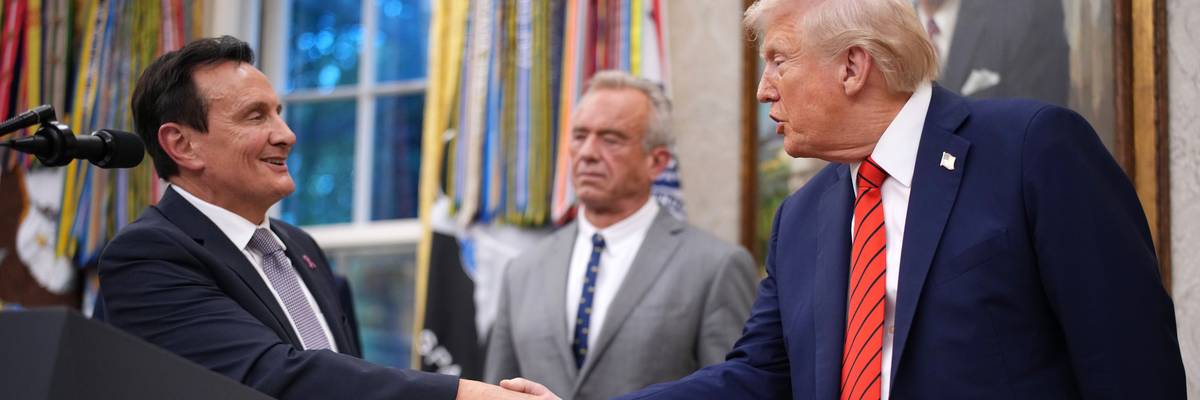
AstraZeneca CEO Pascal Soriot (left) shakes hands with U.S. President Donald Trump in the Oval Office of the White House as Health and Human Services Secretary Robert F. Kennedy Jr. stands by on October 10, 2025 in Washington, DC.
"The Trump team appears to be doing more to protect pharma profits than patients’ pocketbooks,” said Public Citizen.
The Trump administration’s secretive deals with Big Pharma to lower prescription drug prices included benefits for the companies that were not publicly disclosed, according to documents obtained by the consumer advocacy group Public Citizen via a Freedom of Information Act request and published Saturday.
Public Citizen said the deals allow drugmakers to raise prices overseas and limit the scope of promised savings for American patients.
“Trump’s drug pricing deals are a mirage, designed to convince Americans that he’s taken significant action on drug pricing while creating minimal, if any, downside for Big Pharma,” Peter Maybarduk, director of Public Citizen’s Access to Medicines program, said Saturday.
“The texts show Trump handing out favors to Big Pharma, undercutting his own models to lower prices, and throwing the support of the US government behind corporate decisions to deny medicines entirely to other countries,” he added.
Read Public Citizen’s analysis of Trump’s secretive deals with pharma: www.citizen.org/article/publ...
[image or embed]
— Access to Meds | Public Citizen (@pcmedsaccess.bsky.social) September 19, 2026 at 1:19 PM
The disclosures come as President Donald Trump continues to tout his “most-favored nation” (MFN) drug-pricing initiative. On Friday, the administration announced that all 50 states, Washington, DC, and Puerto Rico had applied to participate in a Medicaid program built around MFN pricing, under which participating drugmakers are supposed to offer certain medicines at prices comparable to those charged in other wealthy nations.
However, Public Citizen said the newly disclosed contracts raise questions about how much patients will actually save. The deal with Eli Lilly excludes the company’s blockbuster GLP-1 drugs Mounjaro and Zepbound from the definition of products subject to certain MFN discounts. Public Citizen said a similar carveout for Novo Nordisk could reduce potential Medicaid savings by $1.7 billion.
Eli Lilly’s agreement also permits the company to stop supplying a medicine to another country under certain circumstances, removing that nation’s price from the calculation used to determine the US MFN price.
“That practice threatens patients’ health,” Public Citizen said, adding that such provisions could effectively encourage pharmaceutical companies to make medicines unavailable abroad rather than reduce US prices.
“By agreeing to terms that endorse and facilitate pharma companies discontinuing supplying drugs in other countries, so they can continue to charge US customers more, the Trump team appears to be doing more to protect pharma profits than patients’ pocketbooks,” it said.
Public Citizen also said that the documents do not publicly reveal the full scope of tariff exemptions and other incentives provided to drugmakers, including reported benefits involving expedited US Food and Drug Administration reviews. The Pfizer agreement indicates that the company may share additional revenue generated by higher prices abroad with the US government. But crucial portions are redacted, leaving the public unable to determine how much money is involved, who receives it, or how it would be spent.
“The Trump administration continues to favor secrecy in these limited disclosures under FOIA today,” Maybarduk said, noting that the government has blacked out “the prices, product lists, and information needed to assess whether Trump accomplished anything of substance.”
Public Citizen's disclosures follow months of criticism over Trump's claims that his administration has dramatically reduced drug prices. In August, Sen. Elizabeth Warren (D-Mass.) accused the administration of failing to make the agreements public despite Health and Human Services Secretary Robert F. Kennedy Jr.’s previous commitment to provide them, saying, “still crickets.”
Dear Common Dreams reader, It’s been nearly 30 years since I co-founded Common Dreams with my late wife, Lina Newhouser. We had the radical notion that journalism should serve the public good, not corporate profits. It was clear to us from the outset what it would take to build such a project. No paid advertisements. No corporate sponsors. No millionaire publisher telling us what to think or do. Many people said we wouldn't last a year, but we proved those doubters wrong. Together with a tremendous team of journalists and dedicated staff, we built an independent media outlet free from the constraints of profits and corporate control. Our mission has always been simple: To inform. To inspire. To ignite change for the common good. Building Common Dreams was not easy. Our survival was never guaranteed. When you take on the most powerful forces—Wall Street greed, fossil fuel industry destruction, Big Tech lobbyists, and uber-rich oligarchs who have spent billions upon billions rigging the economy and democracy in their favor—the only bulwark you have is supporters who believe in your work. But here’s the urgent message from me today. It's never been this bad out there. And it's never been this hard to keep us going. At the very moment Common Dreams is most needed, the threats we face are intensifying. We need your support now more than ever. We don't accept corporate advertising and never will. We don't have a paywall because we don't think people should be blocked from critical news based on their ability to pay. Everything we do is funded by the donations of readers like you. When everyone does the little they can afford, we are strong. But if that support retreats or dries up, so do we. Will you donate now to make sure Common Dreams not only survives but thrives? —Craig Brown, Co-founder |
The Trump administration’s secretive deals with Big Pharma to lower prescription drug prices included benefits for the companies that were not publicly disclosed, according to documents obtained by the consumer advocacy group Public Citizen via a Freedom of Information Act request and published Saturday.
Public Citizen said the deals allow drugmakers to raise prices overseas and limit the scope of promised savings for American patients.
“Trump’s drug pricing deals are a mirage, designed to convince Americans that he’s taken significant action on drug pricing while creating minimal, if any, downside for Big Pharma,” Peter Maybarduk, director of Public Citizen’s Access to Medicines program, said Saturday.
“The texts show Trump handing out favors to Big Pharma, undercutting his own models to lower prices, and throwing the support of the US government behind corporate decisions to deny medicines entirely to other countries,” he added.
Read Public Citizen’s analysis of Trump’s secretive deals with pharma: www.citizen.org/article/publ...
[image or embed]
— Access to Meds | Public Citizen (@pcmedsaccess.bsky.social) September 19, 2026 at 1:19 PM
The disclosures come as President Donald Trump continues to tout his “most-favored nation” (MFN) drug-pricing initiative. On Friday, the administration announced that all 50 states, Washington, DC, and Puerto Rico had applied to participate in a Medicaid program built around MFN pricing, under which participating drugmakers are supposed to offer certain medicines at prices comparable to those charged in other wealthy nations.
However, Public Citizen said the newly disclosed contracts raise questions about how much patients will actually save. The deal with Eli Lilly excludes the company’s blockbuster GLP-1 drugs Mounjaro and Zepbound from the definition of products subject to certain MFN discounts. Public Citizen said a similar carveout for Novo Nordisk could reduce potential Medicaid savings by $1.7 billion.
Eli Lilly’s agreement also permits the company to stop supplying a medicine to another country under certain circumstances, removing that nation’s price from the calculation used to determine the US MFN price.
“That practice threatens patients’ health,” Public Citizen said, adding that such provisions could effectively encourage pharmaceutical companies to make medicines unavailable abroad rather than reduce US prices.
“By agreeing to terms that endorse and facilitate pharma companies discontinuing supplying drugs in other countries, so they can continue to charge US customers more, the Trump team appears to be doing more to protect pharma profits than patients’ pocketbooks,” it said.
Public Citizen also said that the documents do not publicly reveal the full scope of tariff exemptions and other incentives provided to drugmakers, including reported benefits involving expedited US Food and Drug Administration reviews. The Pfizer agreement indicates that the company may share additional revenue generated by higher prices abroad with the US government. But crucial portions are redacted, leaving the public unable to determine how much money is involved, who receives it, or how it would be spent.
“The Trump administration continues to favor secrecy in these limited disclosures under FOIA today,” Maybarduk said, noting that the government has blacked out “the prices, product lists, and information needed to assess whether Trump accomplished anything of substance.”
Public Citizen's disclosures follow months of criticism over Trump's claims that his administration has dramatically reduced drug prices. In August, Sen. Elizabeth Warren (D-Mass.) accused the administration of failing to make the agreements public despite Health and Human Services Secretary Robert F. Kennedy Jr.’s previous commitment to provide them, saying, “still crickets.”
The Trump administration’s secretive deals with Big Pharma to lower prescription drug prices included benefits for the companies that were not publicly disclosed, according to documents obtained by the consumer advocacy group Public Citizen via a Freedom of Information Act request and published Saturday.
Public Citizen said the deals allow drugmakers to raise prices overseas and limit the scope of promised savings for American patients.
“Trump’s drug pricing deals are a mirage, designed to convince Americans that he’s taken significant action on drug pricing while creating minimal, if any, downside for Big Pharma,” Peter Maybarduk, director of Public Citizen’s Access to Medicines program, said Saturday.
“The texts show Trump handing out favors to Big Pharma, undercutting his own models to lower prices, and throwing the support of the US government behind corporate decisions to deny medicines entirely to other countries,” he added.
Read Public Citizen’s analysis of Trump’s secretive deals with pharma: www.citizen.org/article/publ...
[image or embed]
— Access to Meds | Public Citizen (@pcmedsaccess.bsky.social) September 19, 2026 at 1:19 PM
The disclosures come as President Donald Trump continues to tout his “most-favored nation” (MFN) drug-pricing initiative. On Friday, the administration announced that all 50 states, Washington, DC, and Puerto Rico had applied to participate in a Medicaid program built around MFN pricing, under which participating drugmakers are supposed to offer certain medicines at prices comparable to those charged in other wealthy nations.
However, Public Citizen said the newly disclosed contracts raise questions about how much patients will actually save. The deal with Eli Lilly excludes the company’s blockbuster GLP-1 drugs Mounjaro and Zepbound from the definition of products subject to certain MFN discounts. Public Citizen said a similar carveout for Novo Nordisk could reduce potential Medicaid savings by $1.7 billion.
Eli Lilly’s agreement also permits the company to stop supplying a medicine to another country under certain circumstances, removing that nation’s price from the calculation used to determine the US MFN price.
“That practice threatens patients’ health,” Public Citizen said, adding that such provisions could effectively encourage pharmaceutical companies to make medicines unavailable abroad rather than reduce US prices.
“By agreeing to terms that endorse and facilitate pharma companies discontinuing supplying drugs in other countries, so they can continue to charge US customers more, the Trump team appears to be doing more to protect pharma profits than patients’ pocketbooks,” it said.
Public Citizen also said that the documents do not publicly reveal the full scope of tariff exemptions and other incentives provided to drugmakers, including reported benefits involving expedited US Food and Drug Administration reviews. The Pfizer agreement indicates that the company may share additional revenue generated by higher prices abroad with the US government. But crucial portions are redacted, leaving the public unable to determine how much money is involved, who receives it, or how it would be spent.
“The Trump administration continues to favor secrecy in these limited disclosures under FOIA today,” Maybarduk said, noting that the government has blacked out “the prices, product lists, and information needed to assess whether Trump accomplished anything of substance.”
Public Citizen's disclosures follow months of criticism over Trump's claims that his administration has dramatically reduced drug prices. In August, Sen. Elizabeth Warren (D-Mass.) accused the administration of failing to make the agreements public despite Health and Human Services Secretary Robert F. Kennedy Jr.’s previous commitment to provide them, saying, “still crickets.”