SUBSCRIBE TO OUR FREE NEWSLETTER
Daily news & progressive opinion—funded by the people, not the corporations—delivered straight to your inbox.
5
#000000
#FFFFFF
To donate by check, phone, or other method, see our More Ways to Give page.
Daily news & progressive opinion—funded by the people, not the corporations—delivered straight to your inbox.
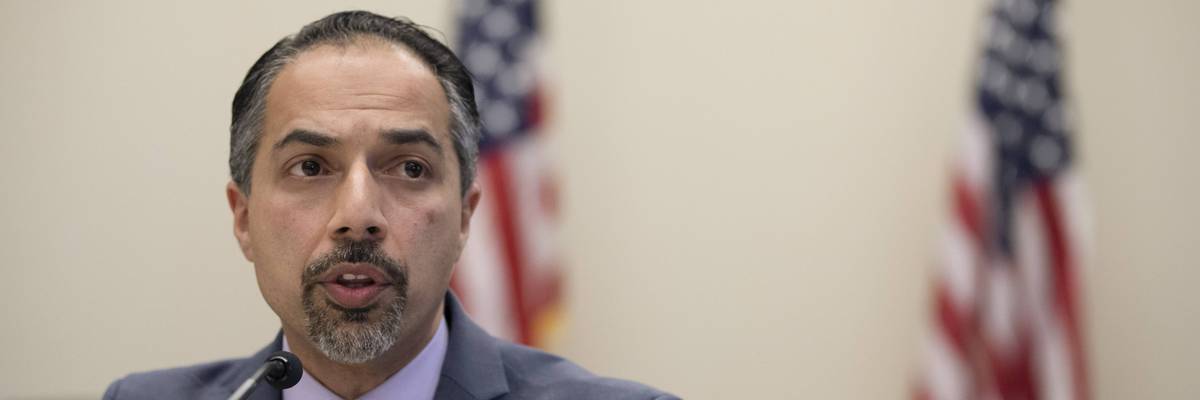
Trita Parsi of the Quincy Institute speaks at the Pathway to Peace Policy panel on February 12, 2020, at the US Capitol in Washington, DC.
"Irony is if the Trump admin had listened to Parsi, they'd be in much better shape now," said a fellow anti-war writer.
The Trump administration is once again being accused of using immigration enforcement to silence speech after it reportedly launched an investigation into one of the most prominent critics of the president's war in Iran, Trita Parsi, as part of an effort to deport him.
Parsi, an Iranian-Swedish citizen who holds a green card in the US, is the co-founder and executive vice president of the Quincy Institute for Responsible Statecraft and co-founded the National Iranian American Council (NIAC).
Since February, when the US and Israel launched a war against Iran that has killed more than 1,700 civilians, wracked the global economy, and spiraled out across the Middle East, Parsi has been a highly cited anti-war voice in the media.
But according to an exclusive report from The Free Press published on Thursday, which quotes senior Trump administration officials, the State Department views Parsi, who has lived in the US for 25 years, not as "another Washington pundit eager to share his point of view," but as someone seeking to nefariously spread "Iranian influence."
“The secretary has been very clear,” an unnamed Trump administration official said, referring to Secretary of State Marco Rubio. “Anyone who seeks to undermine the US, we’re taking a hard look at.” That includes “people who support adversaries of ours and whose work furthers their agenda and undermines our security.”
Since attacking Iran, the Trump administration has brought the hammer down on other Iranians living legally in the US due to their alleged sympathies with their nation of origin.
In April, the State Department arrested two women alleged to be the niece and grandniece of Iranian Gen. Qasem Soleimani, who was extrajudicially assassinated in an airstrike ordered by President Donald Trump in 2020. Rubio accused the two women of promoting "regime propaganda," revoking their green cards, though documents later revealed that the women had no connection to the slain general.
The administration also canceled the visa belonging to the daughter of Ali Larijani, secretary of Iran’s Supreme National Security Council, who was assassinated in March.
The administration has similarly wielded its powers against foreign-born critics of Israel, including Columbia University student protest leader Mahmoud Khalil, and Tufts University student Rümeysa Öztürk, who was snatched off the street by immigration agents and detained for weeks over an opinion piece she co-wrote calling on her school to divest from Israel. The White House's deportation effort against her was thrown out by an immigration judge in February.
Documents unsealed in January showed that five pro-Palestine student activists singled out by the State Department, including Öztürk and Khalil, were targeted for deportation for no other reason than their speech and were not accused of any wrongdoing.
Relying on a previously rarely used provision in the McCarthy era Immigration and Nationality Act, the administration has defended its right to strip legal residents of their status on the grounds of speech alone that was adverse to a "compelling United States foreign policy interest.”
In the case of Khalil, Rubio acknowledged in a memo that his speech was “otherwise lawful,” but claimed that allowing him to remain in the country would undermine the Trump administration's foreign policy goals of supporting Israel and "combating antisemitism."
A similar justification appears to be undergirding the administration's attacks on Parsi. According to The Free Press, the administration has highlighted his and his organization's public warnings against escalation against Iran, his role as an informal adviser to negotiations for the 2015 Iran nuclear deal, opposition to US sanctions against the country, and correspondence with Iranian officials as evidence that he is working to further Tehran's influence.
While Parsi has not yet publicly confirmed that an investigation is underway, The Free Press reported that the Quincy Institute has prepared for legal action if the government attempts to have him detained or deported.
The outlet cited a memo from Quincy CEO Lora Lumpe, who noted that Parsi had recently come into the crosshairs of the notorious pro-Trump influencer Laura Loomer, who accused him of being “a mouthpiece for the Iranian regime" and threatened that his “days in our country are numbered.”
The State Department has previously appeared to make decisions directly in response to Loomer's online outbursts. Loomer was the first to erroneously claim that the two women detained in April were relatives of Soleimani. She also took credit for the department revoking the visa of the British commentator and Israel critic Sami Hamdi, who was abducted by US Immigration and Customs Enforcement (ICE) in the middle of a speaking tour.
The State Department has also appeared to follow her lead after she called for it to block children injured during Israel's genocide in Gaza from entering the US on medical humanitarian visas to receive desperately needed surgeries and rehabilitative care.
News of the State Department's pursuit of an investigation against Parsi was described as the latest attempt by the Trump administration to use the threat of deportation to bully critics into silence.
"Trita Parsi is a courageous and outspoken critic of the US-Israeli war on Iran, alongside whom we’re proud to have worked in opposition to war and injustice for many years," said the civil liberties organization Defending Rights & Dissent. "The Trump administration’s investigation of Parsi is an outrageous attack on free speech. Government officials are explicit that they are exploring deporting Parsi specifically for his advocacy—a blatant affront to the First Amendment."
Branko Marcetic, another prominent war opponent who writes for Jacobin magazine, called the attack on Parsi "contemptible."
"Irony is if the Trump admin had listened to Parsi, they'd be in much better shape now," he added. "Instead, they put their political futures in the hands of people Trump himself called warmonger idiots, and now they're left throwing this bureaucratic temper tantrum."
Drop Site News, which has often interviewed Parsi as an expert, also noted the significance of the fact that the "exclusive" report was being published by The Free Press, a hawkish right-wing publication that "has repeatedly published articles that amplify official pressure on critics of Israel, US wars, and aggressive foreign policy, contributing to a chilling effect intended to deter others from speaking out."
Some of Parsi's ideological opponents have also warned against the government's efforts to punish his speech, like Kaveh Shahrooz, a prominent Iranian-Canadian advocate for regime change in Iran.
"You’d be hard-pressed to find anyone who, over the past decade, has been more aggressively outspoken against Trita Parsi and NIAC than I have," Shahrooz said. "But I’m deeply uncomfortable with what’s being reported."
"Unless the [US government] can demonstrate that Parsi violated US law... deporting him would amount to targeting someone for their speech and political beliefs," he continued. "An abuse of government power directed at someone you despise today can very easily be directed at you, or at someone you support, tomorrow."
Update (6/13/2026): Following the publication of this piece, the US State Department issued a statement that it "has no plans to revoke the green card of Mr. Parsi at this time."
Parsi has responded to the reports with a post to his Substack, in which he said, "I don’t believe there was any investigation against me," but that "some elements within the State Department wanted to start one and thought external pressure," via The Free Press' report "could help move things forward." Parsi's full response can be read here.
Dear Common Dreams reader, It’s been nearly 30 years since I co-founded Common Dreams with my late wife, Lina Newhouser. We had the radical notion that journalism should serve the public good, not corporate profits. It was clear to us from the outset what it would take to build such a project. No paid advertisements. No corporate sponsors. No millionaire publisher telling us what to think or do. Many people said we wouldn't last a year, but we proved those doubters wrong. Together with a tremendous team of journalists and dedicated staff, we built an independent media outlet free from the constraints of profits and corporate control. Our mission has always been simple: To inform. To inspire. To ignite change for the common good. Building Common Dreams was not easy. Our survival was never guaranteed. When you take on the most powerful forces—Wall Street greed, fossil fuel industry destruction, Big Tech lobbyists, and uber-rich oligarchs who have spent billions upon billions rigging the economy and democracy in their favor—the only bulwark you have is supporters who believe in your work. But here’s the urgent message from me today. It's never been this bad out there. And it's never been this hard to keep us going. At the very moment Common Dreams is most needed, the threats we face are intensifying. We need your support now more than ever. We don't accept corporate advertising and never will. We don't have a paywall because we don't think people should be blocked from critical news based on their ability to pay. Everything we do is funded by the donations of readers like you. When everyone does the little they can afford, we are strong. But if that support retreats or dries up, so do we. Will you donate now to make sure Common Dreams not only survives but thrives? —Craig Brown, Co-founder |
The Trump administration is once again being accused of using immigration enforcement to silence speech after it reportedly launched an investigation into one of the most prominent critics of the president's war in Iran, Trita Parsi, as part of an effort to deport him.
Parsi, an Iranian-Swedish citizen who holds a green card in the US, is the co-founder and executive vice president of the Quincy Institute for Responsible Statecraft and co-founded the National Iranian American Council (NIAC).
Since February, when the US and Israel launched a war against Iran that has killed more than 1,700 civilians, wracked the global economy, and spiraled out across the Middle East, Parsi has been a highly cited anti-war voice in the media.
But according to an exclusive report from The Free Press published on Thursday, which quotes senior Trump administration officials, the State Department views Parsi, who has lived in the US for 25 years, not as "another Washington pundit eager to share his point of view," but as someone seeking to nefariously spread "Iranian influence."
“The secretary has been very clear,” an unnamed Trump administration official said, referring to Secretary of State Marco Rubio. “Anyone who seeks to undermine the US, we’re taking a hard look at.” That includes “people who support adversaries of ours and whose work furthers their agenda and undermines our security.”
Since attacking Iran, the Trump administration has brought the hammer down on other Iranians living legally in the US due to their alleged sympathies with their nation of origin.
In April, the State Department arrested two women alleged to be the niece and grandniece of Iranian Gen. Qasem Soleimani, who was extrajudicially assassinated in an airstrike ordered by President Donald Trump in 2020. Rubio accused the two women of promoting "regime propaganda," revoking their green cards, though documents later revealed that the women had no connection to the slain general.
The administration also canceled the visa belonging to the daughter of Ali Larijani, secretary of Iran’s Supreme National Security Council, who was assassinated in March.
The administration has similarly wielded its powers against foreign-born critics of Israel, including Columbia University student protest leader Mahmoud Khalil, and Tufts University student Rümeysa Öztürk, who was snatched off the street by immigration agents and detained for weeks over an opinion piece she co-wrote calling on her school to divest from Israel. The White House's deportation effort against her was thrown out by an immigration judge in February.
Documents unsealed in January showed that five pro-Palestine student activists singled out by the State Department, including Öztürk and Khalil, were targeted for deportation for no other reason than their speech and were not accused of any wrongdoing.
Relying on a previously rarely used provision in the McCarthy era Immigration and Nationality Act, the administration has defended its right to strip legal residents of their status on the grounds of speech alone that was adverse to a "compelling United States foreign policy interest.”
In the case of Khalil, Rubio acknowledged in a memo that his speech was “otherwise lawful,” but claimed that allowing him to remain in the country would undermine the Trump administration's foreign policy goals of supporting Israel and "combating antisemitism."
A similar justification appears to be undergirding the administration's attacks on Parsi. According to The Free Press, the administration has highlighted his and his organization's public warnings against escalation against Iran, his role as an informal adviser to negotiations for the 2015 Iran nuclear deal, opposition to US sanctions against the country, and correspondence with Iranian officials as evidence that he is working to further Tehran's influence.
While Parsi has not yet publicly confirmed that an investigation is underway, The Free Press reported that the Quincy Institute has prepared for legal action if the government attempts to have him detained or deported.
The outlet cited a memo from Quincy CEO Lora Lumpe, who noted that Parsi had recently come into the crosshairs of the notorious pro-Trump influencer Laura Loomer, who accused him of being “a mouthpiece for the Iranian regime" and threatened that his “days in our country are numbered.”
The State Department has previously appeared to make decisions directly in response to Loomer's online outbursts. Loomer was the first to erroneously claim that the two women detained in April were relatives of Soleimani. She also took credit for the department revoking the visa of the British commentator and Israel critic Sami Hamdi, who was abducted by US Immigration and Customs Enforcement (ICE) in the middle of a speaking tour.
The State Department has also appeared to follow her lead after she called for it to block children injured during Israel's genocide in Gaza from entering the US on medical humanitarian visas to receive desperately needed surgeries and rehabilitative care.
News of the State Department's pursuit of an investigation against Parsi was described as the latest attempt by the Trump administration to use the threat of deportation to bully critics into silence.
"Trita Parsi is a courageous and outspoken critic of the US-Israeli war on Iran, alongside whom we’re proud to have worked in opposition to war and injustice for many years," said the civil liberties organization Defending Rights & Dissent. "The Trump administration’s investigation of Parsi is an outrageous attack on free speech. Government officials are explicit that they are exploring deporting Parsi specifically for his advocacy—a blatant affront to the First Amendment."
Branko Marcetic, another prominent war opponent who writes for Jacobin magazine, called the attack on Parsi "contemptible."
"Irony is if the Trump admin had listened to Parsi, they'd be in much better shape now," he added. "Instead, they put their political futures in the hands of people Trump himself called warmonger idiots, and now they're left throwing this bureaucratic temper tantrum."
Drop Site News, which has often interviewed Parsi as an expert, also noted the significance of the fact that the "exclusive" report was being published by The Free Press, a hawkish right-wing publication that "has repeatedly published articles that amplify official pressure on critics of Israel, US wars, and aggressive foreign policy, contributing to a chilling effect intended to deter others from speaking out."
Some of Parsi's ideological opponents have also warned against the government's efforts to punish his speech, like Kaveh Shahrooz, a prominent Iranian-Canadian advocate for regime change in Iran.
"You’d be hard-pressed to find anyone who, over the past decade, has been more aggressively outspoken against Trita Parsi and NIAC than I have," Shahrooz said. "But I’m deeply uncomfortable with what’s being reported."
"Unless the [US government] can demonstrate that Parsi violated US law... deporting him would amount to targeting someone for their speech and political beliefs," he continued. "An abuse of government power directed at someone you despise today can very easily be directed at you, or at someone you support, tomorrow."
Update (6/13/2026): Following the publication of this piece, the US State Department issued a statement that it "has no plans to revoke the green card of Mr. Parsi at this time."
Parsi has responded to the reports with a post to his Substack, in which he said, "I don’t believe there was any investigation against me," but that "some elements within the State Department wanted to start one and thought external pressure," via The Free Press' report "could help move things forward." Parsi's full response can be read here.
The Trump administration is once again being accused of using immigration enforcement to silence speech after it reportedly launched an investigation into one of the most prominent critics of the president's war in Iran, Trita Parsi, as part of an effort to deport him.
Parsi, an Iranian-Swedish citizen who holds a green card in the US, is the co-founder and executive vice president of the Quincy Institute for Responsible Statecraft and co-founded the National Iranian American Council (NIAC).
Since February, when the US and Israel launched a war against Iran that has killed more than 1,700 civilians, wracked the global economy, and spiraled out across the Middle East, Parsi has been a highly cited anti-war voice in the media.
But according to an exclusive report from The Free Press published on Thursday, which quotes senior Trump administration officials, the State Department views Parsi, who has lived in the US for 25 years, not as "another Washington pundit eager to share his point of view," but as someone seeking to nefariously spread "Iranian influence."
“The secretary has been very clear,” an unnamed Trump administration official said, referring to Secretary of State Marco Rubio. “Anyone who seeks to undermine the US, we’re taking a hard look at.” That includes “people who support adversaries of ours and whose work furthers their agenda and undermines our security.”
Since attacking Iran, the Trump administration has brought the hammer down on other Iranians living legally in the US due to their alleged sympathies with their nation of origin.
In April, the State Department arrested two women alleged to be the niece and grandniece of Iranian Gen. Qasem Soleimani, who was extrajudicially assassinated in an airstrike ordered by President Donald Trump in 2020. Rubio accused the two women of promoting "regime propaganda," revoking their green cards, though documents later revealed that the women had no connection to the slain general.
The administration also canceled the visa belonging to the daughter of Ali Larijani, secretary of Iran’s Supreme National Security Council, who was assassinated in March.
The administration has similarly wielded its powers against foreign-born critics of Israel, including Columbia University student protest leader Mahmoud Khalil, and Tufts University student Rümeysa Öztürk, who was snatched off the street by immigration agents and detained for weeks over an opinion piece she co-wrote calling on her school to divest from Israel. The White House's deportation effort against her was thrown out by an immigration judge in February.
Documents unsealed in January showed that five pro-Palestine student activists singled out by the State Department, including Öztürk and Khalil, were targeted for deportation for no other reason than their speech and were not accused of any wrongdoing.
Relying on a previously rarely used provision in the McCarthy era Immigration and Nationality Act, the administration has defended its right to strip legal residents of their status on the grounds of speech alone that was adverse to a "compelling United States foreign policy interest.”
In the case of Khalil, Rubio acknowledged in a memo that his speech was “otherwise lawful,” but claimed that allowing him to remain in the country would undermine the Trump administration's foreign policy goals of supporting Israel and "combating antisemitism."
A similar justification appears to be undergirding the administration's attacks on Parsi. According to The Free Press, the administration has highlighted his and his organization's public warnings against escalation against Iran, his role as an informal adviser to negotiations for the 2015 Iran nuclear deal, opposition to US sanctions against the country, and correspondence with Iranian officials as evidence that he is working to further Tehran's influence.
While Parsi has not yet publicly confirmed that an investigation is underway, The Free Press reported that the Quincy Institute has prepared for legal action if the government attempts to have him detained or deported.
The outlet cited a memo from Quincy CEO Lora Lumpe, who noted that Parsi had recently come into the crosshairs of the notorious pro-Trump influencer Laura Loomer, who accused him of being “a mouthpiece for the Iranian regime" and threatened that his “days in our country are numbered.”
The State Department has previously appeared to make decisions directly in response to Loomer's online outbursts. Loomer was the first to erroneously claim that the two women detained in April were relatives of Soleimani. She also took credit for the department revoking the visa of the British commentator and Israel critic Sami Hamdi, who was abducted by US Immigration and Customs Enforcement (ICE) in the middle of a speaking tour.
The State Department has also appeared to follow her lead after she called for it to block children injured during Israel's genocide in Gaza from entering the US on medical humanitarian visas to receive desperately needed surgeries and rehabilitative care.
News of the State Department's pursuit of an investigation against Parsi was described as the latest attempt by the Trump administration to use the threat of deportation to bully critics into silence.
"Trita Parsi is a courageous and outspoken critic of the US-Israeli war on Iran, alongside whom we’re proud to have worked in opposition to war and injustice for many years," said the civil liberties organization Defending Rights & Dissent. "The Trump administration’s investigation of Parsi is an outrageous attack on free speech. Government officials are explicit that they are exploring deporting Parsi specifically for his advocacy—a blatant affront to the First Amendment."
Branko Marcetic, another prominent war opponent who writes for Jacobin magazine, called the attack on Parsi "contemptible."
"Irony is if the Trump admin had listened to Parsi, they'd be in much better shape now," he added. "Instead, they put their political futures in the hands of people Trump himself called warmonger idiots, and now they're left throwing this bureaucratic temper tantrum."
Drop Site News, which has often interviewed Parsi as an expert, also noted the significance of the fact that the "exclusive" report was being published by The Free Press, a hawkish right-wing publication that "has repeatedly published articles that amplify official pressure on critics of Israel, US wars, and aggressive foreign policy, contributing to a chilling effect intended to deter others from speaking out."
Some of Parsi's ideological opponents have also warned against the government's efforts to punish his speech, like Kaveh Shahrooz, a prominent Iranian-Canadian advocate for regime change in Iran.
"You’d be hard-pressed to find anyone who, over the past decade, has been more aggressively outspoken against Trita Parsi and NIAC than I have," Shahrooz said. "But I’m deeply uncomfortable with what’s being reported."
"Unless the [US government] can demonstrate that Parsi violated US law... deporting him would amount to targeting someone for their speech and political beliefs," he continued. "An abuse of government power directed at someone you despise today can very easily be directed at you, or at someone you support, tomorrow."
Update (6/13/2026): Following the publication of this piece, the US State Department issued a statement that it "has no plans to revoke the green card of Mr. Parsi at this time."
Parsi has responded to the reports with a post to his Substack, in which he said, "I don’t believe there was any investigation against me," but that "some elements within the State Department wanted to start one and thought external pressure," via The Free Press' report "could help move things forward." Parsi's full response can be read here.