5
#000000
#FFFFFF
To donate by check, phone, or other method, see our More Ways to Give page.
Daily news & progressive opinion—funded by the people, not the corporations—delivered straight to your inbox.
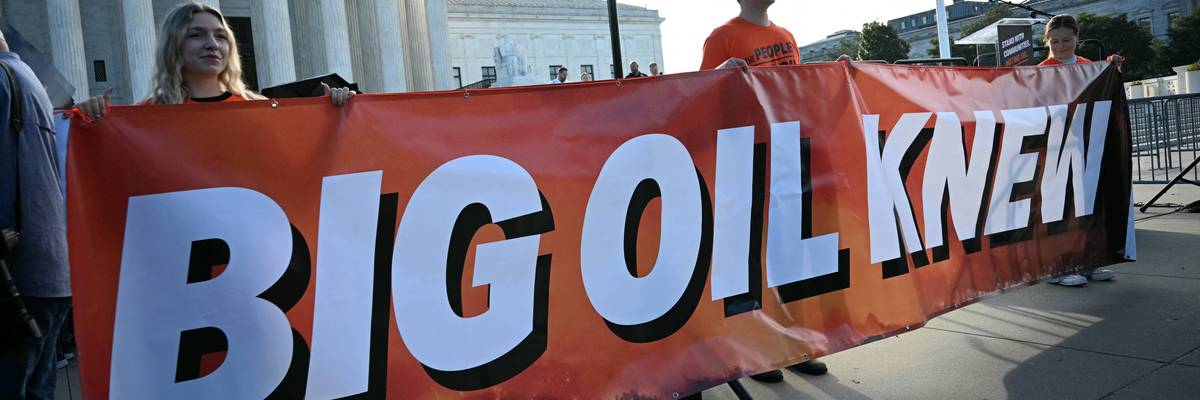
People hold a banner reading "Big Oil Knew" outside the US Supreme Court in Washington, DC on October 5, 2026 as the tribunal heard oral arguments in Suncor Energy Inc. v. County Commissioners of Boulder County.
“The fossil fuel industry’s conduct has become some of the most harmful and culpable in human history," said one campaigner. "Eventually, it will be held to account.”
The US Supreme Court on Monday appeared skeptical of efforts by ExxonMobil and Suncor Energy to prevent a Colorado climate liability lawsuit from going to trial, with justices across the ideological spectrum questioning the fossil fuel companies’ arguments for shutting down the case before evidence of their alleged deception can be heard.
The case—Suncor Energy Inc. v. County Commissioners of Boulder County—could determine the fate of nearly 60 similar lawsuits filed by states, counties, cities, and Indigenous tribes seeking to hold fossil fuel companies financially accountable for climate-related harms.
Boulder sued ExxonMobil and Suncor in 2018, alleging that the companies knew for decades about the dangers associated with burning fossil fuels while misleading the public about those risks. The city and county seek compensation for costs associated with wildfires, drought, flooding, extreme heat, and other climate impacts.
The companies, backed by the Trump administration, argue that federal law preempts the state law claims because greenhouse gas pollution crosses state and national borders. The Colorado Supreme Court ruled 5-2 in May 2025 that the climate lawsuit against ExxonMobil and Suncor could proceed under state law.
Today at the Supreme Court, my home town of Boulder, Colorado is going head-to-head against ExxonMobil in a case that could determine the future of climate litigation and holding Big Oil accountable for the toll of its harms and lies.Boulder County residents who have lost homes and health spoke.
[image or embed]
— Antonia Juhasz (@antoniajuhasz.bsky.social) October 5, 2026 at 7:55 AM
Kannon Shanmugam, an attorney for the companies, contended in oral arguments Monday that climate accountability lawsuits "reflect an all-too-regrettable trend of trying to resolve political issues in court rather than in the political branches where they belong.”
However, Chief Justice John Roberts appeared unconvinced that the interstate argument means that state courts can't consider climate claims.
“There are a lot of familiar situations where conduct outside of a state has broad effects among other states,” the conservative justice said, “and yet we allow state courts in a particular state to bring litigation that affects that.”
Justice Elena Kagan, one of the court's three liberals, also pressed the companies over their claim that federalism prevents Boulder’s lawsuit from proceeding. Kagan repeatedly demanded a legal foundation for the argument, asking: “Where’s the text for that? Where’s the support for that? Where’s the precedent for that?”
Kagan also compared the case to successful lawsuits against tobacco and opioid companies, calling the fossil fuel cases “Chapter 3” in that legal history.
“This is the same kind of lawsuit against the same kind of actors for the same kind of harm,” she said. “And I guess I’m not understanding how this one would be preempted, and the other is not?”
Climate defenders rallied outside the Supreme Court Monday as the justices heard oral arguments in the case.
Corey Riday-White, legal director at the Center for Climate Integrity, said in a statement Monday that "Big Oil’s desperation to escape trial for climate deception is still in search of a legal justification. Justices across the ideological spectrum asked good, skeptical questions that poked holes in Big Oil’s attempt to stop Boulder’s case before it can go to trial."
“Boulder’s case is about holding corporations accountable for deceptive conduct, and the people of Boulder should have their day in court to present the evidence of Exxon and Suncor’s deception," he added.
Kathy Mulvey, director of the Fossil Fuel Accountability program at the Union of Concerned Scientists (UCS), said Monday that “today’s oral arguments in Suncor v. Boulder were the latest act in Big Oil’s desperate attempt to preempt state tort lawsuits and prevent evidence of the fossil fuel industry’s campaign of deception from being heard in court."
"ExxonMobil and Suncor Energy’s efforts to evade accountability hinge on misrepresenting Boulder’s lawsuit as an attempt to regulate emissions," she stressed.
“This last-ditch effort before the Supreme Court is part of a coordinated, well-resourced push to shut down fossil fuel accountability efforts across the country," Mulvey noted. "So far, Big Oil has not achieved its top federal lobbying priority—a bill to grant the industry sweeping immunity from climate laws and lawsuits such as Boulder’s."
“Communities deserve to have their day in court," she added. "The Supreme Court should let this case be heard on its merits in Colorado, and Congress must not stand in the way by gifting Big Oil a get-out-of-jail-free card.”
“Boulder’s case is about holding corporations accountable for deceptive conduct."
In August, UCS and other experts filed an amicus brief in the case "offering a historical account of ExxonMobil’s and Suncor Energy’s concealment and denial of the hazards they knew would result from the normal use of their fossil fuel products."
The brief notes that in 1965, "Frank Ikard, then president of the American Petroleum Institute, informed the organization’s member companies—including Exxon and Suncor’s predecessor Sun Oil—that then-President Lyndon Johnson’s Science Advisory Committee had concluded continued fossil fuel combustion could produce significant climatic changes by the end of the 20th century."
"Ikard warned industry leaders the report would generate significant public concern, noting that ‘there is still time to save the world’s peoples from the catastrophic consequence of pollution, but time is running out,'" the brief added.
In 1977, an Exxon senior scientist briefed company leadership that the “general scientific agreement that the most likely manner in which mankind is influencing the global climate is through carbon dioxide release from the burning of fossil fuels.”
Exxon then conducted rigorous research on the matter, and concluded in a 1982 internal document that there was “little doubt” that atmospheric carbon dioxide was rising due to fossil fuel burning and that the resulting greenhouse effect “would warm the Earth’s surface, causing changes in climate affecting atmospheric and ocean temperatures, rainfall patterns, soil moisture, and … potentially melting the polar ice caps.”
Despite this, starting in the late 1980s, Exxon—later ExxonMobil—publicly stressed uncertainties, questioned models, and supported organizations such as the Global Climate Coalition that challenged the need for climate action.
Local governments sued to hold Big Oil accountable. So on Monday, with backing from the Trump administration, fossil fuel companies like Suncor will ask the Supreme Court to let them off the hook for their lies. Why? Because giant corporations know they have an ally in the corrupt Roberts majority.
[image or embed]
— Demand Justice (@wedemandjustice.bsky.social) October 2, 2026 at 9:28 AM
David Arkush, director of the consumer advocacy group Public Citizen's Climate Program, said Monday that “this case is about whether local communities experiencing devastating climate harms should get their day in court against Big Oil companies that spread climate deception."
"The fossil fuel industry has been going to extraordinary lengths to attack these climate cases, not just asking the Supreme Court to end the lawsuits, but also pushing Congress and state legislatures to grant fossil fuel companies immunity from all climate-related liability," Arkush noted.
"The current offensive isn’t just about defeating the cases. It’s also about preventing the public from learning the extent and severity of the industry’s wrongdoing," he continued. "It’s about fossil fuel CEOs’ profound fear of sitting in front of a jury of 12 Americans and trying to defend their companies’ deceptive conduct—because they know it’s indefensible."
“Regardless of how the Supreme Court rules in Suncor, it’s hard to imagine these companies can bury the evidence and escape accountability indefinitely," Arkush added. "The fossil fuel industry’s conduct has become some of the most harmful and culpable in human history. Eventually, it will be held to account.”
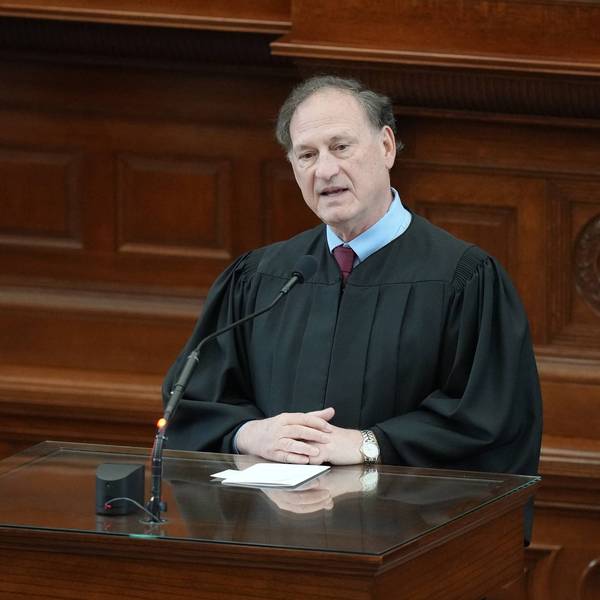
The justices are expected to issue a ruling by the end of June. Far-right Justice Samuel Alito—who holds stock in fossil fuel companies facing dozens of lawsuits that could be affected by the Suncor decision—last week recused himself from the case, leaving his eight colleagues to decide it, and raising the prospect of a 4-4 split that would leave the Colorado Supreme Court’s ruling intact.
Dear Common Dreams reader, It’s been nearly 30 years since I co-founded Common Dreams with my late wife, Lina Newhouser. We had the radical notion that journalism should serve the public good, not corporate profits. It was clear to us from the outset what it would take to build such a project. No paid advertisements. No corporate sponsors. No millionaire publisher telling us what to think or do. Many people said we wouldn't last a year, but we proved those doubters wrong. Together with a tremendous team of journalists and dedicated staff, we built an independent media outlet free from the constraints of profits and corporate control. Our mission has always been simple: To inform. To inspire. To ignite change for the common good. Building Common Dreams was not easy. Our survival was never guaranteed. When you take on the most powerful forces—Wall Street greed, fossil fuel industry destruction, Big Tech lobbyists, and uber-rich oligarchs who have spent billions upon billions rigging the economy and democracy in their favor—the only bulwark you have is supporters who believe in your work. But here’s the urgent message from me today. It's never been this bad out there. And it's never been this hard to keep us going. At the very moment Common Dreams is most needed, the threats we face are intensifying. We need your support now more than ever. We don't accept corporate advertising and never will. We don't have a paywall because we don't think people should be blocked from critical news based on their ability to pay. Everything we do is funded by the donations of readers like you. When everyone does the little they can afford, we are strong. But if that support retreats or dries up, so do we. Will you donate now to make sure Common Dreams not only survives but thrives? —Craig Brown, Co-founder |
The US Supreme Court on Monday appeared skeptical of efforts by ExxonMobil and Suncor Energy to prevent a Colorado climate liability lawsuit from going to trial, with justices across the ideological spectrum questioning the fossil fuel companies’ arguments for shutting down the case before evidence of their alleged deception can be heard.
The case—Suncor Energy Inc. v. County Commissioners of Boulder County—could determine the fate of nearly 60 similar lawsuits filed by states, counties, cities, and Indigenous tribes seeking to hold fossil fuel companies financially accountable for climate-related harms.
Boulder sued ExxonMobil and Suncor in 2018, alleging that the companies knew for decades about the dangers associated with burning fossil fuels while misleading the public about those risks. The city and county seek compensation for costs associated with wildfires, drought, flooding, extreme heat, and other climate impacts.
The companies, backed by the Trump administration, argue that federal law preempts the state law claims because greenhouse gas pollution crosses state and national borders. The Colorado Supreme Court ruled 5-2 in May 2025 that the climate lawsuit against ExxonMobil and Suncor could proceed under state law.
Today at the Supreme Court, my home town of Boulder, Colorado is going head-to-head against ExxonMobil in a case that could determine the future of climate litigation and holding Big Oil accountable for the toll of its harms and lies.Boulder County residents who have lost homes and health spoke.
[image or embed]
— Antonia Juhasz (@antoniajuhasz.bsky.social) October 5, 2026 at 7:55 AM
Kannon Shanmugam, an attorney for the companies, contended in oral arguments Monday that climate accountability lawsuits "reflect an all-too-regrettable trend of trying to resolve political issues in court rather than in the political branches where they belong.”
However, Chief Justice John Roberts appeared unconvinced that the interstate argument means that state courts can't consider climate claims.
“There are a lot of familiar situations where conduct outside of a state has broad effects among other states,” the conservative justice said, “and yet we allow state courts in a particular state to bring litigation that affects that.”
Justice Elena Kagan, one of the court's three liberals, also pressed the companies over their claim that federalism prevents Boulder’s lawsuit from proceeding. Kagan repeatedly demanded a legal foundation for the argument, asking: “Where’s the text for that? Where’s the support for that? Where’s the precedent for that?”
Kagan also compared the case to successful lawsuits against tobacco and opioid companies, calling the fossil fuel cases “Chapter 3” in that legal history.
“This is the same kind of lawsuit against the same kind of actors for the same kind of harm,” she said. “And I guess I’m not understanding how this one would be preempted, and the other is not?”
Climate defenders rallied outside the Supreme Court Monday as the justices heard oral arguments in the case.
Corey Riday-White, legal director at the Center for Climate Integrity, said in a statement Monday that "Big Oil’s desperation to escape trial for climate deception is still in search of a legal justification. Justices across the ideological spectrum asked good, skeptical questions that poked holes in Big Oil’s attempt to stop Boulder’s case before it can go to trial."
“Boulder’s case is about holding corporations accountable for deceptive conduct, and the people of Boulder should have their day in court to present the evidence of Exxon and Suncor’s deception," he added.
Kathy Mulvey, director of the Fossil Fuel Accountability program at the Union of Concerned Scientists (UCS), said Monday that “today’s oral arguments in Suncor v. Boulder were the latest act in Big Oil’s desperate attempt to preempt state tort lawsuits and prevent evidence of the fossil fuel industry’s campaign of deception from being heard in court."
"ExxonMobil and Suncor Energy’s efforts to evade accountability hinge on misrepresenting Boulder’s lawsuit as an attempt to regulate emissions," she stressed.
“This last-ditch effort before the Supreme Court is part of a coordinated, well-resourced push to shut down fossil fuel accountability efforts across the country," Mulvey noted. "So far, Big Oil has not achieved its top federal lobbying priority—a bill to grant the industry sweeping immunity from climate laws and lawsuits such as Boulder’s."
“Communities deserve to have their day in court," she added. "The Supreme Court should let this case be heard on its merits in Colorado, and Congress must not stand in the way by gifting Big Oil a get-out-of-jail-free card.”
“Boulder’s case is about holding corporations accountable for deceptive conduct."
In August, UCS and other experts filed an amicus brief in the case "offering a historical account of ExxonMobil’s and Suncor Energy’s concealment and denial of the hazards they knew would result from the normal use of their fossil fuel products."
The brief notes that in 1965, "Frank Ikard, then president of the American Petroleum Institute, informed the organization’s member companies—including Exxon and Suncor’s predecessor Sun Oil—that then-President Lyndon Johnson’s Science Advisory Committee had concluded continued fossil fuel combustion could produce significant climatic changes by the end of the 20th century."
"Ikard warned industry leaders the report would generate significant public concern, noting that ‘there is still time to save the world’s peoples from the catastrophic consequence of pollution, but time is running out,'" the brief added.
In 1977, an Exxon senior scientist briefed company leadership that the “general scientific agreement that the most likely manner in which mankind is influencing the global climate is through carbon dioxide release from the burning of fossil fuels.”
Exxon then conducted rigorous research on the matter, and concluded in a 1982 internal document that there was “little doubt” that atmospheric carbon dioxide was rising due to fossil fuel burning and that the resulting greenhouse effect “would warm the Earth’s surface, causing changes in climate affecting atmospheric and ocean temperatures, rainfall patterns, soil moisture, and … potentially melting the polar ice caps.”
Despite this, starting in the late 1980s, Exxon—later ExxonMobil—publicly stressed uncertainties, questioned models, and supported organizations such as the Global Climate Coalition that challenged the need for climate action.
Local governments sued to hold Big Oil accountable. So on Monday, with backing from the Trump administration, fossil fuel companies like Suncor will ask the Supreme Court to let them off the hook for their lies. Why? Because giant corporations know they have an ally in the corrupt Roberts majority.
[image or embed]
— Demand Justice (@wedemandjustice.bsky.social) October 2, 2026 at 9:28 AM
David Arkush, director of the consumer advocacy group Public Citizen's Climate Program, said Monday that “this case is about whether local communities experiencing devastating climate harms should get their day in court against Big Oil companies that spread climate deception."
"The fossil fuel industry has been going to extraordinary lengths to attack these climate cases, not just asking the Supreme Court to end the lawsuits, but also pushing Congress and state legislatures to grant fossil fuel companies immunity from all climate-related liability," Arkush noted.
"The current offensive isn’t just about defeating the cases. It’s also about preventing the public from learning the extent and severity of the industry’s wrongdoing," he continued. "It’s about fossil fuel CEOs’ profound fear of sitting in front of a jury of 12 Americans and trying to defend their companies’ deceptive conduct—because they know it’s indefensible."
“Regardless of how the Supreme Court rules in Suncor, it’s hard to imagine these companies can bury the evidence and escape accountability indefinitely," Arkush added. "The fossil fuel industry’s conduct has become some of the most harmful and culpable in human history. Eventually, it will be held to account.”
The justices are expected to issue a ruling by the end of June. Far-right Justice Samuel Alito—who holds stock in fossil fuel companies facing dozens of lawsuits that could be affected by the Suncor decision—last week recused himself from the case, leaving his eight colleagues to decide it, and raising the prospect of a 4-4 split that would leave the Colorado Supreme Court’s ruling intact.
The US Supreme Court on Monday appeared skeptical of efforts by ExxonMobil and Suncor Energy to prevent a Colorado climate liability lawsuit from going to trial, with justices across the ideological spectrum questioning the fossil fuel companies’ arguments for shutting down the case before evidence of their alleged deception can be heard.
The case—Suncor Energy Inc. v. County Commissioners of Boulder County—could determine the fate of nearly 60 similar lawsuits filed by states, counties, cities, and Indigenous tribes seeking to hold fossil fuel companies financially accountable for climate-related harms.
Boulder sued ExxonMobil and Suncor in 2018, alleging that the companies knew for decades about the dangers associated with burning fossil fuels while misleading the public about those risks. The city and county seek compensation for costs associated with wildfires, drought, flooding, extreme heat, and other climate impacts.
The companies, backed by the Trump administration, argue that federal law preempts the state law claims because greenhouse gas pollution crosses state and national borders. The Colorado Supreme Court ruled 5-2 in May 2025 that the climate lawsuit against ExxonMobil and Suncor could proceed under state law.
Today at the Supreme Court, my home town of Boulder, Colorado is going head-to-head against ExxonMobil in a case that could determine the future of climate litigation and holding Big Oil accountable for the toll of its harms and lies.Boulder County residents who have lost homes and health spoke.
[image or embed]
— Antonia Juhasz (@antoniajuhasz.bsky.social) October 5, 2026 at 7:55 AM
Kannon Shanmugam, an attorney for the companies, contended in oral arguments Monday that climate accountability lawsuits "reflect an all-too-regrettable trend of trying to resolve political issues in court rather than in the political branches where they belong.”
However, Chief Justice John Roberts appeared unconvinced that the interstate argument means that state courts can't consider climate claims.
“There are a lot of familiar situations where conduct outside of a state has broad effects among other states,” the conservative justice said, “and yet we allow state courts in a particular state to bring litigation that affects that.”
Justice Elena Kagan, one of the court's three liberals, also pressed the companies over their claim that federalism prevents Boulder’s lawsuit from proceeding. Kagan repeatedly demanded a legal foundation for the argument, asking: “Where’s the text for that? Where’s the support for that? Where’s the precedent for that?”
Kagan also compared the case to successful lawsuits against tobacco and opioid companies, calling the fossil fuel cases “Chapter 3” in that legal history.
“This is the same kind of lawsuit against the same kind of actors for the same kind of harm,” she said. “And I guess I’m not understanding how this one would be preempted, and the other is not?”
Climate defenders rallied outside the Supreme Court Monday as the justices heard oral arguments in the case.
Corey Riday-White, legal director at the Center for Climate Integrity, said in a statement Monday that "Big Oil’s desperation to escape trial for climate deception is still in search of a legal justification. Justices across the ideological spectrum asked good, skeptical questions that poked holes in Big Oil’s attempt to stop Boulder’s case before it can go to trial."
“Boulder’s case is about holding corporations accountable for deceptive conduct, and the people of Boulder should have their day in court to present the evidence of Exxon and Suncor’s deception," he added.
Kathy Mulvey, director of the Fossil Fuel Accountability program at the Union of Concerned Scientists (UCS), said Monday that “today’s oral arguments in Suncor v. Boulder were the latest act in Big Oil’s desperate attempt to preempt state tort lawsuits and prevent evidence of the fossil fuel industry’s campaign of deception from being heard in court."
"ExxonMobil and Suncor Energy’s efforts to evade accountability hinge on misrepresenting Boulder’s lawsuit as an attempt to regulate emissions," she stressed.
“This last-ditch effort before the Supreme Court is part of a coordinated, well-resourced push to shut down fossil fuel accountability efforts across the country," Mulvey noted. "So far, Big Oil has not achieved its top federal lobbying priority—a bill to grant the industry sweeping immunity from climate laws and lawsuits such as Boulder’s."
“Communities deserve to have their day in court," she added. "The Supreme Court should let this case be heard on its merits in Colorado, and Congress must not stand in the way by gifting Big Oil a get-out-of-jail-free card.”
“Boulder’s case is about holding corporations accountable for deceptive conduct."
In August, UCS and other experts filed an amicus brief in the case "offering a historical account of ExxonMobil’s and Suncor Energy’s concealment and denial of the hazards they knew would result from the normal use of their fossil fuel products."
The brief notes that in 1965, "Frank Ikard, then president of the American Petroleum Institute, informed the organization’s member companies—including Exxon and Suncor’s predecessor Sun Oil—that then-President Lyndon Johnson’s Science Advisory Committee had concluded continued fossil fuel combustion could produce significant climatic changes by the end of the 20th century."
"Ikard warned industry leaders the report would generate significant public concern, noting that ‘there is still time to save the world’s peoples from the catastrophic consequence of pollution, but time is running out,'" the brief added.
In 1977, an Exxon senior scientist briefed company leadership that the “general scientific agreement that the most likely manner in which mankind is influencing the global climate is through carbon dioxide release from the burning of fossil fuels.”
Exxon then conducted rigorous research on the matter, and concluded in a 1982 internal document that there was “little doubt” that atmospheric carbon dioxide was rising due to fossil fuel burning and that the resulting greenhouse effect “would warm the Earth’s surface, causing changes in climate affecting atmospheric and ocean temperatures, rainfall patterns, soil moisture, and … potentially melting the polar ice caps.”
Despite this, starting in the late 1980s, Exxon—later ExxonMobil—publicly stressed uncertainties, questioned models, and supported organizations such as the Global Climate Coalition that challenged the need for climate action.
Local governments sued to hold Big Oil accountable. So on Monday, with backing from the Trump administration, fossil fuel companies like Suncor will ask the Supreme Court to let them off the hook for their lies. Why? Because giant corporations know they have an ally in the corrupt Roberts majority.
[image or embed]
— Demand Justice (@wedemandjustice.bsky.social) October 2, 2026 at 9:28 AM
David Arkush, director of the consumer advocacy group Public Citizen's Climate Program, said Monday that “this case is about whether local communities experiencing devastating climate harms should get their day in court against Big Oil companies that spread climate deception."
"The fossil fuel industry has been going to extraordinary lengths to attack these climate cases, not just asking the Supreme Court to end the lawsuits, but also pushing Congress and state legislatures to grant fossil fuel companies immunity from all climate-related liability," Arkush noted.
"The current offensive isn’t just about defeating the cases. It’s also about preventing the public from learning the extent and severity of the industry’s wrongdoing," he continued. "It’s about fossil fuel CEOs’ profound fear of sitting in front of a jury of 12 Americans and trying to defend their companies’ deceptive conduct—because they know it’s indefensible."
“Regardless of how the Supreme Court rules in Suncor, it’s hard to imagine these companies can bury the evidence and escape accountability indefinitely," Arkush added. "The fossil fuel industry’s conduct has become some of the most harmful and culpable in human history. Eventually, it will be held to account.”
The justices are expected to issue a ruling by the end of June. Far-right Justice Samuel Alito—who holds stock in fossil fuel companies facing dozens of lawsuits that could be affected by the Suncor decision—last week recused himself from the case, leaving his eight colleagues to decide it, and raising the prospect of a 4-4 split that would leave the Colorado Supreme Court’s ruling intact.