SUBSCRIBE TO OUR FREE NEWSLETTER
Daily news & progressive opinion—funded by the people, not the corporations—delivered straight to your inbox.
5
#000000
#FFFFFF
To donate by check, phone, or other method, see our More Ways to Give page.
Daily news & progressive opinion—funded by the people, not the corporations—delivered straight to your inbox.
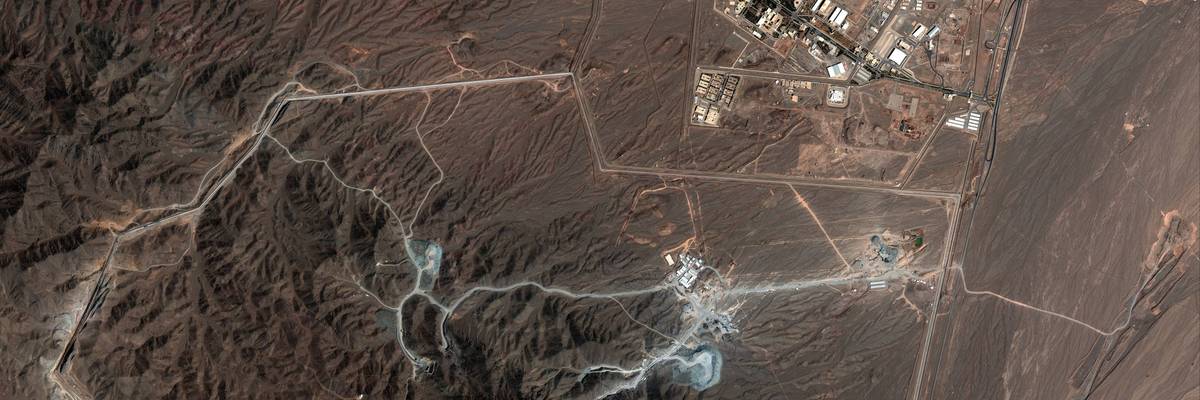
A satellite image shows the Natanz nuclear facility and adjacent underground tunnel complex in a mountainous area of Iran on September 16, 2025.
After Israel's military suggested that the United States bombed the enrichment complex, Iran launched a ballistic missile attack on an Israeli city that's home to a nuclear research center.
The head of the United Nations nuclear watchdog issued a fresh demand for restraint on Saturday after the Atomic Energy Organization of Iran announced that the Shahid Ahmadi-Roshan uranium enrichment complex in Natanz "was subjected to a renewed attack" as the United States and Israel continue to bomb the Middle Eastern country.
The Iranian agency said that "technical assessments indicate that no radioactive material leakage has occurred and there is no danger to residents of the surrounding areas," but the attack was a "violation of international laws and commitments," including the Nuclear Nonproliferation Treaty.
The International Atomic Energy Agency "has been informed by Iran that the Natanz nuclear site was attacked today," the UN watchdog confirmed on social media. "No increase in off-site radiation levels reported. IAEA is looking into the report."
"IAEA Director General Rafael Grossi reiterates call for military restraint to avoid any risk of a nuclear accident," the agency added.
The Times of Israel reported that "in response to a query... the Israel Defense Forces said that it did not conduct any strikes in the area and that it could not comment on American activities."
The Israeli newspaper also noted that "Israel’s Kan news reported that the US had indeed struck the facility, using 'bunker buster' bombs to target the site. It cited unspecified sources."
Later Saturday, The Times of Israel reported that at least 20 people were wounded in an Iranian ballistic missile attack on the Israeli city of Dimona, home to Shimon Peres Negev Nuclear Research Center.
The United States previously bombed Iran's Natanz facility last June. The Associated Press highlighted Saturday that satellite images also suggest the site was damaged during the first week of the current war, which President Donald Trump and Israeli Prime Minister Benjamin Netanyahu launched on February 28.
Condemning the Saturday strike on Iran's complex, Russian Foreign Ministry spokesperson said that "this is a brazen violation of international law, the charters of the UN and the International Atomic Energy Agency, as well as relevant resolutions of the UN Security Council and the agency's General Conference."
Russia has notably also generated fears of a nuclear accident with its ongoing invasion of Ukraine, launched in February 2022.
Trump has sent mixed messages about the US-Israeli war on Iran, both sending thousands more troops to the region this week while also saying on his Truth Social platform Friday that "we are getting very close to meeting our objectives as we consider winding down our great Military efforts in the Middle East with respect to the Terrorist Regime of Iran."
According to the AP: "Iran's capital saw heavy airstrikes overnight and into the morning, residents said, as thousands of worshippers converged on Tehran's grand mosque for prayers marking the end of the holy month of Ramadan. Israeli Defense Minister Israel Katz said attacks would 'increase significantly' next week."
Dear Common Dreams reader, It’s been nearly 30 years since I co-founded Common Dreams with my late wife, Lina Newhouser. We had the radical notion that journalism should serve the public good, not corporate profits. It was clear to us from the outset what it would take to build such a project. No paid advertisements. No corporate sponsors. No millionaire publisher telling us what to think or do. Many people said we wouldn't last a year, but we proved those doubters wrong. Together with a tremendous team of journalists and dedicated staff, we built an independent media outlet free from the constraints of profits and corporate control. Our mission has always been simple: To inform. To inspire. To ignite change for the common good. Building Common Dreams was not easy. Our survival was never guaranteed. When you take on the most powerful forces—Wall Street greed, fossil fuel industry destruction, Big Tech lobbyists, and uber-rich oligarchs who have spent billions upon billions rigging the economy and democracy in their favor—the only bulwark you have is supporters who believe in your work. But here’s the urgent message from me today. It's never been this bad out there. And it's never been this hard to keep us going. At the very moment Common Dreams is most needed, the threats we face are intensifying. We need your support now more than ever. We don't accept corporate advertising and never will. We don't have a paywall because we don't think people should be blocked from critical news based on their ability to pay. Everything we do is funded by the donations of readers like you. When everyone does the little they can afford, we are strong. But if that support retreats or dries up, so do we. Will you donate now to make sure Common Dreams not only survives but thrives? —Craig Brown, Co-founder |
The head of the United Nations nuclear watchdog issued a fresh demand for restraint on Saturday after the Atomic Energy Organization of Iran announced that the Shahid Ahmadi-Roshan uranium enrichment complex in Natanz "was subjected to a renewed attack" as the United States and Israel continue to bomb the Middle Eastern country.
The Iranian agency said that "technical assessments indicate that no radioactive material leakage has occurred and there is no danger to residents of the surrounding areas," but the attack was a "violation of international laws and commitments," including the Nuclear Nonproliferation Treaty.
The International Atomic Energy Agency "has been informed by Iran that the Natanz nuclear site was attacked today," the UN watchdog confirmed on social media. "No increase in off-site radiation levels reported. IAEA is looking into the report."
"IAEA Director General Rafael Grossi reiterates call for military restraint to avoid any risk of a nuclear accident," the agency added.
The Times of Israel reported that "in response to a query... the Israel Defense Forces said that it did not conduct any strikes in the area and that it could not comment on American activities."
The Israeli newspaper also noted that "Israel’s Kan news reported that the US had indeed struck the facility, using 'bunker buster' bombs to target the site. It cited unspecified sources."
Later Saturday, The Times of Israel reported that at least 20 people were wounded in an Iranian ballistic missile attack on the Israeli city of Dimona, home to Shimon Peres Negev Nuclear Research Center.
The United States previously bombed Iran's Natanz facility last June. The Associated Press highlighted Saturday that satellite images also suggest the site was damaged during the first week of the current war, which President Donald Trump and Israeli Prime Minister Benjamin Netanyahu launched on February 28.
Condemning the Saturday strike on Iran's complex, Russian Foreign Ministry spokesperson said that "this is a brazen violation of international law, the charters of the UN and the International Atomic Energy Agency, as well as relevant resolutions of the UN Security Council and the agency's General Conference."
Russia has notably also generated fears of a nuclear accident with its ongoing invasion of Ukraine, launched in February 2022.
Trump has sent mixed messages about the US-Israeli war on Iran, both sending thousands more troops to the region this week while also saying on his Truth Social platform Friday that "we are getting very close to meeting our objectives as we consider winding down our great Military efforts in the Middle East with respect to the Terrorist Regime of Iran."
According to the AP: "Iran's capital saw heavy airstrikes overnight and into the morning, residents said, as thousands of worshippers converged on Tehran's grand mosque for prayers marking the end of the holy month of Ramadan. Israeli Defense Minister Israel Katz said attacks would 'increase significantly' next week."
The head of the United Nations nuclear watchdog issued a fresh demand for restraint on Saturday after the Atomic Energy Organization of Iran announced that the Shahid Ahmadi-Roshan uranium enrichment complex in Natanz "was subjected to a renewed attack" as the United States and Israel continue to bomb the Middle Eastern country.
The Iranian agency said that "technical assessments indicate that no radioactive material leakage has occurred and there is no danger to residents of the surrounding areas," but the attack was a "violation of international laws and commitments," including the Nuclear Nonproliferation Treaty.
The International Atomic Energy Agency "has been informed by Iran that the Natanz nuclear site was attacked today," the UN watchdog confirmed on social media. "No increase in off-site radiation levels reported. IAEA is looking into the report."
"IAEA Director General Rafael Grossi reiterates call for military restraint to avoid any risk of a nuclear accident," the agency added.
The Times of Israel reported that "in response to a query... the Israel Defense Forces said that it did not conduct any strikes in the area and that it could not comment on American activities."
The Israeli newspaper also noted that "Israel’s Kan news reported that the US had indeed struck the facility, using 'bunker buster' bombs to target the site. It cited unspecified sources."
Later Saturday, The Times of Israel reported that at least 20 people were wounded in an Iranian ballistic missile attack on the Israeli city of Dimona, home to Shimon Peres Negev Nuclear Research Center.
The United States previously bombed Iran's Natanz facility last June. The Associated Press highlighted Saturday that satellite images also suggest the site was damaged during the first week of the current war, which President Donald Trump and Israeli Prime Minister Benjamin Netanyahu launched on February 28.
Condemning the Saturday strike on Iran's complex, Russian Foreign Ministry spokesperson said that "this is a brazen violation of international law, the charters of the UN and the International Atomic Energy Agency, as well as relevant resolutions of the UN Security Council and the agency's General Conference."
Russia has notably also generated fears of a nuclear accident with its ongoing invasion of Ukraine, launched in February 2022.
Trump has sent mixed messages about the US-Israeli war on Iran, both sending thousands more troops to the region this week while also saying on his Truth Social platform Friday that "we are getting very close to meeting our objectives as we consider winding down our great Military efforts in the Middle East with respect to the Terrorist Regime of Iran."
According to the AP: "Iran's capital saw heavy airstrikes overnight and into the morning, residents said, as thousands of worshippers converged on Tehran's grand mosque for prayers marking the end of the holy month of Ramadan. Israeli Defense Minister Israel Katz said attacks would 'increase significantly' next week."