SUBSCRIBE TO OUR FREE NEWSLETTER
Daily news & progressive opinion—funded by the people, not the corporations—delivered straight to your inbox.
5
#000000
#FFFFFF
To donate by check, phone, or other method, see our More Ways to Give page.
Daily news & progressive opinion—funded by the people, not the corporations—delivered straight to your inbox.
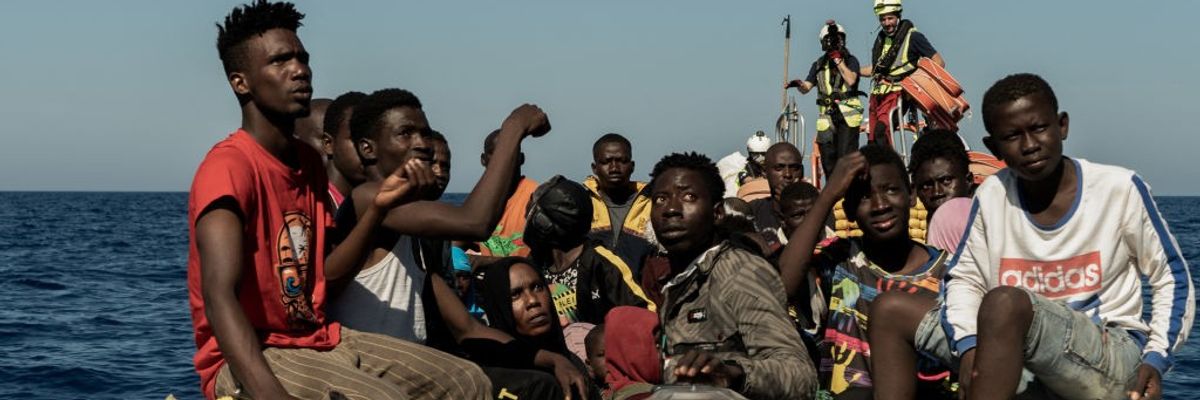
African migrants prepare to be rescued in the Mediterranean Sea on October 25, 2022.
"These figures are evidence of a profound failure of rescue and protection systems," said one campaigner.
More than 10,000 migrants died while trying to reach Spain this year—a more than 50% increase from 2023—according to a Spanish advocacy group's annual report published this week.
The NGO Caminando Fronteras (Walking Borders) said in its Monitoring the Right to Life—2024 report that 10,457 migrants died en route to Spain via the Atlantic Ocean or the Mediterranean Sea this year. Victims included 1,538 children and adolescents and 421 women. Victims hailed from 28 mostly African nations, with some coming from as far afield as Iraq and Pakistan.
"These figures are evidence of a profound failure of rescue and protection systems," the group's founder, Helena Maleno, said in a statement. "More than 10,400 people dead or missing in a single year is an unacceptable tragedy."
Walking Borders said its report "documents the deadliest period on record, with devastating figures averaging 30 deaths a day," up from an average of 18 deaths per day in 2023.
Estás cifras son el horror 👇🏾
[image or embed]
— Helena Maleno Garzón (@helenamaleno.bsky.social) December 26, 2024 at 12:06 AM
According to the report:
The Atlantic route, with 9,757 deaths, remains the deadliest in the world. Tragedies have increased, especially on the Mauritanian route, consolidating this country as the main departure point to the Canary Islands. The Algerian route, in the Mediterranean, is the second deadliest according to our records, with 517 victims. The Strait of Gibraltar has taken up to 110 lives, and another 73 have been lost on the Alboran route. In addition, 131 vessels were lost, with all persons on board.
Spain's Interior Ministry said earlier this month that, as of December 15, 57,738 migrants successfully reached the country this year by sea, an all-time high.
Walking Borders denounced what it called "the main causes of this increase in shipwrecks and victims," including "the omission of the duty to rescue, the prioritization of migration control over the right to life, the externalization of borders in countries without adequate resources, the inaction and arbitrariness in rescues, [and] the criminalization of social organizations and families."
The group also noted "the situations of extreme vulnerability" that push migrants "to throw themselves into the sea in very precarious conditions."
These include "violence, discrimination, racism, deportations, and sexual violence," as well as "being forced to survive in extreme conditions" prior to departure.
"The number of victims continues to grow and the act of documenting deaths or preserving the victims' memory carries the threat of persecution and stigmatization," the publication states, adding that the dead migrants' voices "can be heard in this report, crying out at their disappearance and death and questioning their fate. They call for justice and an end to impunity."
Dear Common Dreams reader, It’s been nearly 30 years since I co-founded Common Dreams with my late wife, Lina Newhouser. We had the radical notion that journalism should serve the public good, not corporate profits. It was clear to us from the outset what it would take to build such a project. No paid advertisements. No corporate sponsors. No millionaire publisher telling us what to think or do. Many people said we wouldn't last a year, but we proved those doubters wrong. Together with a tremendous team of journalists and dedicated staff, we built an independent media outlet free from the constraints of profits and corporate control. Our mission has always been simple: To inform. To inspire. To ignite change for the common good. Building Common Dreams was not easy. Our survival was never guaranteed. When you take on the most powerful forces—Wall Street greed, fossil fuel industry destruction, Big Tech lobbyists, and uber-rich oligarchs who have spent billions upon billions rigging the economy and democracy in their favor—the only bulwark you have is supporters who believe in your work. But here’s the urgent message from me today. It's never been this bad out there. And it's never been this hard to keep us going. At the very moment Common Dreams is most needed, the threats we face are intensifying. We need your support now more than ever. We don't accept corporate advertising and never will. We don't have a paywall because we don't think people should be blocked from critical news based on their ability to pay. Everything we do is funded by the donations of readers like you. When everyone does the little they can afford, we are strong. But if that support retreats or dries up, so do we. Will you donate now to make sure Common Dreams not only survives but thrives? —Craig Brown, Co-founder |
More than 10,000 migrants died while trying to reach Spain this year—a more than 50% increase from 2023—according to a Spanish advocacy group's annual report published this week.
The NGO Caminando Fronteras (Walking Borders) said in its Monitoring the Right to Life—2024 report that 10,457 migrants died en route to Spain via the Atlantic Ocean or the Mediterranean Sea this year. Victims included 1,538 children and adolescents and 421 women. Victims hailed from 28 mostly African nations, with some coming from as far afield as Iraq and Pakistan.
"These figures are evidence of a profound failure of rescue and protection systems," the group's founder, Helena Maleno, said in a statement. "More than 10,400 people dead or missing in a single year is an unacceptable tragedy."
Walking Borders said its report "documents the deadliest period on record, with devastating figures averaging 30 deaths a day," up from an average of 18 deaths per day in 2023.
Estás cifras son el horror 👇🏾
[image or embed]
— Helena Maleno Garzón (@helenamaleno.bsky.social) December 26, 2024 at 12:06 AM
According to the report:
The Atlantic route, with 9,757 deaths, remains the deadliest in the world. Tragedies have increased, especially on the Mauritanian route, consolidating this country as the main departure point to the Canary Islands. The Algerian route, in the Mediterranean, is the second deadliest according to our records, with 517 victims. The Strait of Gibraltar has taken up to 110 lives, and another 73 have been lost on the Alboran route. In addition, 131 vessels were lost, with all persons on board.
Spain's Interior Ministry said earlier this month that, as of December 15, 57,738 migrants successfully reached the country this year by sea, an all-time high.
Walking Borders denounced what it called "the main causes of this increase in shipwrecks and victims," including "the omission of the duty to rescue, the prioritization of migration control over the right to life, the externalization of borders in countries without adequate resources, the inaction and arbitrariness in rescues, [and] the criminalization of social organizations and families."
The group also noted "the situations of extreme vulnerability" that push migrants "to throw themselves into the sea in very precarious conditions."
These include "violence, discrimination, racism, deportations, and sexual violence," as well as "being forced to survive in extreme conditions" prior to departure.
"The number of victims continues to grow and the act of documenting deaths or preserving the victims' memory carries the threat of persecution and stigmatization," the publication states, adding that the dead migrants' voices "can be heard in this report, crying out at their disappearance and death and questioning their fate. They call for justice and an end to impunity."
More than 10,000 migrants died while trying to reach Spain this year—a more than 50% increase from 2023—according to a Spanish advocacy group's annual report published this week.
The NGO Caminando Fronteras (Walking Borders) said in its Monitoring the Right to Life—2024 report that 10,457 migrants died en route to Spain via the Atlantic Ocean or the Mediterranean Sea this year. Victims included 1,538 children and adolescents and 421 women. Victims hailed from 28 mostly African nations, with some coming from as far afield as Iraq and Pakistan.
"These figures are evidence of a profound failure of rescue and protection systems," the group's founder, Helena Maleno, said in a statement. "More than 10,400 people dead or missing in a single year is an unacceptable tragedy."
Walking Borders said its report "documents the deadliest period on record, with devastating figures averaging 30 deaths a day," up from an average of 18 deaths per day in 2023.
Estás cifras son el horror 👇🏾
[image or embed]
— Helena Maleno Garzón (@helenamaleno.bsky.social) December 26, 2024 at 12:06 AM
According to the report:
The Atlantic route, with 9,757 deaths, remains the deadliest in the world. Tragedies have increased, especially on the Mauritanian route, consolidating this country as the main departure point to the Canary Islands. The Algerian route, in the Mediterranean, is the second deadliest according to our records, with 517 victims. The Strait of Gibraltar has taken up to 110 lives, and another 73 have been lost on the Alboran route. In addition, 131 vessels were lost, with all persons on board.
Spain's Interior Ministry said earlier this month that, as of December 15, 57,738 migrants successfully reached the country this year by sea, an all-time high.
Walking Borders denounced what it called "the main causes of this increase in shipwrecks and victims," including "the omission of the duty to rescue, the prioritization of migration control over the right to life, the externalization of borders in countries without adequate resources, the inaction and arbitrariness in rescues, [and] the criminalization of social organizations and families."
The group also noted "the situations of extreme vulnerability" that push migrants "to throw themselves into the sea in very precarious conditions."
These include "violence, discrimination, racism, deportations, and sexual violence," as well as "being forced to survive in extreme conditions" prior to departure.
"The number of victims continues to grow and the act of documenting deaths or preserving the victims' memory carries the threat of persecution and stigmatization," the publication states, adding that the dead migrants' voices "can be heard in this report, crying out at their disappearance and death and questioning their fate. They call for justice and an end to impunity."