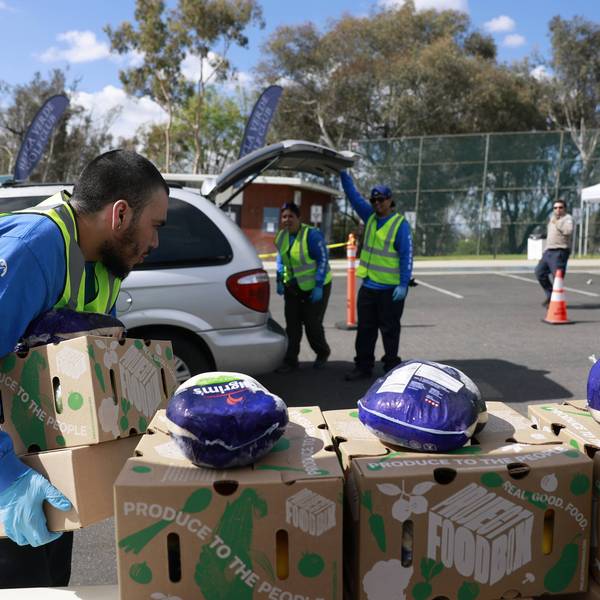
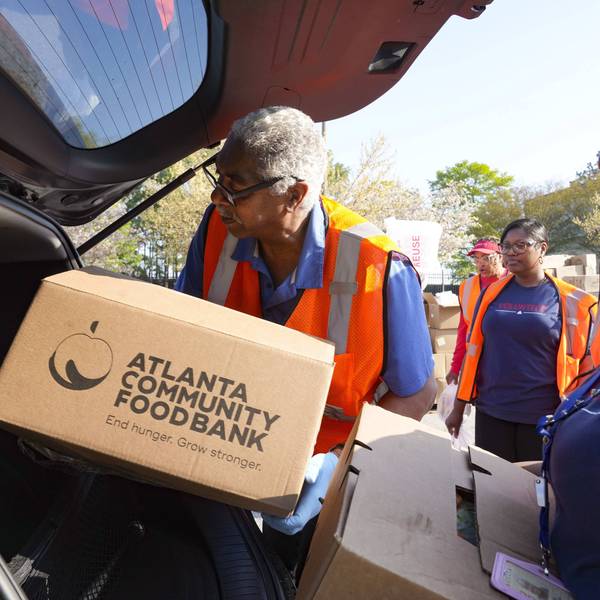
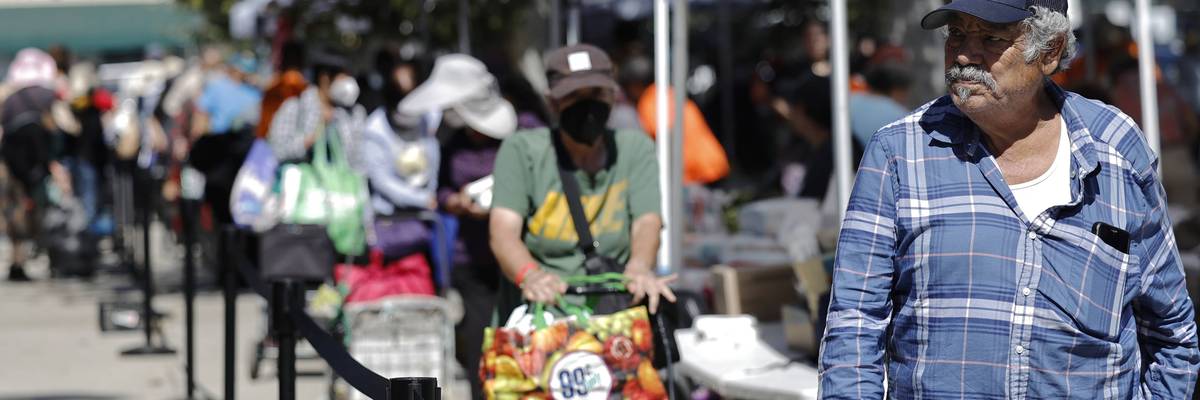
People walk after receiving food from volunteers with Pasadena Community Job Center at the Mano a Mano Pantry food distribution program on July 10, 2026 in Pasadena, California.
‘Frankly Sickening’: Reports Highlight Brutal Impact of Trump-GOP Cuts to Food Aid
"States are absolutely contemplating a world in which SNAP isn’t available."
Several reports published this week highlight the brutal impact cuts made to the Supplemental Nutrition Assistance Program in Republicans' 2025 budget law are having on Americans' access to food.
A lengthy Tuesday report in The New York Times zeroed in on the bill's impact in Arizona, where roughly 440,000 people have been dropped from the program even though many of them are still eligible to receive assistance.
The GOP-passed One Big Beautiful Bill Act established severe penalties for states that have high error rates when awarding SNAP benefits, and Arizona has responded by vastly increasing the paperwork applicants must file to qualify for the program in order to avoid making mistakes that could result in the loss of federal funding.
According to the Times, this has created "bureaucratic chaos" that has caused many otherwise eligible people to lose aid.
"It can take months to reach besieged caseworkers, and offices have gone as far as asking people with panhandling income for verification from strangers dropping cash in their jar," reported the Times. "Arizonans losing SNAP say they are skipping meals, quarreling over food, and missing rent payments to restock pantry shelves."
One former SNAP beneficiary featured in the Times story was Dee McDonald, a 65-year-old cancer survivor who reported skipping meals to ensure that the three grandsons she's raising have enough to eat.
According to the Times, McDonald has been scrambling from one local food pantry to another to ensure there is enough food in the house for the whole family, a process she told the paper has left her "exhausted."
“I go to sleep thinking about what are we going to have,” McDonald said.
Michael Wisehart, director of the Arizona Department of Economic Security, told the Times that it's "frankly sickening to me the number of individuals" who are suffering due to the bureaucratic hurdles the state is enacting.
However, Wisehart said that if Arizona doesn't add these bureaucratic layers, it could risk seeing its SNAP program completely destroyed.
“It’s an existential threat,” he explained. “States are absolutely contemplating a world in which SNAP isn’t available."
Another state facing this dilemma is Arkansas, which the local news station KATV reported on Monday is scrambling to lower its SNAP error rate that, under new rules, could cost the state $55 million per year.
Keesa Smith-Brantley, executive director of Arkansas Advocates for Children and Families and former deputy director of the Arkansas Department of Human Services, told KATV that the financial penalties imposed on the state could create a downward spiral in which state officials have fewer resources to effectively lower the SNAP error rate.
"It is very concerning that we may not have a SNAP program in years to come if the state can't come up with the funding," said Smith-Brantley.
A Tuesday report in Axios examined how the GOP's SNAP cuts have impacted Virginia, where 100,000 fewer residents are now enrolled in the program compared to a year ago.
Aaron McClung, chief development officer at Feed More, an umbrella organization for food banks in the central part of the state, told Axios that visits to food pantries have increased by more than 20% since the passage of the GOP budget law last year.
While food banks have tried to fill the gap, McClung said, they are no substitute for SNAP, which he described as "the nation's most effective, dignified, and scalable tool for reducing food insecurity."
Jacqueline Mott, Virginia state manager for the Save the Children Action Network, expressed a similar sentiment, telling Axios that "charitable food assistance was never designed to replace SNAP."
We are at a crossroads
This country and this world are at a monumental crossroads. In a few short weeks, US voters will have an opportunity to beat back the forces of fascism and confront the billionaires who are rigging the economy, our media system, and our democracy, making it increasingly impossible for ordinary people to get by. We’re not just talking about the election. We’re talking about what must be done once these fascist elements are vanquished from power. We need a bolder set of solutions than what either major party has so far been willing to offer and a working-class movement ready to fight like hell for it. Trump didn't emerge from nowhere. The conditions that fueled MAGA authoritarianism were created by decades of radical neoliberal economic policies and a corrupt political system dominated by corporate interests. They slashed taxes on the super-rich, promising that the benefits would trickle down. They said giveaways to the corporate titans would make life more affordable for the rest of us. It was all bullshit. And when a bitter, betrayed populace searches for someone to blame, right-wing demagogues have little trouble finding scapegoats. People know when they're being lied to, but you won't hear any of this from the corporate media. Only independent journalism—powered and funded by people who believe in building a better world—can deliver truly trustworthy daily news. Our Fall Campaign is underway, and we need your help. To power our newsroom through the rest of the year, we need to raise $125,000 by midnight on October 31. So if you share our vision, please contribute whatever you can to sustain our work. |
Several reports published this week highlight the brutal impact cuts made to the Supplemental Nutrition Assistance Program in Republicans' 2025 budget law are having on Americans' access to food.
A lengthy Tuesday report in The New York Times zeroed in on the bill's impact in Arizona, where roughly 440,000 people have been dropped from the program even though many of them are still eligible to receive assistance.
The GOP-passed One Big Beautiful Bill Act established severe penalties for states that have high error rates when awarding SNAP benefits, and Arizona has responded by vastly increasing the paperwork applicants must file to qualify for the program in order to avoid making mistakes that could result in the loss of federal funding.
According to the Times, this has created "bureaucratic chaos" that has caused many otherwise eligible people to lose aid.
"It can take months to reach besieged caseworkers, and offices have gone as far as asking people with panhandling income for verification from strangers dropping cash in their jar," reported the Times. "Arizonans losing SNAP say they are skipping meals, quarreling over food, and missing rent payments to restock pantry shelves."
One former SNAP beneficiary featured in the Times story was Dee McDonald, a 65-year-old cancer survivor who reported skipping meals to ensure that the three grandsons she's raising have enough to eat.
According to the Times, McDonald has been scrambling from one local food pantry to another to ensure there is enough food in the house for the whole family, a process she told the paper has left her "exhausted."
“I go to sleep thinking about what are we going to have,” McDonald said.
Michael Wisehart, director of the Arizona Department of Economic Security, told the Times that it's "frankly sickening to me the number of individuals" who are suffering due to the bureaucratic hurdles the state is enacting.
However, Wisehart said that if Arizona doesn't add these bureaucratic layers, it could risk seeing its SNAP program completely destroyed.
“It’s an existential threat,” he explained. “States are absolutely contemplating a world in which SNAP isn’t available."
Another state facing this dilemma is Arkansas, which the local news station KATV reported on Monday is scrambling to lower its SNAP error rate that, under new rules, could cost the state $55 million per year.
Keesa Smith-Brantley, executive director of Arkansas Advocates for Children and Families and former deputy director of the Arkansas Department of Human Services, told KATV that the financial penalties imposed on the state could create a downward spiral in which state officials have fewer resources to effectively lower the SNAP error rate.
"It is very concerning that we may not have a SNAP program in years to come if the state can't come up with the funding," said Smith-Brantley.
A Tuesday report in Axios examined how the GOP's SNAP cuts have impacted Virginia, where 100,000 fewer residents are now enrolled in the program compared to a year ago.
Aaron McClung, chief development officer at Feed More, an umbrella organization for food banks in the central part of the state, told Axios that visits to food pantries have increased by more than 20% since the passage of the GOP budget law last year.
While food banks have tried to fill the gap, McClung said, they are no substitute for SNAP, which he described as "the nation's most effective, dignified, and scalable tool for reducing food insecurity."
Jacqueline Mott, Virginia state manager for the Save the Children Action Network, expressed a similar sentiment, telling Axios that "charitable food assistance was never designed to replace SNAP."
- One Year In, Trump's 'Big, Ugly Bill' Is the Kick In the Face Worker Advocates Warned About ›
- 'Don't Let Kids Go Hungry': Trump Panned Over Not Using Emergency Fund for SNAP ›
- Average SNAP Recipient to See 61% Aid Cut—and Millions Will Lose All Benefits—Under Trump Plan ›
- Opinion | Diarrhea Summer: Brought to You by Trump, Big Ag, and the Climate Crisis | Common Dreams ›
- US Food Banks Under Strain as Trump Policies Drive Up Costs | Common Dreams ›
Several reports published this week highlight the brutal impact cuts made to the Supplemental Nutrition Assistance Program in Republicans' 2025 budget law are having on Americans' access to food.
A lengthy Tuesday report in The New York Times zeroed in on the bill's impact in Arizona, where roughly 440,000 people have been dropped from the program even though many of them are still eligible to receive assistance.
The GOP-passed One Big Beautiful Bill Act established severe penalties for states that have high error rates when awarding SNAP benefits, and Arizona has responded by vastly increasing the paperwork applicants must file to qualify for the program in order to avoid making mistakes that could result in the loss of federal funding.
According to the Times, this has created "bureaucratic chaos" that has caused many otherwise eligible people to lose aid.
"It can take months to reach besieged caseworkers, and offices have gone as far as asking people with panhandling income for verification from strangers dropping cash in their jar," reported the Times. "Arizonans losing SNAP say they are skipping meals, quarreling over food, and missing rent payments to restock pantry shelves."
One former SNAP beneficiary featured in the Times story was Dee McDonald, a 65-year-old cancer survivor who reported skipping meals to ensure that the three grandsons she's raising have enough to eat.
According to the Times, McDonald has been scrambling from one local food pantry to another to ensure there is enough food in the house for the whole family, a process she told the paper has left her "exhausted."
“I go to sleep thinking about what are we going to have,” McDonald said.
Michael Wisehart, director of the Arizona Department of Economic Security, told the Times that it's "frankly sickening to me the number of individuals" who are suffering due to the bureaucratic hurdles the state is enacting.
However, Wisehart said that if Arizona doesn't add these bureaucratic layers, it could risk seeing its SNAP program completely destroyed.
“It’s an existential threat,” he explained. “States are absolutely contemplating a world in which SNAP isn’t available."
Another state facing this dilemma is Arkansas, which the local news station KATV reported on Monday is scrambling to lower its SNAP error rate that, under new rules, could cost the state $55 million per year.
Keesa Smith-Brantley, executive director of Arkansas Advocates for Children and Families and former deputy director of the Arkansas Department of Human Services, told KATV that the financial penalties imposed on the state could create a downward spiral in which state officials have fewer resources to effectively lower the SNAP error rate.
"It is very concerning that we may not have a SNAP program in years to come if the state can't come up with the funding," said Smith-Brantley.
A Tuesday report in Axios examined how the GOP's SNAP cuts have impacted Virginia, where 100,000 fewer residents are now enrolled in the program compared to a year ago.
Aaron McClung, chief development officer at Feed More, an umbrella organization for food banks in the central part of the state, told Axios that visits to food pantries have increased by more than 20% since the passage of the GOP budget law last year.
While food banks have tried to fill the gap, McClung said, they are no substitute for SNAP, which he described as "the nation's most effective, dignified, and scalable tool for reducing food insecurity."
Jacqueline Mott, Virginia state manager for the Save the Children Action Network, expressed a similar sentiment, telling Axios that "charitable food assistance was never designed to replace SNAP."
- One Year In, Trump's 'Big, Ugly Bill' Is the Kick In the Face Worker Advocates Warned About ›
- 'Don't Let Kids Go Hungry': Trump Panned Over Not Using Emergency Fund for SNAP ›
- Average SNAP Recipient to See 61% Aid Cut—and Millions Will Lose All Benefits—Under Trump Plan ›
- Opinion | Diarrhea Summer: Brought to You by Trump, Big Ag, and the Climate Crisis | Common Dreams ›
- US Food Banks Under Strain as Trump Policies Drive Up Costs | Common Dreams ›