SUBSCRIBE TO OUR FREE NEWSLETTER
Daily news & progressive opinion—funded by the people, not the corporations—delivered straight to your inbox.
5
#000000
#FFFFFF
To donate by check, phone, or other method, see our More Ways to Give page.
Daily news & progressive opinion—funded by the people, not the corporations—delivered straight to your inbox.
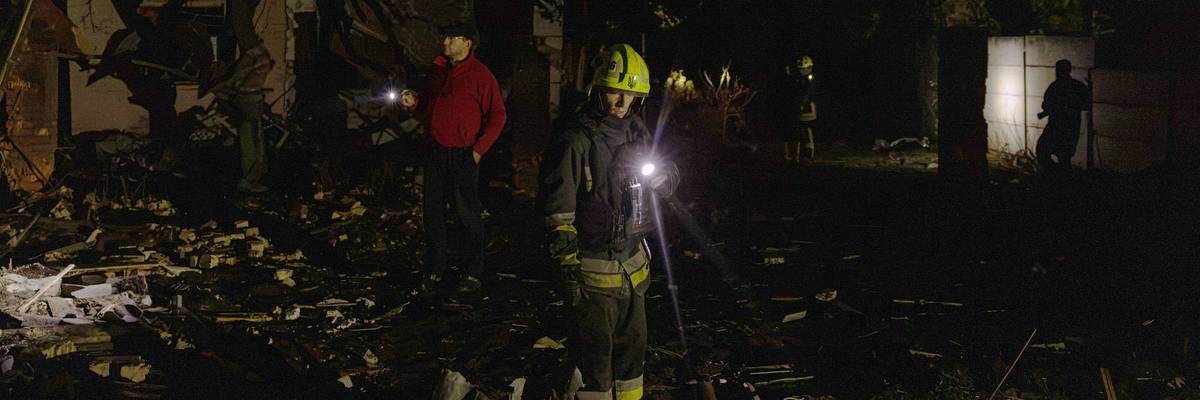
A firefighter and a resident use flashlights to inspect debris on October 22, 2026 at the site of a destroyed house in Kyiv, Ukraine following an aerial attack by Russia that also struck energy infrastructure.
"This is an illegal campaign, carried out with flagrant disregard for the rules of war, and appears to be designed to create unlivable conditions for Ukrainian civilians."
As Russia continues to strike energy infrastructure in neighboring Ukraine over 4.5 years into a full-blown invasion, Amnesty International on Monday sounded the alarm over such attacks, with winter weather approaching.
"The Russian Federation is once again implementing a large-scale campaign against Ukrainian energy and heating infrastructure ahead of a freezing winter, including attacks far from the frontlines of conflict," said Scott Edwards, who directs the human rights group's Crisis Response Program, in a statement.
"These attacks on essential infrastructure are creating a deadly situation for civilians, who directly suffer the consequences," he continued. "This is an illegal campaign, carried out with flagrant disregard for the rules of war, and appears to be designed to create unlivable conditions for Ukrainian civilians."
Russian President Vladimir Putin invaded Ukraine in February 2022, and just over a year later, the International Criminal Court issued a warrant for his arrest. The following year, the ICC also ordered the arrests of various Russian military leaders for allegedly directing attacks on Ukrainian electrical infrastructure.
"Under international humanitarian law, electricity and heating installations are civilian objects unless and for such time as they meet the strict definition of a military objective," Amnesty explained. "Even where an installation constitutes a military objective, attacking forces must comply with the principles of distinction, proportionality and precaution."
"Intentionally directing attacks against civilian objects, launching indiscriminate attacks, or carrying out attacks expected to cause excessive civilian harm in relation to the concrete and direct military advantage anticipated can constitute war crimes," the group highlighted. Both Putin and the Russian Ministry of Defense "have made public statements announcing intentional attacks on Ukraine's energy infrastructure."
Last winter, Russia "carried out at least 423 attacks on electricity infrastructure and 74 strikes on heating facilities," Amnesty detailed, citing the United Nations. "These attacks caused rolling outages affecting millions of people and interrupted heating for hundreds of thousands as temperatures fell below -20°C. The resulting loss of electricity, water, and heating disrupted healthcare and education, and also disproportionately harmed older people, persons with disabilities, women, and families with children."
Amnesty's statement came a day after Ukrainian President Volodymyr Zelenskyy said on the social media platform X that "overnight alone, our energy infrastructure came under Russian attack in four regions: Dnipro, Vinnytsia, Zhytomyr, and Khmelnytskyi."
"Substations, transformers, and power lines that supply electricity to our people's homes were targeted," Zelenskyy noted. "Repair crews are working everywhere. As of now, hundreds of thousands of families remain without power."
"Massive Russian attacks on Ukraine's other critical infrastructure are also continuing unabated," he wrote. "This past week Russia has launched 1,940 attack drones, more than 1,580 guided aerial bombs, and 44 missiles of various types against Ukraine, including 36 ballistic missiles."
The president added that "the intensity of the strikes is extremely high, and the Russians are trying to take maximum advantage of the shortage of ballistic missile interceptors," expressing a need for "Patriot missiles to America, Europe, and other partners who can help."
As Reuters reported Sunday:
On Friday, Russia said Ukraine had resumed strikes on its oil refineries and accused Kyiv of ignoring a request from US President Donald Trump to stop such attacks, which Trump has blamed for raising the cost of diesel before US midterm elections next week.
Ukraine says it supports a full ceasefire on energy targets, including its own battered power grid, but that Moscow is unwilling to agree to this.
Last month, shortly after signing a bipartisan bill targeting Russian revenue from fossil fuel exports, Trump controversially waived sanctions against Russia and struck a deal on diesel, while also blaming Zelenskyy for high US diesel prices—which are tied to Trump and Israel's illegal war on Iran. Trump is also waging war on the ICC, over its warrants for Israeli leaders.
Amnesty—which has forcefully spoken out against Trump's attacks on the tribunal—said Monday that all parties to the conflict in Russia and Ukraine "must respect the principles of distinction, proportionality, and precaution and protect civilians and civilian objects."
"States supporting accountability mechanisms must provide the expertise and resources needed to effectively investigate allegations of violations, secure evidence, and identify suspected perpetrators, including commanders and senior officials who may bear responsibility," the group continued. "All states must urgently act to protect the functioning of the ICC and should execute arrest warrants when and where they can."
Edwards added that "whatever the motives behind the Kremlin's plan to make life unbearable for civilians, it is criminal and cannot be tolerated. World leaders seeking to end this conflict must immediately use their leverage to minimize any potential harm to civilians, before another intentional humanitarian catastrophe begins with the arrival of winter."
This country and this world are at a monumental crossroads. US voters have an opportunity to beat back the forces of fascism and confront the billionaires who are rigging the economy, our media system, and our democracy, making it increasingly impossible for ordinary people to get by. We’re not just talking about the election. We’re talking about what must be done once these fascist elements are vanquished from power. We need a bolder set of solutions than what either major party has so far been willing to offer and a working-class movement ready to fight like hell for it. Trump didn't emerge from nowhere. The conditions that fueled MAGA authoritarianism were created by decades of radical neoliberal economic policies and a corrupt political system dominated by corporate interests. They slashed taxes on the super-rich, promising that the benefits would trickle down. They said giveaways to the corporate titans would make life more affordable for the rest of us. It was all bullshit. And when a bitter, betrayed populace searches for someone to blame, right-wing demagogues have little trouble finding scapegoats. People know when they're being lied to, but you won't hear any of this from the corporate media. Only independent journalism—powered and funded by people who believe in building a better world—can deliver truly trustworthy daily news. If you share our vision, please contribute whatever you can to sustain our work. |
As Russia continues to strike energy infrastructure in neighboring Ukraine over 4.5 years into a full-blown invasion, Amnesty International on Monday sounded the alarm over such attacks, with winter weather approaching.
"The Russian Federation is once again implementing a large-scale campaign against Ukrainian energy and heating infrastructure ahead of a freezing winter, including attacks far from the frontlines of conflict," said Scott Edwards, who directs the human rights group's Crisis Response Program, in a statement.
"These attacks on essential infrastructure are creating a deadly situation for civilians, who directly suffer the consequences," he continued. "This is an illegal campaign, carried out with flagrant disregard for the rules of war, and appears to be designed to create unlivable conditions for Ukrainian civilians."
Russian President Vladimir Putin invaded Ukraine in February 2022, and just over a year later, the International Criminal Court issued a warrant for his arrest. The following year, the ICC also ordered the arrests of various Russian military leaders for allegedly directing attacks on Ukrainian electrical infrastructure.
"Under international humanitarian law, electricity and heating installations are civilian objects unless and for such time as they meet the strict definition of a military objective," Amnesty explained. "Even where an installation constitutes a military objective, attacking forces must comply with the principles of distinction, proportionality and precaution."
"Intentionally directing attacks against civilian objects, launching indiscriminate attacks, or carrying out attacks expected to cause excessive civilian harm in relation to the concrete and direct military advantage anticipated can constitute war crimes," the group highlighted. Both Putin and the Russian Ministry of Defense "have made public statements announcing intentional attacks on Ukraine's energy infrastructure."
Last winter, Russia "carried out at least 423 attacks on electricity infrastructure and 74 strikes on heating facilities," Amnesty detailed, citing the United Nations. "These attacks caused rolling outages affecting millions of people and interrupted heating for hundreds of thousands as temperatures fell below -20°C. The resulting loss of electricity, water, and heating disrupted healthcare and education, and also disproportionately harmed older people, persons with disabilities, women, and families with children."
Amnesty's statement came a day after Ukrainian President Volodymyr Zelenskyy said on the social media platform X that "overnight alone, our energy infrastructure came under Russian attack in four regions: Dnipro, Vinnytsia, Zhytomyr, and Khmelnytskyi."
"Substations, transformers, and power lines that supply electricity to our people's homes were targeted," Zelenskyy noted. "Repair crews are working everywhere. As of now, hundreds of thousands of families remain without power."
"Massive Russian attacks on Ukraine's other critical infrastructure are also continuing unabated," he wrote. "This past week Russia has launched 1,940 attack drones, more than 1,580 guided aerial bombs, and 44 missiles of various types against Ukraine, including 36 ballistic missiles."
The president added that "the intensity of the strikes is extremely high, and the Russians are trying to take maximum advantage of the shortage of ballistic missile interceptors," expressing a need for "Patriot missiles to America, Europe, and other partners who can help."
As Reuters reported Sunday:
On Friday, Russia said Ukraine had resumed strikes on its oil refineries and accused Kyiv of ignoring a request from US President Donald Trump to stop such attacks, which Trump has blamed for raising the cost of diesel before US midterm elections next week.
Ukraine says it supports a full ceasefire on energy targets, including its own battered power grid, but that Moscow is unwilling to agree to this.
Last month, shortly after signing a bipartisan bill targeting Russian revenue from fossil fuel exports, Trump controversially waived sanctions against Russia and struck a deal on diesel, while also blaming Zelenskyy for high US diesel prices—which are tied to Trump and Israel's illegal war on Iran. Trump is also waging war on the ICC, over its warrants for Israeli leaders.
Amnesty—which has forcefully spoken out against Trump's attacks on the tribunal—said Monday that all parties to the conflict in Russia and Ukraine "must respect the principles of distinction, proportionality, and precaution and protect civilians and civilian objects."
"States supporting accountability mechanisms must provide the expertise and resources needed to effectively investigate allegations of violations, secure evidence, and identify suspected perpetrators, including commanders and senior officials who may bear responsibility," the group continued. "All states must urgently act to protect the functioning of the ICC and should execute arrest warrants when and where they can."
Edwards added that "whatever the motives behind the Kremlin's plan to make life unbearable for civilians, it is criminal and cannot be tolerated. World leaders seeking to end this conflict must immediately use their leverage to minimize any potential harm to civilians, before another intentional humanitarian catastrophe begins with the arrival of winter."