SUBSCRIBE TO OUR FREE NEWSLETTER
Daily news & progressive opinion—funded by the people, not the corporations—delivered straight to your inbox.
5
#000000
#FFFFFF
To donate by check, phone, or other method, see our More Ways to Give page.
Daily news & progressive opinion—funded by the people, not the corporations—delivered straight to your inbox.
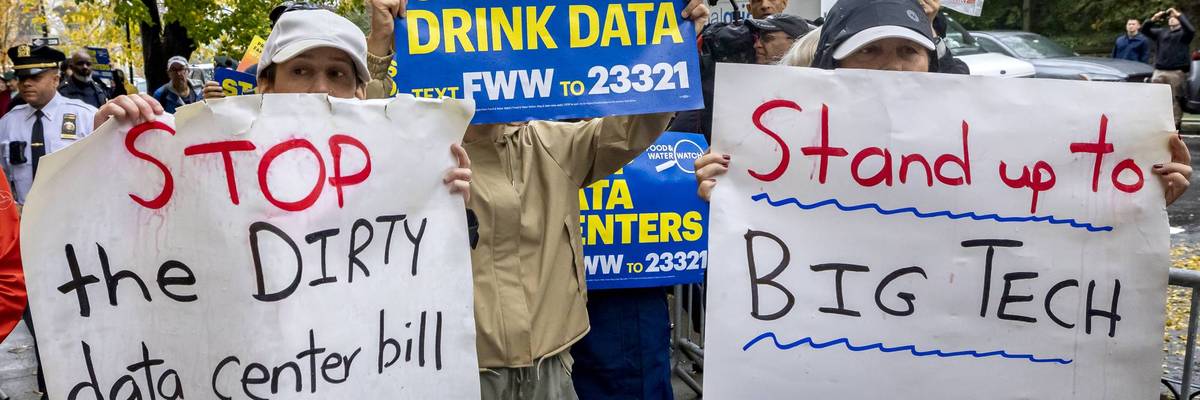
Activists staged a protest outside the home of Senate Minority Leader Chuck Schumer (D-NY), calling out his support for rolling back key environmental laws that would effectively ensure data center projects.
"If Texas of all places can go blue, then we can be bold enough to say a better bill is possible."
Environmental groups are making a last-ditch push to persuade Senate Minority Leader Chuck Schumer to block a bipartisan permitting bill that they warn would speed up approvals for polluting projects and data center infrastructure.
Activists gathered outside Schumer’s (D-NY) Midtown Manhattan office Monday morning, hours before the US Senate’s planned evening vote on whether to advance the Bipartisan American Affordability and Jobs Act (BAAJA).
In a media advisory, organizers from the New York Public Interest Research Group, Food & Water Watch, and New York Communities for Change, who led Monday’s protest and a previous one at Schumer’s apartment on Friday, called the bill an “aggressive attack on federal environmental protections in order to facilitate rapid, unregulated development of fracked gas power plants, dirty fossil fuel pipelines, and expensive hyperscale data centers.”
The motion needs 60 votes to advance, so some Democrats will have to support holding a final vote. The bill’s leading Democratic sponsor, Sen. Sheldon Whitehouse (D-RI), said he believes supporters “have the votes to proceed.”
The bill faces longer odds in the US House of Representatives, especially after Tuesday’s Democratic blowout in the midterms, when voters across the country also backed restrictions on data centers.
Sponsors have revised the bill, but David Watkins, director of government affairs for the Climate and Energy programs at the Union of Concerned Scientists, argued that the amendment “fails to address the fundamental imbalance of the legislation” in favor of polluting energy.
“To get bipartisan support for negligible reductions in emissions,” he said, “this deal would convert compliance with the National Environmental Policy Act, Endangered Species Act, National Historic Preservation Act, and Clean Water Act into largely voluntary exercises.”
While some Democratic proponents of the bill have argued that these compromises are necessary to speed up permits for clean energy infrastructure, Watkins said existing law already allows much of that work and saw no need to enact “the most significant legislative reversal in environmental and community protections in decades.”
A coalition of conservation groups, including Earthjustice Action, Defenders of Wildlife, and Friends of the Earth, sent a letter to the Senate on Monday urging members to delay the vote until newly elected members of the US Congress—some of whom made opposition to data centers central to their campaigns—can be sworn in.
“The elections on November 3 sent a clear message from the American public denouncing the administration’s actions over the past two years and, in states across the country, rejecting the accelerated proliferation of data centers,” they wrote. “We strongly encourage you to heed the public’s wishes and advance energy infrastructure needs and an affordability agenda without making false and unnecessary trade-offs that severely undermine tribal sovereignty and our bedrock environmental, public lands, waters, wildlife, ocean, and historic preservation laws.”
Sen. Jeff Merkley (D-Ore.) said he would vote against advancing the bill without substantial changes, adding that “robust consideration of the bill should be a priority in the new Congress.”
"Permitting reform for electrical transmission lines is essential," he said. But, he added, "Getting more renewable electrons where they are needed doesn’t tackle climate change if you simultaneously promote the burning of more fossil fuels. Unfortunately, this bill does exactly that."
As questions mount about whether Democratic leaders will use their new mandate to pursue a bold legislative agenda, some see BAAJA as a worrying sign that Schumer and other party leaders may squander the moment by reverting to business as usual.
“If Texas of all places can go blue, then we can be bold enough to say a better bill is possible,” said Aru Shiney-Ajay, executive director of the youth-led climate group Sunrise Movement. “Young people and the working class deserve it. To stop the climate crisis, America needs Senate Democrats to fight harder. Senate Democrats must deliver.”
This country and this world are at a monumental crossroads. US voters have an opportunity to beat back the forces of fascism and confront the billionaires who are rigging the economy, our media system, and our democracy, making it increasingly impossible for ordinary people to get by. We’re not just talking about the election. We’re talking about what must be done once these fascist elements are vanquished from power. We need a bolder set of solutions than what either major party has so far been willing to offer and a working-class movement ready to fight like hell for it. Trump didn't emerge from nowhere. The conditions that fueled MAGA authoritarianism were created by decades of radical neoliberal economic policies and a corrupt political system dominated by corporate interests. They slashed taxes on the super-rich, promising that the benefits would trickle down. They said giveaways to the corporate titans would make life more affordable for the rest of us. It was all bullshit. And when a bitter, betrayed populace searches for someone to blame, right-wing demagogues have little trouble finding scapegoats. People know when they're being lied to, but you won't hear any of this from the corporate media. Only independent journalism—powered and funded by people who believe in building a better world—can deliver truly trustworthy daily news. If you share our vision, please contribute whatever you can to sustain our work. |
Environmental groups are making a last-ditch push to persuade Senate Minority Leader Chuck Schumer to block a bipartisan permitting bill that they warn would speed up approvals for polluting projects and data center infrastructure.
Activists gathered outside Schumer’s (D-NY) Midtown Manhattan office Monday morning, hours before the US Senate’s planned evening vote on whether to advance the Bipartisan American Affordability and Jobs Act (BAAJA).
In a media advisory, organizers from the New York Public Interest Research Group, Food & Water Watch, and New York Communities for Change, who led Monday’s protest and a previous one at Schumer’s apartment on Friday, called the bill an “aggressive attack on federal environmental protections in order to facilitate rapid, unregulated development of fracked gas power plants, dirty fossil fuel pipelines, and expensive hyperscale data centers.”
The motion needs 60 votes to advance, so some Democrats will have to support holding a final vote. The bill’s leading Democratic sponsor, Sen. Sheldon Whitehouse (D-RI), said he believes supporters “have the votes to proceed.”
The bill faces longer odds in the US House of Representatives, especially after Tuesday’s Democratic blowout in the midterms, when voters across the country also backed restrictions on data centers.
Sponsors have revised the bill, but David Watkins, director of government affairs for the Climate and Energy programs at the Union of Concerned Scientists, argued that the amendment “fails to address the fundamental imbalance of the legislation” in favor of polluting energy.
“To get bipartisan support for negligible reductions in emissions,” he said, “this deal would convert compliance with the National Environmental Policy Act, Endangered Species Act, National Historic Preservation Act, and Clean Water Act into largely voluntary exercises.”
While some Democratic proponents of the bill have argued that these compromises are necessary to speed up permits for clean energy infrastructure, Watkins said existing law already allows much of that work and saw no need to enact “the most significant legislative reversal in environmental and community protections in decades.”
A coalition of conservation groups, including Earthjustice Action, Defenders of Wildlife, and Friends of the Earth, sent a letter to the Senate on Monday urging members to delay the vote until newly elected members of the US Congress—some of whom made opposition to data centers central to their campaigns—can be sworn in.
“The elections on November 3 sent a clear message from the American public denouncing the administration’s actions over the past two years and, in states across the country, rejecting the accelerated proliferation of data centers,” they wrote. “We strongly encourage you to heed the public’s wishes and advance energy infrastructure needs and an affordability agenda without making false and unnecessary trade-offs that severely undermine tribal sovereignty and our bedrock environmental, public lands, waters, wildlife, ocean, and historic preservation laws.”
Sen. Jeff Merkley (D-Ore.) said he would vote against advancing the bill without substantial changes, adding that “robust consideration of the bill should be a priority in the new Congress.”
"Permitting reform for electrical transmission lines is essential," he said. But, he added, "Getting more renewable electrons where they are needed doesn’t tackle climate change if you simultaneously promote the burning of more fossil fuels. Unfortunately, this bill does exactly that."
As questions mount about whether Democratic leaders will use their new mandate to pursue a bold legislative agenda, some see BAAJA as a worrying sign that Schumer and other party leaders may squander the moment by reverting to business as usual.
“If Texas of all places can go blue, then we can be bold enough to say a better bill is possible,” said Aru Shiney-Ajay, executive director of the youth-led climate group Sunrise Movement. “Young people and the working class deserve it. To stop the climate crisis, America needs Senate Democrats to fight harder. Senate Democrats must deliver.”