SUBSCRIBE TO OUR FREE NEWSLETTER
Daily news & progressive opinion—funded by the people, not the corporations—delivered straight to your inbox.
5
#000000
#FFFFFF
To donate by check, phone, or other method, see our More Ways to Give page.
Daily news & progressive opinion—funded by the people, not the corporations—delivered straight to your inbox.
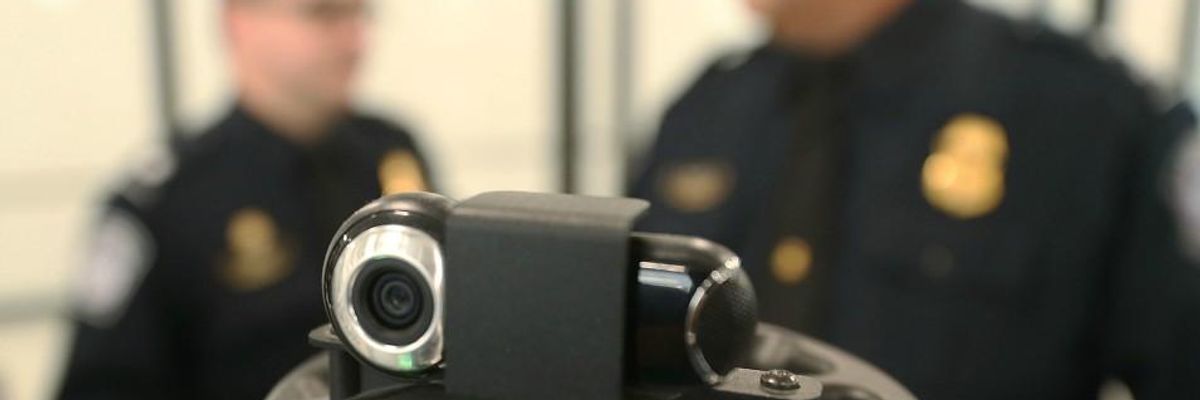
U.S. Customs and Border Protection officers use a facial recognition device at Miami International Airport in Miami to screen travelers entering the United States on February 27, 2018.
"Biometric data collection poses serious risks of privacy invasion and discrimination, and Americans know they should not have to forgo personal privacy for safety," said Sen. Ed Markey.
As evidence mounts that facial recognition technology is racially biased and has led to wrongful arrests of people in the U.S., Sen. Ed Markey and Rep. Pramila Jayapal on Tuesday reintroduced their legislation to impose sweeping prohibitions on the use of the technology by federal agencies and entities that receive federal funding.
The Facial Recognition and Biometric Technology Moratorium Act of 2023 would prohibit federal agencies from using facial recognition as well as biometric technology, including "voice recognition, gate recognition, and recognition of other immutable physical characteristics," according to Markey.
The Massachusetts Democrat has in recent months called on federal agencies including the Transportation Security Administration (TSA) and Immigration and Customs Enforcement (ICE) to stop using such surveillance mechanisms to identify people who may have committed crimes, warning the TSA last month that a recent federal study found "Asian and African-American people were up to 100 times more likely to be misidentified than white men by facial recognition technology."
The use of facial recognition stands "in the way of progress and perpetuate[s] injustice," said Markey in a statement.
"The year is 2023, but we are living through 1984. The continued proliferation of surveillance tools like facial recognition technologies in our society is deeply disturbing," said Markey. "Biometric data collection poses serious risks of privacy invasion and discrimination, and Americans know they should not have to forgo personal privacy for safety."
In addition to imposing a strict ban on the use of facial recognition and biometric technologies by federal entities, said Markey, the legislation would:
In Maryland, Alonzo Sawyer was recently arrested near Baltimore for assaulting a bus driver and stealing their phone, despite the fact that he was home at the time of the attack and his wife confirmed his alibi. An intelligence agency used facial recognition technology to match Sawyer to CCTV footage from the bus.
Sawyer was just the latest Black American man to be arrested after being misidentified using facial recognition technology.
Those wrongful arrests are "why I have long called on government to halt the deployment of facial recognition technology," said Jayapal. "This legislation will not only preserve civil liberties but aggressively fight back against injustice by stopping federal entities from irresponsibly using facial recognition and biometric surveillance tools."
"Facial recognition has continued to harm vulnerable communities and erode our privacy, making this legislation more important than ever," said Caitlin Seeley George, campaigns and managing director for digital rights group Fight for the Future, which supports an outright ban on law enforcement use of the technology. "We cannot afford to wait any longer to put this invasive technology in check, and any lawmaker who claims to care about privacy and justice must prove it by supporting this legislation."
As they introduced the bill, Markey and Jayapal were joined by Sens. Jeff Merkley (D-Ore.), Bernie Sanders (I-Vt.), Elizabeth Warren (D-Mass.), and Ron Wyden (D-Ore.) and Reps. Ayanna Pressley (D-Mass.), Rashida Tlaib (D-Mich.), Earl Blumenauer (D-Ore.), Cori Bush (D-Mo.), Greg Casar (D-Texas), Adriano Espaillat (D-N.Y.), Barbara Lee (D-Calif.), Eleanor Holmes Norton (D-D.C.), Jamaal Bowman (D-N.Y.), and Jan Schakowsky (D-Ill.).
As Common Dreams reported Tuesday, a lawsuit filed by the ACLU unveiled a "major investment" by the FBI in the development of facial recognition software.
"This sweeping government surveillance software is a nightmare for our privacy rights," said the ACLU Tuesday. "Lawmakers need to close the door on government abuse of this technology now, before it's too late."
The newly reintroduced legislation demonstrates that "Markey understands Congress should not be using federal funds to underwrite the use of technologies that threaten our most sacred civil rights and civil liberties," said Chad Marlow, senior policy counsel for the organization. "The ACLU applauds Sen. Markey's leadership on this issue and thanks all the members of Congress who join him in safeguarding our freedoms against the prying eyes of unchecked government surveillance."
Dear Common Dreams reader, It’s been nearly 30 years since I co-founded Common Dreams with my late wife, Lina Newhouser. We had the radical notion that journalism should serve the public good, not corporate profits. It was clear to us from the outset what it would take to build such a project. No paid advertisements. No corporate sponsors. No millionaire publisher telling us what to think or do. Many people said we wouldn't last a year, but we proved those doubters wrong. Together with a tremendous team of journalists and dedicated staff, we built an independent media outlet free from the constraints of profits and corporate control. Our mission has always been simple: To inform. To inspire. To ignite change for the common good. Building Common Dreams was not easy. Our survival was never guaranteed. When you take on the most powerful forces—Wall Street greed, fossil fuel industry destruction, Big Tech lobbyists, and uber-rich oligarchs who have spent billions upon billions rigging the economy and democracy in their favor—the only bulwark you have is supporters who believe in your work. But here’s the urgent message from me today. It's never been this bad out there. And it's never been this hard to keep us going. At the very moment Common Dreams is most needed, the threats we face are intensifying. We need your support now more than ever. We don't accept corporate advertising and never will. We don't have a paywall because we don't think people should be blocked from critical news based on their ability to pay. Everything we do is funded by the donations of readers like you. When everyone does the little they can afford, we are strong. But if that support retreats or dries up, so do we. Will you donate now to make sure Common Dreams not only survives but thrives? —Craig Brown, Co-founder |
As evidence mounts that facial recognition technology is racially biased and has led to wrongful arrests of people in the U.S., Sen. Ed Markey and Rep. Pramila Jayapal on Tuesday reintroduced their legislation to impose sweeping prohibitions on the use of the technology by federal agencies and entities that receive federal funding.
The Facial Recognition and Biometric Technology Moratorium Act of 2023 would prohibit federal agencies from using facial recognition as well as biometric technology, including "voice recognition, gate recognition, and recognition of other immutable physical characteristics," according to Markey.
The Massachusetts Democrat has in recent months called on federal agencies including the Transportation Security Administration (TSA) and Immigration and Customs Enforcement (ICE) to stop using such surveillance mechanisms to identify people who may have committed crimes, warning the TSA last month that a recent federal study found "Asian and African-American people were up to 100 times more likely to be misidentified than white men by facial recognition technology."
The use of facial recognition stands "in the way of progress and perpetuate[s] injustice," said Markey in a statement.
"The year is 2023, but we are living through 1984. The continued proliferation of surveillance tools like facial recognition technologies in our society is deeply disturbing," said Markey. "Biometric data collection poses serious risks of privacy invasion and discrimination, and Americans know they should not have to forgo personal privacy for safety."
In addition to imposing a strict ban on the use of facial recognition and biometric technologies by federal entities, said Markey, the legislation would:
In Maryland, Alonzo Sawyer was recently arrested near Baltimore for assaulting a bus driver and stealing their phone, despite the fact that he was home at the time of the attack and his wife confirmed his alibi. An intelligence agency used facial recognition technology to match Sawyer to CCTV footage from the bus.
Sawyer was just the latest Black American man to be arrested after being misidentified using facial recognition technology.
Those wrongful arrests are "why I have long called on government to halt the deployment of facial recognition technology," said Jayapal. "This legislation will not only preserve civil liberties but aggressively fight back against injustice by stopping federal entities from irresponsibly using facial recognition and biometric surveillance tools."
"Facial recognition has continued to harm vulnerable communities and erode our privacy, making this legislation more important than ever," said Caitlin Seeley George, campaigns and managing director for digital rights group Fight for the Future, which supports an outright ban on law enforcement use of the technology. "We cannot afford to wait any longer to put this invasive technology in check, and any lawmaker who claims to care about privacy and justice must prove it by supporting this legislation."
As they introduced the bill, Markey and Jayapal were joined by Sens. Jeff Merkley (D-Ore.), Bernie Sanders (I-Vt.), Elizabeth Warren (D-Mass.), and Ron Wyden (D-Ore.) and Reps. Ayanna Pressley (D-Mass.), Rashida Tlaib (D-Mich.), Earl Blumenauer (D-Ore.), Cori Bush (D-Mo.), Greg Casar (D-Texas), Adriano Espaillat (D-N.Y.), Barbara Lee (D-Calif.), Eleanor Holmes Norton (D-D.C.), Jamaal Bowman (D-N.Y.), and Jan Schakowsky (D-Ill.).
As Common Dreams reported Tuesday, a lawsuit filed by the ACLU unveiled a "major investment" by the FBI in the development of facial recognition software.
"This sweeping government surveillance software is a nightmare for our privacy rights," said the ACLU Tuesday. "Lawmakers need to close the door on government abuse of this technology now, before it's too late."
The newly reintroduced legislation demonstrates that "Markey understands Congress should not be using federal funds to underwrite the use of technologies that threaten our most sacred civil rights and civil liberties," said Chad Marlow, senior policy counsel for the organization. "The ACLU applauds Sen. Markey's leadership on this issue and thanks all the members of Congress who join him in safeguarding our freedoms against the prying eyes of unchecked government surveillance."
As evidence mounts that facial recognition technology is racially biased and has led to wrongful arrests of people in the U.S., Sen. Ed Markey and Rep. Pramila Jayapal on Tuesday reintroduced their legislation to impose sweeping prohibitions on the use of the technology by federal agencies and entities that receive federal funding.
The Facial Recognition and Biometric Technology Moratorium Act of 2023 would prohibit federal agencies from using facial recognition as well as biometric technology, including "voice recognition, gate recognition, and recognition of other immutable physical characteristics," according to Markey.
The Massachusetts Democrat has in recent months called on federal agencies including the Transportation Security Administration (TSA) and Immigration and Customs Enforcement (ICE) to stop using such surveillance mechanisms to identify people who may have committed crimes, warning the TSA last month that a recent federal study found "Asian and African-American people were up to 100 times more likely to be misidentified than white men by facial recognition technology."
The use of facial recognition stands "in the way of progress and perpetuate[s] injustice," said Markey in a statement.
"The year is 2023, but we are living through 1984. The continued proliferation of surveillance tools like facial recognition technologies in our society is deeply disturbing," said Markey. "Biometric data collection poses serious risks of privacy invasion and discrimination, and Americans know they should not have to forgo personal privacy for safety."
In addition to imposing a strict ban on the use of facial recognition and biometric technologies by federal entities, said Markey, the legislation would:
In Maryland, Alonzo Sawyer was recently arrested near Baltimore for assaulting a bus driver and stealing their phone, despite the fact that he was home at the time of the attack and his wife confirmed his alibi. An intelligence agency used facial recognition technology to match Sawyer to CCTV footage from the bus.
Sawyer was just the latest Black American man to be arrested after being misidentified using facial recognition technology.
Those wrongful arrests are "why I have long called on government to halt the deployment of facial recognition technology," said Jayapal. "This legislation will not only preserve civil liberties but aggressively fight back against injustice by stopping federal entities from irresponsibly using facial recognition and biometric surveillance tools."
"Facial recognition has continued to harm vulnerable communities and erode our privacy, making this legislation more important than ever," said Caitlin Seeley George, campaigns and managing director for digital rights group Fight for the Future, which supports an outright ban on law enforcement use of the technology. "We cannot afford to wait any longer to put this invasive technology in check, and any lawmaker who claims to care about privacy and justice must prove it by supporting this legislation."
As they introduced the bill, Markey and Jayapal were joined by Sens. Jeff Merkley (D-Ore.), Bernie Sanders (I-Vt.), Elizabeth Warren (D-Mass.), and Ron Wyden (D-Ore.) and Reps. Ayanna Pressley (D-Mass.), Rashida Tlaib (D-Mich.), Earl Blumenauer (D-Ore.), Cori Bush (D-Mo.), Greg Casar (D-Texas), Adriano Espaillat (D-N.Y.), Barbara Lee (D-Calif.), Eleanor Holmes Norton (D-D.C.), Jamaal Bowman (D-N.Y.), and Jan Schakowsky (D-Ill.).
As Common Dreams reported Tuesday, a lawsuit filed by the ACLU unveiled a "major investment" by the FBI in the development of facial recognition software.
"This sweeping government surveillance software is a nightmare for our privacy rights," said the ACLU Tuesday. "Lawmakers need to close the door on government abuse of this technology now, before it's too late."
The newly reintroduced legislation demonstrates that "Markey understands Congress should not be using federal funds to underwrite the use of technologies that threaten our most sacred civil rights and civil liberties," said Chad Marlow, senior policy counsel for the organization. "The ACLU applauds Sen. Markey's leadership on this issue and thanks all the members of Congress who join him in safeguarding our freedoms against the prying eyes of unchecked government surveillance."