SUBSCRIBE TO OUR FREE NEWSLETTER
Daily news & progressive opinion—funded by the people, not the corporations—delivered straight to your inbox.
5
#000000
#FFFFFF
To donate by check, phone, or other method, see our More Ways to Give page.
Daily news & progressive opinion—funded by the people, not the corporations—delivered straight to your inbox.

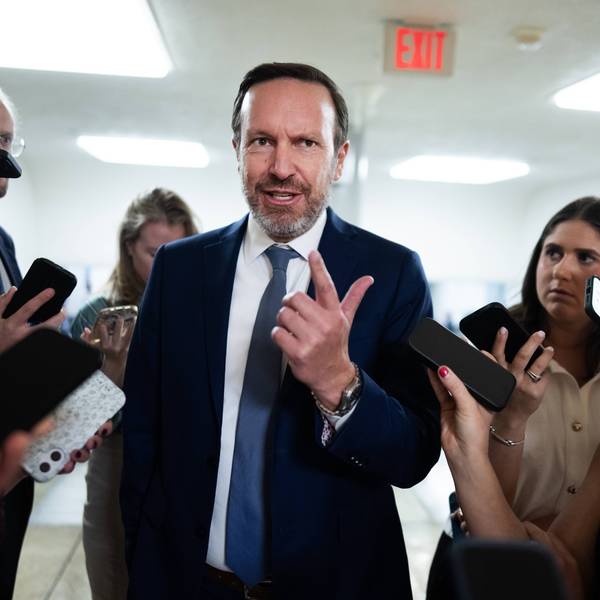
US House Intelligence Committee Ranking Member Jim Himes (D-Conn.) speaks to the press on the sidelines of the Third Black Sea Security Forum at the Odesa National Academic Opera and Ballet Theatre in Odesa, Ukraine, on May 29, 2026.
"Americans across the political spectrum have good reason to distrust unchecked executive branch surveillance power."
As a few leading congressional Democrats urged their Republican colleagues to reauthorize a widely reviled spying power before Democratic majorities take over in January, a diverse coalition of advocacy groups on Thursday demanded lawmakers refrain from including a provision on Section 702 of the Foreign Intelligence Surveillance Act in any critical bills before the year ends.
Rampant abuse of that portion of FISA—which lets the federal government spy on electronic communications of noncitizens located outside the country without a warrant—has fueled calls for reform across the ideological spectrum in Congress and among civil society organizations. Although Section 702 expired in June, surveillance operations will be able to continue through next March.
Noting that various lawmakers have long "sought meaningful reforms," including a warrant requirement for "accessing the private communications of US persons in Section 702 databases and closing the data broker loophole," the new letter calls on top Democrats and Republicans in both chambers of Congress to keep a reauthorization of Section 702 "out of the National Defense Authorization Act (NDAA) or any other must-pass legislation in the waning days of the 119th Congress."
"The principle at stake is fundamental: Foreign intelligence authorities and purchased data should not be used to circumvent Americans’ Fourth Amendment rights," argued more than two dozen groups. "The need for reform is particularly acute as artificial intelligence tools are making it cheaper and easier than ever for the government to compile and analyze Americans' data at scale to reveal our habits, associations, and beliefs."
"Americans across the political spectrum have good reason to distrust unchecked executive branch surveillance power. Conservatives have seen abuses of surveillance authorities targeted at political campaigns and other Americans engaged in lawful, First Amendment-protected activity. And progressives have warned against granting expansive surveillance powers to the current administration," the letter notes. President Donald Trump has both fought for and sabotaged reauthorization efforts.
The letter emphasizes that "in recent years, Section 702 has been abused to spy on protesters on the left and the right; 19,000 donors to a congressional campaign; members of Congress and their staff; and multiple government officials, political commentators, and journalists. No member of Congress knows who will occupy the White House in the years ahead, and constitutional protections should not depend on who is president."
Signatories include the ACLU, Center for Democracy & Technology, Electronic Frontier Foundation, Fight for the Future, Free Press Action, Win Without War, and the Brennan Center for Justice at New York University's School of Law—whose Liberty and National Security Program counsel, Hannah James, stressed that "for too long, Section 702's warrantless foreign intelligence surveillance authority has been abused to spy on Americans. Slipping an extension into must-pass year-end legislation, instead of openly debating and voting on bipartisan reforms, would betray the democratic process and Americans' Fourth Amendment rights."
Hajar Hammado, senior policy adviser at Demand Progress, which helped organize the letter, similarly said in a statement that "following the widespread outcry over Flock cameras, it's clear that the American people don't want mass surveillance. Slipping a renewal of federal mass surveillance powers into a must-pass defense bill during a lame-duck session would be a wholesale rejection of what the American people want."
"Congressional leaders need to reject the failed agenda of out-of-touch Intelligence elites who want unchecked surveillance of Americans by refusing to add FISA to the NDAA or any other must-pass bill," the campaigner continued.
Jason Pye, vice president at the Due Process Institute, another signatory, pointed to Democrats' sweeping victories in the midterms: "Voters just spoke with a resounding voice that they are sick of politics as usual in Congress. They're sick of backroom deals. They're sick of being sold out."
"Putting the reauthorization of Section 702 in the NDAA is a terrible message to send back to voters who are desperately seeking a change in how Congress operates," Pye declared. "Worse, it's coming at a time when there are increasing worries about the executive branch having too much power. The notion that Congress would reauthorize Section 702 without a warrant requirement and without prohibiting the government from buying information on Americans from third-party data brokers is incomprehensible."
The letter came a day after House Intelligence Committee Ranking Member Jim Himes (D-Conn.), who will likely chair the panel next year, urged the GOP to act on reauthorization immediately: "My preference would be, let’s just take the win that’s on the table, get it done in the lame-duck,” he told Politico on Wednesday. "If that fails, we'll do something in the first quarter."
Senate Intelligence Committee Vice Chair Mark Warner (D-Va.) also backed a lame-duck reauthorization, acknowledging that "it becomes much more difficult in a new Congress," while Sen. Mark Kelly (D-Ariz.) told the outlet: "We need to get it reauthorized... As soon as possible."
In response to that reporting, Hammado charged that "Jim Himes has betrayed his own party and the American people," highlighting that a reauthorization is desired by not only Trump but also his controversial new chief of staff, Stephen Miller.
"After seeing a blowout election where Americans overwhelmingly rejected Trump and sided with the Democrats, Himes' first instinct was to urge Republicans to use the little time they have left to hand Donald Trump and Stephen Miller the mass surveillance powers that they're asking for," said the Demand Progress adviser.
"It's incredibly telling that Himes fears the idea of his own party having the leverage to stop Trump from bypassing the courts to spy on everyday Americans, and it is shameful he is advising the administration on how to undermine Americans’ privacy," added Hammado. "Democrats and Republicans alike must reject Himes' agenda and oppose any effort to force a FISA renewal through Congress."
This country and this world are at a monumental crossroads. US voters have an opportunity to beat back the forces of fascism and confront the billionaires who are rigging the economy, our media system, and our democracy, making it increasingly impossible for ordinary people to get by. We’re not just talking about the election. We’re talking about what must be done once these fascist elements are vanquished from power. We need a bolder set of solutions than what either major party has so far been willing to offer and a working-class movement ready to fight like hell for it. Trump didn't emerge from nowhere. The conditions that fueled MAGA authoritarianism were created by decades of radical neoliberal economic policies and a corrupt political system dominated by corporate interests. They slashed taxes on the super-rich, promising that the benefits would trickle down. They said giveaways to the corporate titans would make life more affordable for the rest of us. It was all bullshit. And when a bitter, betrayed populace searches for someone to blame, right-wing demagogues have little trouble finding scapegoats. People know when they're being lied to, but you won't hear any of this from the corporate media. Only independent journalism—powered and funded by people who believe in building a better world—can deliver truly trustworthy daily news. If you share our vision, please contribute whatever you can to sustain our work. |
As a few leading congressional Democrats urged their Republican colleagues to reauthorize a widely reviled spying power before Democratic majorities take over in January, a diverse coalition of advocacy groups on Thursday demanded lawmakers refrain from including a provision on Section 702 of the Foreign Intelligence Surveillance Act in any critical bills before the year ends.
Rampant abuse of that portion of FISA—which lets the federal government spy on electronic communications of noncitizens located outside the country without a warrant—has fueled calls for reform across the ideological spectrum in Congress and among civil society organizations. Although Section 702 expired in June, surveillance operations will be able to continue through next March.
Noting that various lawmakers have long "sought meaningful reforms," including a warrant requirement for "accessing the private communications of US persons in Section 702 databases and closing the data broker loophole," the new letter calls on top Democrats and Republicans in both chambers of Congress to keep a reauthorization of Section 702 "out of the National Defense Authorization Act (NDAA) or any other must-pass legislation in the waning days of the 119th Congress."
"The principle at stake is fundamental: Foreign intelligence authorities and purchased data should not be used to circumvent Americans’ Fourth Amendment rights," argued more than two dozen groups. "The need for reform is particularly acute as artificial intelligence tools are making it cheaper and easier than ever for the government to compile and analyze Americans' data at scale to reveal our habits, associations, and beliefs."
"Americans across the political spectrum have good reason to distrust unchecked executive branch surveillance power. Conservatives have seen abuses of surveillance authorities targeted at political campaigns and other Americans engaged in lawful, First Amendment-protected activity. And progressives have warned against granting expansive surveillance powers to the current administration," the letter notes. President Donald Trump has both fought for and sabotaged reauthorization efforts.
The letter emphasizes that "in recent years, Section 702 has been abused to spy on protesters on the left and the right; 19,000 donors to a congressional campaign; members of Congress and their staff; and multiple government officials, political commentators, and journalists. No member of Congress knows who will occupy the White House in the years ahead, and constitutional protections should not depend on who is president."
Signatories include the ACLU, Center for Democracy & Technology, Electronic Frontier Foundation, Fight for the Future, Free Press Action, Win Without War, and the Brennan Center for Justice at New York University's School of Law—whose Liberty and National Security Program counsel, Hannah James, stressed that "for too long, Section 702's warrantless foreign intelligence surveillance authority has been abused to spy on Americans. Slipping an extension into must-pass year-end legislation, instead of openly debating and voting on bipartisan reforms, would betray the democratic process and Americans' Fourth Amendment rights."
Hajar Hammado, senior policy adviser at Demand Progress, which helped organize the letter, similarly said in a statement that "following the widespread outcry over Flock cameras, it's clear that the American people don't want mass surveillance. Slipping a renewal of federal mass surveillance powers into a must-pass defense bill during a lame-duck session would be a wholesale rejection of what the American people want."
"Congressional leaders need to reject the failed agenda of out-of-touch Intelligence elites who want unchecked surveillance of Americans by refusing to add FISA to the NDAA or any other must-pass bill," the campaigner continued.
Jason Pye, vice president at the Due Process Institute, another signatory, pointed to Democrats' sweeping victories in the midterms: "Voters just spoke with a resounding voice that they are sick of politics as usual in Congress. They're sick of backroom deals. They're sick of being sold out."
"Putting the reauthorization of Section 702 in the NDAA is a terrible message to send back to voters who are desperately seeking a change in how Congress operates," Pye declared. "Worse, it's coming at a time when there are increasing worries about the executive branch having too much power. The notion that Congress would reauthorize Section 702 without a warrant requirement and without prohibiting the government from buying information on Americans from third-party data brokers is incomprehensible."
The letter came a day after House Intelligence Committee Ranking Member Jim Himes (D-Conn.), who will likely chair the panel next year, urged the GOP to act on reauthorization immediately: "My preference would be, let’s just take the win that’s on the table, get it done in the lame-duck,” he told Politico on Wednesday. "If that fails, we'll do something in the first quarter."
Senate Intelligence Committee Vice Chair Mark Warner (D-Va.) also backed a lame-duck reauthorization, acknowledging that "it becomes much more difficult in a new Congress," while Sen. Mark Kelly (D-Ariz.) told the outlet: "We need to get it reauthorized... As soon as possible."
In response to that reporting, Hammado charged that "Jim Himes has betrayed his own party and the American people," highlighting that a reauthorization is desired by not only Trump but also his controversial new chief of staff, Stephen Miller.
"After seeing a blowout election where Americans overwhelmingly rejected Trump and sided with the Democrats, Himes' first instinct was to urge Republicans to use the little time they have left to hand Donald Trump and Stephen Miller the mass surveillance powers that they're asking for," said the Demand Progress adviser.
"It's incredibly telling that Himes fears the idea of his own party having the leverage to stop Trump from bypassing the courts to spy on everyday Americans, and it is shameful he is advising the administration on how to undermine Americans’ privacy," added Hammado. "Democrats and Republicans alike must reject Himes' agenda and oppose any effort to force a FISA renewal through Congress."