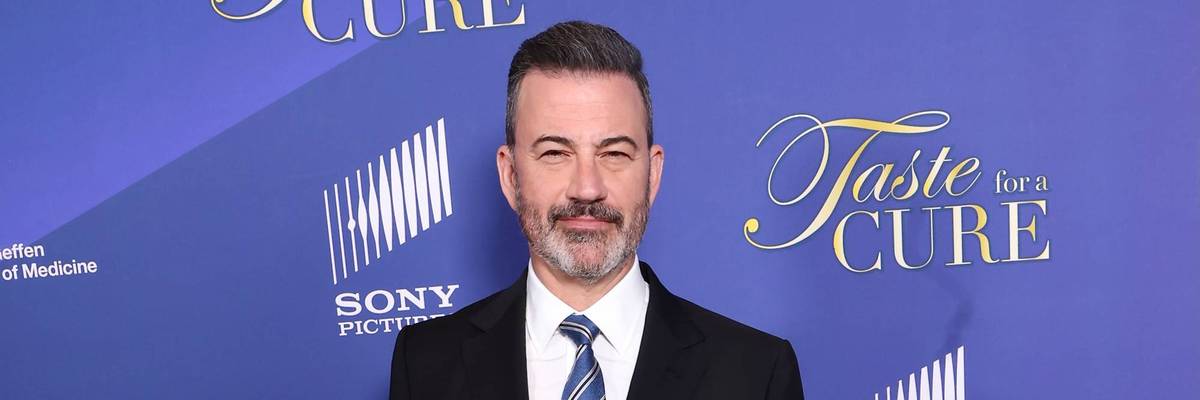
Jimmy Kimmel attends the UCLA Jonsson Cancer Center Foundation’s 28th Annual Taste for a Cure at the Beverly Wilshire, a Four Seasons Hotel, on May 2, 2025, in Beverly Hills, California.
Jimmy Kimmel Pulls Talarico Interview From Broadcast, Moves it to YouTube, Amid Trump FCC Threats
"Another day, another chilling effect on broadcast speech," said one free speech advocate, who added that "nothing about the FCC’s actions is normal—or legal."
Late-night host Jimmy Kimmel told viewers Wednesday night that his show was pulling an interview with Democratic Texas Senate nominee James Talarico from ABC stations amid threats from President Donald Trump's Federal Communications Commission, which press freedom groups are describing as another effort by the administration to "chill" the speech of the president's critics.
“Out of consideration for our local stations, especially our ABC affiliates in Texas who would have to deal with this nonsense, my interview tomorrow with James Talarico will not air on television,” the host said on Wednesday’s episode of “Jimmy Kimmel Live.”
He added that the interview “will be posted on YouTube instead. It will not be on TV.”
It's the second time a major US network has opted to spike a late-night interview with Talarico following FCC pressure. In February, CBS lawyers preemptively stopped Stephen Colbert from conducting an interview with the candidate over what they said were fears of retaliation from the agency, whose chair, Brendan Carr, has threatened to strip broadcast licenses from networks that give Trump unfavorable coverage.
Carr has confirmed that the FCC had opened an investigation and started an "enforcement proceeding" into ABC over whether Talarico's appearance on "The View" violated the equal-time rule, which requires that broadcast stations that host political candidates must give their opponents an equal opportunity to appear as well.
Late-night shows have long been considered exempt from this rule as “bona fide news interview” programs. But a public notice issued by the FCC Media Bureau in January stated that programs that advance “partisan” goals, including talk shows, would no longer be considered as such. Carr has said programs he considers to be “fake news” may not qualify for an exemption.
Kimmel on Wednesday emphasized the "unusual circumstances" of his network's decision to cancel the interview with Talarico.
"For the whole 20-plus years of our show, I've been interviewing Americans who are running for office with no problem at all... from Hillary Clinton, to Ted Cruz, to Donald Trump himself," he said.
Kimmel noted that when he interviewed Trump during his first presidential run in 2015, he seemed to have no issue with political candidates appearing on his show and eagerly returned for more interviews.
"For some reason, and I can't seem to figure out what that reason is, something has changed," Kimmel joked. "Now that he's president, his FCC has threatened me, threatened our show, threatened our network, ABC, our affiliates, our local stations—based on simple, traditional editorial decisions, guest bookings it would seem they don’t like."
For that reason, he said, if viewers "want to learn about a candidate for the Senate tomorrow, you will have to go to the 'Jimmy Kimmel Live' YouTube channel."
"Thank goodness we have that," Kimmel said. "Because in the America we have right now, that is the best that we can do, until November, of course."
In August, ABC parent company Disney sued the FCC on First Amendment grounds following the agency’s unusual request for its eight ABC stations to submit their broadcast renewal requests several years in advance, which it described as part of a “retaliatory campaign” against the network's negative coverage of Trump.
The complaint notes that ABC has felt compelled to alter its editorial judgment in order to avoid further retaliation, including passing on interviews with several other political candidates it felt would invite Trump's ire and choosing to air a lie-filled Trump address about supposed election fraud, which it noted it "ordinarily would not have done."
Last September, ABC briefly removed Kimmel from the air following direct threats from Carr to strip ABC stations of their broadcast licenses, which came after a critical monologue from the late-night host about Trump and Republicans in the wake of the assassination of right-wing activist Charlie Kirk.
The complaint notes Carr’s use of explicit coercion to pressure ABC to remove Kimmel, including telling the network that it could proceed “the easy way or the hard way."
Kimmel emphasized what he said was the political nature of the pressure campaign against him and the network, which has continued even after he was reinstated. Republicans, he said, "are very nervous about the midterms and very rightly so," as they are "in serious danger of losing 'bigly.'"
"They are in danger of losing a Senate seat in Texas of all places," he said to cheers from the crowd, "where James Talarico is leading a piece of human silly putty named Ken Paxton there," according to several recent polls.
Press freedom and civil liberties organizations described Carr's threats to networks as part of an effort to chill critical speech on behalf of the president, one that is ratcheting up as the midterms approach.
Timothy Karr, the senior director of strategy and communications for Free Press, told Common Dreams that Carr's "unconstitutional crusade against a free press has a clear bias against individuals and outlets that President Trump doesn't like."
"Combine that with Trump's desperation in the face of electoral polling that shows people ready to change political course come November, and you can see the real reason driving Carr's reckless fixation with silencing opposing views," Karr said.
Karr argued that networks were unnecessarily casting aside their rights to editorial judgment out of fear of retaliation.
"For years, the FCC has been very clear that bona fide news interviews, including on late-night talk shows, are entitled to editorial discretion," Karr said. "Carr's ongoing efforts to take this discretion away are part and parcel of his campaign to transform broadcast media into full-time megaphones for Trumpist propaganda."
He said, "What's doubly worrying is that many of these broadcast networks are too eager to cave to Trump and Carr's demands when the First Amendment is clearly on their side."
Jenna Leventoff, senior policy counsel for the ACLU, concurred, telling Common Dreams that the FCC "abusing its rules to chill speech" is "particularly problematic before an election, when voters need more information, not less."
Bob Corn-Revere, the chief counsel for the Foundation for Individual Rights and Expression (FIRE), told Common Dreams it was “another day, another chilling effect on broadcast speech," adding that ”nothing about the FCC’s actions is normal—or legal.“
Shiva Stella, the legal director at Public Knowledge, emphasized that networks capitulating helps to cement a climate of fear.
"This is a classic chilling effect," Stella told Common Dreams. "Once the FCC threatens stations over editorial decisions, it does not need to repeat the threat every time. Broadcasters begin changing their programming to avoid retaliation."
“The FCC needs to stop using its power to bully news organizations into silencing voices it simply disagrees with,” added Tim Richardson, journalism and disinformation program director at PEN America, in a statement to Common Dreams.
“When broadcasters alter decisions because they fear government retaliation," he said, "that damage extends beyond a single program and threatens the independence of the entire press and the public’s access to information. Which, unfortunately, seems to be the intent in this case.”
We are at a crossroads
This country and this world are at a monumental crossroads. In a few short weeks, US voters will have an opportunity to beat back the forces of fascism and confront the billionaires who are rigging the economy, our media system, and our democracy, making it increasingly impossible for ordinary people to get by. We’re not just talking about the election. We’re talking about what must be done once these fascist elements are vanquished from power. We need a bolder set of solutions than what either major party has so far been willing to offer and a working-class movement ready to fight like hell for it. Trump didn't emerge from nowhere. The conditions that fueled MAGA authoritarianism were created by decades of radical neoliberal economic policies and a corrupt political system dominated by corporate interests. They slashed taxes on the super-rich, promising that the benefits would trickle down. They said giveaways to the corporate titans would make life more affordable for the rest of us. It was all bullshit. And when a bitter, betrayed populace searches for someone to blame, right-wing demagogues have little trouble finding scapegoats. People know when they're being lied to, but you won't hear any of this from the corporate media. Only independent journalism—powered and funded by people who believe in building a better world—can deliver truly trustworthy daily news. Our Fall Campaign is underway, and we need your help. To power our newsroom through the rest of the year, we need to raise $125,000 by midnight on October 31. So if you share our vision, please contribute whatever you can to sustain our work. |
Late-night host Jimmy Kimmel told viewers Wednesday night that his show was pulling an interview with Democratic Texas Senate nominee James Talarico from ABC stations amid threats from President Donald Trump's Federal Communications Commission, which press freedom groups are describing as another effort by the administration to "chill" the speech of the president's critics.
“Out of consideration for our local stations, especially our ABC affiliates in Texas who would have to deal with this nonsense, my interview tomorrow with James Talarico will not air on television,” the host said on Wednesday’s episode of “Jimmy Kimmel Live.”
He added that the interview “will be posted on YouTube instead. It will not be on TV.”
It's the second time a major US network has opted to spike a late-night interview with Talarico following FCC pressure. In February, CBS lawyers preemptively stopped Stephen Colbert from conducting an interview with the candidate over what they said were fears of retaliation from the agency, whose chair, Brendan Carr, has threatened to strip broadcast licenses from networks that give Trump unfavorable coverage.
Carr has confirmed that the FCC had opened an investigation and started an "enforcement proceeding" into ABC over whether Talarico's appearance on "The View" violated the equal-time rule, which requires that broadcast stations that host political candidates must give their opponents an equal opportunity to appear as well.
Late-night shows have long been considered exempt from this rule as “bona fide news interview” programs. But a public notice issued by the FCC Media Bureau in January stated that programs that advance “partisan” goals, including talk shows, would no longer be considered as such. Carr has said programs he considers to be “fake news” may not qualify for an exemption.
Kimmel on Wednesday emphasized the "unusual circumstances" of his network's decision to cancel the interview with Talarico.
"For the whole 20-plus years of our show, I've been interviewing Americans who are running for office with no problem at all... from Hillary Clinton, to Ted Cruz, to Donald Trump himself," he said.
Kimmel noted that when he interviewed Trump during his first presidential run in 2015, he seemed to have no issue with political candidates appearing on his show and eagerly returned for more interviews.
"For some reason, and I can't seem to figure out what that reason is, something has changed," Kimmel joked. "Now that he's president, his FCC has threatened me, threatened our show, threatened our network, ABC, our affiliates, our local stations—based on simple, traditional editorial decisions, guest bookings it would seem they don’t like."
For that reason, he said, if viewers "want to learn about a candidate for the Senate tomorrow, you will have to go to the 'Jimmy Kimmel Live' YouTube channel."
"Thank goodness we have that," Kimmel said. "Because in the America we have right now, that is the best that we can do, until November, of course."
In August, ABC parent company Disney sued the FCC on First Amendment grounds following the agency’s unusual request for its eight ABC stations to submit their broadcast renewal requests several years in advance, which it described as part of a “retaliatory campaign” against the network's negative coverage of Trump.
The complaint notes that ABC has felt compelled to alter its editorial judgment in order to avoid further retaliation, including passing on interviews with several other political candidates it felt would invite Trump's ire and choosing to air a lie-filled Trump address about supposed election fraud, which it noted it "ordinarily would not have done."
Last September, ABC briefly removed Kimmel from the air following direct threats from Carr to strip ABC stations of their broadcast licenses, which came after a critical monologue from the late-night host about Trump and Republicans in the wake of the assassination of right-wing activist Charlie Kirk.
The complaint notes Carr’s use of explicit coercion to pressure ABC to remove Kimmel, including telling the network that it could proceed “the easy way or the hard way."
Kimmel emphasized what he said was the political nature of the pressure campaign against him and the network, which has continued even after he was reinstated. Republicans, he said, "are very nervous about the midterms and very rightly so," as they are "in serious danger of losing 'bigly.'"
"They are in danger of losing a Senate seat in Texas of all places," he said to cheers from the crowd, "where James Talarico is leading a piece of human silly putty named Ken Paxton there," according to several recent polls.
Press freedom and civil liberties organizations described Carr's threats to networks as part of an effort to chill critical speech on behalf of the president, one that is ratcheting up as the midterms approach.
Timothy Karr, the senior director of strategy and communications for Free Press, told Common Dreams that Carr's "unconstitutional crusade against a free press has a clear bias against individuals and outlets that President Trump doesn't like."
"Combine that with Trump's desperation in the face of electoral polling that shows people ready to change political course come November, and you can see the real reason driving Carr's reckless fixation with silencing opposing views," Karr said.
Karr argued that networks were unnecessarily casting aside their rights to editorial judgment out of fear of retaliation.
"For years, the FCC has been very clear that bona fide news interviews, including on late-night talk shows, are entitled to editorial discretion," Karr said. "Carr's ongoing efforts to take this discretion away are part and parcel of his campaign to transform broadcast media into full-time megaphones for Trumpist propaganda."
He said, "What's doubly worrying is that many of these broadcast networks are too eager to cave to Trump and Carr's demands when the First Amendment is clearly on their side."
Jenna Leventoff, senior policy counsel for the ACLU, concurred, telling Common Dreams that the FCC "abusing its rules to chill speech" is "particularly problematic before an election, when voters need more information, not less."
Bob Corn-Revere, the chief counsel for the Foundation for Individual Rights and Expression (FIRE), told Common Dreams it was “another day, another chilling effect on broadcast speech," adding that ”nothing about the FCC’s actions is normal—or legal.“
Shiva Stella, the legal director at Public Knowledge, emphasized that networks capitulating helps to cement a climate of fear.
"This is a classic chilling effect," Stella told Common Dreams. "Once the FCC threatens stations over editorial decisions, it does not need to repeat the threat every time. Broadcasters begin changing their programming to avoid retaliation."
“The FCC needs to stop using its power to bully news organizations into silencing voices it simply disagrees with,” added Tim Richardson, journalism and disinformation program director at PEN America, in a statement to Common Dreams.
“When broadcasters alter decisions because they fear government retaliation," he said, "that damage extends beyond a single program and threatens the independence of the entire press and the public’s access to information. Which, unfortunately, seems to be the intent in this case.”
- 'The Fight Doesn’t End Here': Despite Kimmel's Return, Accountability Demanded for Trump's FCC Chair, Media Execs ›
- Democratic Commissioner Anna Gomez Blasts Trump FCC Attack on Disney-ABC in Blistering Letter ›
- FCC Moves to Yank Disney Broadcast Licenses as Trumps Demand ABC Fire Kimmel ›
- ABC Learns from Past Mistakes, Takes Stronger Stance Against Carr and Trump's Censorship Campaign ›
- ABC Hits Trump FCC With First Amendment Suit Over 'Deeply Un-American' Effort to Strip Broadcast Licenses ›
- 'It's About Time': ABC News Pushes Back Against Trump's FCC Attack on Free Press ›
- Colbert Blasts CBS for Cowering to Trump, Refusing to Air Interview With Texas Democrat James Talarico ›
- Ted Cruz Silent After GOP Rallygoer Shouts That Dems 'Should Be Shot' During Speech | Common Dreams ›
Late-night host Jimmy Kimmel told viewers Wednesday night that his show was pulling an interview with Democratic Texas Senate nominee James Talarico from ABC stations amid threats from President Donald Trump's Federal Communications Commission, which press freedom groups are describing as another effort by the administration to "chill" the speech of the president's critics.
“Out of consideration for our local stations, especially our ABC affiliates in Texas who would have to deal with this nonsense, my interview tomorrow with James Talarico will not air on television,” the host said on Wednesday’s episode of “Jimmy Kimmel Live.”
He added that the interview “will be posted on YouTube instead. It will not be on TV.”
It's the second time a major US network has opted to spike a late-night interview with Talarico following FCC pressure. In February, CBS lawyers preemptively stopped Stephen Colbert from conducting an interview with the candidate over what they said were fears of retaliation from the agency, whose chair, Brendan Carr, has threatened to strip broadcast licenses from networks that give Trump unfavorable coverage.
Carr has confirmed that the FCC had opened an investigation and started an "enforcement proceeding" into ABC over whether Talarico's appearance on "The View" violated the equal-time rule, which requires that broadcast stations that host political candidates must give their opponents an equal opportunity to appear as well.
Late-night shows have long been considered exempt from this rule as “bona fide news interview” programs. But a public notice issued by the FCC Media Bureau in January stated that programs that advance “partisan” goals, including talk shows, would no longer be considered as such. Carr has said programs he considers to be “fake news” may not qualify for an exemption.
Kimmel on Wednesday emphasized the "unusual circumstances" of his network's decision to cancel the interview with Talarico.
"For the whole 20-plus years of our show, I've been interviewing Americans who are running for office with no problem at all... from Hillary Clinton, to Ted Cruz, to Donald Trump himself," he said.
Kimmel noted that when he interviewed Trump during his first presidential run in 2015, he seemed to have no issue with political candidates appearing on his show and eagerly returned for more interviews.
"For some reason, and I can't seem to figure out what that reason is, something has changed," Kimmel joked. "Now that he's president, his FCC has threatened me, threatened our show, threatened our network, ABC, our affiliates, our local stations—based on simple, traditional editorial decisions, guest bookings it would seem they don’t like."
For that reason, he said, if viewers "want to learn about a candidate for the Senate tomorrow, you will have to go to the 'Jimmy Kimmel Live' YouTube channel."
"Thank goodness we have that," Kimmel said. "Because in the America we have right now, that is the best that we can do, until November, of course."
In August, ABC parent company Disney sued the FCC on First Amendment grounds following the agency’s unusual request for its eight ABC stations to submit their broadcast renewal requests several years in advance, which it described as part of a “retaliatory campaign” against the network's negative coverage of Trump.
The complaint notes that ABC has felt compelled to alter its editorial judgment in order to avoid further retaliation, including passing on interviews with several other political candidates it felt would invite Trump's ire and choosing to air a lie-filled Trump address about supposed election fraud, which it noted it "ordinarily would not have done."
Last September, ABC briefly removed Kimmel from the air following direct threats from Carr to strip ABC stations of their broadcast licenses, which came after a critical monologue from the late-night host about Trump and Republicans in the wake of the assassination of right-wing activist Charlie Kirk.
The complaint notes Carr’s use of explicit coercion to pressure ABC to remove Kimmel, including telling the network that it could proceed “the easy way or the hard way."
Kimmel emphasized what he said was the political nature of the pressure campaign against him and the network, which has continued even after he was reinstated. Republicans, he said, "are very nervous about the midterms and very rightly so," as they are "in serious danger of losing 'bigly.'"
"They are in danger of losing a Senate seat in Texas of all places," he said to cheers from the crowd, "where James Talarico is leading a piece of human silly putty named Ken Paxton there," according to several recent polls.
Press freedom and civil liberties organizations described Carr's threats to networks as part of an effort to chill critical speech on behalf of the president, one that is ratcheting up as the midterms approach.
Timothy Karr, the senior director of strategy and communications for Free Press, told Common Dreams that Carr's "unconstitutional crusade against a free press has a clear bias against individuals and outlets that President Trump doesn't like."
"Combine that with Trump's desperation in the face of electoral polling that shows people ready to change political course come November, and you can see the real reason driving Carr's reckless fixation with silencing opposing views," Karr said.
Karr argued that networks were unnecessarily casting aside their rights to editorial judgment out of fear of retaliation.
"For years, the FCC has been very clear that bona fide news interviews, including on late-night talk shows, are entitled to editorial discretion," Karr said. "Carr's ongoing efforts to take this discretion away are part and parcel of his campaign to transform broadcast media into full-time megaphones for Trumpist propaganda."
He said, "What's doubly worrying is that many of these broadcast networks are too eager to cave to Trump and Carr's demands when the First Amendment is clearly on their side."
Jenna Leventoff, senior policy counsel for the ACLU, concurred, telling Common Dreams that the FCC "abusing its rules to chill speech" is "particularly problematic before an election, when voters need more information, not less."
Bob Corn-Revere, the chief counsel for the Foundation for Individual Rights and Expression (FIRE), told Common Dreams it was “another day, another chilling effect on broadcast speech," adding that ”nothing about the FCC’s actions is normal—or legal.“
Shiva Stella, the legal director at Public Knowledge, emphasized that networks capitulating helps to cement a climate of fear.
"This is a classic chilling effect," Stella told Common Dreams. "Once the FCC threatens stations over editorial decisions, it does not need to repeat the threat every time. Broadcasters begin changing their programming to avoid retaliation."
“The FCC needs to stop using its power to bully news organizations into silencing voices it simply disagrees with,” added Tim Richardson, journalism and disinformation program director at PEN America, in a statement to Common Dreams.
“When broadcasters alter decisions because they fear government retaliation," he said, "that damage extends beyond a single program and threatens the independence of the entire press and the public’s access to information. Which, unfortunately, seems to be the intent in this case.”
- 'The Fight Doesn’t End Here': Despite Kimmel's Return, Accountability Demanded for Trump's FCC Chair, Media Execs ›
- Democratic Commissioner Anna Gomez Blasts Trump FCC Attack on Disney-ABC in Blistering Letter ›
- FCC Moves to Yank Disney Broadcast Licenses as Trumps Demand ABC Fire Kimmel ›
- ABC Learns from Past Mistakes, Takes Stronger Stance Against Carr and Trump's Censorship Campaign ›
- ABC Hits Trump FCC With First Amendment Suit Over 'Deeply Un-American' Effort to Strip Broadcast Licenses ›
- 'It's About Time': ABC News Pushes Back Against Trump's FCC Attack on Free Press ›
- Colbert Blasts CBS for Cowering to Trump, Refusing to Air Interview With Texas Democrat James Talarico ›
- Ted Cruz Silent After GOP Rallygoer Shouts That Dems 'Should Be Shot' During Speech | Common Dreams ›