SUBSCRIBE TO OUR FREE NEWSLETTER
Daily news & progressive opinion—funded by the people, not the corporations—delivered straight to your inbox.
5
#000000
#FFFFFF
To donate by check, phone, or other method, see our More Ways to Give page.
Daily news & progressive opinion—funded by the people, not the corporations—delivered straight to your inbox.
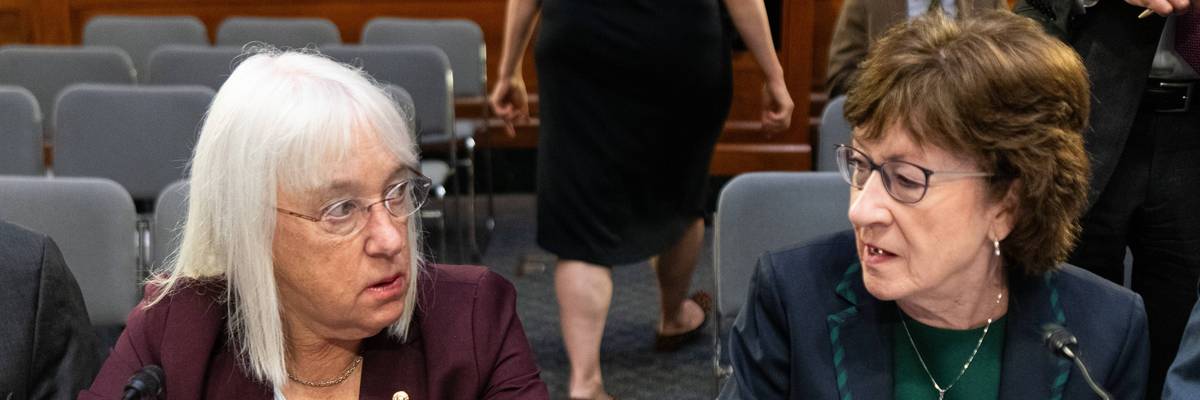
US Senate Appropriations Committee Ranking Member Patty Murray (D-Wash) and Chair Susan Collins (R-Maine) talk before the start of a bill markup on July 24, 2025 in Washington, DC.
The Senate Appropriations Committee's top Democrats celebrated that the bill rejects the president's "frivolous war spending wish list" and "corrupt new grants rule."
The Republican and Democratic leaders of the US Senate Appropriations Committee on Sunday released a stopgap funding bill that would push a potential government shutdown to after the November midterm elections, which could shake up control of Congress.
Committee Chair Susan Collins (R-Maine) called their proposed continuing resolution "straightforward," saying in a statement that "it continues current government funding levels until December 11th and includes necessary adjustments for programs like the Special Supplemental Nutrition Program for Women, Infants, and Children (WIC), vital national security programs, including shipbuilding across multiple vessels, and the Disaster Relief Fund. The CR also avoids any poison pills."
Both Collins—who a serious challenge from Democratic candidate Troy Jackson this cycle—and the panel's ranking member, Sen. Patty Murray (D-Wash.), highlighted that their legislation would prevent the Office of Management and Budget's (OMB) legally contested proposal to politicize federal grants from taking effect for the duration of the CR.
"It’s good that we were able to produce a much-improved CR to keep the government funded and avert a shutdown that no one wants," Murray said in her own statement, pointing to "important extensions" that were not included in a funding bill recently passed by Republicans in the House of Representatives.
The Senate version rejected President Donald Trump's "frivolous war spending wish list," Murray stressed. "Importantly, we closed the loophole in House Republicans' CR that would have allowed the Trump administration to transfer funding provided for other programs to Border Patrol, which desperately needs reform, not more money."
"Because of Democrats' unrelenting efforts, this bill blocks implementation of OMB's corrupt new grants rule for the duration of the CR," she said. "The proposed rule would systematically politicize federal funding and allow Trump officials to cancel grants at any time for any reason. Enabling this rule would only give Trump the green light to take even more federal funding hostage. While Republicans rejected killing the proposed rule outright, I'm going to keep fighting to put a stop to it once and for all, and I will keep pressing my Republican colleagues to do exactly that."
"I pushed hard to extend infrastructure funding set to run out on September 30, so that we can save jobs and keep fixing America's roads and bridges, and I also fought to protect Congress' power of the purse and prevent Russ Vought from attempting another end-run around Congress with illegal 'pocket rescissions,'" the senator noted, referring to the OMB director.
Murray said that "ultimately, Republicans refused to work with us to get these commonsense priorities enacted in law, but I hope everyone who shares my frustration that Republicans refuse to do more to stand up to this president will join us in speaking out and speaking up for change in every way possible."
The CR appears to have support from party leaders in the chamber. Thanking Murray "for her tireless work on this deal and her success blocking Trump's disgraceful efforts to further politicize all federal grants," Senate Minority Leader Chuck Schumer (D-NY) called it "a responsible path forward that allows continued bipartisan negotiations on a budget that delivers for American families."
Ryan Wrasse, a spokesperson for Senate Majority Leader John Thune (R-SD), said on social media that "passing it now will avert costly government shutdown in the fall," and the first procedural vote will be held on Monday. However, getting the bill to Trump's desk will require support from the GOP-controlled House.
House Appropriations Committee Ranking Member Rosa DeLauro (D-Conn.) said Sunday that "two weeks ago, House Republican leadership forced us to vote on an incomplete and inadequate first draft of a continuing resolution. I was clear at the time—any serious measure to fund the government must continue the bipartisan, bicameral agreement to prohibit funding for Immigration and Customs Enforcement and the Border Patrol in annual appropriations bills unless dramatic reforms are included."
DeLauro pointed out that she'd also called for addressing OMB's "continued attempts to codify their desire to discriminate against Federal grant recipients based on their political viewpoints and undermine the first amendment rights of Americans—anti-constitutional actions which the Department of Energy recently admitted in court to carrying out."
"The bill the Senate is expected to consider this week includes both of those critical elements, along with other important provisions needed to keep government functioning without disruption," she said. "While the bill temporarily blocks the proposed OMB rule, the fight must continue. The Senate bill forces OMB to continue reviewing the half-million comments that were submitted, but Congress must permanently prevent this corrupt, harmful power grab before the new deadline of December 11."
"This bill is a clear improvement over the House Republican continuing resolution," DeLauro concluded, "but we are still nearly two months away from the end of the fiscal year and should be working together to pass full-year funding bills that lower the cost of living, rein in the corruption at the highest levels of the government, and can earn the support of Democrats and Republicans in the House and in the Senate."
Dear Common Dreams reader, It’s been nearly 30 years since I co-founded Common Dreams with my late wife, Lina Newhouser. We had the radical notion that journalism should serve the public good, not corporate profits. It was clear to us from the outset what it would take to build such a project. No paid advertisements. No corporate sponsors. No millionaire publisher telling us what to think or do. Many people said we wouldn't last a year, but we proved those doubters wrong. Together with a tremendous team of journalists and dedicated staff, we built an independent media outlet free from the constraints of profits and corporate control. Our mission has always been simple: To inform. To inspire. To ignite change for the common good. Building Common Dreams was not easy. Our survival was never guaranteed. When you take on the most powerful forces—Wall Street greed, fossil fuel industry destruction, Big Tech lobbyists, and uber-rich oligarchs who have spent billions upon billions rigging the economy and democracy in their favor—the only bulwark you have is supporters who believe in your work. But here’s the urgent message from me today. It's never been this bad out there. And it's never been this hard to keep us going. At the very moment Common Dreams is most needed, the threats we face are intensifying. We need your support now more than ever. We don't accept corporate advertising and never will. We don't have a paywall because we don't think people should be blocked from critical news based on their ability to pay. Everything we do is funded by the donations of readers like you. When everyone does the little they can afford, we are strong. But if that support retreats or dries up, so do we. Will you donate now to make sure Common Dreams not only survives but thrives? —Craig Brown, Co-founder |
The Republican and Democratic leaders of the US Senate Appropriations Committee on Sunday released a stopgap funding bill that would push a potential government shutdown to after the November midterm elections, which could shake up control of Congress.
Committee Chair Susan Collins (R-Maine) called their proposed continuing resolution "straightforward," saying in a statement that "it continues current government funding levels until December 11th and includes necessary adjustments for programs like the Special Supplemental Nutrition Program for Women, Infants, and Children (WIC), vital national security programs, including shipbuilding across multiple vessels, and the Disaster Relief Fund. The CR also avoids any poison pills."
Both Collins—who a serious challenge from Democratic candidate Troy Jackson this cycle—and the panel's ranking member, Sen. Patty Murray (D-Wash.), highlighted that their legislation would prevent the Office of Management and Budget's (OMB) legally contested proposal to politicize federal grants from taking effect for the duration of the CR.
"It’s good that we were able to produce a much-improved CR to keep the government funded and avert a shutdown that no one wants," Murray said in her own statement, pointing to "important extensions" that were not included in a funding bill recently passed by Republicans in the House of Representatives.
The Senate version rejected President Donald Trump's "frivolous war spending wish list," Murray stressed. "Importantly, we closed the loophole in House Republicans' CR that would have allowed the Trump administration to transfer funding provided for other programs to Border Patrol, which desperately needs reform, not more money."
"Because of Democrats' unrelenting efforts, this bill blocks implementation of OMB's corrupt new grants rule for the duration of the CR," she said. "The proposed rule would systematically politicize federal funding and allow Trump officials to cancel grants at any time for any reason. Enabling this rule would only give Trump the green light to take even more federal funding hostage. While Republicans rejected killing the proposed rule outright, I'm going to keep fighting to put a stop to it once and for all, and I will keep pressing my Republican colleagues to do exactly that."
"I pushed hard to extend infrastructure funding set to run out on September 30, so that we can save jobs and keep fixing America's roads and bridges, and I also fought to protect Congress' power of the purse and prevent Russ Vought from attempting another end-run around Congress with illegal 'pocket rescissions,'" the senator noted, referring to the OMB director.
Murray said that "ultimately, Republicans refused to work with us to get these commonsense priorities enacted in law, but I hope everyone who shares my frustration that Republicans refuse to do more to stand up to this president will join us in speaking out and speaking up for change in every way possible."
The CR appears to have support from party leaders in the chamber. Thanking Murray "for her tireless work on this deal and her success blocking Trump's disgraceful efforts to further politicize all federal grants," Senate Minority Leader Chuck Schumer (D-NY) called it "a responsible path forward that allows continued bipartisan negotiations on a budget that delivers for American families."
Ryan Wrasse, a spokesperson for Senate Majority Leader John Thune (R-SD), said on social media that "passing it now will avert costly government shutdown in the fall," and the first procedural vote will be held on Monday. However, getting the bill to Trump's desk will require support from the GOP-controlled House.
House Appropriations Committee Ranking Member Rosa DeLauro (D-Conn.) said Sunday that "two weeks ago, House Republican leadership forced us to vote on an incomplete and inadequate first draft of a continuing resolution. I was clear at the time—any serious measure to fund the government must continue the bipartisan, bicameral agreement to prohibit funding for Immigration and Customs Enforcement and the Border Patrol in annual appropriations bills unless dramatic reforms are included."
DeLauro pointed out that she'd also called for addressing OMB's "continued attempts to codify their desire to discriminate against Federal grant recipients based on their political viewpoints and undermine the first amendment rights of Americans—anti-constitutional actions which the Department of Energy recently admitted in court to carrying out."
"The bill the Senate is expected to consider this week includes both of those critical elements, along with other important provisions needed to keep government functioning without disruption," she said. "While the bill temporarily blocks the proposed OMB rule, the fight must continue. The Senate bill forces OMB to continue reviewing the half-million comments that were submitted, but Congress must permanently prevent this corrupt, harmful power grab before the new deadline of December 11."
"This bill is a clear improvement over the House Republican continuing resolution," DeLauro concluded, "but we are still nearly two months away from the end of the fiscal year and should be working together to pass full-year funding bills that lower the cost of living, rein in the corruption at the highest levels of the government, and can earn the support of Democrats and Republicans in the House and in the Senate."
The Republican and Democratic leaders of the US Senate Appropriations Committee on Sunday released a stopgap funding bill that would push a potential government shutdown to after the November midterm elections, which could shake up control of Congress.
Committee Chair Susan Collins (R-Maine) called their proposed continuing resolution "straightforward," saying in a statement that "it continues current government funding levels until December 11th and includes necessary adjustments for programs like the Special Supplemental Nutrition Program for Women, Infants, and Children (WIC), vital national security programs, including shipbuilding across multiple vessels, and the Disaster Relief Fund. The CR also avoids any poison pills."
Both Collins—who a serious challenge from Democratic candidate Troy Jackson this cycle—and the panel's ranking member, Sen. Patty Murray (D-Wash.), highlighted that their legislation would prevent the Office of Management and Budget's (OMB) legally contested proposal to politicize federal grants from taking effect for the duration of the CR.
"It’s good that we were able to produce a much-improved CR to keep the government funded and avert a shutdown that no one wants," Murray said in her own statement, pointing to "important extensions" that were not included in a funding bill recently passed by Republicans in the House of Representatives.
The Senate version rejected President Donald Trump's "frivolous war spending wish list," Murray stressed. "Importantly, we closed the loophole in House Republicans' CR that would have allowed the Trump administration to transfer funding provided for other programs to Border Patrol, which desperately needs reform, not more money."
"Because of Democrats' unrelenting efforts, this bill blocks implementation of OMB's corrupt new grants rule for the duration of the CR," she said. "The proposed rule would systematically politicize federal funding and allow Trump officials to cancel grants at any time for any reason. Enabling this rule would only give Trump the green light to take even more federal funding hostage. While Republicans rejected killing the proposed rule outright, I'm going to keep fighting to put a stop to it once and for all, and I will keep pressing my Republican colleagues to do exactly that."
"I pushed hard to extend infrastructure funding set to run out on September 30, so that we can save jobs and keep fixing America's roads and bridges, and I also fought to protect Congress' power of the purse and prevent Russ Vought from attempting another end-run around Congress with illegal 'pocket rescissions,'" the senator noted, referring to the OMB director.
Murray said that "ultimately, Republicans refused to work with us to get these commonsense priorities enacted in law, but I hope everyone who shares my frustration that Republicans refuse to do more to stand up to this president will join us in speaking out and speaking up for change in every way possible."
The CR appears to have support from party leaders in the chamber. Thanking Murray "for her tireless work on this deal and her success blocking Trump's disgraceful efforts to further politicize all federal grants," Senate Minority Leader Chuck Schumer (D-NY) called it "a responsible path forward that allows continued bipartisan negotiations on a budget that delivers for American families."
Ryan Wrasse, a spokesperson for Senate Majority Leader John Thune (R-SD), said on social media that "passing it now will avert costly government shutdown in the fall," and the first procedural vote will be held on Monday. However, getting the bill to Trump's desk will require support from the GOP-controlled House.
House Appropriations Committee Ranking Member Rosa DeLauro (D-Conn.) said Sunday that "two weeks ago, House Republican leadership forced us to vote on an incomplete and inadequate first draft of a continuing resolution. I was clear at the time—any serious measure to fund the government must continue the bipartisan, bicameral agreement to prohibit funding for Immigration and Customs Enforcement and the Border Patrol in annual appropriations bills unless dramatic reforms are included."
DeLauro pointed out that she'd also called for addressing OMB's "continued attempts to codify their desire to discriminate against Federal grant recipients based on their political viewpoints and undermine the first amendment rights of Americans—anti-constitutional actions which the Department of Energy recently admitted in court to carrying out."
"The bill the Senate is expected to consider this week includes both of those critical elements, along with other important provisions needed to keep government functioning without disruption," she said. "While the bill temporarily blocks the proposed OMB rule, the fight must continue. The Senate bill forces OMB to continue reviewing the half-million comments that were submitted, but Congress must permanently prevent this corrupt, harmful power grab before the new deadline of December 11."
"This bill is a clear improvement over the House Republican continuing resolution," DeLauro concluded, "but we are still nearly two months away from the end of the fiscal year and should be working together to pass full-year funding bills that lower the cost of living, rein in the corruption at the highest levels of the government, and can earn the support of Democrats and Republicans in the House and in the Senate."