
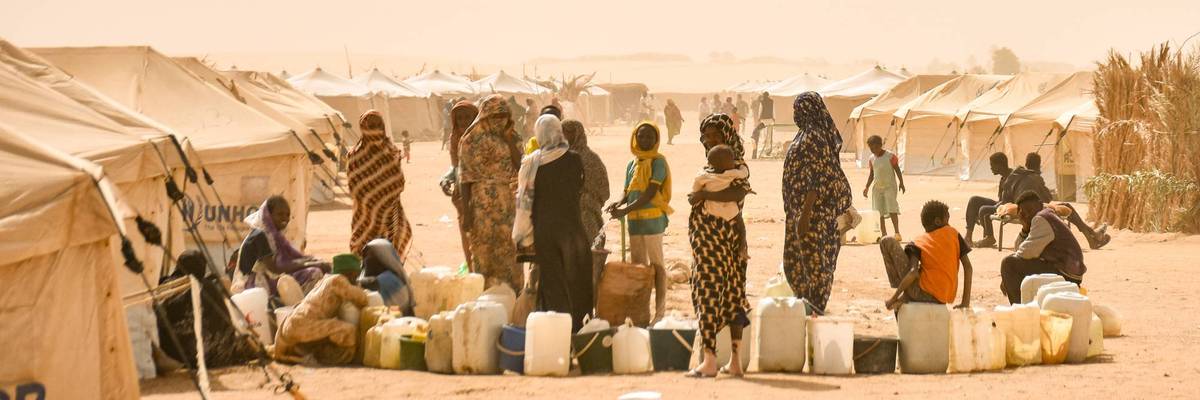
Sudanese families, numbering around 22,000 people, struggle to survive under conditions where even basic needs are met with great difficulty at Al-Affad Refugee Camp in Al-Dabbah, Sudan on January 13, 2026.
‘Collective Failure of Humanity’: Nearly 118 Million Refugees Violently Displaced Worldwide
The number of people who were forcibly displaced at the end of last year dropped from 2024 levels, but that change was largely driven by people who were forced to return home, sometimes to precarious conditions.
The number of people forcibly displaced around the world fell last year for the first time in years, dropping by more than 5 million—but with that trend driven in part by countries that have forced refugees to return home, often to precarious or dangerous conditions, advocacy groups warned that the world's refugee and displacement crises are far from being solved.
At the end of last year, 117.8 million people were forcibly displaced around the world, according to data released Thursday by the United Nations High Commissioner for Refugees (UNHCR). That number includes 41.6 million refugees, 9 million asylum-seekers, and 68.7 million internally displaced people.
While the number of displaced people fell from 123.2 million in 2024, the UNHCR emphasized that the change reflected "a sharp increase in the returns of refugees, mostly to Afghanistan, Syria, and Sudan."
"Many of the returns occurred under adverse circumstances and the reintegration conditions remain extremely challenging," said the agency.
Jan Egeland, secretary general of the Norwegian Refugee Council (NRC), said that "in Afghanistan, millions were forcibly returned from neighboring Pakistan and Iran, and in [the Democratic Republic of] Congo some displacement camps were evacuated at gunpoint, sending thousands of families back to homes that no longer exist."
Of 2.9 million Afghans who were no longer considered forcibly displaced last year, most of their returns to their home country were "involuntary in nature due to changes in the policies of host countries."
In the US, the Trump administration last year terminated Temporary Protected Status for Afghan nationals, between 9,500 and 11,700 of whom were legally residing in the US. Hundreds of thousands of Afghans were deported from Iran, Pakistan, and Tajikistan last year.
"The first fall in global displacement in over a decade should be good news. Instead, it reflects misery on a historic scale," said David Milliband, president of the International Rescue Committee. "These numbers tell a story of both forced returns and forced displacement. People are returning to countries mired in crisis, most with no choice, with every route to safety collapsed around them."
The number of refugees who were successfully resettled dropped precipitously last year along with the number of people who were classified as displaced. Just 81,800 people found new homes through resettlement programs or sponsorship pathways, representing a year-on-year drop of more than half.
The top countries that continued to host refugees last year were Colombia, Turkey, and Germany, and more than 70% of refugees came from just six countries: Afghanistan, South Sudan, Sudan, Syria, Ukraine, and Venezuela.
Egeland emphasized that while the number of forcibly displaced people fell last year, "the number of people who have fled their home because of violence and conflict has nearly tripled over the last 15 years."
"The 117.8 million people now violently displaced around the globe would constitute the world’s 13th-largest country by population. Larger than Egypt, Germany, or the UK. A human toll of vast proportions, and a collective failure of humanity," said Egeland.
The numbers released by UNHCR indicated that while millions "continued to be uprooted" last year, "many more endured protracted crises with no solution in sight. The world continues to fail civilians caught by conflict and violence."
UNHCR warned that among those who remain forcibly displaced, 7 in 10 refugees have been exiled from their homes for at least five years with little prospect of ever leaving refugee camps with precarious living conditions.
“For too many refugees, displacement starts as a lifeline but lasts a lifetime," said Barham Salih, the UN high commissioner for refugees. "Humanitarian aid saves lives, but it is not the end point and does not enable refugees to become active agents in control of their futures. We need a paradigm shift that creates a new sense of hope and opportunity for people fleeing war and persecution."
Salih called for a reduction by more than half, over the next decade, in the number of refugees who are reliant on humanitarian assistance and are living in temporary shelters.
"The initiative would expand opportunities for voluntary returns, humanitarian visas, and relocation, while transitioning refugees from aid dependency to self-reliance through access to education, healthcare, financial services, and labor markets," said the UNHCR.
The large numbers of people who have been forced from their homes—and in a rising number of cases, forced to return home under duress—"are almost impossible to comprehend," said Egeland. "And as an increasingly nationalistic world becomes increasingly desensitized to what it truly means to be forced to flee home, the gap between decision makers and donors and displaced people continues to widen. This cannot be accepted as the new normal."
“As humanitarians our work is to support displaced people in their hour of greatest need," he added. “But we cannot do this without a world that is willing to stand up for humanity... We must support diplomatic solutions to end crisis, and fund aid to relieve suffering. We must protect civilians and stand up for international humanitarian law. We must all remember our humanity.”
We are at a crossroads
This country and this world are at a monumental crossroads. In a few short weeks, US voters will have an opportunity to beat back the forces of fascism and confront the billionaires who are rigging the economy, our media system, and our democracy, making it increasingly impossible for ordinary people to get by. We’re not just talking about the election. We’re talking about what must be done once these fascist elements are vanquished from power. We need a bolder set of solutions than what either major party has so far been willing to offer and a working-class movement ready to fight like hell for it. Trump didn't emerge from nowhere. The conditions that fueled MAGA authoritarianism were created by decades of radical neoliberal economic policies and a corrupt political system dominated by corporate interests. They slashed taxes on the super-rich, promising that the benefits would trickle down. They said giveaways to the corporate titans would make life more affordable for the rest of us. It was all bullshit. And when a bitter, betrayed populace searches for someone to blame, right-wing demagogues have little trouble finding scapegoats. People know when they're being lied to, but you won't hear any of this from the corporate media. Only independent journalism—powered and funded by people who believe in building a better world—can deliver truly trustworthy daily news. Our Fall Campaign is underway, and we need your help. To power our newsroom through the rest of the year, we need to raise $125,000 by midnight on October 31. So if you share our vision, please contribute whatever you can to sustain our work. |
The number of people forcibly displaced around the world fell last year for the first time in years, dropping by more than 5 million—but with that trend driven in part by countries that have forced refugees to return home, often to precarious or dangerous conditions, advocacy groups warned that the world's refugee and displacement crises are far from being solved.
At the end of last year, 117.8 million people were forcibly displaced around the world, according to data released Thursday by the United Nations High Commissioner for Refugees (UNHCR). That number includes 41.6 million refugees, 9 million asylum-seekers, and 68.7 million internally displaced people.
While the number of displaced people fell from 123.2 million in 2024, the UNHCR emphasized that the change reflected "a sharp increase in the returns of refugees, mostly to Afghanistan, Syria, and Sudan."
"Many of the returns occurred under adverse circumstances and the reintegration conditions remain extremely challenging," said the agency.
Jan Egeland, secretary general of the Norwegian Refugee Council (NRC), said that "in Afghanistan, millions were forcibly returned from neighboring Pakistan and Iran, and in [the Democratic Republic of] Congo some displacement camps were evacuated at gunpoint, sending thousands of families back to homes that no longer exist."
Of 2.9 million Afghans who were no longer considered forcibly displaced last year, most of their returns to their home country were "involuntary in nature due to changes in the policies of host countries."
In the US, the Trump administration last year terminated Temporary Protected Status for Afghan nationals, between 9,500 and 11,700 of whom were legally residing in the US. Hundreds of thousands of Afghans were deported from Iran, Pakistan, and Tajikistan last year.
"The first fall in global displacement in over a decade should be good news. Instead, it reflects misery on a historic scale," said David Milliband, president of the International Rescue Committee. "These numbers tell a story of both forced returns and forced displacement. People are returning to countries mired in crisis, most with no choice, with every route to safety collapsed around them."
The number of refugees who were successfully resettled dropped precipitously last year along with the number of people who were classified as displaced. Just 81,800 people found new homes through resettlement programs or sponsorship pathways, representing a year-on-year drop of more than half.
The top countries that continued to host refugees last year were Colombia, Turkey, and Germany, and more than 70% of refugees came from just six countries: Afghanistan, South Sudan, Sudan, Syria, Ukraine, and Venezuela.
Egeland emphasized that while the number of forcibly displaced people fell last year, "the number of people who have fled their home because of violence and conflict has nearly tripled over the last 15 years."
"The 117.8 million people now violently displaced around the globe would constitute the world’s 13th-largest country by population. Larger than Egypt, Germany, or the UK. A human toll of vast proportions, and a collective failure of humanity," said Egeland.
The numbers released by UNHCR indicated that while millions "continued to be uprooted" last year, "many more endured protracted crises with no solution in sight. The world continues to fail civilians caught by conflict and violence."
UNHCR warned that among those who remain forcibly displaced, 7 in 10 refugees have been exiled from their homes for at least five years with little prospect of ever leaving refugee camps with precarious living conditions.
“For too many refugees, displacement starts as a lifeline but lasts a lifetime," said Barham Salih, the UN high commissioner for refugees. "Humanitarian aid saves lives, but it is not the end point and does not enable refugees to become active agents in control of their futures. We need a paradigm shift that creates a new sense of hope and opportunity for people fleeing war and persecution."
Salih called for a reduction by more than half, over the next decade, in the number of refugees who are reliant on humanitarian assistance and are living in temporary shelters.
"The initiative would expand opportunities for voluntary returns, humanitarian visas, and relocation, while transitioning refugees from aid dependency to self-reliance through access to education, healthcare, financial services, and labor markets," said the UNHCR.
The large numbers of people who have been forced from their homes—and in a rising number of cases, forced to return home under duress—"are almost impossible to comprehend," said Egeland. "And as an increasingly nationalistic world becomes increasingly desensitized to what it truly means to be forced to flee home, the gap between decision makers and donors and displaced people continues to widen. This cannot be accepted as the new normal."
“As humanitarians our work is to support displaced people in their hour of greatest need," he added. “But we cannot do this without a world that is willing to stand up for humanity... We must support diplomatic solutions to end crisis, and fund aid to relieve suffering. We must protect civilians and stand up for international humanitarian law. We must all remember our humanity.”
- One in Every 122 Humans Forcibly Displaced by War and Persecution: UN ›
- Opinion | On World Refugee Day, Support Refugees, Don't Deport Them | Common Dreams ›
The number of people forcibly displaced around the world fell last year for the first time in years, dropping by more than 5 million—but with that trend driven in part by countries that have forced refugees to return home, often to precarious or dangerous conditions, advocacy groups warned that the world's refugee and displacement crises are far from being solved.
At the end of last year, 117.8 million people were forcibly displaced around the world, according to data released Thursday by the United Nations High Commissioner for Refugees (UNHCR). That number includes 41.6 million refugees, 9 million asylum-seekers, and 68.7 million internally displaced people.
While the number of displaced people fell from 123.2 million in 2024, the UNHCR emphasized that the change reflected "a sharp increase in the returns of refugees, mostly to Afghanistan, Syria, and Sudan."
"Many of the returns occurred under adverse circumstances and the reintegration conditions remain extremely challenging," said the agency.
Jan Egeland, secretary general of the Norwegian Refugee Council (NRC), said that "in Afghanistan, millions were forcibly returned from neighboring Pakistan and Iran, and in [the Democratic Republic of] Congo some displacement camps were evacuated at gunpoint, sending thousands of families back to homes that no longer exist."
Of 2.9 million Afghans who were no longer considered forcibly displaced last year, most of their returns to their home country were "involuntary in nature due to changes in the policies of host countries."
In the US, the Trump administration last year terminated Temporary Protected Status for Afghan nationals, between 9,500 and 11,700 of whom were legally residing in the US. Hundreds of thousands of Afghans were deported from Iran, Pakistan, and Tajikistan last year.
"The first fall in global displacement in over a decade should be good news. Instead, it reflects misery on a historic scale," said David Milliband, president of the International Rescue Committee. "These numbers tell a story of both forced returns and forced displacement. People are returning to countries mired in crisis, most with no choice, with every route to safety collapsed around them."
The number of refugees who were successfully resettled dropped precipitously last year along with the number of people who were classified as displaced. Just 81,800 people found new homes through resettlement programs or sponsorship pathways, representing a year-on-year drop of more than half.
The top countries that continued to host refugees last year were Colombia, Turkey, and Germany, and more than 70% of refugees came from just six countries: Afghanistan, South Sudan, Sudan, Syria, Ukraine, and Venezuela.
Egeland emphasized that while the number of forcibly displaced people fell last year, "the number of people who have fled their home because of violence and conflict has nearly tripled over the last 15 years."
"The 117.8 million people now violently displaced around the globe would constitute the world’s 13th-largest country by population. Larger than Egypt, Germany, or the UK. A human toll of vast proportions, and a collective failure of humanity," said Egeland.
The numbers released by UNHCR indicated that while millions "continued to be uprooted" last year, "many more endured protracted crises with no solution in sight. The world continues to fail civilians caught by conflict and violence."
UNHCR warned that among those who remain forcibly displaced, 7 in 10 refugees have been exiled from their homes for at least five years with little prospect of ever leaving refugee camps with precarious living conditions.
“For too many refugees, displacement starts as a lifeline but lasts a lifetime," said Barham Salih, the UN high commissioner for refugees. "Humanitarian aid saves lives, but it is not the end point and does not enable refugees to become active agents in control of their futures. We need a paradigm shift that creates a new sense of hope and opportunity for people fleeing war and persecution."
Salih called for a reduction by more than half, over the next decade, in the number of refugees who are reliant on humanitarian assistance and are living in temporary shelters.
"The initiative would expand opportunities for voluntary returns, humanitarian visas, and relocation, while transitioning refugees from aid dependency to self-reliance through access to education, healthcare, financial services, and labor markets," said the UNHCR.
The large numbers of people who have been forced from their homes—and in a rising number of cases, forced to return home under duress—"are almost impossible to comprehend," said Egeland. "And as an increasingly nationalistic world becomes increasingly desensitized to what it truly means to be forced to flee home, the gap between decision makers and donors and displaced people continues to widen. This cannot be accepted as the new normal."
“As humanitarians our work is to support displaced people in their hour of greatest need," he added. “But we cannot do this without a world that is willing to stand up for humanity... We must support diplomatic solutions to end crisis, and fund aid to relieve suffering. We must protect civilians and stand up for international humanitarian law. We must all remember our humanity.”
- One in Every 122 Humans Forcibly Displaced by War and Persecution: UN ›
- Opinion | On World Refugee Day, Support Refugees, Don't Deport Them | Common Dreams ›