SUBSCRIBE TO OUR FREE NEWSLETTER
Daily news & progressive opinion—funded by the people, not the corporations—delivered straight to your inbox.
5
#000000
#FFFFFF
To donate by check, phone, or other method, see our More Ways to Give page.
Daily news & progressive opinion—funded by the people, not the corporations—delivered straight to your inbox.
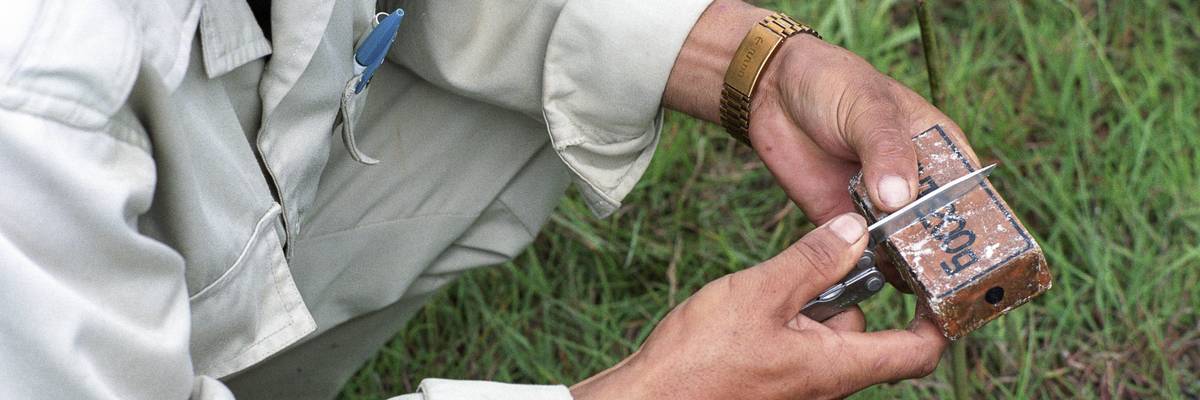
Unexploded ordnance are cleared by humanitarian deminers in Phonsavan, Lao People's Democratic Republic, August, 2003.
The US dropped the bombs that forced Southeast Asian families to flee and is now deporting them back to the very land that is still littered with American bombs.
I was only an infant when my family slipped into a weathered wooden boat under the cover of darkness in 1978. Our journey across the mighty Mekong River was wrapped in an eerie, suffocating stillness as my parents, older brother, and I fled Laos. Whenever my mother recounts that night, she always ends with the same whispered awe: “It is a miracle you and Alex didn’t make a sound. I was terrified we wouldn’t make it.”
It would be decades before I fully grasped the terror of that treacherous crossing, the complex geopolitical forces at play, and the shared history between the US and my birth country that forced us out into the night.
I think of that river escape every year on World Refugee Day. It is a day to honor the immense courage of those forced to flee everything they know. For me, it is also a day that demands a deeply honest look at how we treat people once they arrive on our shores.
Following the violence that consumed Laos, Cambodia, and Vietnam in 1975, millions fled, culminating in the largest refugee resettlement in American history. We arrived first through sponsorship programs, and later through the Refugee Act of 1980, laying new roots across the US. Today, our Southeast Asian American community has grown to over 3 million, with vibrant enclaves from California to Minnesota, and my home here in Ohio.
Instead of tearing families apart here at home, the United States must commit to fully funding the removal of unexploded ordnance in Laos until the job is done.
My family is one of the lucky ones. After years of hardship, Columbus welcomed us and helped us plant our roots. Today, I am full of gratitude for my parents' sacrifice, and we are proud to give back through family businesses we built and by serving on nonprofit boards like the annual Columbus Asian Festival and Legacies of War.
Not every story mirrors ours.
Many Southeast Asian refugees were resettled in severely under-resourced, over-policed neighborhoods without the support necessary to heal from the invisible, lingering wounds of war. Forced to navigate poverty and systemic barriers, some young refugees became entangled in the criminal justice system. Decades later—long after they have served their time, rehabilitated, and built families—they are being subjected to a cruel double punishment.
Since 1998, over 17,000 Southeast Asians have received deportation orders. Many have lived here for decades; the United States is their chosen home, and often the only home they have ever known. Once someone is deported, there is almost no way back, severing families permanently. These policies do not make America safer. They merely manufacture new trauma, uprooting lives all over again.
The tragic irony of these deportations is impossible to ignore. We are sending refugees back to a country still littered with the very weapons that drove their families into the dark to begin with.
Laos remains the most heavily bombed country per capita in history. From 1964 to 1973, in a covert effort to destroy traffic along the Ho Chi Minh Trail, the US dropped at least 2.5 million tons of ordnance across 580,000 bombing missions. That is the equivalent of a planeload of bombs falling every eight minutes, 24 hours a day, for nine years. Even today, unexploded ordnance continues to claim civilian lives, with children making up over 60% of those harmed.
True accountability requires a different path. It requires cleaning up the remnants of war that America left behind in Laos and honoring the humanity of those who survived it. For decades, US programs have addressed these lasting legacies. These efforts not only save lives and support vulnerable communities, but they also bolster years of diplomatic progress in a region of immense strategic importance. Foreign aid is not charity—it is a strategic investment for our country. US assistance in Southeast Asia consistently garners bipartisan support precisely because it yields clear, tangible benefits: enhanced safety, economic stability, and strengthened bilateral cooperation.
Instead of tearing families apart here at home, the United States must commit to fully funding the removal of unexploded ordnance in Laos until the job is done. I urge members of Congress to join the UXO and Demining Caucus and support legislation like the Southeast Asian Deportation Relief Act. We must end this cycle of displacement and keep our communities whole.
The United States was forged by those seeking a better life. This enduring legacy is embodied by the Statue of Liberty, our "Mother of Exiles," who stands as a beacon of hope for people escaping persecution and war.
World Refugee Day was first celebrated 25 years ago. This year’s theme, "solidarity with refugees," calls on us to recognize that true compassion does not end at the border. It means standing by refugees as they build their lives, acknowledging the full weight of our shared past, and ensuring that no one who seeks refuge from danger is ever forced back into harm’s way.
Dear Common Dreams reader, It’s been nearly 30 years since I co-founded Common Dreams with my late wife, Lina Newhouser. We had the radical notion that journalism should serve the public good, not corporate profits. It was clear to us from the outset what it would take to build such a project. No paid advertisements. No corporate sponsors. No millionaire publisher telling us what to think or do. Many people said we wouldn't last a year, but we proved those doubters wrong. Together with a tremendous team of journalists and dedicated staff, we built an independent media outlet free from the constraints of profits and corporate control. Our mission has always been simple: To inform. To inspire. To ignite change for the common good. Building Common Dreams was not easy. Our survival was never guaranteed. When you take on the most powerful forces—Wall Street greed, fossil fuel industry destruction, Big Tech lobbyists, and uber-rich oligarchs who have spent billions upon billions rigging the economy and democracy in their favor—the only bulwark you have is supporters who believe in your work. But here’s the urgent message from me today. It's never been this bad out there. And it's never been this hard to keep us going. At the very moment Common Dreams is most needed, the threats we face are intensifying. We need your support now more than ever. We don't accept corporate advertising and never will. We don't have a paywall because we don't think people should be blocked from critical news based on their ability to pay. Everything we do is funded by the donations of readers like you. When everyone does the little they can afford, we are strong. But if that support retreats or dries up, so do we. Will you donate now to make sure Common Dreams not only survives but thrives? —Craig Brown, Co-founder |
I was only an infant when my family slipped into a weathered wooden boat under the cover of darkness in 1978. Our journey across the mighty Mekong River was wrapped in an eerie, suffocating stillness as my parents, older brother, and I fled Laos. Whenever my mother recounts that night, she always ends with the same whispered awe: “It is a miracle you and Alex didn’t make a sound. I was terrified we wouldn’t make it.”
It would be decades before I fully grasped the terror of that treacherous crossing, the complex geopolitical forces at play, and the shared history between the US and my birth country that forced us out into the night.
I think of that river escape every year on World Refugee Day. It is a day to honor the immense courage of those forced to flee everything they know. For me, it is also a day that demands a deeply honest look at how we treat people once they arrive on our shores.
Following the violence that consumed Laos, Cambodia, and Vietnam in 1975, millions fled, culminating in the largest refugee resettlement in American history. We arrived first through sponsorship programs, and later through the Refugee Act of 1980, laying new roots across the US. Today, our Southeast Asian American community has grown to over 3 million, with vibrant enclaves from California to Minnesota, and my home here in Ohio.
Instead of tearing families apart here at home, the United States must commit to fully funding the removal of unexploded ordnance in Laos until the job is done.
My family is one of the lucky ones. After years of hardship, Columbus welcomed us and helped us plant our roots. Today, I am full of gratitude for my parents' sacrifice, and we are proud to give back through family businesses we built and by serving on nonprofit boards like the annual Columbus Asian Festival and Legacies of War.
Not every story mirrors ours.
Many Southeast Asian refugees were resettled in severely under-resourced, over-policed neighborhoods without the support necessary to heal from the invisible, lingering wounds of war. Forced to navigate poverty and systemic barriers, some young refugees became entangled in the criminal justice system. Decades later—long after they have served their time, rehabilitated, and built families—they are being subjected to a cruel double punishment.
Since 1998, over 17,000 Southeast Asians have received deportation orders. Many have lived here for decades; the United States is their chosen home, and often the only home they have ever known. Once someone is deported, there is almost no way back, severing families permanently. These policies do not make America safer. They merely manufacture new trauma, uprooting lives all over again.
The tragic irony of these deportations is impossible to ignore. We are sending refugees back to a country still littered with the very weapons that drove their families into the dark to begin with.
Laos remains the most heavily bombed country per capita in history. From 1964 to 1973, in a covert effort to destroy traffic along the Ho Chi Minh Trail, the US dropped at least 2.5 million tons of ordnance across 580,000 bombing missions. That is the equivalent of a planeload of bombs falling every eight minutes, 24 hours a day, for nine years. Even today, unexploded ordnance continues to claim civilian lives, with children making up over 60% of those harmed.
True accountability requires a different path. It requires cleaning up the remnants of war that America left behind in Laos and honoring the humanity of those who survived it. For decades, US programs have addressed these lasting legacies. These efforts not only save lives and support vulnerable communities, but they also bolster years of diplomatic progress in a region of immense strategic importance. Foreign aid is not charity—it is a strategic investment for our country. US assistance in Southeast Asia consistently garners bipartisan support precisely because it yields clear, tangible benefits: enhanced safety, economic stability, and strengthened bilateral cooperation.
Instead of tearing families apart here at home, the United States must commit to fully funding the removal of unexploded ordnance in Laos until the job is done. I urge members of Congress to join the UXO and Demining Caucus and support legislation like the Southeast Asian Deportation Relief Act. We must end this cycle of displacement and keep our communities whole.
The United States was forged by those seeking a better life. This enduring legacy is embodied by the Statue of Liberty, our "Mother of Exiles," who stands as a beacon of hope for people escaping persecution and war.
World Refugee Day was first celebrated 25 years ago. This year’s theme, "solidarity with refugees," calls on us to recognize that true compassion does not end at the border. It means standing by refugees as they build their lives, acknowledging the full weight of our shared past, and ensuring that no one who seeks refuge from danger is ever forced back into harm’s way.
I was only an infant when my family slipped into a weathered wooden boat under the cover of darkness in 1978. Our journey across the mighty Mekong River was wrapped in an eerie, suffocating stillness as my parents, older brother, and I fled Laos. Whenever my mother recounts that night, she always ends with the same whispered awe: “It is a miracle you and Alex didn’t make a sound. I was terrified we wouldn’t make it.”
It would be decades before I fully grasped the terror of that treacherous crossing, the complex geopolitical forces at play, and the shared history between the US and my birth country that forced us out into the night.
I think of that river escape every year on World Refugee Day. It is a day to honor the immense courage of those forced to flee everything they know. For me, it is also a day that demands a deeply honest look at how we treat people once they arrive on our shores.
Following the violence that consumed Laos, Cambodia, and Vietnam in 1975, millions fled, culminating in the largest refugee resettlement in American history. We arrived first through sponsorship programs, and later through the Refugee Act of 1980, laying new roots across the US. Today, our Southeast Asian American community has grown to over 3 million, with vibrant enclaves from California to Minnesota, and my home here in Ohio.
Instead of tearing families apart here at home, the United States must commit to fully funding the removal of unexploded ordnance in Laos until the job is done.
My family is one of the lucky ones. After years of hardship, Columbus welcomed us and helped us plant our roots. Today, I am full of gratitude for my parents' sacrifice, and we are proud to give back through family businesses we built and by serving on nonprofit boards like the annual Columbus Asian Festival and Legacies of War.
Not every story mirrors ours.
Many Southeast Asian refugees were resettled in severely under-resourced, over-policed neighborhoods without the support necessary to heal from the invisible, lingering wounds of war. Forced to navigate poverty and systemic barriers, some young refugees became entangled in the criminal justice system. Decades later—long after they have served their time, rehabilitated, and built families—they are being subjected to a cruel double punishment.
Since 1998, over 17,000 Southeast Asians have received deportation orders. Many have lived here for decades; the United States is their chosen home, and often the only home they have ever known. Once someone is deported, there is almost no way back, severing families permanently. These policies do not make America safer. They merely manufacture new trauma, uprooting lives all over again.
The tragic irony of these deportations is impossible to ignore. We are sending refugees back to a country still littered with the very weapons that drove their families into the dark to begin with.
Laos remains the most heavily bombed country per capita in history. From 1964 to 1973, in a covert effort to destroy traffic along the Ho Chi Minh Trail, the US dropped at least 2.5 million tons of ordnance across 580,000 bombing missions. That is the equivalent of a planeload of bombs falling every eight minutes, 24 hours a day, for nine years. Even today, unexploded ordnance continues to claim civilian lives, with children making up over 60% of those harmed.
True accountability requires a different path. It requires cleaning up the remnants of war that America left behind in Laos and honoring the humanity of those who survived it. For decades, US programs have addressed these lasting legacies. These efforts not only save lives and support vulnerable communities, but they also bolster years of diplomatic progress in a region of immense strategic importance. Foreign aid is not charity—it is a strategic investment for our country. US assistance in Southeast Asia consistently garners bipartisan support precisely because it yields clear, tangible benefits: enhanced safety, economic stability, and strengthened bilateral cooperation.
Instead of tearing families apart here at home, the United States must commit to fully funding the removal of unexploded ordnance in Laos until the job is done. I urge members of Congress to join the UXO and Demining Caucus and support legislation like the Southeast Asian Deportation Relief Act. We must end this cycle of displacement and keep our communities whole.
The United States was forged by those seeking a better life. This enduring legacy is embodied by the Statue of Liberty, our "Mother of Exiles," who stands as a beacon of hope for people escaping persecution and war.
World Refugee Day was first celebrated 25 years ago. This year’s theme, "solidarity with refugees," calls on us to recognize that true compassion does not end at the border. It means standing by refugees as they build their lives, acknowledging the full weight of our shared past, and ensuring that no one who seeks refuge from danger is ever forced back into harm’s way.