SUBSCRIBE TO OUR FREE NEWSLETTER
Daily news & progressive opinion—funded by the people, not the corporations—delivered straight to your inbox.
5
#000000
#FFFFFF
To donate by check, phone, or other method, see our More Ways to Give page.
Daily news & progressive opinion—funded by the people, not the corporations—delivered straight to your inbox.
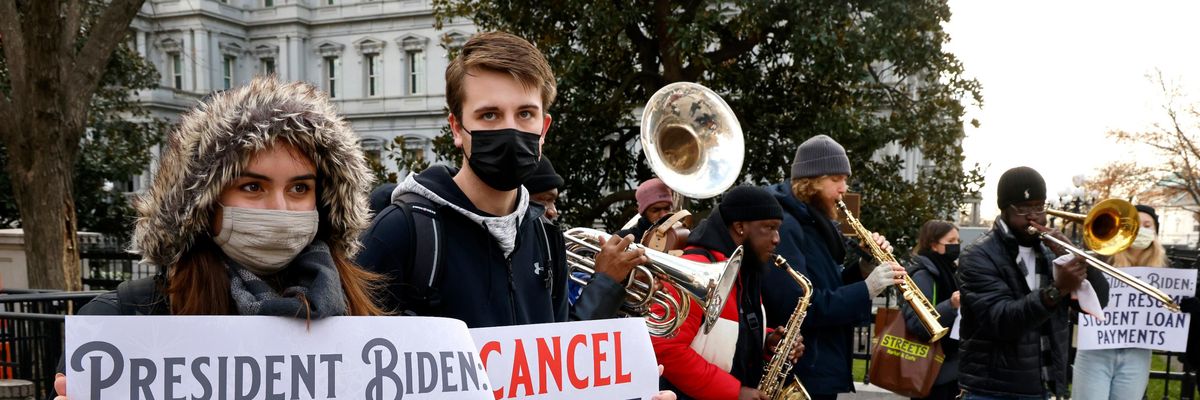
Activists and artists call on President Biden to not resume student loan payments and to cancel student debt on December 15, 2021 in Washington, D,C. (Photo: Paul Morigi/Getty Images for We, The 45 Million)
Two weeks after the White House announced--following intense pressure from economic justice advocates and progressive lawmakers--that the moratorium on federal student loan payments would be extended until May, activists are beginning the new year with renewed calls for President Joe Biden to cancel student debt by executive order.
In a tweet late Monday, Rep. Pramila Jayapal (D-Wash.), chair of the Congressional Progressive Caucus, pointed out that "student debt cancellation is supported by more than 60% of Americans."
While the Biden administration has claimed it is still investigating the president's authority to cancel student loan debt for all 45 million borrowers in the U.S., legal experts say the Higher Education Act of 1965 clearly empowers Biden to direct Education Secretary Miguel Cardona to do so.
"Taking this step would be a much-needed victory that could stoke enthusiasm for Democrats heading into the midterm elections."
Section 432(a) of the law states that the education secretary has the authority to modify loan terms and "enforce, pay, compromise, waive, or release any right, title, claim, lien, or demand, however acquired, including any equity or any right of redemption."
As Common Dreams reported last year, the Debt Collective, a union for student loan debtors, went as far as to draft an executive order for the president ordering Cardona to "cancel all obligations to repay federal student loans," an action which would save an average of nearly $500 per month for borrowers and would boost the gross domestic product by $86 billion to $108 billion per year.
"President Biden, grab a pen and give the people what they want, need, and deserve," said Jayapal in her Monday night tweet.
As Vox reported last week, the student debt payment freeze which was implemented in March 2020 by Congress as the coronavirus pandemic hit the U.S. and has been extended several times since has offered concrete benefits for many Americans.
A woman identified as Sarah R. told Vox that without her $650 monthly student loan payment during the moratorium, she was able to go on maternity leave when she had a baby last year. Cheryl Patton, who owes $51,000 in federal student loan debt after obtaining a Master's degree in clinical mental health, said she has been able to save money, complete home repairs, travel to visit family members, and pay for medical care she had been putting off.
"It's hard to save money when you have a student loan payment every month that's equivalent to a BMW payment," Patton told Vox. "I work a part-time job just to pay my student loans every month, which means that I get to spend less time with my kids, less time with my family; it's just what I have to do to survive."
Rep. Ro Khanna (D-Calif.) joined Jayapal Monday in demanding student debt cancellation, calling on Biden to end the loan system that is "weighing our young people down before they can get on their feet."
Americans "need to be able to spend their money, not try and pay off endless debt," Khanna tweeted.
Progressives have also warned that restarting student loan payments in a midterm election year--particularly after Democrats failed last week to extend the Child Tax Credit, which was credited with lifting millions of children out of poverty--would be politically as well as economically destructive.
"Groups such as Debt Collective, the Student Borrower Protection Center, and others have been organizing toward this end for years," wrote The Nation's Katrina vanden Heuvel in her Washington Post column last week, pointing out that the president pledged to cancel at least $10,000 in debt per borrower while campaigning in 2020. "Taking this step would be a much-needed victory that could stoke enthusiasm for Democrats heading into the midterm elections."
"With so much of his agenda in jeopardy," she added, "Biden should help Americans in the ways he can right now: by building on grassroots energy, making good on his word, and giving tens of millions of people greater ability to invest in their futures."
Dear Common Dreams reader, It’s been nearly 30 years since I co-founded Common Dreams with my late wife, Lina Newhouser. We had the radical notion that journalism should serve the public good, not corporate profits. It was clear to us from the outset what it would take to build such a project. No paid advertisements. No corporate sponsors. No millionaire publisher telling us what to think or do. Many people said we wouldn't last a year, but we proved those doubters wrong. Together with a tremendous team of journalists and dedicated staff, we built an independent media outlet free from the constraints of profits and corporate control. Our mission has always been simple: To inform. To inspire. To ignite change for the common good. Building Common Dreams was not easy. Our survival was never guaranteed. When you take on the most powerful forces—Wall Street greed, fossil fuel industry destruction, Big Tech lobbyists, and uber-rich oligarchs who have spent billions upon billions rigging the economy and democracy in their favor—the only bulwark you have is supporters who believe in your work. But here’s the urgent message from me today. It's never been this bad out there. And it's never been this hard to keep us going. At the very moment Common Dreams is most needed, the threats we face are intensifying. We need your support now more than ever. We don't accept corporate advertising and never will. We don't have a paywall because we don't think people should be blocked from critical news based on their ability to pay. Everything we do is funded by the donations of readers like you. When everyone does the little they can afford, we are strong. But if that support retreats or dries up, so do we. Will you donate now to make sure Common Dreams not only survives but thrives? —Craig Brown, Co-founder |
Two weeks after the White House announced--following intense pressure from economic justice advocates and progressive lawmakers--that the moratorium on federal student loan payments would be extended until May, activists are beginning the new year with renewed calls for President Joe Biden to cancel student debt by executive order.
In a tweet late Monday, Rep. Pramila Jayapal (D-Wash.), chair of the Congressional Progressive Caucus, pointed out that "student debt cancellation is supported by more than 60% of Americans."
While the Biden administration has claimed it is still investigating the president's authority to cancel student loan debt for all 45 million borrowers in the U.S., legal experts say the Higher Education Act of 1965 clearly empowers Biden to direct Education Secretary Miguel Cardona to do so.
"Taking this step would be a much-needed victory that could stoke enthusiasm for Democrats heading into the midterm elections."
Section 432(a) of the law states that the education secretary has the authority to modify loan terms and "enforce, pay, compromise, waive, or release any right, title, claim, lien, or demand, however acquired, including any equity or any right of redemption."
As Common Dreams reported last year, the Debt Collective, a union for student loan debtors, went as far as to draft an executive order for the president ordering Cardona to "cancel all obligations to repay federal student loans," an action which would save an average of nearly $500 per month for borrowers and would boost the gross domestic product by $86 billion to $108 billion per year.
"President Biden, grab a pen and give the people what they want, need, and deserve," said Jayapal in her Monday night tweet.
As Vox reported last week, the student debt payment freeze which was implemented in March 2020 by Congress as the coronavirus pandemic hit the U.S. and has been extended several times since has offered concrete benefits for many Americans.
A woman identified as Sarah R. told Vox that without her $650 monthly student loan payment during the moratorium, she was able to go on maternity leave when she had a baby last year. Cheryl Patton, who owes $51,000 in federal student loan debt after obtaining a Master's degree in clinical mental health, said she has been able to save money, complete home repairs, travel to visit family members, and pay for medical care she had been putting off.
"It's hard to save money when you have a student loan payment every month that's equivalent to a BMW payment," Patton told Vox. "I work a part-time job just to pay my student loans every month, which means that I get to spend less time with my kids, less time with my family; it's just what I have to do to survive."
Rep. Ro Khanna (D-Calif.) joined Jayapal Monday in demanding student debt cancellation, calling on Biden to end the loan system that is "weighing our young people down before they can get on their feet."
Americans "need to be able to spend their money, not try and pay off endless debt," Khanna tweeted.
Progressives have also warned that restarting student loan payments in a midterm election year--particularly after Democrats failed last week to extend the Child Tax Credit, which was credited with lifting millions of children out of poverty--would be politically as well as economically destructive.
"Groups such as Debt Collective, the Student Borrower Protection Center, and others have been organizing toward this end for years," wrote The Nation's Katrina vanden Heuvel in her Washington Post column last week, pointing out that the president pledged to cancel at least $10,000 in debt per borrower while campaigning in 2020. "Taking this step would be a much-needed victory that could stoke enthusiasm for Democrats heading into the midterm elections."
"With so much of his agenda in jeopardy," she added, "Biden should help Americans in the ways he can right now: by building on grassroots energy, making good on his word, and giving tens of millions of people greater ability to invest in their futures."
Two weeks after the White House announced--following intense pressure from economic justice advocates and progressive lawmakers--that the moratorium on federal student loan payments would be extended until May, activists are beginning the new year with renewed calls for President Joe Biden to cancel student debt by executive order.
In a tweet late Monday, Rep. Pramila Jayapal (D-Wash.), chair of the Congressional Progressive Caucus, pointed out that "student debt cancellation is supported by more than 60% of Americans."
While the Biden administration has claimed it is still investigating the president's authority to cancel student loan debt for all 45 million borrowers in the U.S., legal experts say the Higher Education Act of 1965 clearly empowers Biden to direct Education Secretary Miguel Cardona to do so.
"Taking this step would be a much-needed victory that could stoke enthusiasm for Democrats heading into the midterm elections."
Section 432(a) of the law states that the education secretary has the authority to modify loan terms and "enforce, pay, compromise, waive, or release any right, title, claim, lien, or demand, however acquired, including any equity or any right of redemption."
As Common Dreams reported last year, the Debt Collective, a union for student loan debtors, went as far as to draft an executive order for the president ordering Cardona to "cancel all obligations to repay federal student loans," an action which would save an average of nearly $500 per month for borrowers and would boost the gross domestic product by $86 billion to $108 billion per year.
"President Biden, grab a pen and give the people what they want, need, and deserve," said Jayapal in her Monday night tweet.
As Vox reported last week, the student debt payment freeze which was implemented in March 2020 by Congress as the coronavirus pandemic hit the U.S. and has been extended several times since has offered concrete benefits for many Americans.
A woman identified as Sarah R. told Vox that without her $650 monthly student loan payment during the moratorium, she was able to go on maternity leave when she had a baby last year. Cheryl Patton, who owes $51,000 in federal student loan debt after obtaining a Master's degree in clinical mental health, said she has been able to save money, complete home repairs, travel to visit family members, and pay for medical care she had been putting off.
"It's hard to save money when you have a student loan payment every month that's equivalent to a BMW payment," Patton told Vox. "I work a part-time job just to pay my student loans every month, which means that I get to spend less time with my kids, less time with my family; it's just what I have to do to survive."
Rep. Ro Khanna (D-Calif.) joined Jayapal Monday in demanding student debt cancellation, calling on Biden to end the loan system that is "weighing our young people down before they can get on their feet."
Americans "need to be able to spend their money, not try and pay off endless debt," Khanna tweeted.
Progressives have also warned that restarting student loan payments in a midterm election year--particularly after Democrats failed last week to extend the Child Tax Credit, which was credited with lifting millions of children out of poverty--would be politically as well as economically destructive.
"Groups such as Debt Collective, the Student Borrower Protection Center, and others have been organizing toward this end for years," wrote The Nation's Katrina vanden Heuvel in her Washington Post column last week, pointing out that the president pledged to cancel at least $10,000 in debt per borrower while campaigning in 2020. "Taking this step would be a much-needed victory that could stoke enthusiasm for Democrats heading into the midterm elections."
"With so much of his agenda in jeopardy," she added, "Biden should help Americans in the ways he can right now: by building on grassroots energy, making good on his word, and giving tens of millions of people greater ability to invest in their futures."