

SUBSCRIBE TO OUR FREE NEWSLETTER
Daily news & progressive opinion—funded by the people, not the corporations—delivered straight to your inbox.
5
#000000
#FFFFFF
To donate by check, phone, or other method, see our More Ways to Give page.
Daily news & progressive opinion—funded by the people, not the corporations—delivered straight to your inbox.

Lending apps are offering credit to consumers struggling to afford basic necessities, including electricity, broadband, groceries, and more as prices rise.
Companies that provide "buy now, pay later" loans are increasingly offering their products to Americans struggling to afford utilities and other necessities as costs rise across the US economy, with President Donald Trump's illegal war on Iran pushing up energy prices while wage growth slows.
The New York Times reported Monday that "the lending apps Flex and Zip allow customers to take out loans to pay for their broadband, electricity, health insurance, mobile phone service, mortgage, and water bills," while Affirm "has started providing some tenants loans to extend their monthly rent payment for a few weeks." On the homepage of its website, Affirm is currently promoting its product for school supplies as prices for basic items surge.
Despite Trump's pledge to cut household electricity costs in half and "bring down the prices of all goods," federal data shows electricity prices are up 18% since the start of the president's second White House term. On Monday, the average price for a gallon of gas in the US reached $4.06—the highest ever recorded for mid-August.
Recent polling by Data for Progress shows that 38% of "buy now, pay later" users have turned to the product to cover gasoline costs. Nearly half—46%—have used it for groceries, 42% for medical or dental care, 39% for utility bills, and 22% for childcare.
Last month, the advocacy group Protect Borrowers released a detailed report showing that buy now, pay later lenders are "touting shiny and oftentimes deceptive offers of zero-interest, fee-free installment loans to millions of Americans struggling with the rapidly rising costs of groceries, rent, utility bills, takeout, new clothes, medical care, and more."
"Leading BNPL lenders currently include Affirm, Klarna, Afterpay, PayPal, Synchrony, Splitit, Sezzle, and Zip, but more are popping up by the day, largely funded by private equity firms and venture capitalists looking to cash in on families’ financial desperation," the report states. "BNPL loans are packed to the brim with financing fees, late fees, and other junk fees. Many BNPL loans feature late fees of $7 to $8 per missed payment, up to an aggregate cap of 25% of the purchase price. Additional fees may be charged for financing, if the user does not set a bank account as the default method of payment, reschedules an upcoming payment, or has non-sufficient funds or a bounced payment."
The Times pointed to June Federal Reserve research showing that Americans collectively spent $160 billion through buy now, pay later programs last year, nearly twice what US consumers spent in 2023.
"That’s still a fraction of the more than $3 trillion US shoppers spend annually on consumer credit cards," the Times noted. "But the industry continues to expand by double-digit rates each year."
Jennifer Zhang, a policy analyst at Protect Borrowers, has called on the US Congress to enact "sweeping protections" that "end deceptive pricing, bring down the cost of BNPL debt, ban predatory practices that harm consumers, and empower Americans to enforce their rights under the law."
"BNPL loans are expensive and risky, and often worsen financial outcomes for borrowers who come to rely on them to make ends meet. However, millions of Americans are being driven into these debt products just as they’re trying to get by. Prices are soaring and show no signs of coming down anytime soon," Zhang wrote. "Americans need help."
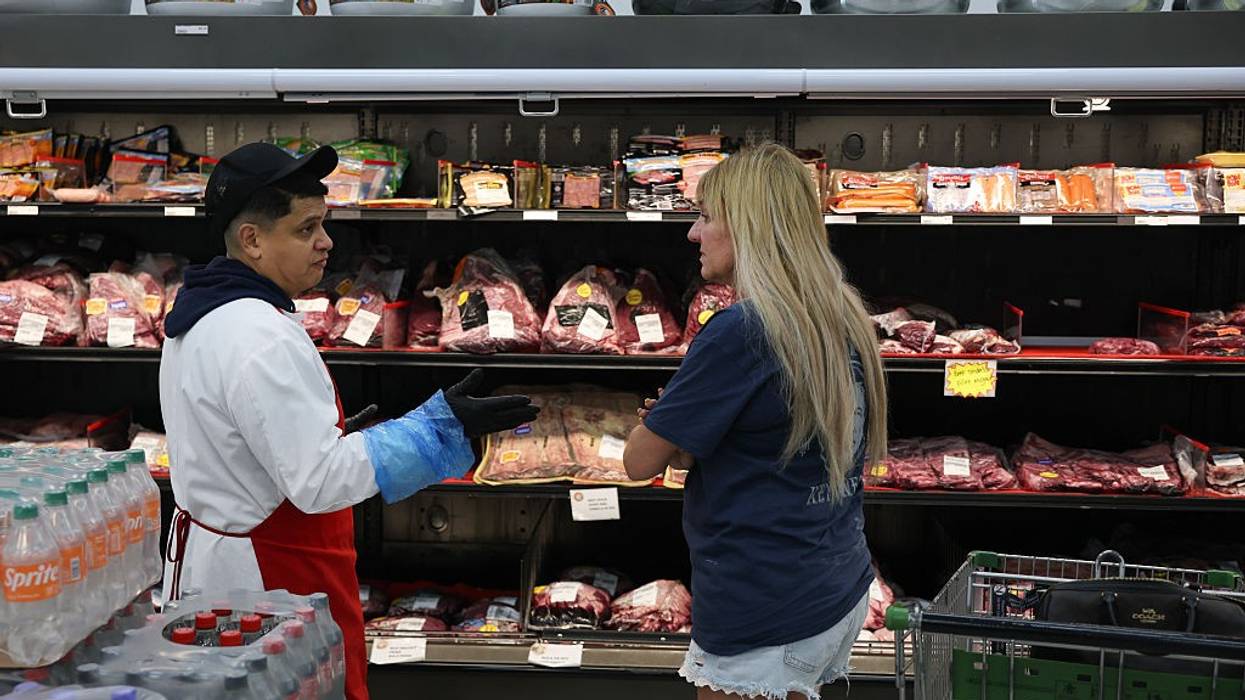
"These numbers tell the real story," said one campaigner. "His administration has failed to address—and in many cases, worsened—an historic cost-of-living crisis that is crushing everyday Americans."
While inflation hit a three-year high on Tuesday and President Donald Trump publicly confessed that he doesn't consider how his illegal war on Iran impacts Americans' finances, a Federal Reserve bank revealed that US household debt has risen to a record high of $18.8 trillion.
The Federal Reserve Bank of New York's Center for Microeconomic Data found that household debt increased by $18 billion in the first quarter of this year.
It specifically found that by the end of March, mortgage balances increased by $21 billion to $13.19 trillion, home equity line of credit balances jumped by $12 billion to $446 billion, and automobile loan balances rose by $18 billion to $1.69 trillion.
The center further found that "while student loan balances remained essentially flat, decreasing by $6 billion and standing at $1.66 trillion," the delinquency rate "increased to 10.3% of balances 90+ days delinquent, up from the 9.6%" in the last quarter of 2025.
The analysis notes that credit card balances dropped by $25 billion to $1.25 trillion, a seasonal decline that generally occurs after the winter holidays. However, in its coverage of the New York Fed's findings, CNBC highlighted another report out Tuesday that shows how Americans are struggling with current economic conditions.
As CNBC detailed:
More than half—53%—of consumers carry credit card balances to cover essential expenses, according to a report released Tuesday by debt management company Achieve.
"For many households, higher balances are less a sign of economic optimism and more a sign that wages and savings are struggling to keep pace with essential expenses like groceries, utilities, and housing," Austin Kilgore, analyst for the Achieve Center for Consumer Insights, said in a statement.
Among respondents in Achieve's survey of 2,000 consumers, 57% of borrowers said it would take six months or longer to pay off all their credit card debt.
According to ABC News, "On a call with reporters Tuesday morning, researchers at the New York Fed described Americans' overall credit as 'stable,' but noted there are weaknesses among younger consumers and lower-income households."
Mike Pierce, co-founder and executive director of the advocacy group Protect Borrowers, was far more scathing, declaring in a statement that "working families are at a breaking point and desperately need relief. Instead, President Trump is bragging about his plans for a new White House ballroom while his head economist touts families' surging debts as a sign of a booming economy."
"These numbers tell the real story: Trump's economy has driven up costs," Pierce continued. "His administration has failed to address—and in many cases, worsened—an historic cost-of-living crisis that is crushing everyday Americans under stagnant wages and rampant price gouging by grocery conglomerates, data centers, corporate landlords, and private equity firms."
"Making matters worse, Trump's war with Iran is pushing inflation to record levels and forcing Americans to feel the economic pain at the pump," he added, as gasoline prices topped $4.50 a gallon on Tuesday. "It is clear that President Trump is not only failing to 'Make America Affordable Again' but is actively pushing millions of families further into the red."
Last week, Pierce's group and The Century Foundation published an analysis about soaring US auto loan debt. Report co-author and Protect Borrowers senior fellow Tara Mikkilineni said at the time that "for millions of working families, a car is not a luxury, it is an essential economic lifeline. Working families deserve relief, and they deserve to have a government that is watching out for them, not allowing lenders and auto dealers to rake in record profits at their expense."
Meanwhile, Trump—who is facing intense disapproval from the US public, particularly regarding the economy—has repeatedly made clear he doesn't care how his policies, from sweeping tariffs to the Iran War, impact Americans' pocketbooks.
Trump's assault prompted Iran to restrict ship traffic through the Strait of Hormuz, a key trade route, which has driven up the prices of fossil fuels worldwide. Speaking with journalists outside the White House last month, Trump suggested that $4 a gallon for gas is "not very high."
Asked about the war's impact on the US public's finances again on Tuesday, Trump said that "the only thing that matters when I'm talking about Iran—they can't have a nuclear weapon. I don't think about Americans' financial situation. I don't think about anybody. I think about one thing—we cannot let Iran have a nuclear weapon. That's all."
Those remarks came just hours after the latest consumer price index from the US Bureau of Labor Statistics, which shows that prices increased by 3.8% on an annual basis in April—above economists' expected 3.7% jump—and the cost of living rose above average monthly wage gains. Various experts responded by taking aim at the president.
University of Michigan economist Justin Wolfers said that "Trump campaigned on bringing down the cost of living 'starting on day one,' and then: started a trade war; deported much of the farm workforce, bombed Iran, allowed healthcare subsidies to expire, cut food assistance, ran an interest-rate boosting deficit, and attacked Fed independence."