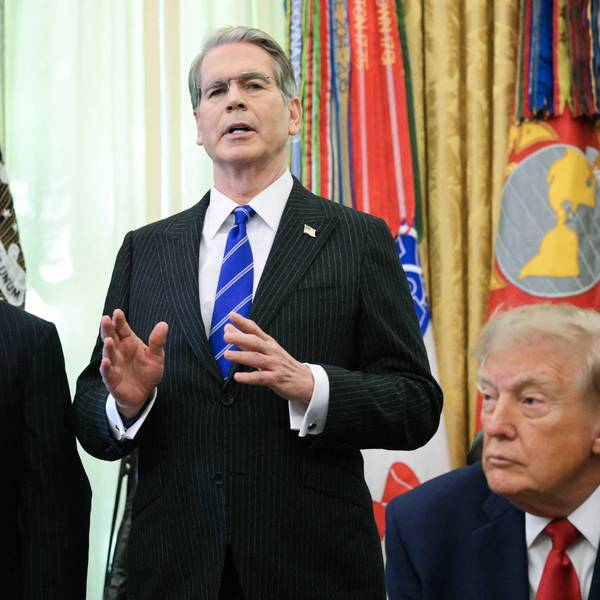
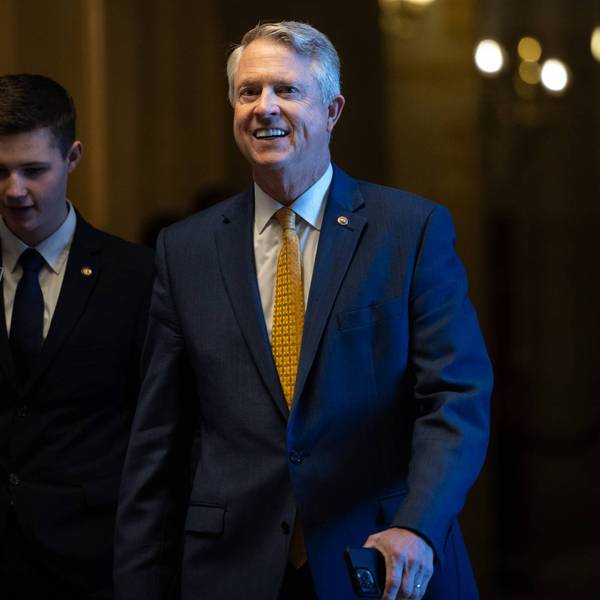

Sen. Ron Wyden (D-Ore.) speaks at a press conference with other Senate Democrats on April 1, 2025 in Washington, D.C.
'Enough Is Enough': Dems Aim to Force GOP on Record as Trump Tariffs Wreak Havoc
"Republicans can't keep ducking the vote on these taxes," said Rep. Gregory Meeks. "It is time they take a vote and show their constituents whether or not they support the 'economic pain' President Trump is inflicting."
Congressional Democrats—and a small but growing number of Republicans—are throwing their support behind last-ditch legislative efforts to wrest tariff authority from U.S. President Donald Trump as he unilaterally plunges the nation into a full-blown global trade war, with potentially catastrophic consequences for workers, businesses, and the worldwide economy.
"Enough is enough," Sen. Ron Wyden (D-Ore.) said Tuesday, accusing the president of "driving our economy into recession, killing jobs, and wiping out seniors' retirement funds as we speak."
Wyden and several other senators—including Senate Minority Leader Chuck Schumer (D-N.Y.) and a lone Republican, Sen. Rand Paul (R-Ky.)—introduced a privileged resolution Tuesday that would terminate the national emergency that Trump declared last week to impose sweeping tariffs on countries across the globe, including major U.S. allies and trading partners.
"Donald Trump's reckless agenda will hurt American families, small businesses, and manufacturers," said Sen. Elizabeth Warren (D-Mass.), a co-sponsor of the resolution. "The Trump tariffs are economic sabotage, and Congress has the power to stop them. Republicans can join Democrats and end this today."
House Democrats, led by Rep. Gregory Meeks (D-N.Y.), are pursuing a similar resolution.
"Republicans can't keep ducking the vote on these taxes," Meeks and other leading House Democrats said in a statement Tuesday. "It is time they take a vote and show their constituents whether or not they support the 'economic pain' President Trump is inflicting on American families."
"This is a self-own, a crisis dictated by one authoritarian with a ridiculous way of seeing the world."
Under GOP control, Congress has effectively ceded the power of the purse to the Trump administration, allowing it to unlawfully withhold approved spending and rush ahead with what's been described as the largest tax hike in U.S. history.
But in recent days, facing increasingly furious backlash across American society—including billionaire hedge fund managers, retirees, and small business owners who fear they may have to close their doors—some Republicans have expressed support for legislative efforts to rein in Trump's ability to impose tariffs without congressional approval.
The Hill reported Tuesday that at least seven Senate Republicans have signed on to a bipartisan bill that would place limits on presidential tariff authority, including a provision under which any new tariff would lapse after 60 days if not approved by Congress.
Additionally, according to Axios, "at least a dozen House Republicans are considering signing onto Rep. Don Bacon's (R-Neb.) bill to restrict the White House's ability to impose tariffs unilaterally."
Thus far, though, not enough Republicans have publicly backed the legislative push to rein in Trump, who has threatened to veto the bipartisan Senate legislation.
The growing legislative push to slow or reverse Trump's tariff spree comes as China announced Wednesday that it is slapping U.S. goods with an 84% duty in retaliation for the president's decision to dramatically hike tariffs on imports from the world's second-largest economy.
Tariffs on Chinese imports to the U.S. now total at least 104%.
"The U.S. approach of upgrading tariffs on China is wrong, seriously violating China's legitimate rights and interests, and seriously undermining the rules-based multilateral trading system," China's Finance Ministry said in a statement Wednesday.
The American Prospect's David Dayen wrote Wednesday that China's retaliation makes "clear that at least with respect to the world's largest manufacturer, a trade war is far more likely."
"It's important to note that a reversal of course on tariffs would mitigate a lot of the damage, which is why Congress putting on the pressure for that reversal is important," Dayen added. "This is a self-own, a crisis dictated by one authoritarian with a ridiculous way of seeing the world. But Trump's policies were driving the country into a ditch since Inauguration Day, setting the stage for the fear and doubt we're seeing right now."
We are at a crossroads
This country and this world are at a monumental crossroads. In a few short weeks, US voters will have an opportunity to beat back the forces of fascism and confront the billionaires who are rigging the economy, our media system, and our democracy, making it increasingly impossible for ordinary people to get by. We’re not just talking about the election. We’re talking about what must be done once these fascist elements are vanquished from power. We need a bolder set of solutions than what either major party has so far been willing to offer and a working-class movement ready to fight like hell for it. Trump didn't emerge from nowhere. The conditions that fueled MAGA authoritarianism were created by decades of radical neoliberal economic policies and a corrupt political system dominated by corporate interests. They slashed taxes on the super-rich, promising that the benefits would trickle down. They said giveaways to the corporate titans would make life more affordable for the rest of us. It was all bullshit. And when a bitter, betrayed populace searches for someone to blame, right-wing demagogues have little trouble finding scapegoats. People know when they're being lied to, but you won't hear any of this from the corporate media. Only independent journalism—powered and funded by people who believe in building a better world—can deliver truly trustworthy daily news. Our Fall Campaign is underway, and we need your help. To power our newsroom through the rest of the year, we need to raise $125,000 by midnight on October 31. So if you share our vision, please contribute whatever you can to sustain our work. |
Congressional Democrats—and a small but growing number of Republicans—are throwing their support behind last-ditch legislative efforts to wrest tariff authority from U.S. President Donald Trump as he unilaterally plunges the nation into a full-blown global trade war, with potentially catastrophic consequences for workers, businesses, and the worldwide economy.
"Enough is enough," Sen. Ron Wyden (D-Ore.) said Tuesday, accusing the president of "driving our economy into recession, killing jobs, and wiping out seniors' retirement funds as we speak."
Wyden and several other senators—including Senate Minority Leader Chuck Schumer (D-N.Y.) and a lone Republican, Sen. Rand Paul (R-Ky.)—introduced a privileged resolution Tuesday that would terminate the national emergency that Trump declared last week to impose sweeping tariffs on countries across the globe, including major U.S. allies and trading partners.
"Donald Trump's reckless agenda will hurt American families, small businesses, and manufacturers," said Sen. Elizabeth Warren (D-Mass.), a co-sponsor of the resolution. "The Trump tariffs are economic sabotage, and Congress has the power to stop them. Republicans can join Democrats and end this today."
House Democrats, led by Rep. Gregory Meeks (D-N.Y.), are pursuing a similar resolution.
"Republicans can't keep ducking the vote on these taxes," Meeks and other leading House Democrats said in a statement Tuesday. "It is time they take a vote and show their constituents whether or not they support the 'economic pain' President Trump is inflicting on American families."
"This is a self-own, a crisis dictated by one authoritarian with a ridiculous way of seeing the world."
Under GOP control, Congress has effectively ceded the power of the purse to the Trump administration, allowing it to unlawfully withhold approved spending and rush ahead with what's been described as the largest tax hike in U.S. history.
But in recent days, facing increasingly furious backlash across American society—including billionaire hedge fund managers, retirees, and small business owners who fear they may have to close their doors—some Republicans have expressed support for legislative efforts to rein in Trump's ability to impose tariffs without congressional approval.
The Hill reported Tuesday that at least seven Senate Republicans have signed on to a bipartisan bill that would place limits on presidential tariff authority, including a provision under which any new tariff would lapse after 60 days if not approved by Congress.
Additionally, according to Axios, "at least a dozen House Republicans are considering signing onto Rep. Don Bacon's (R-Neb.) bill to restrict the White House's ability to impose tariffs unilaterally."
Thus far, though, not enough Republicans have publicly backed the legislative push to rein in Trump, who has threatened to veto the bipartisan Senate legislation.
The growing legislative push to slow or reverse Trump's tariff spree comes as China announced Wednesday that it is slapping U.S. goods with an 84% duty in retaliation for the president's decision to dramatically hike tariffs on imports from the world's second-largest economy.
Tariffs on Chinese imports to the U.S. now total at least 104%.
"The U.S. approach of upgrading tariffs on China is wrong, seriously violating China's legitimate rights and interests, and seriously undermining the rules-based multilateral trading system," China's Finance Ministry said in a statement Wednesday.
The American Prospect's David Dayen wrote Wednesday that China's retaliation makes "clear that at least with respect to the world's largest manufacturer, a trade war is far more likely."
"It's important to note that a reversal of course on tariffs would mitigate a lot of the damage, which is why Congress putting on the pressure for that reversal is important," Dayen added. "This is a self-own, a crisis dictated by one authoritarian with a ridiculous way of seeing the world. But Trump's policies were driving the country into a ditch since Inauguration Day, setting the stage for the fear and doubt we're seeing right now."