

SUBSCRIBE TO OUR FREE NEWSLETTER
Daily news & progressive opinion—funded by the people, not the corporations—delivered straight to your inbox.
5
#000000
#FFFFFF
To donate by check, phone, or other method, see our More Ways to Give page.
Daily news & progressive opinion—funded by the people, not the corporations—delivered straight to your inbox.
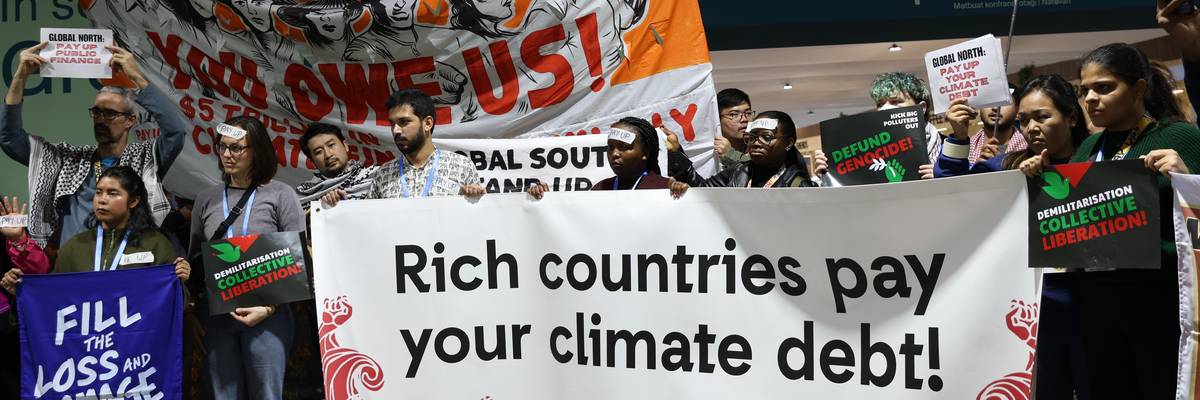
Advocates of rich countries paying their climate debt to the Global South gather at the United Nations Climate Change Conference (COP29) in Baku, Azerbaijan, on November 22, 2024.
"This is a shameful failure of leadership," said one Oxfam campaigner. "There is only one option for those grappling with the harshest impacts of climate collapse: trillions, not billions, in public and grants-based finance."
With the United Nations' annual climate summit scheduled to end Friday in Baku, Azerbaijan, green groups denounced the latest draft finance deal, which would direct the Global North to provide just $250 billion per year to help developing countries with emission cuts and adaptation—far below the $1.3 trillion campaigners demanded.
Although the figure represented progress from Thursday, when there was a placeholder "X" for the new collective quantified goal (NCQG) on climate finance, Oil Change International global public finance manager Laurie van der Burg still stressed that "this text is an absolute embarrassment. It's the equivalent of governments handing the keys to the firetruck to the arsonists."
There is a broader goal to raise $1.3 trillion in annual climate finance, but that would include funding from private sources.
"The vague $1.3 trillion investment target is not to be relied on and the $250 billion goal is not debt-free. Previous suggestions to end fossil fuel handouts and make polluters pay have all been axed," Van der Burg noted. "This amounts to a cop-out for polluters and allows rich countries to dodge their responsibilities by relying on the private sector and even developing countries to cover the bill, creating a debt trap for countries most vulnerable to the climate crisis."
She was far from alone in calling out developed nations, which previously failed to deliver on a 2009 pledge of $100 billion annually for poorer countries impacted by the climate emergency by 2020.
"With a paltry climate finance offer of $250 billion annually, and a deadline to deliver as late as 2035, richer nations including E.U. countries and the United States are dangerously close to betraying the Paris agreement," Rachel Cleetus, policy director of the Union of Concerned Scientists' Climate and Energy Program, said from Baku.
Parties to the 2015 Paris agreement hope to keep global temperature rise this century "well below" 2°C, relative to preindustrial levels, with a target of 1.5°C. However, a U.N. analysis revealed last month that the world is currently on track for 2.6-3.1°C of warming by 2100.
"The central demand coming into COP29 was for a strong, science-aligned climate finance commitment, which this appalling text utterly fails to provide" Cleetus highlighted. "Wealthier nations seem content to shamefully renege on their responsibility and cave in to fossil fuel interests while unjustly foisting the costs of deadly climate extremes on countries that have contributed the least to the climate crisis."
Jess Beagley, policy lead at the Global Climate and Health Alliance, a consortium of over 200 health professional and civil society groups, warned that "if COP29 agrees on the text shown to us today, it would sign a death sentence for millions."
The alliance's executive director, Jeni Miller, pointed out that "many of the countries most impacted by climate change are already paying more to service their international loans than the combined budgets for their health systems and education, with devastating impacts on people's health and well-being."
"It is unconscionable that wealthy countries are proposing a climate finance deal that could worsen the debt burden of countries facing the brunt of a climate crisis they did not cause," Miller asserted. "As people around the world experience firsthand the devastating impacts of heat, storms, floods, and droughts, the failure of developed countries to step up to their responsibilities is completely unacceptable, not to mention profoundly shortsighted."
Oxfam International's climate justice lead, Safa' Al Jayoussi, took aim at the summit's host, saying: "This is a shameful failure of leadership. The COP29 Presidency's top-down 'take-it-or-leave-it' approach has sidelined progressive voices. All while rich countries boycott climate justice by refusing to pay up and putting only false solutions on the table."
"No deal would be better than a bad deal, but let's be clear—there is only one option for those grappling with the harshest impacts of climate collapse: trillions, not billions, in public and grants-based finance," Al Jayoussi added.
Power Shift Africa director Mohamed Adow said that "our expectations were low, but this is a slap in the face. No developing country will fall for this. What trick is the presidency trying to pull? They've already disappointed everyone, but they have now angered and offended the developing world."
"The figure of $250 billion is about 20% of what developing countries have asked for. Are we really settling for a fifth of the ambition needed to tackle the climate crisis?" he continued. "It seems that building an ambitious climate finance outcome in Baku is not the ballgame this presidency is playing."
The U.N. climate summits often run into overtime, but there are concerns that COP29 talks could collapse entirely, given that there must be unanimous support for final deals. There are also fears that rich countries may fail to deliver on any pledge—again—especially with the return of U.S. President-elect Donald Trump, who ditched the Paris agreement during his first term.
"The Global North must stop playing poker with people's lives and pay their overdue debt," declared Namrata Chowdhary, chief of public engagement at 350.org, one of the groups calling for an overhaul of the COP process. "We need real leadership—from wealthy nations and the presidency—to land this deal. If they can't deliver, they must step aside, because we will not accept a bad deal that fails to meet the moment."
"As the world watches what should be the final day of this year's climate talks, the agreement we came here for remains elusive. This new climate finance goal is three years in the making, and the global majority remains leaps and bounds ahead of the governments who are continuing to stall and let progress slip away in the name of profits," Chowdhary concluded. "But we will not be silenced. At COP29, we hold the line in our demand for more climate finance, not this bare minimum offer."
Dear Common Dreams reader, It’s been nearly 30 years since I co-founded Common Dreams with my late wife, Lina Newhouser. We had the radical notion that journalism should serve the public good, not corporate profits. It was clear to us from the outset what it would take to build such a project. No paid advertisements. No corporate sponsors. No millionaire publisher telling us what to think or do. Many people said we wouldn't last a year, but we proved those doubters wrong. Together with a tremendous team of journalists and dedicated staff, we built an independent media outlet free from the constraints of profits and corporate control. Our mission has always been simple: To inform. To inspire. To ignite change for the common good. Building Common Dreams was not easy. Our survival was never guaranteed. When you take on the most powerful forces—Wall Street greed, fossil fuel industry destruction, Big Tech lobbyists, and uber-rich oligarchs who have spent billions upon billions rigging the economy and democracy in their favor—the only bulwark you have is supporters who believe in your work. But here’s the urgent message from me today. It's never been this bad out there. And it's never been this hard to keep us going. At the very moment Common Dreams is most needed, the threats we face are intensifying. We need your support now more than ever. We don't accept corporate advertising and never will. We don't have a paywall because we don't think people should be blocked from critical news based on their ability to pay. Everything we do is funded by the donations of readers like you. When everyone does the little they can afford, we are strong. But if that support retreats or dries up, so do we. Will you donate now to make sure Common Dreams not only survives but thrives? —Craig Brown, Co-founder |
With the United Nations' annual climate summit scheduled to end Friday in Baku, Azerbaijan, green groups denounced the latest draft finance deal, which would direct the Global North to provide just $250 billion per year to help developing countries with emission cuts and adaptation—far below the $1.3 trillion campaigners demanded.
Although the figure represented progress from Thursday, when there was a placeholder "X" for the new collective quantified goal (NCQG) on climate finance, Oil Change International global public finance manager Laurie van der Burg still stressed that "this text is an absolute embarrassment. It's the equivalent of governments handing the keys to the firetruck to the arsonists."
There is a broader goal to raise $1.3 trillion in annual climate finance, but that would include funding from private sources.
"The vague $1.3 trillion investment target is not to be relied on and the $250 billion goal is not debt-free. Previous suggestions to end fossil fuel handouts and make polluters pay have all been axed," Van der Burg noted. "This amounts to a cop-out for polluters and allows rich countries to dodge their responsibilities by relying on the private sector and even developing countries to cover the bill, creating a debt trap for countries most vulnerable to the climate crisis."
She was far from alone in calling out developed nations, which previously failed to deliver on a 2009 pledge of $100 billion annually for poorer countries impacted by the climate emergency by 2020.
"With a paltry climate finance offer of $250 billion annually, and a deadline to deliver as late as 2035, richer nations including E.U. countries and the United States are dangerously close to betraying the Paris agreement," Rachel Cleetus, policy director of the Union of Concerned Scientists' Climate and Energy Program, said from Baku.
Parties to the 2015 Paris agreement hope to keep global temperature rise this century "well below" 2°C, relative to preindustrial levels, with a target of 1.5°C. However, a U.N. analysis revealed last month that the world is currently on track for 2.6-3.1°C of warming by 2100.
"The central demand coming into COP29 was for a strong, science-aligned climate finance commitment, which this appalling text utterly fails to provide" Cleetus highlighted. "Wealthier nations seem content to shamefully renege on their responsibility and cave in to fossil fuel interests while unjustly foisting the costs of deadly climate extremes on countries that have contributed the least to the climate crisis."
Jess Beagley, policy lead at the Global Climate and Health Alliance, a consortium of over 200 health professional and civil society groups, warned that "if COP29 agrees on the text shown to us today, it would sign a death sentence for millions."
The alliance's executive director, Jeni Miller, pointed out that "many of the countries most impacted by climate change are already paying more to service their international loans than the combined budgets for their health systems and education, with devastating impacts on people's health and well-being."
"It is unconscionable that wealthy countries are proposing a climate finance deal that could worsen the debt burden of countries facing the brunt of a climate crisis they did not cause," Miller asserted. "As people around the world experience firsthand the devastating impacts of heat, storms, floods, and droughts, the failure of developed countries to step up to their responsibilities is completely unacceptable, not to mention profoundly shortsighted."
Oxfam International's climate justice lead, Safa' Al Jayoussi, took aim at the summit's host, saying: "This is a shameful failure of leadership. The COP29 Presidency's top-down 'take-it-or-leave-it' approach has sidelined progressive voices. All while rich countries boycott climate justice by refusing to pay up and putting only false solutions on the table."
"No deal would be better than a bad deal, but let's be clear—there is only one option for those grappling with the harshest impacts of climate collapse: trillions, not billions, in public and grants-based finance," Al Jayoussi added.
Power Shift Africa director Mohamed Adow said that "our expectations were low, but this is a slap in the face. No developing country will fall for this. What trick is the presidency trying to pull? They've already disappointed everyone, but they have now angered and offended the developing world."
"The figure of $250 billion is about 20% of what developing countries have asked for. Are we really settling for a fifth of the ambition needed to tackle the climate crisis?" he continued. "It seems that building an ambitious climate finance outcome in Baku is not the ballgame this presidency is playing."
The U.N. climate summits often run into overtime, but there are concerns that COP29 talks could collapse entirely, given that there must be unanimous support for final deals. There are also fears that rich countries may fail to deliver on any pledge—again—especially with the return of U.S. President-elect Donald Trump, who ditched the Paris agreement during his first term.
"The Global North must stop playing poker with people's lives and pay their overdue debt," declared Namrata Chowdhary, chief of public engagement at 350.org, one of the groups calling for an overhaul of the COP process. "We need real leadership—from wealthy nations and the presidency—to land this deal. If they can't deliver, they must step aside, because we will not accept a bad deal that fails to meet the moment."
"As the world watches what should be the final day of this year's climate talks, the agreement we came here for remains elusive. This new climate finance goal is three years in the making, and the global majority remains leaps and bounds ahead of the governments who are continuing to stall and let progress slip away in the name of profits," Chowdhary concluded. "But we will not be silenced. At COP29, we hold the line in our demand for more climate finance, not this bare minimum offer."
With the United Nations' annual climate summit scheduled to end Friday in Baku, Azerbaijan, green groups denounced the latest draft finance deal, which would direct the Global North to provide just $250 billion per year to help developing countries with emission cuts and adaptation—far below the $1.3 trillion campaigners demanded.
Although the figure represented progress from Thursday, when there was a placeholder "X" for the new collective quantified goal (NCQG) on climate finance, Oil Change International global public finance manager Laurie van der Burg still stressed that "this text is an absolute embarrassment. It's the equivalent of governments handing the keys to the firetruck to the arsonists."
There is a broader goal to raise $1.3 trillion in annual climate finance, but that would include funding from private sources.
"The vague $1.3 trillion investment target is not to be relied on and the $250 billion goal is not debt-free. Previous suggestions to end fossil fuel handouts and make polluters pay have all been axed," Van der Burg noted. "This amounts to a cop-out for polluters and allows rich countries to dodge their responsibilities by relying on the private sector and even developing countries to cover the bill, creating a debt trap for countries most vulnerable to the climate crisis."
She was far from alone in calling out developed nations, which previously failed to deliver on a 2009 pledge of $100 billion annually for poorer countries impacted by the climate emergency by 2020.
"With a paltry climate finance offer of $250 billion annually, and a deadline to deliver as late as 2035, richer nations including E.U. countries and the United States are dangerously close to betraying the Paris agreement," Rachel Cleetus, policy director of the Union of Concerned Scientists' Climate and Energy Program, said from Baku.
Parties to the 2015 Paris agreement hope to keep global temperature rise this century "well below" 2°C, relative to preindustrial levels, with a target of 1.5°C. However, a U.N. analysis revealed last month that the world is currently on track for 2.6-3.1°C of warming by 2100.
"The central demand coming into COP29 was for a strong, science-aligned climate finance commitment, which this appalling text utterly fails to provide" Cleetus highlighted. "Wealthier nations seem content to shamefully renege on their responsibility and cave in to fossil fuel interests while unjustly foisting the costs of deadly climate extremes on countries that have contributed the least to the climate crisis."
Jess Beagley, policy lead at the Global Climate and Health Alliance, a consortium of over 200 health professional and civil society groups, warned that "if COP29 agrees on the text shown to us today, it would sign a death sentence for millions."
The alliance's executive director, Jeni Miller, pointed out that "many of the countries most impacted by climate change are already paying more to service their international loans than the combined budgets for their health systems and education, with devastating impacts on people's health and well-being."
"It is unconscionable that wealthy countries are proposing a climate finance deal that could worsen the debt burden of countries facing the brunt of a climate crisis they did not cause," Miller asserted. "As people around the world experience firsthand the devastating impacts of heat, storms, floods, and droughts, the failure of developed countries to step up to their responsibilities is completely unacceptable, not to mention profoundly shortsighted."
Oxfam International's climate justice lead, Safa' Al Jayoussi, took aim at the summit's host, saying: "This is a shameful failure of leadership. The COP29 Presidency's top-down 'take-it-or-leave-it' approach has sidelined progressive voices. All while rich countries boycott climate justice by refusing to pay up and putting only false solutions on the table."
"No deal would be better than a bad deal, but let's be clear—there is only one option for those grappling with the harshest impacts of climate collapse: trillions, not billions, in public and grants-based finance," Al Jayoussi added.
Power Shift Africa director Mohamed Adow said that "our expectations were low, but this is a slap in the face. No developing country will fall for this. What trick is the presidency trying to pull? They've already disappointed everyone, but they have now angered and offended the developing world."
"The figure of $250 billion is about 20% of what developing countries have asked for. Are we really settling for a fifth of the ambition needed to tackle the climate crisis?" he continued. "It seems that building an ambitious climate finance outcome in Baku is not the ballgame this presidency is playing."
The U.N. climate summits often run into overtime, but there are concerns that COP29 talks could collapse entirely, given that there must be unanimous support for final deals. There are also fears that rich countries may fail to deliver on any pledge—again—especially with the return of U.S. President-elect Donald Trump, who ditched the Paris agreement during his first term.
"The Global North must stop playing poker with people's lives and pay their overdue debt," declared Namrata Chowdhary, chief of public engagement at 350.org, one of the groups calling for an overhaul of the COP process. "We need real leadership—from wealthy nations and the presidency—to land this deal. If they can't deliver, they must step aside, because we will not accept a bad deal that fails to meet the moment."
"As the world watches what should be the final day of this year's climate talks, the agreement we came here for remains elusive. This new climate finance goal is three years in the making, and the global majority remains leaps and bounds ahead of the governments who are continuing to stall and let progress slip away in the name of profits," Chowdhary concluded. "But we will not be silenced. At COP29, we hold the line in our demand for more climate finance, not this bare minimum offer."

