5
#000000
#FFFFFF
To donate by check, phone, or other method, see our More Ways to Give page.
Daily news & progressive opinion—funded by the people, not the corporations—delivered straight to your inbox.
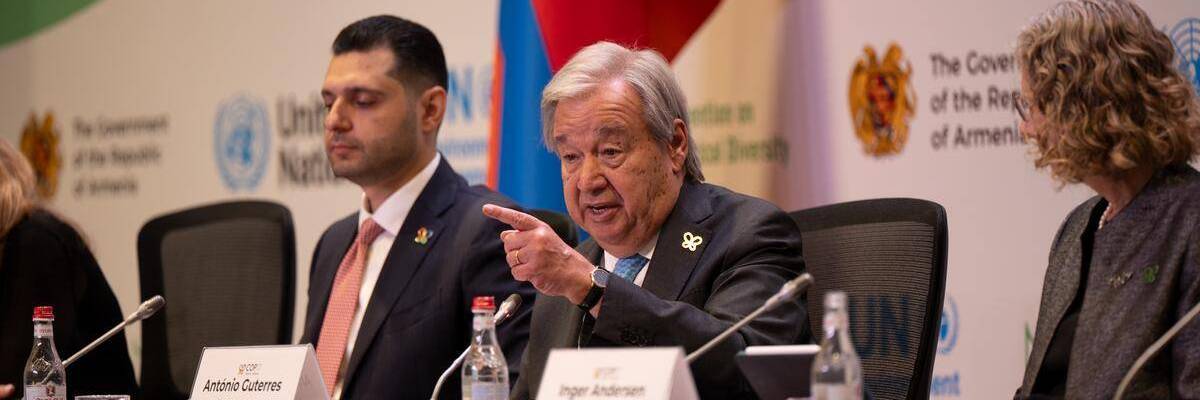
United Nations Secretary-General António Guterres briefs reporters on the launch the "State of Biodiversity Action" report on the sidelines of the 17th meeting of the Conference of Parties on the Convention on Biological Diversity in Yerevan, Armenia on October 16, 2026.
"I urge governments everywhere to end these handouts once and for all, and to use the savings for people and planet instead," said António Guterres.
"The food we eat, the water we drink, the very air we breathe—all are the gifts of biodiversity. Yet every day, humankind saws another branch off the tree of life," outgoing United Nations Secretary-General António Guterres declared Friday, before a key global summit in Armenia.
"Climate chaos. Invasive species. Overgrazing and overfishing. Excessive fertilizers, pesticides, plastics, and heavy metals. All these and more are driving the triple planetary crisis of pollution, biodiversity loss, and climate chaos," he warned. "Over 1 million species now face the risk of extinction, edging us ever closer towards an uninhabitable world."
Guterres advocated for both government and financial leadership, calling out funding for "agribusiness that strips the land" as well as the leading driver of the worsening climate emergency: fossil fuels. According to him, "Subsidizing fossil fuels is subsidizing suicide."
"They are boiling our planet, and are the scourge of biodiversity," said the secretary-general—who has often argued for not only phasing out fossil fuels but also making polluters pay for their damage. "I urge governments everywhere to end these handouts once and for all, and to use the savings for people and planet instead."
Four years ago, at the 15th Conference of the Parties to the Convention on Biological Diversity, world leaders agreed to the Kunming-Montreal Global Biodiversity Framework—which critics called "weak" and "an open invitation to greenwash." With COP17 kicking off in the Armenian capital on Monday, the UN chief said that "Yerevan is our moment of accountability."
The "good news" is that the framework "has inspired action across the globe," with nearly 90% of parties to the convention establishing national biodiversity targets, Guterres said. The "bad news" is that "progress is uneven, and far too slow. Even if current national commitments are met, only 26% of terrestrial, and 12% of marine ecosystems would be protected by 2030."
"That is well short of the promise made in Montreal to protect 30% of land and sea by 2030. Major gaps also remain in targets linked to economic systems, including those focused on reducing harmful incentives," he noted. "And many of the critical elements of progress—including finance, capacity, cooperation and data—are still largely missing in action."
The figures come from the United Nations Environment Program's "State of Biodiversity Action" report, released in preparation for next week's conference. That followed the September publication of the UNEP's "Limiting Overshoot" report, which warns that the world will at least temporarily surpass the Paris Agreement's temperature target for this century: 1.5°C beyond preindustrial levels.
In response to the overshoot report, Stephanie Roe, global climate and energy lead scientist at the international nonprofit WWF, said last month that "overshooting 1.5°C is not a cliff edge, but neither is it harmless. Every fraction of a degree of warming increases risks for people and nature, while every fraction avoided reduces harm."
"What matters now is how far temperatures rise above 1.5°C and how long they stay there," Roe continued. "The science shows that lower and shorter overshoot means fewer impacts on ecosystems, communities, and economies. Limiting peak warming and returning temperatures to safer levels as quickly as possible can help reduce risks, avoid irreversible losses, and improve resilience for the future."
Roe's organization has also released a series of relevant reports in the weeks before the summit, including a Wednesday analysis it commissioned from the Global Cooperation Institute that lays out "major barriers countries face in delivering the Global Biodiversity Framework and what could help unblock it," and urges "decisive action in Yerevan."
WWF International director general Kirsten Schuijt said that that "COP17 must move countries towards action and implementation. The benefits of collective action for nature are clear: stronger ecological resilience, more secure food and water systems, and reduced economic vulnerability. WWF's latest 'Living Planet Report' shows that nature can recover when the right actions are taken."
Released last month, that report found a 73% decline in the average size of monitored wildlife populations over a 52-year period—with an 85% decline in freshwater ecosystems, followed by 69% in terrestrial, and 59% in marine.
"Lasting progress," said Schuijt, "depends on transforming the systems driving nature loss and shifting decision-making from short-term fixes to long-term solutions. For COP17, this requires governments, businesses, Indigenous peoples, local communities, women, youth, and wider society to all participate actively in decision-making that moves agreements into urgent implementation, to shape and deliver nature-positive solutions."
The political declaration released Friday by heads of state in Yerevan for a leaders' summit preceding the conference already has some advocates, like WWF International president Adil Najam, issuing warnings. Najam explained from the Armenian capital that "leaders came together to discuss the promise made in Montreal in 2022 to halt and reverse biodiversity loss by 2030. The declaration acknowledges that progress is insufficient and that implementation must accelerate. It also recognizes that our economies, communities, and peace depend on nature. But recognition alone will not fulfill that promise."
"The declaration lacks explicit commitments to align economic and financial decisions with nature goals, including reforming subsidies that harm nature," he said. "Governments must make these choices if they are serious about delivering on their commitments. At COP17, they must turn the global review into clear implementation pathways backed by finance on the scale needed. The declaration signals a commitment to action across government; the real test is whether it changes decisions back home."
Dear Common Dreams reader, It’s been nearly 30 years since I co-founded Common Dreams with my late wife, Lina Newhouser. We had the radical notion that journalism should serve the public good, not corporate profits. It was clear to us from the outset what it would take to build such a project. No paid advertisements. No corporate sponsors. No millionaire publisher telling us what to think or do. Many people said we wouldn't last a year, but we proved those doubters wrong. Together with a tremendous team of journalists and dedicated staff, we built an independent media outlet free from the constraints of profits and corporate control. Our mission has always been simple: To inform. To inspire. To ignite change for the common good. Building Common Dreams was not easy. Our survival was never guaranteed. When you take on the most powerful forces—Wall Street greed, fossil fuel industry destruction, Big Tech lobbyists, and uber-rich oligarchs who have spent billions upon billions rigging the economy and democracy in their favor—the only bulwark you have is supporters who believe in your work. But here’s the urgent message from me today. It's never been this bad out there. And it's never been this hard to keep us going. At the very moment Common Dreams is most needed, the threats we face are intensifying. We need your support now more than ever. We don't accept corporate advertising and never will. We don't have a paywall because we don't think people should be blocked from critical news based on their ability to pay. Everything we do is funded by the donations of readers like you. When everyone does the little they can afford, we are strong. But if that support retreats or dries up, so do we. Will you donate now to make sure Common Dreams not only survives but thrives? —Craig Brown, Co-founder |
"The food we eat, the water we drink, the very air we breathe—all are the gifts of biodiversity. Yet every day, humankind saws another branch off the tree of life," outgoing United Nations Secretary-General António Guterres declared Friday, before a key global summit in Armenia.
"Climate chaos. Invasive species. Overgrazing and overfishing. Excessive fertilizers, pesticides, plastics, and heavy metals. All these and more are driving the triple planetary crisis of pollution, biodiversity loss, and climate chaos," he warned. "Over 1 million species now face the risk of extinction, edging us ever closer towards an uninhabitable world."
Guterres advocated for both government and financial leadership, calling out funding for "agribusiness that strips the land" as well as the leading driver of the worsening climate emergency: fossil fuels. According to him, "Subsidizing fossil fuels is subsidizing suicide."
"They are boiling our planet, and are the scourge of biodiversity," said the secretary-general—who has often argued for not only phasing out fossil fuels but also making polluters pay for their damage. "I urge governments everywhere to end these handouts once and for all, and to use the savings for people and planet instead."
Four years ago, at the 15th Conference of the Parties to the Convention on Biological Diversity, world leaders agreed to the Kunming-Montreal Global Biodiversity Framework—which critics called "weak" and "an open invitation to greenwash." With COP17 kicking off in the Armenian capital on Monday, the UN chief said that "Yerevan is our moment of accountability."
The "good news" is that the framework "has inspired action across the globe," with nearly 90% of parties to the convention establishing national biodiversity targets, Guterres said. The "bad news" is that "progress is uneven, and far too slow. Even if current national commitments are met, only 26% of terrestrial, and 12% of marine ecosystems would be protected by 2030."
"That is well short of the promise made in Montreal to protect 30% of land and sea by 2030. Major gaps also remain in targets linked to economic systems, including those focused on reducing harmful incentives," he noted. "And many of the critical elements of progress—including finance, capacity, cooperation and data—are still largely missing in action."
The figures come from the United Nations Environment Program's "State of Biodiversity Action" report, released in preparation for next week's conference. That followed the September publication of the UNEP's "Limiting Overshoot" report, which warns that the world will at least temporarily surpass the Paris Agreement's temperature target for this century: 1.5°C beyond preindustrial levels.
In response to the overshoot report, Stephanie Roe, global climate and energy lead scientist at the international nonprofit WWF, said last month that "overshooting 1.5°C is not a cliff edge, but neither is it harmless. Every fraction of a degree of warming increases risks for people and nature, while every fraction avoided reduces harm."
"What matters now is how far temperatures rise above 1.5°C and how long they stay there," Roe continued. "The science shows that lower and shorter overshoot means fewer impacts on ecosystems, communities, and economies. Limiting peak warming and returning temperatures to safer levels as quickly as possible can help reduce risks, avoid irreversible losses, and improve resilience for the future."
Roe's organization has also released a series of relevant reports in the weeks before the summit, including a Wednesday analysis it commissioned from the Global Cooperation Institute that lays out "major barriers countries face in delivering the Global Biodiversity Framework and what could help unblock it," and urges "decisive action in Yerevan."
WWF International director general Kirsten Schuijt said that that "COP17 must move countries towards action and implementation. The benefits of collective action for nature are clear: stronger ecological resilience, more secure food and water systems, and reduced economic vulnerability. WWF's latest 'Living Planet Report' shows that nature can recover when the right actions are taken."
Released last month, that report found a 73% decline in the average size of monitored wildlife populations over a 52-year period—with an 85% decline in freshwater ecosystems, followed by 69% in terrestrial, and 59% in marine.
"Lasting progress," said Schuijt, "depends on transforming the systems driving nature loss and shifting decision-making from short-term fixes to long-term solutions. For COP17, this requires governments, businesses, Indigenous peoples, local communities, women, youth, and wider society to all participate actively in decision-making that moves agreements into urgent implementation, to shape and deliver nature-positive solutions."
The political declaration released Friday by heads of state in Yerevan for a leaders' summit preceding the conference already has some advocates, like WWF International president Adil Najam, issuing warnings. Najam explained from the Armenian capital that "leaders came together to discuss the promise made in Montreal in 2022 to halt and reverse biodiversity loss by 2030. The declaration acknowledges that progress is insufficient and that implementation must accelerate. It also recognizes that our economies, communities, and peace depend on nature. But recognition alone will not fulfill that promise."
"The declaration lacks explicit commitments to align economic and financial decisions with nature goals, including reforming subsidies that harm nature," he said. "Governments must make these choices if they are serious about delivering on their commitments. At COP17, they must turn the global review into clear implementation pathways backed by finance on the scale needed. The declaration signals a commitment to action across government; the real test is whether it changes decisions back home."
"The food we eat, the water we drink, the very air we breathe—all are the gifts of biodiversity. Yet every day, humankind saws another branch off the tree of life," outgoing United Nations Secretary-General António Guterres declared Friday, before a key global summit in Armenia.
"Climate chaos. Invasive species. Overgrazing and overfishing. Excessive fertilizers, pesticides, plastics, and heavy metals. All these and more are driving the triple planetary crisis of pollution, biodiversity loss, and climate chaos," he warned. "Over 1 million species now face the risk of extinction, edging us ever closer towards an uninhabitable world."
Guterres advocated for both government and financial leadership, calling out funding for "agribusiness that strips the land" as well as the leading driver of the worsening climate emergency: fossil fuels. According to him, "Subsidizing fossil fuels is subsidizing suicide."
"They are boiling our planet, and are the scourge of biodiversity," said the secretary-general—who has often argued for not only phasing out fossil fuels but also making polluters pay for their damage. "I urge governments everywhere to end these handouts once and for all, and to use the savings for people and planet instead."
Four years ago, at the 15th Conference of the Parties to the Convention on Biological Diversity, world leaders agreed to the Kunming-Montreal Global Biodiversity Framework—which critics called "weak" and "an open invitation to greenwash." With COP17 kicking off in the Armenian capital on Monday, the UN chief said that "Yerevan is our moment of accountability."
The "good news" is that the framework "has inspired action across the globe," with nearly 90% of parties to the convention establishing national biodiversity targets, Guterres said. The "bad news" is that "progress is uneven, and far too slow. Even if current national commitments are met, only 26% of terrestrial, and 12% of marine ecosystems would be protected by 2030."
"That is well short of the promise made in Montreal to protect 30% of land and sea by 2030. Major gaps also remain in targets linked to economic systems, including those focused on reducing harmful incentives," he noted. "And many of the critical elements of progress—including finance, capacity, cooperation and data—are still largely missing in action."
The figures come from the United Nations Environment Program's "State of Biodiversity Action" report, released in preparation for next week's conference. That followed the September publication of the UNEP's "Limiting Overshoot" report, which warns that the world will at least temporarily surpass the Paris Agreement's temperature target for this century: 1.5°C beyond preindustrial levels.
In response to the overshoot report, Stephanie Roe, global climate and energy lead scientist at the international nonprofit WWF, said last month that "overshooting 1.5°C is not a cliff edge, but neither is it harmless. Every fraction of a degree of warming increases risks for people and nature, while every fraction avoided reduces harm."
"What matters now is how far temperatures rise above 1.5°C and how long they stay there," Roe continued. "The science shows that lower and shorter overshoot means fewer impacts on ecosystems, communities, and economies. Limiting peak warming and returning temperatures to safer levels as quickly as possible can help reduce risks, avoid irreversible losses, and improve resilience for the future."
Roe's organization has also released a series of relevant reports in the weeks before the summit, including a Wednesday analysis it commissioned from the Global Cooperation Institute that lays out "major barriers countries face in delivering the Global Biodiversity Framework and what could help unblock it," and urges "decisive action in Yerevan."
WWF International director general Kirsten Schuijt said that that "COP17 must move countries towards action and implementation. The benefits of collective action for nature are clear: stronger ecological resilience, more secure food and water systems, and reduced economic vulnerability. WWF's latest 'Living Planet Report' shows that nature can recover when the right actions are taken."
Released last month, that report found a 73% decline in the average size of monitored wildlife populations over a 52-year period—with an 85% decline in freshwater ecosystems, followed by 69% in terrestrial, and 59% in marine.
"Lasting progress," said Schuijt, "depends on transforming the systems driving nature loss and shifting decision-making from short-term fixes to long-term solutions. For COP17, this requires governments, businesses, Indigenous peoples, local communities, women, youth, and wider society to all participate actively in decision-making that moves agreements into urgent implementation, to shape and deliver nature-positive solutions."
The political declaration released Friday by heads of state in Yerevan for a leaders' summit preceding the conference already has some advocates, like WWF International president Adil Najam, issuing warnings. Najam explained from the Armenian capital that "leaders came together to discuss the promise made in Montreal in 2022 to halt and reverse biodiversity loss by 2030. The declaration acknowledges that progress is insufficient and that implementation must accelerate. It also recognizes that our economies, communities, and peace depend on nature. But recognition alone will not fulfill that promise."
"The declaration lacks explicit commitments to align economic and financial decisions with nature goals, including reforming subsidies that harm nature," he said. "Governments must make these choices if they are serious about delivering on their commitments. At COP17, they must turn the global review into clear implementation pathways backed by finance on the scale needed. The declaration signals a commitment to action across government; the real test is whether it changes decisions back home."