SUBSCRIBE TO OUR FREE NEWSLETTER
Daily news & progressive opinion—funded by the people, not the corporations—delivered straight to your inbox.
5
#000000
#FFFFFF
To donate by check, phone, or other method, see our More Ways to Give page.
Daily news & progressive opinion—funded by the people, not the corporations—delivered straight to your inbox.
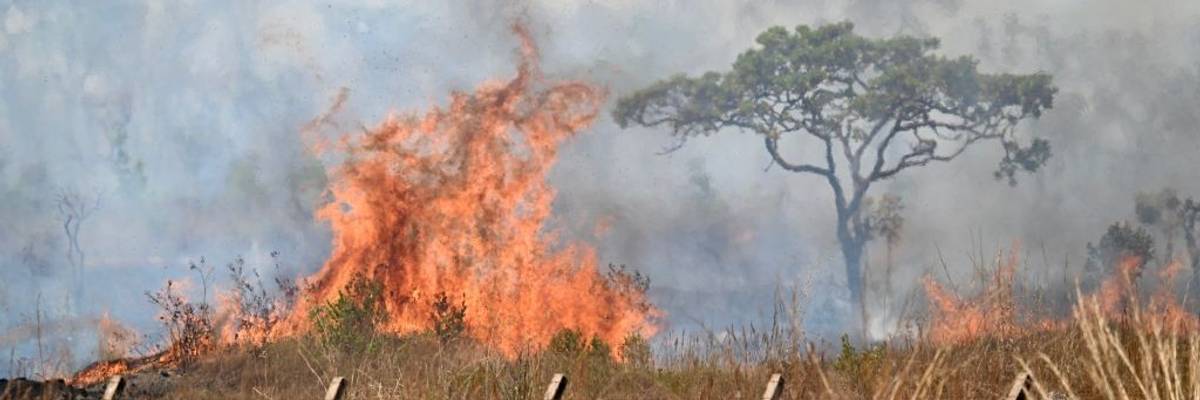
Smoke and flames arise from a forest fire affecting the Brasilia National Park in Brazil on September 16, 2024.
"What we need is real system change that gets to the root of the current economic, social, and political systems that prioritize maximizing profits over people and the environment," said the report's lead author.
As the world celebrated the 55th annual Earth Day, one leading green group released a report exploring how the fossil fuel-driven climate emergency and species loss impact each other, existing policies, and "false" and "real" solutions to the intertwined crises.
The Friends of the Earth International (FOIE) report, Climate and Biodiversity in Freefall, says that "the vicious cycle between climate change and biodiversity loss is harmful and dangerous. Climate change negatively impacts biodiversity in multiple ways."
"For example, ecosystems become unbalanced as different species respond and adapt to climate change in different ways and at different paces," the publication notes. "Pests become more prevalent, destroying entire ecosystems, while ocean acidification threatens coral reefs and the many species that depend on them."
"We can forge a path toward system change that protects our planet's ecosystems and provides a sustainable future for peoples and communities."
"At the same time, biodiversity loss further destabilizes the climate," the report continues. "Since life on Earth contains significant amounts of carbon, biodiversity loss also means the loss of important carbon reservoirs. Biodiversity loss will further reduce carbon storage in ecosystems, and we are fast approaching tipping points like the Amazon dieback where forests may turn from carbon sinks into carbon sources."
After sections that lay out how the climate and biodiversity crises affect each other, the report tackles problematic climate projects and policies: tree planting and monoculture tree plantations; carbon offsetting; nature-based solutions; geoengineering; bioenergy, including with carbon capture and storage; nuclear energy; and hydropower dams.
Tree plantations, for example, "are essentially 'green deserts,' often made up of a single non-native species, and thus require extensive pesticide use, provide no habitat for other species, and are highly prone to fire," the document details.
Projects labeled nature-based solutions, the report adds, "are primarily focused on compensating for climate emissions, and often serve as greenwashing tools for heavily polluting corporations, allowing them to continue their harmful practices under the guise of environmental responsibility."
There is also a section on United Nations policies, which points out that although the two crises "each have their own U.N. treaty—the Framework Convention on Climate Change (UNFCCC) and the Convention on Biological Diversity (CBD)—extremely little attention has been paid to the interlinkages."
"While the connection is often made at the discourse level, a systemic view that addresses climate and biodiversity simultaneously is largely absent in real policies," adds the U.N. section of the report, which was published just over six months away from the next United Nations climate summit, COP30, in Brazil.
In this blog, @nelemarien.bsky.social highlights how current climate policies worsen the climate and biodiversity crises, with disastrous consequences for communities & ecosystems! Read more here: www.foei.org/system-chang... #SystemChange #biodiversityloss #climatechange
[image or embed]
— Friends of the Earth International (@foeint.bsky.social) April 22, 2025 at 5:53 AM
The next section of the report, promoting what FOEI dubs "real solutions," calls for "rigorous regulation of all sectors that harm biodiversity," an end to financing for "environmentally destructive corporate activities," a moratorium on harmful "development" projects, ditching industrial agriculture in favor of agroecology, and investments in measures such as "reducing or eliminating pesticides and other toxins, curbing noise and light pollution, and encouraging native species to thrive."
The report also stresses the need for broader impact assessments and that "the impacts of the biodiversity and climate crises hit Indigenous Peoples and local communities (IPLCs) and poor and marginalized people hard by undermining their livelihoods, jeopardizing food sovereignty, and worsening general living conditions." It calls for protecting these groups, including by "recognizing collective rights to land and community governance of territories."
On the climate front, the document emphasizes the necessity of "a rapid and just energy transition" that guarantees energy sufficiency for all; ensures direct democratic control and governance; guarantees the right to free, prior, and informed consent; and prioritizes "renewable technology that is climate resilient, locally appropriate, low impact, and not harmful to biodiversity."
Nele Marien, the report's lead author and FOEI's forests and biodiversity program coordinator, said in a Tuesday statement that "the intertwined crises of climate change and biodiversity loss call for a fundamental rethinking of our approach."
"What we need is real system change that gets to the root of the current economic, social, and political systems that prioritize maximizing profits over people and the environment," Marien asserted. "By recognizing these interconnections between the climate and biodiversity crises, halting detrimental climate policies, and supporting Indigenous knowledge, we can forge a path toward system change that protects our planet's ecosystems and provides a sustainable future for peoples and communities, especially those in the Global South who are most affected."
Dear Common Dreams reader, It’s been nearly 30 years since I co-founded Common Dreams with my late wife, Lina Newhouser. We had the radical notion that journalism should serve the public good, not corporate profits. It was clear to us from the outset what it would take to build such a project. No paid advertisements. No corporate sponsors. No millionaire publisher telling us what to think or do. Many people said we wouldn't last a year, but we proved those doubters wrong. Together with a tremendous team of journalists and dedicated staff, we built an independent media outlet free from the constraints of profits and corporate control. Our mission has always been simple: To inform. To inspire. To ignite change for the common good. Building Common Dreams was not easy. Our survival was never guaranteed. When you take on the most powerful forces—Wall Street greed, fossil fuel industry destruction, Big Tech lobbyists, and uber-rich oligarchs who have spent billions upon billions rigging the economy and democracy in their favor—the only bulwark you have is supporters who believe in your work. But here’s the urgent message from me today. It's never been this bad out there. And it's never been this hard to keep us going. At the very moment Common Dreams is most needed, the threats we face are intensifying. We need your support now more than ever. We don't accept corporate advertising and never will. We don't have a paywall because we don't think people should be blocked from critical news based on their ability to pay. Everything we do is funded by the donations of readers like you. When everyone does the little they can afford, we are strong. But if that support retreats or dries up, so do we. Will you donate now to make sure Common Dreams not only survives but thrives? —Craig Brown, Co-founder |
As the world celebrated the 55th annual Earth Day, one leading green group released a report exploring how the fossil fuel-driven climate emergency and species loss impact each other, existing policies, and "false" and "real" solutions to the intertwined crises.
The Friends of the Earth International (FOIE) report, Climate and Biodiversity in Freefall, says that "the vicious cycle between climate change and biodiversity loss is harmful and dangerous. Climate change negatively impacts biodiversity in multiple ways."
"For example, ecosystems become unbalanced as different species respond and adapt to climate change in different ways and at different paces," the publication notes. "Pests become more prevalent, destroying entire ecosystems, while ocean acidification threatens coral reefs and the many species that depend on them."
"We can forge a path toward system change that protects our planet's ecosystems and provides a sustainable future for peoples and communities."
"At the same time, biodiversity loss further destabilizes the climate," the report continues. "Since life on Earth contains significant amounts of carbon, biodiversity loss also means the loss of important carbon reservoirs. Biodiversity loss will further reduce carbon storage in ecosystems, and we are fast approaching tipping points like the Amazon dieback where forests may turn from carbon sinks into carbon sources."
After sections that lay out how the climate and biodiversity crises affect each other, the report tackles problematic climate projects and policies: tree planting and monoculture tree plantations; carbon offsetting; nature-based solutions; geoengineering; bioenergy, including with carbon capture and storage; nuclear energy; and hydropower dams.
Tree plantations, for example, "are essentially 'green deserts,' often made up of a single non-native species, and thus require extensive pesticide use, provide no habitat for other species, and are highly prone to fire," the document details.
Projects labeled nature-based solutions, the report adds, "are primarily focused on compensating for climate emissions, and often serve as greenwashing tools for heavily polluting corporations, allowing them to continue their harmful practices under the guise of environmental responsibility."
There is also a section on United Nations policies, which points out that although the two crises "each have their own U.N. treaty—the Framework Convention on Climate Change (UNFCCC) and the Convention on Biological Diversity (CBD)—extremely little attention has been paid to the interlinkages."
"While the connection is often made at the discourse level, a systemic view that addresses climate and biodiversity simultaneously is largely absent in real policies," adds the U.N. section of the report, which was published just over six months away from the next United Nations climate summit, COP30, in Brazil.
In this blog, @nelemarien.bsky.social highlights how current climate policies worsen the climate and biodiversity crises, with disastrous consequences for communities & ecosystems! Read more here: www.foei.org/system-chang... #SystemChange #biodiversityloss #climatechange
[image or embed]
— Friends of the Earth International (@foeint.bsky.social) April 22, 2025 at 5:53 AM
The next section of the report, promoting what FOEI dubs "real solutions," calls for "rigorous regulation of all sectors that harm biodiversity," an end to financing for "environmentally destructive corporate activities," a moratorium on harmful "development" projects, ditching industrial agriculture in favor of agroecology, and investments in measures such as "reducing or eliminating pesticides and other toxins, curbing noise and light pollution, and encouraging native species to thrive."
The report also stresses the need for broader impact assessments and that "the impacts of the biodiversity and climate crises hit Indigenous Peoples and local communities (IPLCs) and poor and marginalized people hard by undermining their livelihoods, jeopardizing food sovereignty, and worsening general living conditions." It calls for protecting these groups, including by "recognizing collective rights to land and community governance of territories."
On the climate front, the document emphasizes the necessity of "a rapid and just energy transition" that guarantees energy sufficiency for all; ensures direct democratic control and governance; guarantees the right to free, prior, and informed consent; and prioritizes "renewable technology that is climate resilient, locally appropriate, low impact, and not harmful to biodiversity."
Nele Marien, the report's lead author and FOEI's forests and biodiversity program coordinator, said in a Tuesday statement that "the intertwined crises of climate change and biodiversity loss call for a fundamental rethinking of our approach."
"What we need is real system change that gets to the root of the current economic, social, and political systems that prioritize maximizing profits over people and the environment," Marien asserted. "By recognizing these interconnections between the climate and biodiversity crises, halting detrimental climate policies, and supporting Indigenous knowledge, we can forge a path toward system change that protects our planet's ecosystems and provides a sustainable future for peoples and communities, especially those in the Global South who are most affected."
As the world celebrated the 55th annual Earth Day, one leading green group released a report exploring how the fossil fuel-driven climate emergency and species loss impact each other, existing policies, and "false" and "real" solutions to the intertwined crises.
The Friends of the Earth International (FOIE) report, Climate and Biodiversity in Freefall, says that "the vicious cycle between climate change and biodiversity loss is harmful and dangerous. Climate change negatively impacts biodiversity in multiple ways."
"For example, ecosystems become unbalanced as different species respond and adapt to climate change in different ways and at different paces," the publication notes. "Pests become more prevalent, destroying entire ecosystems, while ocean acidification threatens coral reefs and the many species that depend on them."
"We can forge a path toward system change that protects our planet's ecosystems and provides a sustainable future for peoples and communities."
"At the same time, biodiversity loss further destabilizes the climate," the report continues. "Since life on Earth contains significant amounts of carbon, biodiversity loss also means the loss of important carbon reservoirs. Biodiversity loss will further reduce carbon storage in ecosystems, and we are fast approaching tipping points like the Amazon dieback where forests may turn from carbon sinks into carbon sources."
After sections that lay out how the climate and biodiversity crises affect each other, the report tackles problematic climate projects and policies: tree planting and monoculture tree plantations; carbon offsetting; nature-based solutions; geoengineering; bioenergy, including with carbon capture and storage; nuclear energy; and hydropower dams.
Tree plantations, for example, "are essentially 'green deserts,' often made up of a single non-native species, and thus require extensive pesticide use, provide no habitat for other species, and are highly prone to fire," the document details.
Projects labeled nature-based solutions, the report adds, "are primarily focused on compensating for climate emissions, and often serve as greenwashing tools for heavily polluting corporations, allowing them to continue their harmful practices under the guise of environmental responsibility."
There is also a section on United Nations policies, which points out that although the two crises "each have their own U.N. treaty—the Framework Convention on Climate Change (UNFCCC) and the Convention on Biological Diversity (CBD)—extremely little attention has been paid to the interlinkages."
"While the connection is often made at the discourse level, a systemic view that addresses climate and biodiversity simultaneously is largely absent in real policies," adds the U.N. section of the report, which was published just over six months away from the next United Nations climate summit, COP30, in Brazil.
In this blog, @nelemarien.bsky.social highlights how current climate policies worsen the climate and biodiversity crises, with disastrous consequences for communities & ecosystems! Read more here: www.foei.org/system-chang... #SystemChange #biodiversityloss #climatechange
[image or embed]
— Friends of the Earth International (@foeint.bsky.social) April 22, 2025 at 5:53 AM
The next section of the report, promoting what FOEI dubs "real solutions," calls for "rigorous regulation of all sectors that harm biodiversity," an end to financing for "environmentally destructive corporate activities," a moratorium on harmful "development" projects, ditching industrial agriculture in favor of agroecology, and investments in measures such as "reducing or eliminating pesticides and other toxins, curbing noise and light pollution, and encouraging native species to thrive."
The report also stresses the need for broader impact assessments and that "the impacts of the biodiversity and climate crises hit Indigenous Peoples and local communities (IPLCs) and poor and marginalized people hard by undermining their livelihoods, jeopardizing food sovereignty, and worsening general living conditions." It calls for protecting these groups, including by "recognizing collective rights to land and community governance of territories."
On the climate front, the document emphasizes the necessity of "a rapid and just energy transition" that guarantees energy sufficiency for all; ensures direct democratic control and governance; guarantees the right to free, prior, and informed consent; and prioritizes "renewable technology that is climate resilient, locally appropriate, low impact, and not harmful to biodiversity."
Nele Marien, the report's lead author and FOEI's forests and biodiversity program coordinator, said in a Tuesday statement that "the intertwined crises of climate change and biodiversity loss call for a fundamental rethinking of our approach."
"What we need is real system change that gets to the root of the current economic, social, and political systems that prioritize maximizing profits over people and the environment," Marien asserted. "By recognizing these interconnections between the climate and biodiversity crises, halting detrimental climate policies, and supporting Indigenous knowledge, we can forge a path toward system change that protects our planet's ecosystems and provides a sustainable future for peoples and communities, especially those in the Global South who are most affected."