

SUBSCRIBE TO OUR FREE NEWSLETTER
Daily news & progressive opinion—funded by the people, not the corporations—delivered straight to your inbox.
5
#000000
#FFFFFF
To donate by check, phone, or other method, see our More Ways to Give page.
Daily news & progressive opinion—funded by the people, not the corporations—delivered straight to your inbox.
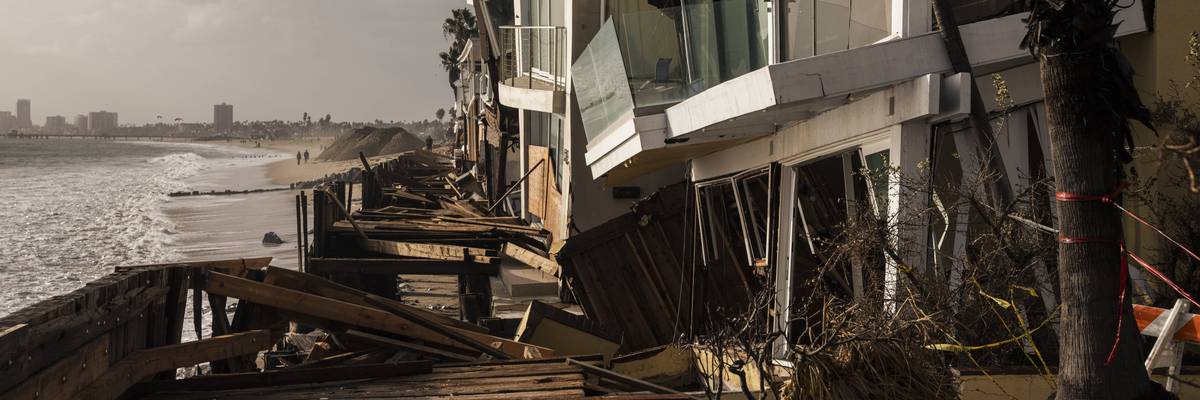
Damaged beachfront homes are seen in Long Beach, California following Tropical Storm Rachel on October 11, 2026.
"After spending years pointing to climate change and rising disaster costs to justify offering policyholders less protection at a higher price, the insurance industry is reaping record profits."
As fossil fuels push up temperatures worldwide, with deadly consequences, and governments debate how to handle the worsening climate emergency at a summit in Türkiye, a trio of groups on Thursday called out home insurance companies in the United States for "generating $113 billion dollars of excess underwriting profit over the last five years" by hiking premium rates and suppressing claim payouts.
"Rather than helping customers adapt and reduce climate risk, the industry funnels these profits into financial markets, boosting investment income, and enriching executives and shareholders," says the new report from Americans for Financial Reform Education Fund (AFREF), Public Citizen, and the Revolving Door Project (RDP), titled "Home Insurers Are Ripping People Off Amid the Climate Crisis."
The publication features four main sections, the first of which analyzes national trends. It shows that "between 2021 and 2025, home insurance premium revenue has increased by almost 60%. All but one of the 10 largest property and casualty (P&C) insurers increased premium revenue in their home insurance line by at least 40%. In the same period, claims payouts increased at only half the rate of premium revenue. As a result, loss ratios in the home insurance market fell by 20%."
Data shows soaring home insurance costs cannot be fully explained by rising climate impacts, increased cost of reinsurance, or construction costs. “Families are paying too much for home insurance and getting less back when climate disasters strike.” - Alex Martin, AFREF
[image or embed]
— Americans for Financial Reform (@ourfinancialsecurity.org) November 19, 2026 at 8:01 AM
Specifically, home insurance companies earned $113.9 billion from premiums in 2021, and paid out about 69 cents in claims for every dollar collected. By 2025, they brought in $181.2 billion and paid out only about 55 cents per dollar collected. Both of those figures are "far below the historical average of 70 to 80 cents in the 1990s," noted Alex Martin, climate finance policy director at AFREF.
The companies are "maximizing profits" by not only raising rates, but also "closing a staggering number of claims without payment," explained Elyse Schupak, policy advocate with Public Citizen's Climate Program. During the study period, insurers closed nearly a third of claims without payment, and of those they paid, more than a fifth took at least two months to process.
"After spending years pointing to climate change and rising disaster costs to justify offering policyholders less protection at a higher price, the insurance industry is reaping record profits," Schupak stressed. "Insurance companies preach about protecting households, but the numbers reveal that the industry is actively padding its bottom line at their expense."
The report points out that "in 2025, some states had exceptionally low loss ratios, meaning insurers held onto much of the premiums they collected. These include Hawaii, where insurers paid out just eight cents of every dollar collected in premiums (8%), Florida (11%), New Mexico (22%), Louisiana (23%), and South Carolina (26%)."
Part two of the publication focuses on some of the states where home insurers "posted extremely low loss ratios" last year: Idaho, Iowa, Florida, Maine, and Texas. In Florida, which faces rising seas and increasingly devastating hurricanes due to the climate crisis, "insurers increased premiums collected in the state by 64% over the past five years, from $11.4 billion in 2021 to $18.7 billion in 2025. Claims payouts decreased by 67% during the same period, from $6.5 billion to $2.1 billion."
"No hurricanes made landfall in the US in 2025, which contributed to extremely low loss ratios in the state, though insurers also had low loss ratios in 2024 when the state had high hurricane activity," the report says. "Nonetheless, the high cost of reinsurance and the risk of especially damaging hurricanes requires insurers to purchase reinsurance to cover severe hurricanes, and may require additional reserves to promote solvency."
Home insurance rates increased even where claims payouts fell:🚨 In Texas, insurers collected 78% more in premiums in 2025 than in 2021, while claims payouts fell 23%. Liberty Mutual’s largest home insurance company in Texas increased its rates by a cumulative 144%.
[image or embed]
— Americans for Financial Reform (@ourfinancialsecurity.org) November 19, 2026 at 8:01 AM
Part three of the report lays out how industry profits "could have been used to fund climate adaption," highlighting that "even if only a small fraction of the industry's excess underwriting income was reinvested in communities to support adaptation efforts, it would make an enormous difference in preserving people's ability to stay insured."
Redirecting just 10% of the industry's excess underwriting income from 2021-25 could have provided nearly $5 billion dollars each year for climate adaptation projects, "far more" than the Federal Emergency Management Agency's annual spending on pre-disaster mitigation, according to the analysis. The full $113 billion "is enough money to fund 11.3 million standard roof fortification matching grants valued at $10,000, providing grants to over a third of the estimated 33.1 million US homes facing moderate or greater hurricane wind risk."
Part four features policy recommendations, urging decision-makers to "consider prior loss ratios in rate regulation, strengthen oversight of insurer rate increases, require insurers to invest in and reward resilience, increase oversight of insurer claims handling, and increase transparency over insurer underwriting, pricing, and claims decisions."
With home insurers "simultaneously overcharging and short-changing households as the fossil fuel-driven climate crisis intensifies," said RDP deputy research director Kenny Stancil, "public officials must use every tool at their disposal to curb industry profiteering and insist that these ill-gotten gains be used instead to help communities adapt to increasingly frequent and severe weather."
This country and this world are at a monumental crossroads. US voters have an opportunity to beat back the forces of fascism and confront the billionaires who are rigging the economy, our media system, and our democracy, making it increasingly impossible for ordinary people to get by. We’re not just talking about the election. We’re talking about what must be done once these fascist elements are vanquished from power. We need a bolder set of solutions than what either major party has so far been willing to offer and a working-class movement ready to fight like hell for it. Trump didn't emerge from nowhere. The conditions that fueled MAGA authoritarianism were created by decades of radical neoliberal economic policies and a corrupt political system dominated by corporate interests. They slashed taxes on the super-rich, promising that the benefits would trickle down. They said giveaways to the corporate titans would make life more affordable for the rest of us. It was all bullshit. And when a bitter, betrayed populace searches for someone to blame, right-wing demagogues have little trouble finding scapegoats. People know when they're being lied to, but you won't hear any of this from the corporate media. Only independent journalism—powered and funded by people who believe in building a better world—can deliver truly trustworthy daily news. If you share our vision, please contribute whatever you can to sustain our work. |
As fossil fuels push up temperatures worldwide, with deadly consequences, and governments debate how to handle the worsening climate emergency at a summit in Türkiye, a trio of groups on Thursday called out home insurance companies in the United States for "generating $113 billion dollars of excess underwriting profit over the last five years" by hiking premium rates and suppressing claim payouts.
"Rather than helping customers adapt and reduce climate risk, the industry funnels these profits into financial markets, boosting investment income, and enriching executives and shareholders," says the new report from Americans for Financial Reform Education Fund (AFREF), Public Citizen, and the Revolving Door Project (RDP), titled "Home Insurers Are Ripping People Off Amid the Climate Crisis."
The publication features four main sections, the first of which analyzes national trends. It shows that "between 2021 and 2025, home insurance premium revenue has increased by almost 60%. All but one of the 10 largest property and casualty (P&C) insurers increased premium revenue in their home insurance line by at least 40%. In the same period, claims payouts increased at only half the rate of premium revenue. As a result, loss ratios in the home insurance market fell by 20%."
Data shows soaring home insurance costs cannot be fully explained by rising climate impacts, increased cost of reinsurance, or construction costs. “Families are paying too much for home insurance and getting less back when climate disasters strike.” - Alex Martin, AFREF
[image or embed]
— Americans for Financial Reform (@ourfinancialsecurity.org) November 19, 2026 at 8:01 AM
Specifically, home insurance companies earned $113.9 billion from premiums in 2021, and paid out about 69 cents in claims for every dollar collected. By 2025, they brought in $181.2 billion and paid out only about 55 cents per dollar collected. Both of those figures are "far below the historical average of 70 to 80 cents in the 1990s," noted Alex Martin, climate finance policy director at AFREF.
The companies are "maximizing profits" by not only raising rates, but also "closing a staggering number of claims without payment," explained Elyse Schupak, policy advocate with Public Citizen's Climate Program. During the study period, insurers closed nearly a third of claims without payment, and of those they paid, more than a fifth took at least two months to process.
"After spending years pointing to climate change and rising disaster costs to justify offering policyholders less protection at a higher price, the insurance industry is reaping record profits," Schupak stressed. "Insurance companies preach about protecting households, but the numbers reveal that the industry is actively padding its bottom line at their expense."
The report points out that "in 2025, some states had exceptionally low loss ratios, meaning insurers held onto much of the premiums they collected. These include Hawaii, where insurers paid out just eight cents of every dollar collected in premiums (8%), Florida (11%), New Mexico (22%), Louisiana (23%), and South Carolina (26%)."
Part two of the publication focuses on some of the states where home insurers "posted extremely low loss ratios" last year: Idaho, Iowa, Florida, Maine, and Texas. In Florida, which faces rising seas and increasingly devastating hurricanes due to the climate crisis, "insurers increased premiums collected in the state by 64% over the past five years, from $11.4 billion in 2021 to $18.7 billion in 2025. Claims payouts decreased by 67% during the same period, from $6.5 billion to $2.1 billion."
"No hurricanes made landfall in the US in 2025, which contributed to extremely low loss ratios in the state, though insurers also had low loss ratios in 2024 when the state had high hurricane activity," the report says. "Nonetheless, the high cost of reinsurance and the risk of especially damaging hurricanes requires insurers to purchase reinsurance to cover severe hurricanes, and may require additional reserves to promote solvency."
Home insurance rates increased even where claims payouts fell:🚨 In Texas, insurers collected 78% more in premiums in 2025 than in 2021, while claims payouts fell 23%. Liberty Mutual’s largest home insurance company in Texas increased its rates by a cumulative 144%.
[image or embed]
— Americans for Financial Reform (@ourfinancialsecurity.org) November 19, 2026 at 8:01 AM
Part three of the report lays out how industry profits "could have been used to fund climate adaption," highlighting that "even if only a small fraction of the industry's excess underwriting income was reinvested in communities to support adaptation efforts, it would make an enormous difference in preserving people's ability to stay insured."
Redirecting just 10% of the industry's excess underwriting income from 2021-25 could have provided nearly $5 billion dollars each year for climate adaptation projects, "far more" than the Federal Emergency Management Agency's annual spending on pre-disaster mitigation, according to the analysis. The full $113 billion "is enough money to fund 11.3 million standard roof fortification matching grants valued at $10,000, providing grants to over a third of the estimated 33.1 million US homes facing moderate or greater hurricane wind risk."
Part four features policy recommendations, urging decision-makers to "consider prior loss ratios in rate regulation, strengthen oversight of insurer rate increases, require insurers to invest in and reward resilience, increase oversight of insurer claims handling, and increase transparency over insurer underwriting, pricing, and claims decisions."
With home insurers "simultaneously overcharging and short-changing households as the fossil fuel-driven climate crisis intensifies," said RDP deputy research director Kenny Stancil, "public officials must use every tool at their disposal to curb industry profiteering and insist that these ill-gotten gains be used instead to help communities adapt to increasingly frequent and severe weather."
As fossil fuels push up temperatures worldwide, with deadly consequences, and governments debate how to handle the worsening climate emergency at a summit in Türkiye, a trio of groups on Thursday called out home insurance companies in the United States for "generating $113 billion dollars of excess underwriting profit over the last five years" by hiking premium rates and suppressing claim payouts.
"Rather than helping customers adapt and reduce climate risk, the industry funnels these profits into financial markets, boosting investment income, and enriching executives and shareholders," says the new report from Americans for Financial Reform Education Fund (AFREF), Public Citizen, and the Revolving Door Project (RDP), titled "Home Insurers Are Ripping People Off Amid the Climate Crisis."
The publication features four main sections, the first of which analyzes national trends. It shows that "between 2021 and 2025, home insurance premium revenue has increased by almost 60%. All but one of the 10 largest property and casualty (P&C) insurers increased premium revenue in their home insurance line by at least 40%. In the same period, claims payouts increased at only half the rate of premium revenue. As a result, loss ratios in the home insurance market fell by 20%."
Data shows soaring home insurance costs cannot be fully explained by rising climate impacts, increased cost of reinsurance, or construction costs. “Families are paying too much for home insurance and getting less back when climate disasters strike.” - Alex Martin, AFREF
[image or embed]
— Americans for Financial Reform (@ourfinancialsecurity.org) November 19, 2026 at 8:01 AM
Specifically, home insurance companies earned $113.9 billion from premiums in 2021, and paid out about 69 cents in claims for every dollar collected. By 2025, they brought in $181.2 billion and paid out only about 55 cents per dollar collected. Both of those figures are "far below the historical average of 70 to 80 cents in the 1990s," noted Alex Martin, climate finance policy director at AFREF.
The companies are "maximizing profits" by not only raising rates, but also "closing a staggering number of claims without payment," explained Elyse Schupak, policy advocate with Public Citizen's Climate Program. During the study period, insurers closed nearly a third of claims without payment, and of those they paid, more than a fifth took at least two months to process.
"After spending years pointing to climate change and rising disaster costs to justify offering policyholders less protection at a higher price, the insurance industry is reaping record profits," Schupak stressed. "Insurance companies preach about protecting households, but the numbers reveal that the industry is actively padding its bottom line at their expense."
The report points out that "in 2025, some states had exceptionally low loss ratios, meaning insurers held onto much of the premiums they collected. These include Hawaii, where insurers paid out just eight cents of every dollar collected in premiums (8%), Florida (11%), New Mexico (22%), Louisiana (23%), and South Carolina (26%)."
Part two of the publication focuses on some of the states where home insurers "posted extremely low loss ratios" last year: Idaho, Iowa, Florida, Maine, and Texas. In Florida, which faces rising seas and increasingly devastating hurricanes due to the climate crisis, "insurers increased premiums collected in the state by 64% over the past five years, from $11.4 billion in 2021 to $18.7 billion in 2025. Claims payouts decreased by 67% during the same period, from $6.5 billion to $2.1 billion."
"No hurricanes made landfall in the US in 2025, which contributed to extremely low loss ratios in the state, though insurers also had low loss ratios in 2024 when the state had high hurricane activity," the report says. "Nonetheless, the high cost of reinsurance and the risk of especially damaging hurricanes requires insurers to purchase reinsurance to cover severe hurricanes, and may require additional reserves to promote solvency."
Home insurance rates increased even where claims payouts fell:🚨 In Texas, insurers collected 78% more in premiums in 2025 than in 2021, while claims payouts fell 23%. Liberty Mutual’s largest home insurance company in Texas increased its rates by a cumulative 144%.
[image or embed]
— Americans for Financial Reform (@ourfinancialsecurity.org) November 19, 2026 at 8:01 AM
Part three of the report lays out how industry profits "could have been used to fund climate adaption," highlighting that "even if only a small fraction of the industry's excess underwriting income was reinvested in communities to support adaptation efforts, it would make an enormous difference in preserving people's ability to stay insured."
Redirecting just 10% of the industry's excess underwriting income from 2021-25 could have provided nearly $5 billion dollars each year for climate adaptation projects, "far more" than the Federal Emergency Management Agency's annual spending on pre-disaster mitigation, according to the analysis. The full $113 billion "is enough money to fund 11.3 million standard roof fortification matching grants valued at $10,000, providing grants to over a third of the estimated 33.1 million US homes facing moderate or greater hurricane wind risk."
Part four features policy recommendations, urging decision-makers to "consider prior loss ratios in rate regulation, strengthen oversight of insurer rate increases, require insurers to invest in and reward resilience, increase oversight of insurer claims handling, and increase transparency over insurer underwriting, pricing, and claims decisions."
With home insurers "simultaneously overcharging and short-changing households as the fossil fuel-driven climate crisis intensifies," said RDP deputy research director Kenny Stancil, "public officials must use every tool at their disposal to curb industry profiteering and insist that these ill-gotten gains be used instead to help communities adapt to increasingly frequent and severe weather."