
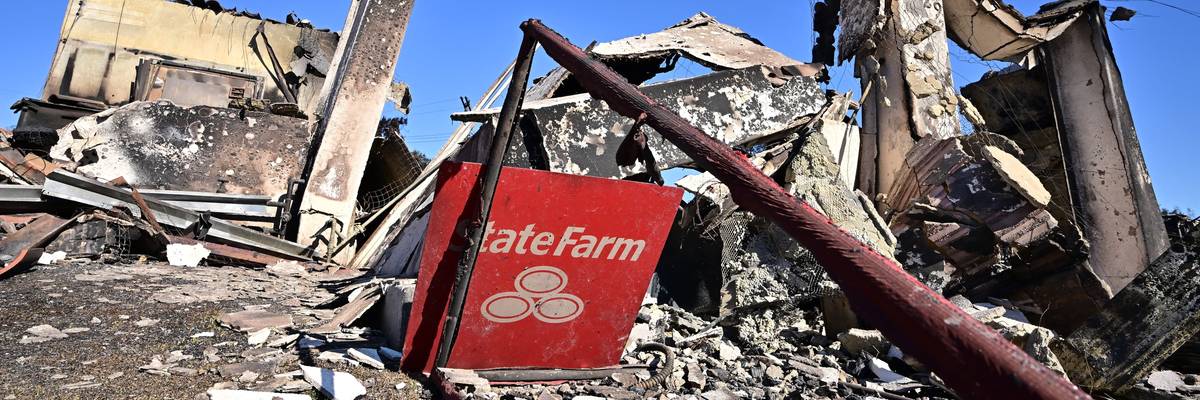
A State Farm insurance company sign sits amid the rubble of a building destroyed by the Palisades Fire on Sunset Boulevard in the Pacific Palisades neighborhood of Los Angeles on January 16, 2025.
Climate-Fueled Insurance Cost Hikes Putting American Dream 'Out of Reach'
"Policymakers across the country should see this data as a blaring warning that they can no longer ignore the alarm bells of a climate-driven financial crisis," said one advocate.
As communities across the Los Angeles area continued to grapple with catastrophic wildfires, the U.S. Treasury Department on Thursday released the most far-reaching report ever on the climate emergency's impact on home insurance—shedding light on how disasters like the one devastating Southern California this month could increasingly push U.S. families toward financial ruin.
More than three years after President Joe Biden issued an executive order directing the Federal Insurance Office to assess "the potential for major disruptions of private insurance coverage in regions of the country particularly vulnerable to climate change impacts," the FIO released an analysis showing that homeowner insurance costs are rapidly rising across the U.S.—8.7% faster than the rate of inflation in 2018-22.
During that period, homeowners in the 20% of ZIP codes in coastal areas and other regions vulnerable to climate disasters faced insurance premiums that averaged $2,321—82% higher than people in the ZIP codes with the lowest risk.
"Climate change is already increasing our cost of living—and it's only going to get worse," said Steven Rattner, an investor and New York Times opinion writer.
For a growing number of homeowners, rising insurance costs have led to a cost-benefit analysis that puts them at risk for financial ruin, as they have given up on keeping current with their payments.
Analyzing 246 million insurance policies issued by 330 insurers nationwide from 2018-22, the FIO found that insurers canceled at least 10% of policies in 2022 due to nonpayment. Cancellation rates were highest in hurricane-prone areas such as Hilton Head, Charleston, and Myrtle Beach, South Carolina, as well as places that are vulnerable to increasingly fast-moving wildfires like California and Arizona.
During the time period analyzed, five wildfires in the Southwest caused more than $100 million in damages, with homeowners claiming an average of $27,000.
"While insurance companies will no doubt find ways to profit from the crisis, households across the country cannot sustain rising costs indefinitely."
"Treasury's analysis comes at a time of devastating tragedy, loss of life, and destruction from the wildfires in the Los Angeles area," said Secretary of the Treasury Janet Yellen. "While it's far from clear what the exact financial costs of this disaster will be, it is a stark reminder of the impacts of the growing magnitude of natural disasters on the U.S. economy."
"This report identifies alarming trends of rising costs of insurance—to consumers and insurers themselves—as well as lack of availability of insurance, all of which threaten the long-term prosperity of American families," Yellen added.
In other words, said Carly Fabian, senior insurance policy advocate with Public Citizen's Climate Program, the climate-fueled insurance crisis is helping to push the American Dream of home ownership "out of reach" for a growing number of families.
"This report shows exactly what we feared: Climate change is creating an insurance crisis for households across the country. For many Americans, home ownership is a key part of the American Dream," said Fabian. "While insurance companies will no doubt find ways to profit from the crisis, households across the country cannot sustain rising costs indefinitely."
In 2022, Public Citizen joined more than 75 consumer advocacy and environmental justice groups in calling on the Treasury Department to promptly follow Biden's executive order and collect data on how the climate emergency is affecting homeowners.
"While this report is an essential step, it is only a first window into the data necessary to monitor this crisis," said Fabian. "The fact that the Federal Insurance Office had to be the first to propose collecting and now publishing this data shows the utter failure of the fragmented state regulatory system to protect the public. In the aftermath of the fires in Los Angeles and the devastation in Asheville [from Hurricane Helene], policymakers across the country should see this data as a blaring warning that they can no longer ignore the alarm bells of a climate-driven financial crisis."
The Los Angeles fires this month could ultimately cost as much as $275 billion, AccuWeather reported this week, and the National Oceanic and Atmospheric Administration revealed this month that from 2018-22, 84 billion-dollar climate disasters—excluding floods, which are typically not covered by home insurance—cost more than $609 billion. The costs of such events have continued rising since 2022.
Climate reporter Kate Aronoff of The New Republic likened the burgeoning home insurance crisis to the for-profit health insurance industry, in which corporate consolidation is also pushing premiums higher and contributing to medical debt that's owed by about 20 million people.
"Everyone gets sick. Dealing with that's a nightmare even if you have good coverage," said Aronoff. "Not everyone's house will burn down or flood but [there are] some real parallels in terms of human tragedy and suffering being mediated through an infuriating for-profit bureaucracy with haphazard public backing."
We are at a crossroads
This country and this world are at a monumental crossroads. US voters have an opportunity to beat back the forces of fascism and confront the billionaires who are rigging the economy, our media system, and our democracy, making it increasingly impossible for ordinary people to get by. We’re not just talking about the election. We’re talking about what must be done once these fascist elements are vanquished from power. We need a bolder set of solutions than what either major party has so far been willing to offer and a working-class movement ready to fight like hell for it. Trump didn't emerge from nowhere. The conditions that fueled MAGA authoritarianism were created by decades of radical neoliberal economic policies and a corrupt political system dominated by corporate interests. They slashed taxes on the super-rich, promising that the benefits would trickle down. They said giveaways to the corporate titans would make life more affordable for the rest of us. It was all bullshit. And when a bitter, betrayed populace searches for someone to blame, right-wing demagogues have little trouble finding scapegoats. People know when they're being lied to, but you won't hear any of this from the corporate media. Only independent journalism—powered and funded by people who believe in building a better world—can deliver truly trustworthy daily news. Our Fall Campaign is underway, and we need your help. To power our newsroom through the rest of the year, we need to raise $125,000 by midnight on October 31. So if you share our vision, please contribute whatever you can to sustain our work. |
As communities across the Los Angeles area continued to grapple with catastrophic wildfires, the U.S. Treasury Department on Thursday released the most far-reaching report ever on the climate emergency's impact on home insurance—shedding light on how disasters like the one devastating Southern California this month could increasingly push U.S. families toward financial ruin.
More than three years after President Joe Biden issued an executive order directing the Federal Insurance Office to assess "the potential for major disruptions of private insurance coverage in regions of the country particularly vulnerable to climate change impacts," the FIO released an analysis showing that homeowner insurance costs are rapidly rising across the U.S.—8.7% faster than the rate of inflation in 2018-22.
During that period, homeowners in the 20% of ZIP codes in coastal areas and other regions vulnerable to climate disasters faced insurance premiums that averaged $2,321—82% higher than people in the ZIP codes with the lowest risk.
"Climate change is already increasing our cost of living—and it's only going to get worse," said Steven Rattner, an investor and New York Times opinion writer.
For a growing number of homeowners, rising insurance costs have led to a cost-benefit analysis that puts them at risk for financial ruin, as they have given up on keeping current with their payments.
Analyzing 246 million insurance policies issued by 330 insurers nationwide from 2018-22, the FIO found that insurers canceled at least 10% of policies in 2022 due to nonpayment. Cancellation rates were highest in hurricane-prone areas such as Hilton Head, Charleston, and Myrtle Beach, South Carolina, as well as places that are vulnerable to increasingly fast-moving wildfires like California and Arizona.
During the time period analyzed, five wildfires in the Southwest caused more than $100 million in damages, with homeowners claiming an average of $27,000.
"While insurance companies will no doubt find ways to profit from the crisis, households across the country cannot sustain rising costs indefinitely."
"Treasury's analysis comes at a time of devastating tragedy, loss of life, and destruction from the wildfires in the Los Angeles area," said Secretary of the Treasury Janet Yellen. "While it's far from clear what the exact financial costs of this disaster will be, it is a stark reminder of the impacts of the growing magnitude of natural disasters on the U.S. economy."
"This report identifies alarming trends of rising costs of insurance—to consumers and insurers themselves—as well as lack of availability of insurance, all of which threaten the long-term prosperity of American families," Yellen added.
In other words, said Carly Fabian, senior insurance policy advocate with Public Citizen's Climate Program, the climate-fueled insurance crisis is helping to push the American Dream of home ownership "out of reach" for a growing number of families.
"This report shows exactly what we feared: Climate change is creating an insurance crisis for households across the country. For many Americans, home ownership is a key part of the American Dream," said Fabian. "While insurance companies will no doubt find ways to profit from the crisis, households across the country cannot sustain rising costs indefinitely."
In 2022, Public Citizen joined more than 75 consumer advocacy and environmental justice groups in calling on the Treasury Department to promptly follow Biden's executive order and collect data on how the climate emergency is affecting homeowners.
"While this report is an essential step, it is only a first window into the data necessary to monitor this crisis," said Fabian. "The fact that the Federal Insurance Office had to be the first to propose collecting and now publishing this data shows the utter failure of the fragmented state regulatory system to protect the public. In the aftermath of the fires in Los Angeles and the devastation in Asheville [from Hurricane Helene], policymakers across the country should see this data as a blaring warning that they can no longer ignore the alarm bells of a climate-driven financial crisis."
The Los Angeles fires this month could ultimately cost as much as $275 billion, AccuWeather reported this week, and the National Oceanic and Atmospheric Administration revealed this month that from 2018-22, 84 billion-dollar climate disasters—excluding floods, which are typically not covered by home insurance—cost more than $609 billion. The costs of such events have continued rising since 2022.
Climate reporter Kate Aronoff of The New Republic likened the burgeoning home insurance crisis to the for-profit health insurance industry, in which corporate consolidation is also pushing premiums higher and contributing to medical debt that's owed by about 20 million people.
"Everyone gets sick. Dealing with that's a nightmare even if you have good coverage," said Aronoff. "Not everyone's house will burn down or flood but [there are] some real parallels in terms of human tragedy and suffering being mediated through an infuriating for-profit bureaucracy with haphazard public backing."
- Mega-Rich Are Paying $600,000+ a Year to Insure Their Mansions Against Climate Disaster ›
- Congressional Report Warns of Climate Threat to US Insurance, Housing Markets ›
- The Climate Crisis Is Also an Insurance Crisis ›
- Opinion | Like a Bad Neighbor, State Farm Is There... in California | Common Dreams ›